Ireland’s Matches Against Israel Should Have Been Canceled
Irish goalkeeper Gavin Bazunu took a brave stand by refusing to play against Israel on Sunday night. It was the cowardice of football’s governing bodies and their refusal to exclude Israel from international competition that made his stand necessary.
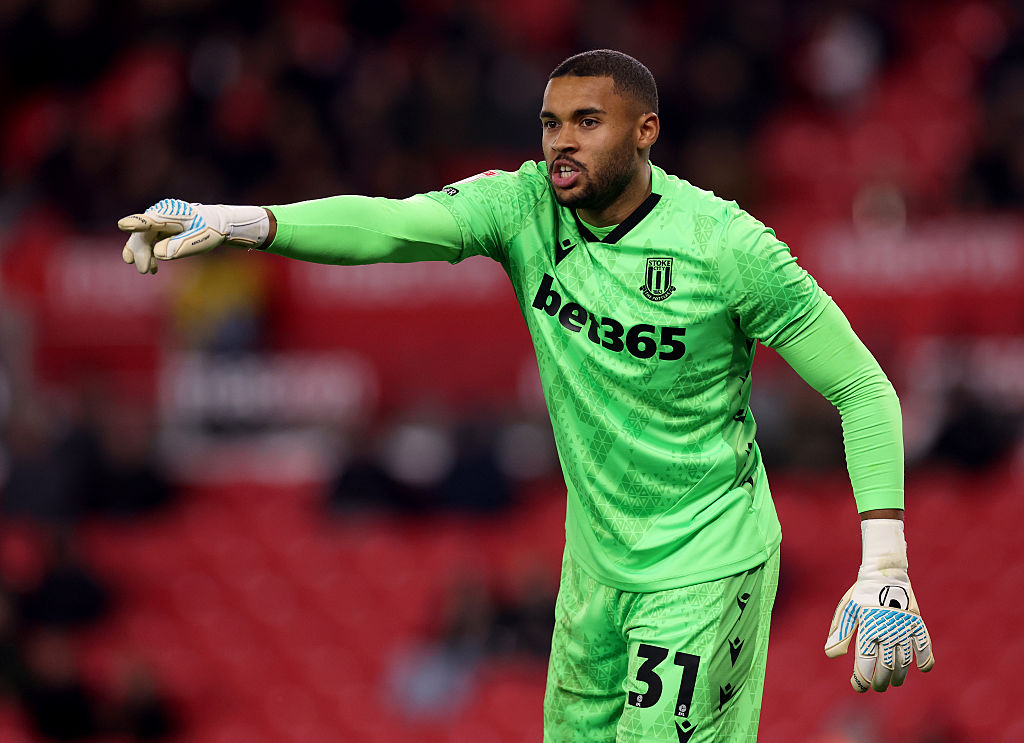
Irish goalkeeper Gavin Bazunu on his decision not to participate in matches against the Israeli football team: “There are few times where you get a chance in life to stand up for something bigger and I strongly believe this is one of them.” (Carl Recine / Getty Images)
On Sunday night, the Irish soccer team bowed their heads in silence as the Israeli anthem echoed through the all but empty Nagyerdei Stadium in Debrecen, Hungary’s second-largest city. The Irish players, who wore black armbands, skipped the traditional pregame rituals. There were no handshakes, no pennants, and (for the most part) no fans.
After months of deliberations and growing demands for a boycott, these trite gestures of dissent were all the Irish team could muster. Having spurned an opportunity to set an international precedent, the Football Association of Ireland (FAI) succumbed to fear, meekly agreeing to go through with the matches.
This was a decision that the Irish players had seemed destined to glumly accept until some final deliberations nearly scuttled the ship at the eleventh hour. In the end, goalkeeper Gavin Bazunu opted to take a one-man stand after a truly dramatic day for Irish soccer.
The evolution of this match into a contentious diplomatic high-wire act demonstrates the full extent of Israel’s international isolation. Nonetheless, the saga ultimately reveals how, despite ardent public support, fears of punitive action continue to undermine Irish support for Palestine.
From Dublin to Debrecen
Israel selected Hungary as the location of its Nations League clash against Ireland, the site of nearly all its “home” internationals since October 7, 2023. Although the Union of European Football Associations (UEFA) did not allocate away tickets for Irish fans, a dozen or so diehards managed to enter the stadium to offer their support.
Not only were Irish fans effectively blocked from attending, but the national broadcaster, Raidió Teilifís Éireann (RTÉ), also decided to strip back its coverage to the bare minimum. Television viewership dropped below its usual levels as fans across the country staged mini-boycotts of their own.
The shrill blast of the opening whistle ultimately brought down the curtain on a failed boycott campaign that had gripped the country for months. At this late stage, the very fact that the game was even happening seemed to overshadow the importance of its actual outcome.
At the end of an admittedly challenging week, Ireland took out their frustration on their opponents from the start, amassing a three–nil lead in the space of just twenty-five minutes. After scoring Ireland’s third and final goal, Jack Moylan removed his black armband and kissed it in front of the Israeli fans in an apparent gesture of Palestinian solidarity.
No number of goals or pointed celebrations could dampen the spirit of the hundred or so Israeli fans who had made the pilgrimage to Hungary. Regardless of the result, they seemed to be celebrating the mere fact that the game had gone ahead.
A Pyrrhic Victory
Even after their team had gone three goals down, the Israeli supporters continued to chant in support of the Israel Defense Forces (IDF). In a video recorded from the stands, Yoseph Haddad, a far-right Israeli activist, proclaimed that while Ireland might have won, “they will never, ever break the Israeli spirit.”
The Israeli fans reportedly directed racist abuse at one of Ireland’s goal scorers, Adam Idah. UEFA have since declined to investigate the incident on the basis that the Irish players did not properly report it. This appears to mean that while Idah’s teammate Jayson Molumby asked the match officials to listen to the chanting, he did not specifically mention the word “racism.”
As the game wore on, tempers frayed. Various on-field scuffles later culminated in an alleged changing room melee between Irish defender Jake O’Brien and Israeli captain Manor Solomon.
The hostility continued well after the final whistle. In a post-match outburst, Solomon boasted to reporters that “we have a country that is ten times better than theirs.” When asked about the Irish players, the former IDF soldier said that he would probably be suspended if he stated his opinion in full: “Obviously they hate us, and we don’t like them.”
Ireland, who have not won a competitive game by this margin in over three years, sliced through the Israeli defense with uncharacteristic precision. Any satisfaction came with a nagging sense of guilt, knowing that any victory pales in comparison to what could have been gained by a full-fledged boycott.
Bypassing the Boycott
As soon as UEFA announced the Nations League draw back in February, many Irish fans mobilized behind the boycott campaign. On the eve of Sunday’s game, over 160 Irish sports figures had signed an open letter urging the team to stop the game.
With public pressure mounting, the FAI opted to play Ireland’s second game against Israel, which was due to take place in Dublin, at a small stadium in rural Serbia instead, citing “security concerns” as a rationale. The FAI’s decision essentially denied Irish fans the chance to directly picket any of the games.
Within the Irish football community, the debate has created a rift between the grassroots and those at the institutional level. A broad coalition of fans, players, and coaches from the domestic league has come out strongly against the FAI’s decision.
War of Words
The FAI officials responsible for the decision to play seemed keen to avoid the spotlight and left the team’s Icelandic head coach, Heimir Hallgrímson, to bear the brunt of public scrutiny. The Israel Football Association launched an extraordinary attack on Hallgrímson after he made the following statement in the run-up to the game: “We’re not playing with genocide, we’re playing against genocide. We are playing against Israel; we are not playing with Israel.”
There can be few if any precedents in modern sporting history for the Israel FA’s official response:
We have contributed to the world and humanity in countless fields, earning an impressive number of Nobel Prizes along the way. Unfortunately, we have not yet found a cure for stupidity, ignorance and hypocrisy displayed by the Republic of Ireland team coach. We’re not playing with ignorance, hypocrisy and stupidity, we’re playing against the coach who embodies them.
This put paid to any notion that it was possible to keep politics out of sport in this situation. However, the FAI did not see it as an opportunity to revisit their decision to play the games.
Nor did they see any need to publicly defend Hallgrímson. The Irish taoiseach, Micheál Martin, did intervene on his behalf, branding the Israeli remarks “unacceptable” and calling for them to be withdrawn: “Israel can’t keep denying what the world knows, and what the world understands.” But there was no statement from the FAI, although it was reported to have complained to UEFA privately.
The FAI could easily have stated that Hallgrímson was using the word “genocide” because this is the official position of the Irish government, which has decided to join the South African case at the International Court of Justice, accusing Israel of violating the Genocide Convention through its actions in Gaza. It could also have briefed Hallgrímson to make the same point in his defense. There appears to have been no effort to do so.
Ill-equipped to handle the political weight of the situation, the former dentist wilted in the line of fire at the pre-match press conference. Hallgrímson fielded questions from combative Israeli journalists, hounding him over a past coaching position in Qatar as well as Ireland’s decision to play against Nazi Germany in the 1930s. Under pressure, he apologized for using the word “genocide” in his previous statement: “It is a strong word and the wrong word for me to use.”
Hallgrímson’s capitulation seemed only to embolden the Israel FA, which flippantly declared, after Ireland agreed to play, that “football had won.” Israel FA Head of Communications Shlomi Barzel was asked if he was responsible for the statement that charged Hallgrímson with “stupidity, ignorance and hypocrisy.” His response was defiant: “I am responsible for that, and I am not going to apologize. After hearing him today, I will take back the word ‘stupidity.’” In other words, he stood by his description of the Ireland manager as an ignorant hypocrite.
Uncomfortable Position
With most of the public discontent directed at both the FAI and the Irish government, recent protests had started to target the players themselves. Activists had picketed the team’s Dublin hotel before they departed for their upcoming games.
After the team suffered an ignominious defeat to Kosovo a few days beforehand, Irish midfielder Jason Knight became the first player to state that the games against Israel should not go ahead. Others, such as Chiedozie Ogbene, later vented their frustration, urging the public “not to put pressure on us.”
As uncertainty spread through the camp, news broke on Saturday that goalkeeper Gavin Bazunu would be withdrawing from the match-day squad. He issued a statement explaining his motivations:
My decision is based purely upon my personal belief that the killing of innocent people is wrong. It is important to note that my stance is not in opposition of the Israeli people or the Jewish community but against the atrocities in the region. There are few times where you get a chance in life to stand up for something bigger and I strongly believe this is one of them.
Reporters camped outside the hotel as Irish players deliberated on whether to go ahead with the game.
Former Ireland manager Brian Kerr, who has been a vocal supporter of the boycott campaign, was in touch with Bazunu. He reported that a vote was held with Bazunu absent, with the players voting 14–8 in favor of going ahead. The FAI declined to confirm or deny the exact figures, merely referring to a “significant majority” among the players.
Having had months to establish a firm stance, the FAI haplessly equivocated. According to Brian Kerr, Bazunu was left “feeling quite low and shunned by some of the players and by the FAI” after his decision.
Seemingly immune to the chorus of criticism, FAI President Paul Cooke later claimed that the situation “went as well as could be expected in the face of unprecedented coverage.” Opposition parties have since called on the FAI leadership to step down in the wake of the fiasco.
Fear of Retribution
The FAI cited the threat of disciplinary action in support of its decision not to boycott the matches. The decision also comes against the backdrop of Ireland cohosting the 2028 European Championship — the country’s first time staging a major tournament.
In a bulletin distributed to FAI members at a July extraordinary general meeting (EGM), the association suggested that Ireland could be suspended from future competitions in the event of a boycott. Further estimations of a potential $10.3 million loss of revenue seem overblown in the light of other recent boycott actions.
Since 2024, Lithuania, Latvia, and Estonia have all refused to play various women’s and underage matches against Belarus, citing the country’s ongoing involvement in the Ukraine war. UEFA docked the Baltic teams no more than three points each, and in one instance dished out a €5,000 fine.
After the match on Sunday, the FAI’s Paul Cooke referred to the exclusion of Southampton from the promotion playoffs for the English Championship earlier this year as an example of what might have happened to Ireland in the event of a boycott. But the two situations could hardly be less similar: Southampton were punished for spying on the training sessions of their rivals.
The Irish players may have also been subjected to other forms of external pressure. Several well-informed sources passed on rumors that some players were told by their agents that they might be blacklisted from playing for English clubs with American owners if they chose not to play.
Inconsistent Action
Although they rejected the boycott at the July EGM, FAI members voted overwhelmingly last November to submit a motion calling for Israel’s suspension from UEFA. This obvious contradiction demonstrates how institutional support for Palestine does not yet outweigh the perceived costs of unilateral action.
Under similar circumstances in 1999, Ireland chose to boycott a European qualifier against Yugoslavia because of atrocities carried out in Kosovo. The FAI avoided expulsion from the European Championship, receiving only a moderate fine from UEFA.
Norway, which hosted Israel in a World Cup qualifier earlier last year, has spearheaded the campaign to suspend Israel from UEFA. Its officials have drawn comparisons with the ban on Russian national and club teams that UEFA imposed soon after the invasion of Ukraine began.
Following the recent controversy, the FAI asked that Ireland and Israel be separated from future group stage pairings. UEFA denied the request on the basis that the two nations “have never been in direct conflict.”
Cognitive Dissonance
The ongoing controversy has unfolded against the backdrop of Ireland’s increasingly strained relations with Israel. The Irish government has imposed travel bans on two far-right Israeli ministers and recently moved to prohibit the import of goods from Israeli settlements in occupied Palestinian territories.
Ireland’s heavy reliance on US investment leaves it potentially vulnerable to pressure from Washington. Before his recent death, Republican Senator Lindsey Graham threatened that countries that “participate in the effort to marginalize Israel in sports” would “pay a heavy price when it comes to access to the American economy.”
The Occupied Territories Bill had promised to be a groundbreaking piece of legislation when first proposed to the Irish parliament in 2018. After extensive deliberations, the government eventually passed a diluted version of the bill earlier this year, which excluded trade in services from the ban.
Despite otherwise advocating for international sanctions on Israel, the Irish government has supported the FAI’s decision to participate in the games. “We don’t want to damage ourselves unnecessarily,” cautioned Micheál Martin. In a separate interview, he argued that “sport is an area that can be challenging when it crosses into the realm of politics.”
Martin’s comments echo the rhetoric of international soccer bodies that extol the sport’s power to unite people while approaching contentious political issues with caution if not cowardice. Amid demands for Israel’s suspension, FIFA President Gianni Infantino has said that “football cannot solve geopolitical problems,” instead summoning its “power to bring people together in a divided world.”
At FIFA’s annual congress this year, Infantino tried to organize a now infamous photo op between Israeli and Palestinian delegates. The toe-curling gaffe followed a passionate speech by the Palestinian representative in which he called for sanctions against Israel over the formation of soccer clubs in the occupied territories.
Looking Ahead
Although the decisive nature of the victory may have restored some public faith in the team, it remains to be seen how the fans will receive the players when they take on Austria in Dublin today. The match comes just days before the second clash against Israel in Serbia.
The FAI has already moved fans with pitch-side seats in anticipation of further protest action. Ireland’s last home game, a May friendly against Qatar, featured a demonstration in which fans threw tennis balls with printed Palestine flags onto the pitch.
In what briefly promised to be the dawn of a new era in the global campaign to boycott Israel, the limits of Irish institutional support for Palestine have become clear. Without coordinated multilateral action involving other associations, the FAI seems unlikely to lead by example, particularly under its current gutless leadership.
Despite the best efforts of those leaders to isolate sports from politics, this contentious match proves that the two are inseparable, if not integral to each other. With the FAI’s credibility all but erased, it’s left to the players once again to make a decision.