Ireland Can Lead the Sporting Boycott of Israel

Ireland is due to play Israel in soccer’s Nations League later this year. The Irish government and the sporting authorities want the fixtures to go ahead, but a campaign to boycott Israeli apartheid on the field of play is gathering strength.
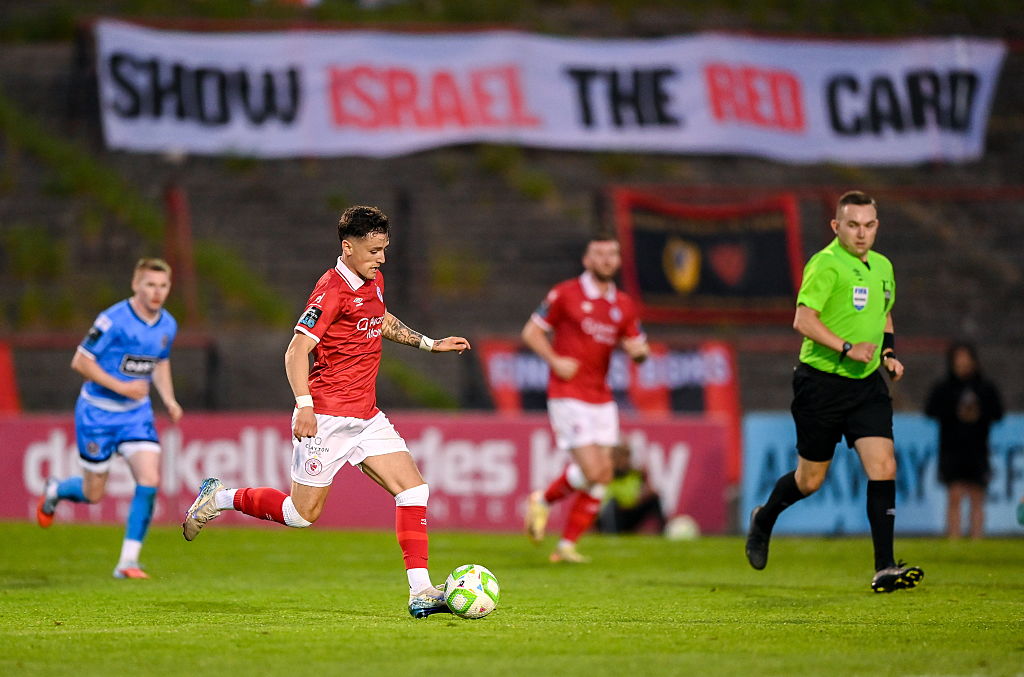
A player from the Sligo Rovers team about to kick a soccer ball on the field with a ref and two other players in the background.

For the UEFA Nations League men’s soccer tournament, 76 percent of Irish fans believe the games with Israel should not go ahead. (Stephen McCarthy / Sportsfile via Getty Images)


On February 12, the draw for the Union of European Football Associations (UEFA) Nations League men’s soccer tournament saw the Republic of Ireland side placed in the same group as Israel. There was a one in four chance it would happen, and the Football Association of Ireland (FAI) was ready with a statement, quickly confirming that Ireland would be playing the two matches against the Israeli team, home and away.

Such an announcement would seem strange at any other time. But the question of a sporting boycott of Israel has percolated throughout Europe, and Ireland has a particularly strong reputation for solidarity with the Palestinian people. The FAI knew that the call to boycott the games would be thunderous. And so it has been.

Sinn Féin, the main opposition party in Dublin, strongly criticized the FAI’s decision. Its spokesperson Joanna Byrne described Israel’s assault on Gaza as a “genocidal, ethnic cleansing mission that has seen tens of thousands of innocents murdered, including hundreds of sports men and women.” The Services Industrial Professional and Technical Union (SIPTU), Ireland’s largest trade union, said that it was “unacceptable” that the FAI would “demand its employees and players engage with their Israeli counterparts” by fulfilling fixtures that “the vast majority of Irish people believe should not be taking place.”

Against Sportswashing

A poll has since backed up SIPTU’s assertion: 76 percent of Irish soccer fans believe the games, currently on the calendar for September and October, should not go ahead. With confirmation that the Ireland team will play the home game in Dublin rather than a neutral venue, as some had suggested as an alternative, the sentiment continues to grow rather than dissolve. One local councilor has called for protests to begin at Dublin Airport as soon as the Israeli team touches down on Irish soil.

Rebecca O’Keefe is a former Ireland international basketball player and spokesperson for the group Irish Sport for Palestine. She sums up the anger with these pointed questions for the FAI:

How can you in good conscience play against a genocide regime? How can you normalize this? How can you invite that into sport and continue to stand for what sport should represent?

It’s a sentiment supported by the broader Boycott Divestment and Sanctions (BDS) movement. Omar Barghouti, the Qatari Palestinian cofounder of BDS, charges European soccer’s governing body, UEFA, with “sportswashing Israel’s ongoing genocide against 2.3 million Palestinians in Gaza and its decades-old regime of settler-colonialism, apartheid, and military occupation.” Barghouti calls on his comrades in Ireland to apply “grassroots pressure on the FAI to refuse to play Israel in order to avoid being complicit.”

Should the team opt out of the matches, their efforts would not exist in a bubble. Ireland has already pulled out of the Eurovision Song Contest in protest over Israel’s ongoing participation. Meanwhile, the Irish government says it needs to spend more time scrutinizing the Occupied Territories Bill, which is intended to ban trade with illegal Israeli settlements in the West Bank. Progress on the bill has been slow, stoking fears it might eventually be watered down or ditched altogether.

The FAI did attempt to have Israel banned from the competition before the question of playing them ever arose. Last year, its general assembly voted overwhelmingly to put forward a motion to UEFA, calling for Israel to be excluded from all club and international competitions. The motion cited games organized by the Israel Football Association (IFA) on illegal settlements and its failure to enact a satisfactory anti-racism policy.

Neither Irish nor Palestinian complaints have led to serious sanctions against Israel. Now that the Nations League draw has set Ireland and Israel on a collision course, the FAI leadership’s position is that refusing to play the games would be an act of self-harm and it will not be answering the calls for a boycott.

Drawing the Line

The potential punishment for not fulfilling the fixtures was initially unclear, meaning that Irish soccer was not in a position to properly debate the pitfalls. Would the perpetually cash-strapped FAI be fined or banned from future competitions? Dublin is set to cohost the UEFA Euro 2028 tournament — could those games be taken away from the city?

“I thought that they would keep the punishments vague because as soon as you slap an ironclad guarantee that this is the punishment and no more, people can begin to run a cost-benefit analysis of whether it’s worth taking a stand or not,” says Gavin Cooney, who reports on Irish soccer for The42.ie. Recently, though, FAI CEO David Courell revealed that UEFA has not threatened Ireland with sanctions beyond forfeiting the games themselves.

As Cooney remarks:

We would forfeit these two games against Israel and lose the points, which obviously affect our sporting picture. A lot of people are looking at it thinking, “Well, is that that great a cost?” It wouldn’t be great to be relegated to League C of the Nations League, but it wouldn’t be a catastrophe.

For most activists, though, the conversation on punishment is moot. “Sometimes it is just bigger than this,” says O’Keefe on potential sanctions. “What is your red line if it’s not genocide?”

The FAI still appears resolved to ignore the criticism and brazen its way through the storm. It’s a tactic with its own precedents. There was huge pressure on the Irish basketball team to withdraw from a game against Israel last November, which intensified when the Israeli team welcomed Israel Defense Forces (IDF) soldiers to a training session. Yet Basketball Ireland CEO John Feehan resisted all demands: “I’m not prepared to destroy my sport for a gesture that will have no impact.”

There has been a similar experience with the Gaelic Athletic Association (GAA), a long-standing Irish sporting and cultural institution with a huge presence in communities across the island. It has yet to bend to calls from its membership to cut ties with its sponsor Allianz after UN Special Rapporteur Francesca Albanese found that the German company was profiting from Israel’s occupation. The situation returned to the news in February when protesters stormed the GAA’s annual congress meeting.

There’s no denying that soccer’s cultural standing throughout Europe heightens the stakes in this case. For those advocating the boycott, it’s a simple domino theory: by refusing to play Israel, Ireland could establish a precedent that leads to the sporting and cultural isolation of a rogue state.

Ireland, as it happens, is not a giant of international soccer — the men’s team has not qualified for a World Cup since 2002. In a situation of such urgency and desperation, could the most significant thing the country ever achieves in soccer come from not playing a match?

Ireland and Palestine

It’s worth taking a moment to consider why this enclave of Palestinian solidarity exists in this far corner of Europe. There’s no doubt that Ireland draws much empathy from its own history of being at the sharp end of colonial oppression and the lingering trauma of the Great Famine in the nineteenth century. Though it is a small country, Ireland also likes to believe that it exercises outsize influence on the rest of the world, aided by a mighty diaspora and the prevalence of Irish culture (or an increasingly warped view of it) throughout the West.

For motivation, there’s also the proud memory of the Dunnes Stores anti-apartheid strike of the 1980s, when a group of young staff members complied with their union’s instructions and refused to handle goods from apartheid South Africa. The three-year protest led to Ireland becoming the first Western country to ban the import of all South African products, earning the appreciation of Nelson Mandela in the process.

This kinship between Ireland and Palestine has not gone unnoticed in Israel itself. In November 2023, Israeli Minister Amichai Eliyahu told bombarded Gazans to “go to Ireland or the desert” (while also calling for a nuclear bomb to be dropped on Gaza). Israel closed its Irish embassy the following year, citing “extreme anti-Israel policies” of the government, although the Israeli ambassador Dana Erlich continued to make regular appearances in the Irish media.

Yet the Irish government, a center-right coalition, is more cautious than much of the population when it comes to relations with Israel, as shown by its support of the FAI in its determination to play the upcoming matches. (In an email to me, the Department of Culture, Communications and Sport noted that the government has no role in determining whether these fixtures take place, but said that “Ireland supports ongoing efforts to implement the Comprehensive Plan to end the Gaza conflict,” in reference to Donald Trump’s scheme for the region.) For O’Keefe, it is crucial to distinguish between Irish civil society and a government that offers “hollow words and symbolic gestures but takes no material action.”

Israel, of course, bitterly resists all calls for a cultural or sporting boycott, fearful that such a movement would lead to it being treated as a pariah state. “Don’t mix politics and sport” is a familiar mantra — the idea that the pureness of competition should transcend the actions of governments, ignoring the fact that entry into UEFA competition undeniably helps Israel’s political ambitions of fostering closer ties with Europe.

The idea that you could possibly disentangle the actions of the Israeli state from sports seems more ludicrous when you begin searching for sports stories from within the ongoing genocide, in which more than one thousand Palestinian sportsmen and women have been killed.

Taking a Stand

Despite the dogged determination to get these games played, there may still be a plausible route to a boycott. Cooney suspects another motion will be introduced at the FAI’s next annual general meeting (AGM) calling for Ireland to withdraw from the fixtures. If it goes to the floor, “you’d imagine that it would be carried by the simple majority that is needed for FAI to be bound by it,” he says. “We have to see how the FAI would handle that because, on an executive board level, the determination is that UEFA writes the rules, we’re subject to them, we’ve got to play it.”

If the FAI does fend off all challenges, the Dublin game poses logistical concerns. Protests are certain. A revolt could even occur from within the FAI itself. “I spoke to FAI staff, like match day staff, who feel uncomfortable working at the event,” reveals Cooney. “So we may see a grassroots strike movement.”

Israeli officials have said they do not expect many fans to travel to Ireland for the match. But after spending the last couple of years playing its home games outside of Israel, the local federation is hopeful that international soccer can resume within its borders in time for the scheduled contest with Ireland, though that appears uncertain.

As the battle for Irish soccer’s soul plays out, the upcoming World Cup in North America has also become a political battleground. The International Federation of Association Football (FIFA) president, Gianni Infantino, is still insisting that the Iranian team will be able to play its World Cup matches, even though Trump has said the players will not be safe if they set foot in the United States. Iranian requests to relocate their games to Mexico have been batted away, and one Trump ally has even asked for Italy to be gifted Iran’s place in the tournament as a favor to Giorgia Meloni.

With mounting calls for a boycott as US foreign policy becomes increasingly aggressive, and the announcement that Immigration and Customs Enforcement (ICE) agents are expected to play a “key part” in security during the event, the controversy surrounding the spectacle looks set to eclipse that of the previous World Cup in Qatar, which was built on widespread migrant labor abuses. Against that backdrop, is there any way that international soccer can be a principled endeavor?

“When you have organizations, and leaders of these organizations, who are just rotten to the core, it seeps out everywhere,” O’Keefe observes. “However, that’s not a reason to not act. . . .  You have to take a stand.”