The Green Party Will Regain Momentum if It Keeps Its Nerve
Zack Polanski’s leadership of the Green Party is facing its biggest challenge to date. But the Greens can weather the storm if they stand their ground against deceitful attacks from Andy Burnham’s Labour government over their solidarity with Palestine.
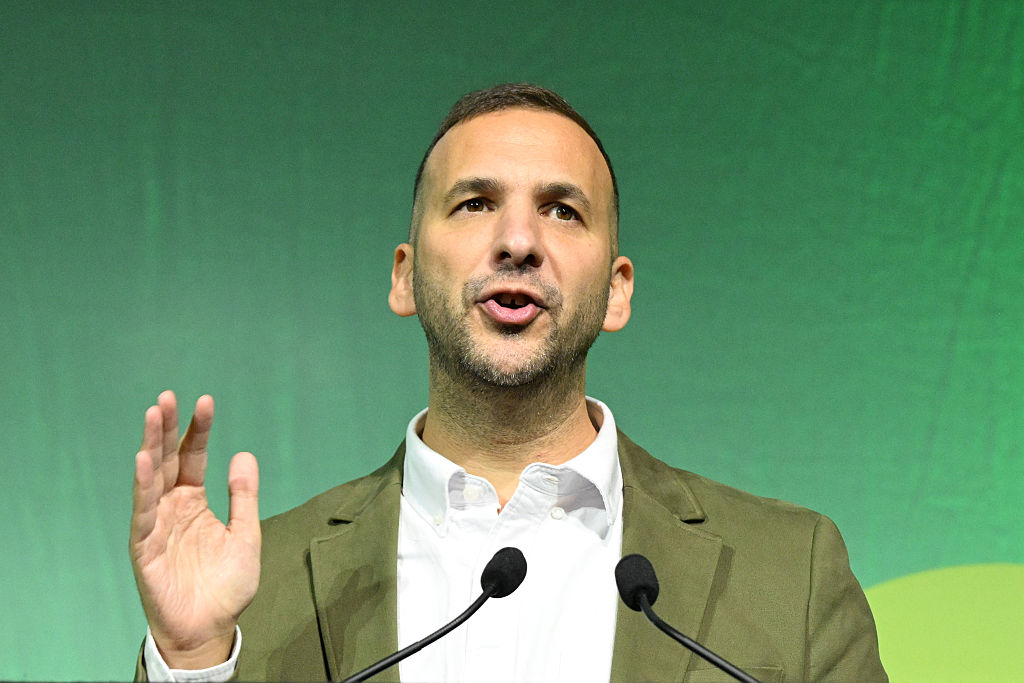
The British media has expressed more outrage about a Green Party motion that branded Zionism as a racist ideology than it has ever expressed about the crimes Israel has committed in Gaza. The hypocrisy would be breathtaking if it wasn’t so predictable. (Will Colebourne / PA Images via Getty Images)
On October 8, the Green Party fell short in a parliamentary by-election for the London constituency of Holborn and St Pancras that had been triggered by the resignation of Keir Starmer. The by-election was always going to be a long shot for the Green leader Zack Polanski, who stood as the party’s candidate. The result, which saw Labour retain the seat, was broadly what you would have expected from the current state of national opinion polls.
That hasn’t stopped much of the British media from proclaiming the outcome to have been a game-changing disaster for the Greens and Polanski in particular. Some prominent Green politicians have also launched a push to reverse the party’s left turn under Polanski and guide it back into their political comfort zone. A motion that Green members passed at their recent party conference about Israel and Zionism has become a rallying point for Polanski’s critics.
If the advocates of a more conventional and unthreatening approach to politics win out, the gains that the Greens have made over the last year will prove to be ephemeral. If the party can hold its collective nerve, there will be new opportunities to win support as the contradictions of Andy Burnham’s political platform reveal themselves in practice.
From Starmer to Burnham
Zack Polanski became the leader of the English and Welsh Greens in August 2025 with resounding support from party members for his “eco-populist” agenda. At the time, Polanski’s leadership campaign was one of two projects that sought to capitalize on disillusionment with the Labour Party. The new Green leader declared his willingness to cooperate with the new left-wing party that Jeremy Corbyn and his allies were planning to launch in the next few months.
In the best-case scenario for the British left, the parallel projects would have proved to be complementary. But there was a huge gap between the objective potential of the situation and the subjective readiness of Your Party’s founding team to exploit it. A faction fight between rival camps grouped around Corbyn and Zarah Sultana dominated the first months of the new party’s existence, while the enthusiasm of the previous summer gradually drained away. During a period of unprecedented volatility in British politics, Your Party proved to be much less than the sum of its parts.
While all of this was happening, Polanski and his allies pressed ahead with their own project, and they made some very significant political gains at Labour’s expense during the first half of this year. In February, Hannah Spencer delivered the first ever Green by-election victory in the Manchester constituency of Gorton and Denton after a three-way contest with Labour and Reform, the hard-right party led by Nigel Farage. Labour sources explicitly stated that they would have preferred Reform to win the seat, because Spencer’s breakthrough showed that progressive voters no longer felt obliged to support Labour.
Popular anger at the genocide in Gaza and Starmer’s endorsement of Israeli war crimes was an important factor behind disillusionment with Labour. Polanski and the Greens explicitly charged Israel with genocide and strongly opposed the ban on Palestine Action that resulted in hundreds of peaceful protesters being arrested and charged with terrorism. The fact that Polanski himself was Jewish merely added to the fury of his critics, who had grown accustomed to branding the Palestine solidarity movement as a putrid cesspool of antisemitism.
The local elections in May represented another big step forward for Polanski’s party, which now overtook Labour in terms of projected vote share. For every English vote that Labour lost to Reform, it lost nearly four to the Greens. The Greens in Scotland have a separate organization with its own leadership team, but Polanski joined them on the campaign trail before they achieved their highest ever vote for the Scottish Parliament. The election results prompted a dramatic change of approach from the Labour Party, at least in terms of style and presentation.
Under Starmer’s leadership, Labour treated left-wing voters with undisguised contempt and sought to compete with Reform on its chosen political ground. After Starmer’s meltdown, Labour turned to the Manchester mayor, Andy Burnham, as his replacement. Burnham was the most high-profile Labour politician who was not tainted by association with the Starmer project. He brought with him a new kind of rhetoric that contrasted sharply with the familiar tropes of Starmerism.
Starmer had praised Margaret Thatcher for “setting loose our natural entrepreneurialism.” Burnham now declared his belief that Britain had spent “forty years on the wrong path” since Thatcher’s neoliberal Great Leap Forward. He promised that his government would be a “circuit breaker,” working to establish “a new political model and a new economic model.”
There was also a clear discursive shift in relation to Palestine, with Burnham’s Foreign Secretary Ed Miliband taking the lead. His comments at this year’s Labour conference reflected the pressure of the solidarity movement, including its impact on the field of electoral politics:
We call out ethnic cleansing by the settler terrorists in the West Bank. We call out the evidence of war crimes In Gaza. We call out Israel’s illegal occupation of Palestine. And we match words with actions. We will ban the import of goods from illegal settlements. We will disrupt the supply lines of British finance, British construction, and British services for illegal settlements.
Surrendering on Day One
If we look beyond the rhetoric, the substance of Burnham’s new regime doesn’t measure up to his sales pitch. When he announced his first cabinet, he reappointed ministers like Pat McFadden, an influential figure who wants to roll back what is left of Britain’s welfare state and shares Tony Blair’s conviction that Labour should abandon its goal of phasing out fossil fuels by 2050.
John McTernan, an unapologetic Blairite who nonetheless seems to recognize that Britain has changed radically since 1997, urged Burnham to defy a critical chorus by nominating Ed Miliband as his chancellor: “The journey of ending neoliberalism starts with one appointment.” For McTernan, shirking this “easy choice” would mean “surrendering, on day one, to economic orthodoxy and conceding to those who oppose your fundamental agenda.” Burnham disregarded his advice and surrendered to orthodoxy by selecting John Healey instead.
There is also a big gap between language and policy when it comes to Israel. Miliband has ruled out applying any sanctions to Israel as a whole and condemned the Boycott, Divestment, and Sanctions movement. But the “illegal settlements” are in no way external to the Israeli state. The overwhelming consensus of the Israeli political class defines those settlements as an integral part of Israel itself.
Moreover, the war crimes Miliband correctly identifies in Gaza were obviously not the work of “settler terrorists.” It was the regular armed forces that turned Gaza into a charnel house. Since Miliband delivered his conference speech, the British government has capitulated to Israel over the order to evacuate the British consulate in East Jerusalem. According to the reporting of Peter Oborne, this act of surrender was a victory for Burnham’s national security adviser, Jonathan Powell, who successfully imposed his line on the foreign secretary.
The selection of ministers and advisers who are deeply committed to the economic status quo and Britain’s traditional role in world affairs gives us a much better sense of what Burnham’s project is going to deliver than his speechmaking. But we have to recognize that most voters won’t be paying close attention to the details of his appointments. For now, his language about “the break we are making with the flawed thinking of the last forty years” clearly does appeal to a section of Labour’s target electorate.
Even if Burnham was deadly serious about his stated goals, it would not be possible to reverse four decades of economic policy in the space of a few months. Many people will be inclined to wait and see if he can deliver on his promises, especially when Labour still seems to offer the best chance of blocking a government led by Reform. In the month of the Gorton and Denton by-election, the average polling gap between Labour and the Greens was less than 5 percent. By September, it was almost 15 percent.
In itself, this is enough to explain the outcome in Holborn and St Pancras. If Polanski had run for the constituency when Starmer was still the Labour leader, he would probably have won — but in that scenario, of course, there never would have been a by-election in the first place. To some extent, Polanski and the Greens have been victims of their own success. By forcing Labour to hold out the promise of a genuinely transformative agenda, they have inadvertently reduced the political space available to them, at least temporarily.
Under these circumstances, the best course of action would be to remain patient, avoid panicking, and look for opportunities to expose the gap between Burnham’s rhetoric and the substance of his policies. If it were up to Polanski alone, or the members who voted for him, this would surely have been the main line of argument from the Greens as they sought to move on from the by-election defeat. But the result in Holborn and St Pancras supplied an opening for Green politicians who never wanted the party to challenge Labour from the left in the first place.
Eco-centrism
It would be a mistake to speak about the right wing of the Green Party as if it were merely a smaller version of Labour’s dominant faction, since the two organizations have very different relationships with the British state and the capitalist class. As things stand, there is no Green counterpart of Peter Mandelson, who was passing on information about the Labour government’s economic plans to his friend Jeffrey Epstein while serving as a cabinet minister. Nor is there a Green version of Tom Watson, Labour’s deputy leader under Corbyn, who has recently taken up a job as a lobbyist for Palantir.
At the same time, there are clear ideological differences within the Green Party that were on display during the 2025 leadership campaign. Polanski defeated a joint ticket comprising two of the Green MPs elected the previous year, Adrian Ramsay and Ellie Chowns. A New Statesman profile described Ramsay and Chowns, without any hint of malice, as “eco-centrists.” Ramsay claimed that Polanski’s approach would alienate more potential supporters than it gained, while Chowns insisted that the Greens were “way past those kinds of old ideas of politics being binary, left and right.”
There is no reason to think that the experience of the last year has prompted them to rethink their basic political outlook. When Ramsay spoke recently about the need for his party to establish “a broad base of support,” it was more than a platitude. He would like the Greens to position themselves as an ecological version of the Liberal Democrats instead of competing aggressively with Labour for urban left-wing voters. This is a recipe for being all things to all people and nothing much to anyone in particular.
It is important to note here that Ramsay and Chowns are Westminster MPs, while Polanski and the two Green deputy leaders elected alongside him are not (Polanski is a member of the London Assembly; Mothin Ali and Rachel Millward are local councilors). No matter how democratic a party constitution may be, elected representatives still occupy the key positions of influence, with MPs at the top of the hierarchy.
There was a spectacular increase in party membership after Polanski took the reins, from 66,000 in September 2025 to 215,000 by the following spring. However, as the examples of Labour and the Scottish National Party from the last decade show, an influx of new members will not change a party unless there is a wider transformation of its program and personnel.
Nice to Be Nice
Caroline Lucas, who was the first and only Green MP between 2010 and 2024, endorsed the unsuccessful leadership ticket of Ramsay and Chowns. On the eve of the English local elections this year, Lucas issued a statement that generated the following headline in the Guardian: “Greens must take immediate action against antisemitism in party, says Lucas.” She seemed to be very pleased with the results of her handiwork: “I felt that it needed to be said . . . I hadn’t seen it being said in quite those terms.”
You don’t have to be an expert in codebreaking to decipher the criticism of Polanski that Lucas was putting forward here. If it were simply a question of stating that prejudice against Jews has no place in the Green Party, there would have been no need for Lucas to stick her oar in, since Polanski has made that point over and over again. She clearly felt that the current leadership was being much too combative in its response to allegations of antisemitism instead of taking them at face value.
We can find a good example of what those allegations really amounted to in another Guardian article published during the election campaign. The Labour politician Steve Reed claimed that Polanski had opened the floodgates to antisemitism: “Some of the worst antisemites that we kicked out of the Labour Party not only joined the Green Party, but are now standing for the Green Party.”
Remarkably, the Guardian did not ask Reed to identify any of the Green election candidates he had in mind. It would have been very easy to check whether he was telling the truth about “the people that the Labour Party kicked out for being antisemites” if he had supplied a list of names, or even a single name. One can only assume that Reed chose not to offer any concrete examples because he knew that it would have undermined his case instead of bolstering it.
A Green spokesperson contemptuously dismissed the accusations that Reed made against their party: “Bad-faith attacks are all Labour has left.” Long experience shows that this is the only principled and pragmatic way of dealing with people who lie about antisemitism as casually as they breathe. Caroline Lucas would no doubt have preferred a meek and deferential response, promising to do better. Her style of politics relies heavily on a politically structured understanding of niceness that will always leave her exposed to the stratagems of a charlatan like Reed.
Defining Zionism
This episode was a foretaste of the much more virulent controversy over a motion passed at this year’s Green conference that defined Zionism as “a political ideology which called for the creation — and, now it exists, the continuity — of an ethnonationalist Jewish State in historic Palestine to the exclusion and/or domination of the non-Jewish population.” The motion also expressed support for “the establishment of a single democratic Palestinian State in all of historic Palestine with Jerusalem as its capital, equal rights for all, and the right of return for Palestinians and their descendants.”
These were the main aspects of the policy statement that provoked the ire of British media commentators. Surprisingly perhaps, few seem to have picked up on another clause that affirmed the legitimacy of Palestinian resistance to Israeli occupation “by all available means under international law.” Guardian pundit Jonathan Freedland did highlight this aspect of the motion, claiming that the Green policy was “more extreme than mainstream Palestinian opinion — they’re saying violence is now legitimate.”
In reality, Palestinian support for armed struggle has fluctuated over the past three years, from a high point of 63 percent in December 2023 to a low point of 27 percent in August this year. This does not mean that Palestinians have changed their mind about the moral legitimacy of violence. It is a tactical debate about what methods are likely to prove most effective. The Green motion does not say that Palestinians should or must take up arms against the Israeli occupation forces — it merely defends their right to do so if they consider it to be the wisest course of action.
Green politicians such as Caroline Lucas objected to defining Zionism as a racist ideology, but their arguments were unconvincing and inconsistent. At first, Lucas objected on the grounds that “Zionism can be interpreted in so many different ways,” as if theoretical versions of Zionism that have never had any political impact should be given the same weight as the actually existing Zionism of the Israeli state from the Nakba to the present day.
During the conference, she changed tack by suggesting that Zionism was “both racist AND a response to racism” against European Jews. Having acknowledged that for Palestinians, “Zionism was and remains a violent settler-colonial project, exclusionary and yes, racist,” Lucas then reverted back to her original line about the irreducible plurality of Zionism after the motion was passed: “It tries to have a singular definition of Zionism when we know that there are many.”
Lucas also complained that the motion was “divisive.” This was hardly likely to persuade anyone who was not already in her camp, since any position the Greens adopt in relation to Palestine is bound to be divisive. The real question is whether it draws the line of division in the right place.
Paddling Pools
If Lucas and her allies had a stronger grounding in the politics of Palestine solidarity, they might have developed some more convincing arguments. For example, instead of claiming that it is impossible to define the core tenets of Zionism, it would be more useful to ask whether this is the most effective line of attack for a political party. The evidence of the past few weeks suggests that supporters of Israel are only too glad to spend their time on hairsplitting debates about the possible meanings of Zionism.
Let’s return for a moment to Jonathan Freedland, who has spent much of his career pretending to feel sad about the oppression of the Palestinians while relentlessly defaming anyone who proposes to do something about it. Freedland was evidently delighted to have the opportunity to splash around in this paddling pool of discourse — much safer than venturing into deep waters, where he might have to speak about the material realities of what the Zionist state-building project has involved for the Palestinian people. In a characteristically vicious column, Freedland managed to compare the Greens to the Spanish Inquisition — any echo of Monty Python was presumably unintentional — without offering so much as a sideways glance at the Nakba.
There will always be chancers like Freedland clogging up the public sphere with their disingenuous talking points. The issue is whether focusing on the correct definition of Zionism is the best way to put them on the back foot. Freedland and his ideological peers can spin their wheels from here to eternity talking about how Zionism “means different things to different people.” They will be much less comfortable making the same argument about the Balfour Declaration, the Deir Yassin massacre, or the destruction of Gaza’s health care system.
A similar point applies to the motion’s call for a “single democratic Palestinian state in all of historic Palestine.” This is an entirely legitimate goal, and there should be no question of imposing a two-state model based on the 1967 border as the only acceptable framework. However, it is not essential for a political party in Britain to adopt its own programmatic view of what the final outcome should be, so long as it supports the right of the Palestinian people to self-determination.
Britain’s Palestine Solidarity Campaign (PSC) issued a statement that strongly defended the Green Party and its members from a wave of attacks after the motion was passed. In the course of doing so, the PSC carefully noted that its own position is one of principled agnosticism: “Our longstanding policy, shaped in dialogue with our Palestinian partners, is that it is for the Palestinian people as a whole, rather than the solidarity movement in Britain, to decide what form Palestinian self-determination should take.” There was a proposed amendment to the motion that would have taken the same basic line, but it did not receive enough votes to pass.
Red Lines
It is perfectly normal and healthy to have tactical discussions about the best way to formulate arguments and weaken the pro-Israel bloc in British politics. But it is a very different matter to present the ideas in the conference motion as if they were fundamentally illegitimate for a mainstream political party. That is precisely what figures like Adrian Ramsay and Caroline Lucas did after the vote.
Ramsay said that he was “deeply upset” about the motion and implied that Jewish people had reason to feel threatened by it, while Lucas claimed that it was “dangerous.” She appeared to be particularly concerned about the call for a single state in historic Palestine: “Supporting a motion which effectively denies Israel’s right to exist crosses a very significant red line.”
It would be interesting to ask Lucas for a detailed account of why she thinks the motion crossed “a very significant red line.” Is it a matter of principle for her that Israel must always continue to exist within its pre-1967 boundaries? That version of a two-state model would give Israel almost four-fifths of the territory of historic Palestine. The Oslo accords collapsed because that still wasn’t enough for Israel’s leaders: from Ehud Barak to Benjamin Netanyahu, they have all insisted on grabbing more of the remaining 22 percent.
In principle, one could support the idea of a two-state model while insisting that historic Palestine should be evenly divided between Israelis and Palestinians. After all, there has never been a single day since 1967 when Israel treated the so-called Green Line as if it were a permanent boundary, so the idea that Palestinians must always do so has neither logic nor justice on its side.
The most likely explanation is that Lucas hadn’t thought very much about the precise rationale for her “very significant red line.” Her main priority was to indicate to the British media that she strongly disapproved of the motion, because the commentariat was furious about it. The predictable effect of her intervention was to invite further attacks.
The Bottom of the Barrel
The bias of the Tory press goes without saying, not to mention its unconcealed racism, so let’s turn to the liberal end of the media marketplace. The Observer published a story that set aside any claim to journalistic credibility for the sake of ideological warfare, with the headline “Greens face ‘existential threat’ as membership plummets after anti-Zionist motion.”
On closer inspection, the claim about members leaving in droves relied upon a single piece of data: “One local party has seen a two-point drop in membership since last Sunday, with similar falls reported in other areas. If this were replicated across the country, it would mean 4,400 people had resigned.” Even if this exercise in speculative statistics proved to be accurate, it would mean that the Green membership was well over three times higher than it had been before Polanski took over.
Scraping the very bottom of the barrel, the author of the piece, Rachel Sylvester, turned to Ian Austin for a hostile quote: “They’re zealots, they’re extremists and they’re obsessed . . . you win elections by being reasonable and pleasant.” Austin himself is one of the most unreasonable and unpleasant individuals you will find in British politics, a swivel-eyed extremist who categorically denies that Israel bears any responsibility for the carnage in Gaza.
This former Labour MP never has to worry about facing the voters again, because Boris Johnson gave him a peerage after he campaigned for a Tory victory in the 2019 general election. Andy Burnham decided to keep Austin in his post as the UK trade envoy to Israel — a post that he has previously used to encourage a sense of impunity among Israeli government officials.
Burnham himself seized the opportunity to go on the offensive against the Green Party, claiming that the conference motion was antisemitic and ruling out any coalition with the Greens at Westminster. Polanski hit back hard with the following statement: “I’m the only Jewish leader of a political party. I’m a victim of antisemitism every day and I’ve made it clear Jewish people are welcome in my party. You’re a prime minister who arms a genocide and locks up pensioners for opposing it.”
The Green Party leader responded in similar terms when the Labour politician Bridget Phillipson issued an edict to Labour councilors around the country, telling them they must break off governing pacts with their Green counterparts unless they explicitly denounce the motion: “Antisemitism is serious. That’s precisely why it should never be weaponised as a political football.”
A War on Children
This is the right basis on which to hold the line against Labour, a party that has absolutely no standing to issue certificates of moral legitimacy. As Tom Blackburn has argued, capitulation to Burham’s demands would be futile as well as unprincipled: “Were the Greens to renounce Zionism is Racism, the goalposts would be shifted once again, and they would be placed at the centre of some other concocted crisis.” The aim is to tilt the balance of forces inside the Green Party so that it no longer poses any threat to Labour.
In the midst of this contrived hysteria, the Guardian published an article by Dave Rich of the Community Security Trust that put the attacks on the Green Party in their proper perspective. Rich set out to demonize everyone who acknowledges the overwhelming evidence that Israel has been deliberately targeting children in Gaza:
Without doubt, it is deeply upsetting that thousands of Palestinian children have been killed in Gaza, and many feel that Israel could have done more to minimise civilian casualties. But to describe this not as the result of a tragic and unbearable conflict, but as a “war on children,” is to imply that killing children is the whole point: a charge that echoes the medieval blood libel. From that assumption to Jihad al-Shamie yelling: “This is what you get for killing our children” as he tried to batter down the doors of Heaton Park synagogue last Yom Kippur is not as big a leap as some might wish.
For Rich, the only acceptable response when an Israeli sniper carefully aims his rifle before shooting a child in the head and chest is to wring one’s hands ineffectually about the “tragic and unbearable conflict.” He smears and slanders everybody who expresses outrage about such crimes by associating them with the man who attacked a Manchester synagogue last year, killing two people.
No matter how brazenly he denies the evidence of Israel’s genocide, Rich will never lose his status as a legitimate figure in the eyes of the British media. The Community Security Trust, a body that works closely with the British state and its police forces, will not face any pressure to distance itself from his morally repugnant views. These are the standards of the British political mainstream, whose gatekeepers now presume to exclude the Green Party from their most exalted company.