How Revolutionary, Really, Was Christianity?
Amid renewed interest in the religion across the political spectrum, the historian of antiquity Tim Whitmarsh argues in his new book, Rome’s Age of Revolution, that Christianity’s success relied on the physical and cultural infrastructure of empire.
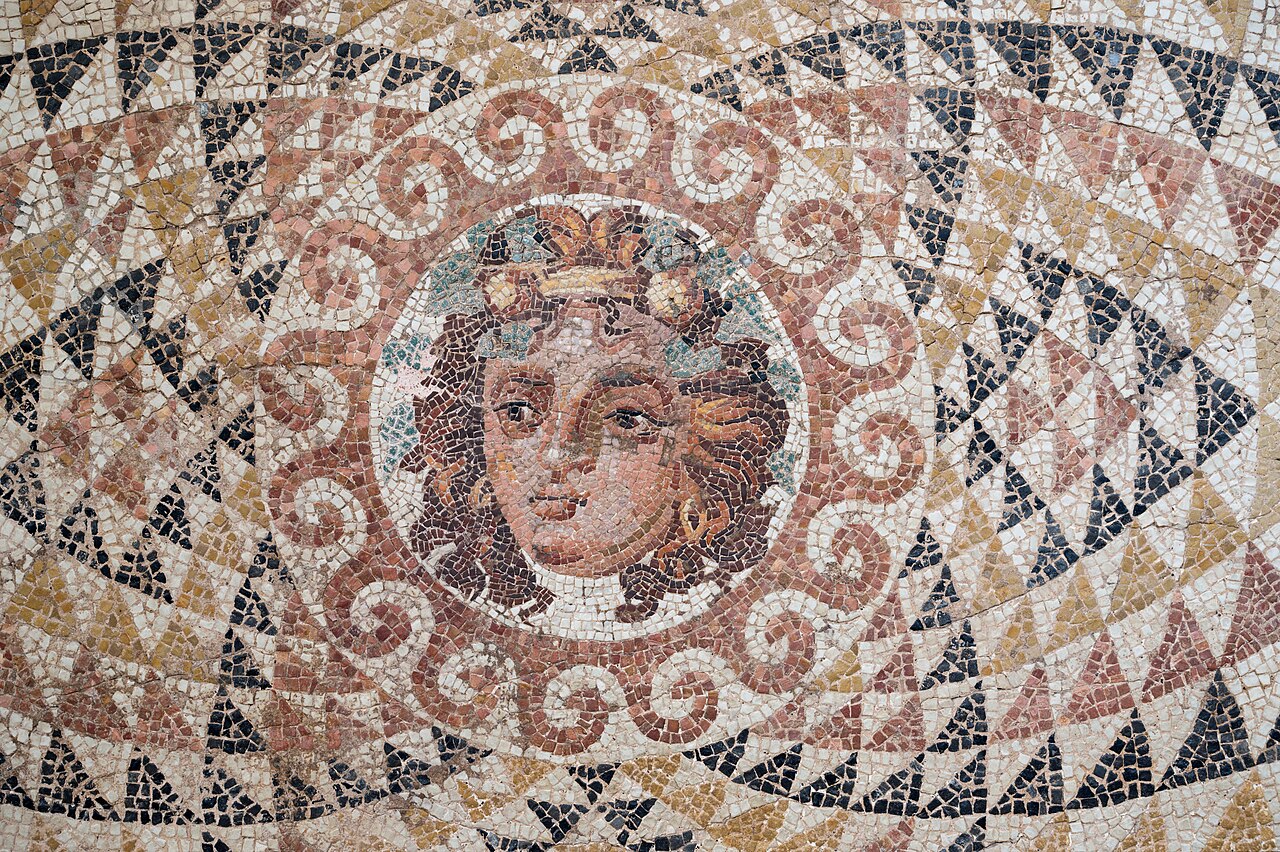
A detail from a Roman mosaic of the Greek god Dionysus, whom several pagan texts align with Jesus Christ. (Archaeological Museum of Ancient Corinth)
In the Acts of the Apostles, the followers of Jesus Christ are repeatedly described as belonging to “the Way.” In the modern Christian lexicon, this phrase is often understood as a spiritual path rather than a physical one. One travels the Way from a life without Christ to one with him. Returning to the original ancient Greek texts, the classicist Tim Whitmarsh points out that the word that underpins the idea of the Way, hodos, can mean a spiritual path, but it can also, and more often, means a physical road — or a journey along one.
Paul and other early Christian missionaries were on a spiritual journey, but they were also on what Whitmarsh calls a literal road trip, traveling across modern-day Turkey, Syria, Greece, and elsewhere to convert anyone who would listen. They made these journeys through a Roman world whose network of roads had been dramatically reorganized and extended under Augustus, facilitating movement across the empire. Whitmarsh’s new book, Rome’s Age of Revolution: Augustus, Empire and the Making of Christianity, asks how revolutionary the religion really was, and does so by situating its original texts in the context from which they emerged and which aided their success: the Roman Empire, and the myriad cultures that it encompassed.
The question of Christianity’s influence is usually fought out at the extremes. On one side are the New Atheists of the 2000s, among them the late Christopher Hitchens (God Is Not Great) and Richard Dawkins (The God Delusion), who saw religion as a poison to be reasoned out of existence. On the other are the likes of Tom Holland, whose Dominion argues that Christianity broke with the ancient world and shaped the West’s ideas of morality, compassion and human dignity — arguments he has carried to a vast audience through The Rest Is History podcast.