Germany’s Far Right Is Attacking Bauhaus Again
It’s been 100 years since the opening of Walter Gropius’s Bauhaus building in Dessau, but the Alternative für Deutschland wants to cut funding from centenary events. The winner of recent state elections, the far-right party labels Bauhaus un-German.
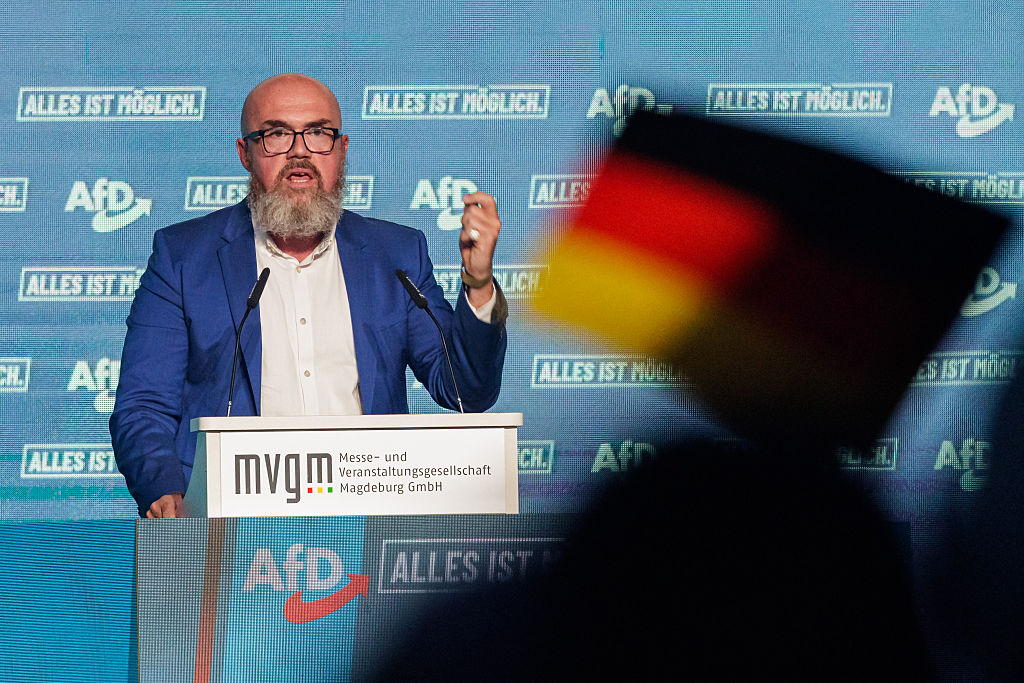
After its election win in Saxony-Anhalt, the Alternative für Deutschland is trying to form a government. One of its first targets is Bauhaus, as the party says funding should be taken away from projects that don’t uphold German national culture. (Jens Schlueter / Getty Images)
A hundred years since the opening of Walter Gropius’s Bauhaus building in Dessau, Germany, there may be no centenary. This December 4, the winner of the election in the surrounding state of Saxony-Anhalt, the far-right Alternative für Deutschland (AfD), does not intend to throw a big party for the Bauhaus Foundation, but to shut it down.
According to the AfD, the Bauhaus is a “misguided path of modernism,” whose works are impersonal and uninviting. From there, it’s only a stone’s throw to the word “degenerate” — the term used in the Third Reich to describe “un-German” art, that is, art by Jews or art whose aesthetics did not conform to the Nazi regime’s propaganda glorifying “racial purity.”
If the AfD succeeds in forming a government in Saxony-Anhalt, after scoring 44 percent of the vote in the September 6 state election, the Bauhaus would not be the only victim of its “cultural policy.” Still, it would certainly be the most prominent. The party’s cultural-policy spokesperson in the state parliament, Hans-Thomas Tillschneider, already demanded during the campaign that, in the future, all theaters and cultural institutions that want state funding must sign a declaration of their “commitment to the state, democracy, and German culture.” The statement is supposed to confirm that each recipient of public funds treats German cultural tradition “with respect.” Tillschneider leaves open exactly what this means. Naturally, cultural professionals in the state are up in arms over this demand.
As it stands, theaters and orchestras in Saxony-Anhalt are almost entirely funded by public money, with €276 million flowing into the state’s municipal theaters between 2024 and 2028 — a good €55 million annually — plus a total annual cultural budget of around €192 million for museums, libraries, independent organizations, and historical preservation. Effectively, such an obligation to declare their loyalties would hit all theaters and cultural institutions in the state. What is exhibited, shown, screened in theaters, and staged in Saxony-Anhalt would thus depend on the approval of the far-right AfD.
There’s a reason why the Bauhaus is being singled out here. In doing so, the AfD is directly appealing to those of its voters who can clearly be classified as far right. After all, the Bauhaus was already an abomination to Adolf Hitler’s Nazis. His National Socialist German Workers’ Party (NSDAP) initially suspected the faculty of the Dessau Academy of Design of being Bolsheviks; only later did it accuse individual professors of creating “degenerate art.” On October 1, 1932, almost four months before Hitler became Reich chancellor, the Nazis closed the Bauhaus in Dessau because the party had won a majority there in the 1931 city council elections and subsequently cut off all subsidies to the municipally funded school (the AfD now wants to revive this tactic of cutting off public funding and apply it throughout the entire state).
The last Bauhaus director, Ludwig Mies van der Rohe, moved the school to Berlin at his own expense and continued to run it privately there until the Gestapo raided and closed it in April 1933. In the 1937 propaganda exhibition Degenerate Art held in Munich, several former Bauhaus teachers were publicly paraded, and their art was denounced as “degenerate.” Tillschneider’s statements about the Bauhaus sound like an echo from that era: “The Bauhaus raped the human need for security and comfort in every possible way,” he said on October 24, 2024, in the Saxony-Anhalt state parliament. The AfD has held seats in that parliament since 2016; the party has been represented in the neighboring Free State of Saxony’s state parliament since 2014. During the Weimar Republic, the province of Saxony and the Free State of Anhalt were early Nazi strongholds. The AfD’s early successes here seem to indicate a certain continuity of right-wing ideology that has persisted through the era of the East German dictatorship (GDR). In any case, no other state chapter has called for a ban on the Bauhaus or for a “cultural commitment” like the one Tillschneider seeks to impose.
Protests against the closure of the Bauhaus in 1932 were unsuccessful. To prevent history from repeating itself, the federal culture minister, Wolfram Weimer, has called on civil society actors to form a united front against the far-right wrecking ball: fourteen institutions and associations, including the Academy of Arts, the Chamber of Architects, the German United Nations Educational, Scientific and Cultural Organization Commission (the Bauhaus has been a World Heritage Site since 1996), the German Association of Cities, and the major Christian churches in Germany have signed the resulting “Bauhaus Manifesto 2026.” It declares that they are “proud of the Bauhaus” and want to defend its “creative freedom and social inclusivity as a model” against “any anti-democratic attacks.” The AfD is not mentioned in this manifesto.
For its part, the AfD, now the largest party in Saxony-Anhalt, has not commented on the manifesto but is tightening its demands for “Germanness.” According to a parliamentary motion by the party, the Saxony-Anhalt state branding slogan is to change from moderndenken (modern thinking) to deutschdenken (German thinking). Just as with its cultural commitments, the party has yet to explain exactly what the “German” aspect of this way of thinking entails.