A Strong Welfare State Changes the Meaning of Unemployment

Under capitalism, being unemployed is usually a hardship, and often a financial and personal disaster. Yet the experience of unemployment in countries with generous welfare states is radically different from what Americans are used to.
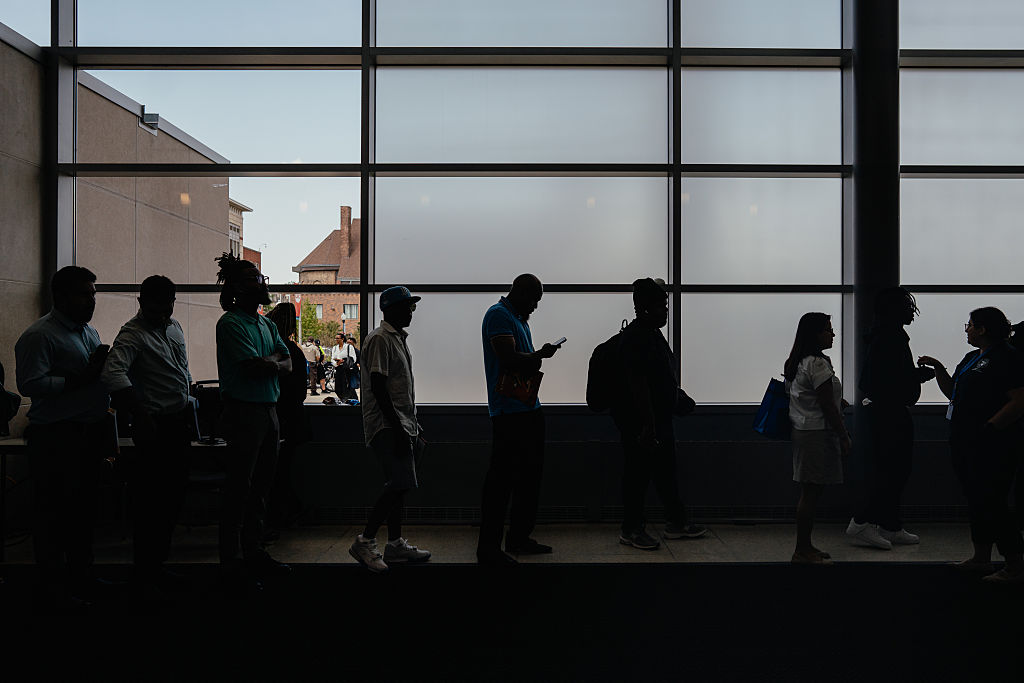
Job seekers wait in line to enter an auditorium for a job fair.

Job seekers wait in line to enter an auditorium for a job fair hosted by Cook County to support federal workers in Chicago, Illinois, on June 26, 2025. (Jamie Kelter Davis / Bloomberg via Getty Images)


On a fall evening in 2015, I accepted — with some reluctance — an invitation to a gathering at the home of Nina Witoszek, a popular émigré writer and gadfly in Oslo. I did not know Nina well, though for years I had read her columns in Aftenposten, Norway’s largest newspaper. I had also seen firsthand how her acerbic, insider-outsider commentary on this or that object of Norwegian pride could drive her more patriotic readers to the point of an almost foaming apoplexy.

Nina was unafraid to ask big, difficult questions and offer a perspective that much of the public inevitably scorned — even as they eagerly awaited what she had to say next. And now she had fixed her aim on something truly sacred: the so-called Nordic model of welfare capitalism. Her plan was to recruit an interdisciplinary group of academics from Norway and abroad and set them to the task of determining, once and for all if, in a crisis-ridden world, the Nordics — Norway, Sweden, Denmark, Iceland, and Finland — did in fact offer a blueprint for common and sustainable prosperity.

What has stayed with me quite vividly from this gathering in Oslo is a single question that punctuated the evening as I, careful not to linger for too long, was preparing to leave. I had said my farewells and was collecting my things near the front door when Nina formally introduced me to a business professor. She told him that I was, oddly enough, an American cultural anthropologist who had come to Norway to conduct field research on the lives of the country’s unemployed.

“Ah,” he said with a smile. “So you have come to study the losers?”

He did not quite mean what you think he did. I had heard this kind of thing before in Norway, a country where I have conducted research consistently since 2010. Each time, I winced thinking of how “loser” is invariably used as an insult in my own country, the United States (imagine the kid with a hand shaped like an “L” on his forehead, etc.). But this was a mistake: the Norwegian word for “loser” — taper — often lacks the connotation of individual moral failure that clings to its American English counterpart.

A taper can be someone who has been violated, deprived, or wronged, typically through no fault of their own. Norway’s indigenous Sami people, long persecuted and dispossessed, are at times described as tapere (the plural). Bullied children are tapere. The unemployed are tapere. The business professor was in some sense correct: I had moved to one of the world’s most prosperous societies to study, of all things, its losers.

But as a cultural anthropologist, I was also interested in this exact problem — the problem of what we might call “cultural false friends.” A false friend is a word in one language that sounds or looks like a word from another language but in fact has a different meaning or connotation. These exist even in languages that are mutually intelligible, such as Norwegian and Swedish. In Norwegian, for example, the word artig means “funny” or “amusing.” In Swedish, it means “polite.” The Norwegian word forstørre means “to enlarge.” The Swedish förstöra, dramatically enough, is “to destroy.”

A cultural false friend involves this same confusion of appearances and meanings, except for concepts and institutions. Both Norwegians and Americans, for instance, talk about “losers,” but in most cases do not quite mean the same thing. More important, they both talk about “the state” (staten), “welfare” (velferd), “freedom” (frihet), “taxes” (skatt), and “unemployment” (arbeidsledighet). They even share ways of measuring and comparing these things and their impacts, and in both the United States and Norway, one hears of welfare states that are more or less generous, of people that are freer and less free, of taxes that are too high or too low, unemployment that goes up and down, and so on. It is tempting to believe that when we use the same words (or their equivalents), we do really mean the same things.

But we do not. After fifteen years of intermittently living, traveling, working, and conducting research in Norway, I am convinced that these and other shared terms enclose meanings, experiences, relationships, histories, and sentiments that diverge in ways that should be taken seriously.

Consider unemployment among the nondisabled. Both Norwegians and Americans dutifully measure their unemployment rates, but the Norwegian and American worlds of unemployment bear only passing resemblance to one another. When an American loses her job, she may draw on savings and turn to family, friends, or a religious community for help. Perhaps she accumulates credit card debt and takes out a collateral loan. Depending on her circumstances, she might even try to solicit financial support using an online tool like GoFundMe or CashApp. If she is eligible for unemployment benefits, she will likely file, though often with the expectation that the money will be insufficient, the wait times will be long, and the eligibility period will be short. If benefits are extended due to extraordinary circumstances, such as a national economic downturn, she can expect much political hand-wringing about “big government,” entitlement, coddling, and perverse incentives. And then there is health care — she may have also lost the insurance she had through her employer.

In Norway, I observed, things are typically different. The newly jobless do not usually turn to their families, friends, religious communities (if they have them), or some kind of saved “emergency fund” (again, if they have such a thing). They are, however, extremely likely to register as unemployed with the Norwegian Labor and Welfare Administration, or “NAV,” the cradle-to-grave public agency that manages everything from maternity and paternity leave to funerary allowances. If the person is a member of the National Insurance Scheme (as is the case for all legal residents who plan to live in Norway for at least twelve months) and has met a relatively low earnings threshold, they will be eligible to receive up to 62.4 percent of their previous annual salary — up to a ceiling — for two years. If the applicant has not reached the previous earnings threshold, they can still apply for social assistance, which, on average, is about $1,000 a month. These benefits are usually provided in addition to other cash transfers, including child benefits — a monthly deposit of between approximately $200 per child until the age of eighteen.

Meanwhile, if our jobless person in Norway does have children, they are unlikely to agonize about saving for education: daycare costs are capped at approximately $120 a month per child, primary and secondary education are free, bachelor’s and master’s programs at Norway’s public universities are tuition-free, and college students are eligible for generous loans from the Norwegian State Educational Loan Fund. They are also probably not putting away money for future health care expenses or paying for health insurance as medical care is universal, and out-of-pocket costs — whether for a broken finger or open-heart surgery — cannot exceed approximately $320 per year. And one does not have to worry too much about failing to save for retirement. Minimum pensions are guaranteed, and increased payouts are available depending on years of employment.

While every individual’s experience of unemployment is unique, there are encounters and exchanges that are more or less likely to occur depending on the institutional context within which one lives — or, more technically, depending on the “welfare regime” within which one lives. Danish sociologist Gøsta Esping-Andersen defines a welfare regime as an institutional arrangement in which “state activities are interlocked with the market’s and the family’s role in social provision.” In other words, who can you rely upon when you lose your job? Or get sick? What makes it possible for you to live with dignity — however you define that — when you are elderly? Or when you are a child? Or are raising children? The answers to these questions differ from place to place — sometimes dramatically.

Welfare regimes also differ, though they cluster into discernible types based on institutional features, including the mix of actors involved in support (e.g., the state, religious communities, firms, families, etc.), degrees of support, patterns of social stratification, and policy design principles. These types reflect different answers to the shared question of how to manage the evolving risks, insecurities, inequities, and surpluses of modern capitalism — an economic system that upended preindustrial ways of life and networks of support, making it imperative for a growing share of the population to work for wages to survive.

Some important qualitative differences between welfare regime types are captured in the “worlds of welfare capitalism” originally described by Esping-Andersen. The Anglo-American world, for instance, gave rise to “liberal” welfare regimes in the nineteenth and twentieth centuries. These were constructed by elites and ideologues who, unlike their conservative opponents, believed in the positive moral and material effects of markets. It was the receipt of aid, not wage labor, that was in general viewed as degrading and corrupting. Therefore, the state’s role in protecting the individual from the exigencies of health or the economy was minimal, and public benefits were paltry — if one could even access them in the first place.

A “social democratic” alternative coalesced in the Nordic countries. Holding that the commodification of labor was a necessary but alienating and divisive part of modern capitalism, powerful workers’ movements and their political representatives used public goods and services to reduce individuals’ dependence on the market for their well-being and dignity over the life cycle. These goods and services were of comparatively high quality and largely administered based on the principle of universalism, which holds that the broadest possible swath of the population should be provisioned without means-testing. At the same time, given the expense of directly supporting so many people and the need for productive and tax-generating labor, the authorities developed an elaborate system of active labor market policy to provide training, education, and job search support to the unemployed.

No country perfectly fits any of these types, and the types themselves do not reflect today’s world, which has been remade by globalization, advancements in information and communications technology, the growth of financial markets, and neoliberal reform. And yet, if policymakers around the world have planted similar technological and ideological seeds to foster economic growth, they have done so in different institutional soils — in different welfare regimes — and with different results. Though it might feel as if most governments have converged toward a pro-market consensus, significant differences remain between welfare regimes, and it matters, for a variety of reasons, where you are when you find yourself “down and out” — to use George Orwell’s memorable expression.

With its distinctive take on the social democratic welfare regime, contemporary Norway encloses a unique world of experience — one in which seemingly familiar hardships and life events play out in ways that would be unfamiliar, perhaps even unintelligible, to people in other welfare regimes. To my mind, in focusing on the quantifiable outcomes of social policies, we have largely overlooked the profound implications of these experiential differences. After all, hardships like unemployment are not merely liminal phases that we simply pass through. We learn from these experiences and are changed by what we discover about ourselves and others.

This is why I think the question of embracing aspects of the Nordic model goes far beyond adopting policies to remove the sting of unemployment, reduce poverty, make old age more secure, and so on. It is in fact a question of moving from one constellation of experience, meaning, and morality to another. When we use policy to remake our hardships and their associated relations of exchange and dependency, we work toward remaking ourselves and who we are to one another — always with unintended consequences. Thus, every attempt to tease out the secrets of some model economic order, whether in Norway or somewhere else, should be understood for what it actually is: a reflection on the kinds of people we would like to be and the kinds of lives we would like to live.