The Fate of the Rohingyas Is Crucial for Myanmar’s Future
The military dictatorship in Myanmar has lost control over much of the country to rebel forces. The status of the Rohingya people, victims of genocide, will be a crucial test of the new political order that appears to be taking shape.
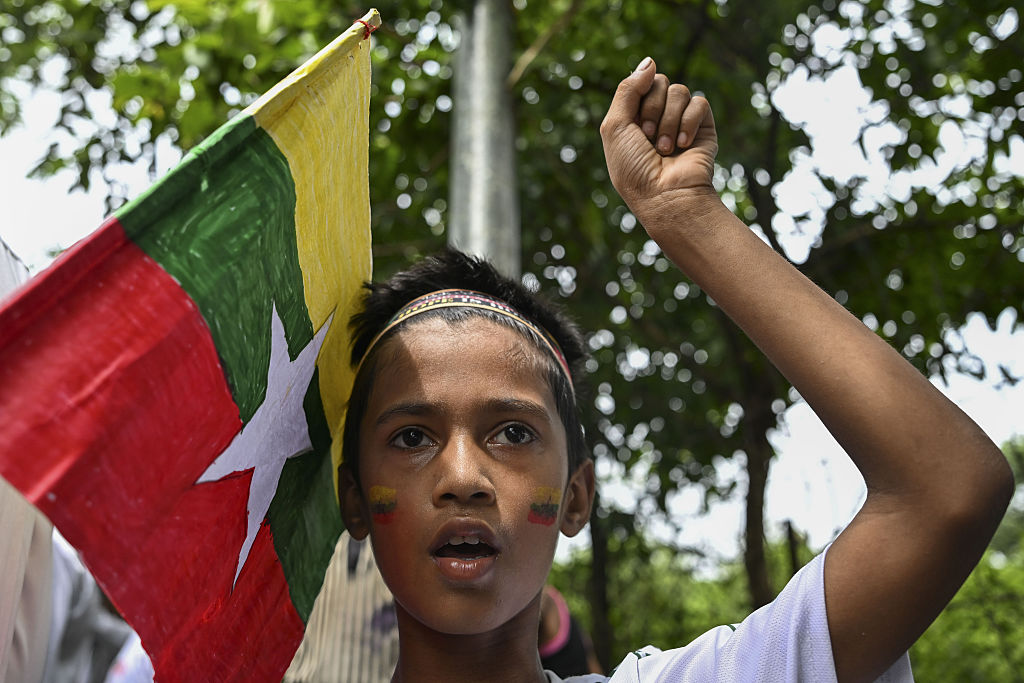
Nine years ago, the Myanmar state expelled the Rohingya in a genocidal campaign. That state is now falling apart in the face of armed rebellion, but the Rohingya are still waiting to learn whether anything different is being built in its place. (Abdul Goni / Anadolu via Getty Images)
In August 2024, Rohingya families gathered on the banks of the Naf River in Maungdaw, waiting to cross into Bangladesh as the fighting closed in. Drones and mortars found them there. Roughly two hundred people were killed, another entry in a catalogue of atrocity the Rohingya have been forced to keep for decades.
What made this massacre different was who stood accused of it. The killing was attributed not to the Myanmar military, the army that drove three-quarters of a million Rohingya into exile in 2017, but to the Arakan Army, the ethnic Rakhine force that has spent the past two years dismantling that same military’s grip on the state. The genocidaire was in retreat but the Rohingya were dying anyway.
That is the contradiction at the heart of Myanmar today, and it is why we should mark the ninth anniversary of the 2017 genocide as something other than a humanitarian remembrance. The Rohingya are usually cast as victims of a specific army and a specific campaign of expulsion. But the genocide was never only a crime committed by soldiers.
It was the sharpest expression of a political order: a state built on Burman-Buddhist supremacy, a citizenship regime designed to render an entire people stateless, and a center that has always treated its ethnic peripheries as territory to be subdued rather than nations to be included. The question the anniversary poses is not whether the world remembers the Rohingya. It is whether the forces now tearing down the Myanmar state are capable of tearing down the order that produced them, or whether they will simply inherit it.
Statelessness by Design
The genocide was structural before it was violent. Myanmar’s postindependence state was built around a hierarchy of belonging, and the 1982 Citizenship Law codified it into a taxonomy of “national races”: 135 ethnic groups whose presence before British colonization qualified them as authentic sons of the soil.
The Rohingya were left off the list. At a stroke, people who had lived in Arakan for generations were reclassified as illegal immigrants from Bengal. Statelessness was not an accident of the Rohingya condition; it was its legal foundation.
This was the logic of the state itself. Independent Burma inherited from British rule a political geography in which a Burman-Buddhist core governed a ring of minority peripheries (Kachin, Shan, Karen, Chin, Rakhine). Promises of autonomy dissolved almost immediately into the reality of military domination.
The relationship between center and periphery was colonial in every meaningful sense of the term: extraction, denial of self-rule, the permanent threat of force. The Tatmadaw entrenched itself as the guardian of this arrangement, a Bonapartist apparatus that governed by balancing the antagonisms beneath it while serving no interest so faithfully as its own.
Burman-Buddhist chauvinism was its ideological cement, and the Rohingya were its most useful enemy: a stateless, defenseless Muslim population against whom national unity could always be manufactured. The 2017 “clearance operations” were the culmination of that logic, not a departure from it.
This is the precondition for everything that follows. If the Rohingya were merely victims of one army’s brutality, the defeat of that army would be their liberation. However, if their expulsion was the work of an entire architecture — citizenship as ethnic patrimony, belonging as bloodline, the periphery as conquered territory — then the collapse of the army settles nothing. The architecture can survive the fall of any single institution that once inhabited it. It can even be rebuilt by the forces that fought the original builders.
Not Democracy vs. Dictatorship
That collapse is now well underway. The February 2021 coup, meant to restore untrammeled military rule, instead detonated the most serious challenge to the Myanmar state since independence. Mass protest gave way to armed resistance; People’s Defense Forces sprang up across the Burman heartland, and the established ethnic armies seized the moment to expand.
Five years on, the junta controls only around a fifth of the country. It has staged sham elections and installed Min Aung Hlaing, the general behind both the genocide and the coup, as president of a nominally civilian government, while at the same time it bombs hospitals in the territories slipping from its hands.
Here the internationalist left has to resist a comforting simplification. It is tempting, from a distance, to read what is happening in Myanmar as a straightforward contest between democracy and dictatorship. That story is not false, but it is dangerously incomplete. The crisis convulsing Myanmar is simultaneously a crisis of the state constructed in 1948: of Burman domination, of the unresolved claims of a dozen nationalities, of who controls territory and resources, and of what citizenship means and who is entitled to it.
The war is not only about who rules the state. It is about whether that state, centralized, ethnically hierarchical, colonial toward its periphery, should exist in its present form at all. The Rohingya are the population on whom that deeper question falls most heavily, because they are the ones the existing order was most determined to exclude.
Whose Self-Determination?
Nowhere is the ambiguity of Myanmar’s unmaking sharper than in Rakhine, and no force embodies it more completely than the Arakan Army (AA). The AA’s rise is genuinely extraordinary. Having been founded as recently as 2009, it has seized some 90 percent of Rakhine State, captured the entire border with Bangladesh, and overrun a regional military command that had held for generations.
Through its political wing, it now runs a functioning administration (courts, policing, taxation, conscription) and speaks openly of confederal self-rule. This is not banditry but state-building, animated by a real and deeply felt Rakhine nationalism, a demand for self-determination after decades of subordination to the Burman center. In its own terms, the AA is exactly what the Left says it supports: the vehicle of an oppressed nationality asserting its right to determine its future against a colonial state.
And yet the territory the AA is liberating is also home to the Rohingya, and the record of how they have fared in the course of its advance is by now extensively documented. As AA forces took Buthidaung and Maungdaw in 2024, investigators recorded a familiar pattern of dispossession: villages shelled and burned, Rohingya men detained and killed, others pressed into forced labor.
At Hoyyar Siri in May 2024, AA fighters are alleged to have fired on unarmed Rohingya fleeing the fighting; Human Rights Watch documented at least 170 dead, and survivors put the figure higher. Then came the killings at the Naf. Since taking control, the AA has imposed the machinery of an occupation: bans on movement and livelihood, confiscation of land, and a refusal to use the very word “Rohingya,” naming them instead as “Bengalis” or “Muslims.”
Rohingya who fled AA-held areas told Amnesty International that life under the Arakan Army felt not merely as bad as life under the Tatmadaw but worse, because now they were permanently suspected of collaboration. The AA denies all of it as activist propaganda. Those denials are hard to sustain against testimony gathered by the UN’s own human rights office, Amnesty, Fortify Rights, and Human Rights Watch alike.
This is the contradiction that ought to trouble anyone who thinks seriously about national liberation. The nationalism of the oppressed can harden into the domination of a new oppressor the moment it takes power. A nation defined by ethnicity and secured by territory tends to reproduce, against whatever minority lives inside its borders, the very logic of exclusion it fought to escape.
The Arakan the AA is building is an Arakan for the Rakhine. It reproduces, in miniature and against the Rohingya, precisely the “national races” logic the Burman state used against the Rakhine themselves. One oppressed nationality’s road to freedom is being paved with another’s subjection. This is not a betrayal of Rakhine nationalism; rather, it is what ethnically defined self-determination looks like when it meets a population it does not count as its own.
The Rohingya’s position is uniquely desperate, and the reason is structural. Every other major actor has a territory, an army, a claim. The Rohingya have none: no army that protects them, no ground they control, no patron that will fight for them. So they are caught between the armed camps and made into instruments of their own destruction.
When the junta activated conscription in 2024, it forcibly recruited Rohingya men and boys, the same population it had tried to exterminate seven years earlier, to fight and die against the Arakan Army. The AA then points to the role of those fighters to justify treating the whole population as a fifth column. The victims are pressed into service, then condemned as collaborators for it.
The Democratic Opposition
If the Arakan Army is one horn of the dilemma, the democratic opposition is the other. Here the picture is more hopeful, though still unfinished.
The change since 2017 is real. In that year, the chauvinism aimed at the Rohingya was near-total; Aung San Suu Kyi herself went to The Hague to defend the military against the charge of genocide.
The coup shattered some of that consensus. Burman activists hunted by the same army began, haltingly, to recognize a kinship with the people it had hunted before them.
In June 2021, the National Unity Government (NUG), the shadow administration of ousted lawmakers and resistance figures, pledged to repeal the 1982 Citizenship Law, abolish the hated verification cards, ground citizenship in birth in the country rather than membership in a “national race,” and grant international courts jurisdiction over crimes against the Rohingya. For a body dependent on a base steeped in anti-Rohingya sentiment, this took courage.
But recognizing a past wrong is not the same as dismantling the structure that produced it. The NUG controls no territory in Rakhine; its writ does not run where the Rohingya live. Its citizenship reform is deferred to a future constitution that does not yet exist.
The deeper problem is one that the NUG gestures at but does not resolve. So long as Myanmar’s political imagination is organized around ethnicity — around federated homelands, with each representing the patrimony of a titular nationality — the Rohingya will remain the constitutive exception, the group that fits no homeland and therefore belongs nowhere.
A federation of ethnic states is a coherent answer to Burman domination. It is not by itself an answer to Rohingya statelessness. It can just as easily become a framework in which every people has its territory and the Rohingya have none.
The Rohingya Are the Test
This is why the Rohingya cannot be treated as a humanitarian appendix to the Myanmar conflict, a suffering to be addressed once the real political questions are settled. Their fate is the real political question posed in its most demanding form.
It is the clearest available test of whether the collapse of the old order will produce a genuinely different Myanmar or merely a redistribution of territory and power among armed actors, each erecting its own machinery of belonging and unbelonging, while the deepest structures of exclusion survive the state that first built them.
So far, the evidence points more toward reshuffling than transformation. The Tatmadaw is being defeated, and that is a genuine gain: an army that committed genocide is losing its capacity to commit it again. But the force supplanting it in Rakhine has begun to build an ethnic statelet that treats the Rohingya as the Burman state once treated the Rakhine. The democratic opposition has renounced the old chauvinism in words while remaining unable, and not yet fully willing, to attack its foundations.
A Myanmar worthy of the name that the Spring Revolution gave it would have to break not with this or that institution but with the principle beneath all of them: the idea that belonging is a matter of ethnic descent and the nation the property of a race. It would have to found citizenship on residence and birth rather than bloodline and extend it to the Rohingya not as a concession wrung from the international community but as a right. Whether any force in Myanmar is prepared to fight for that, rather than merely for its own share of the wreckage, is the question the ninth anniversary should put to everyone who claims to stand with the country’s revolution.
Nine years ago, the Myanmar state expelled the Rohingya to prove what kind of state it was. That state is now falling apart. The Rohingya are still waiting to learn whether anything different is being built in its place, or whether they are simply being handed from one guardian of the old order to the next. Their answer will tell us what the Myanmar revolution actually amounts to.