A Labour Prime Minister Inaugurated Britain’s Neoliberal Era

Fifty years ago, British Labour leader James Callaghan used his party conference speech to promote some of the key ideas associated with neoliberalism. A close look at the speech can help explain why neoliberalism keeps defying predictions of its demise.
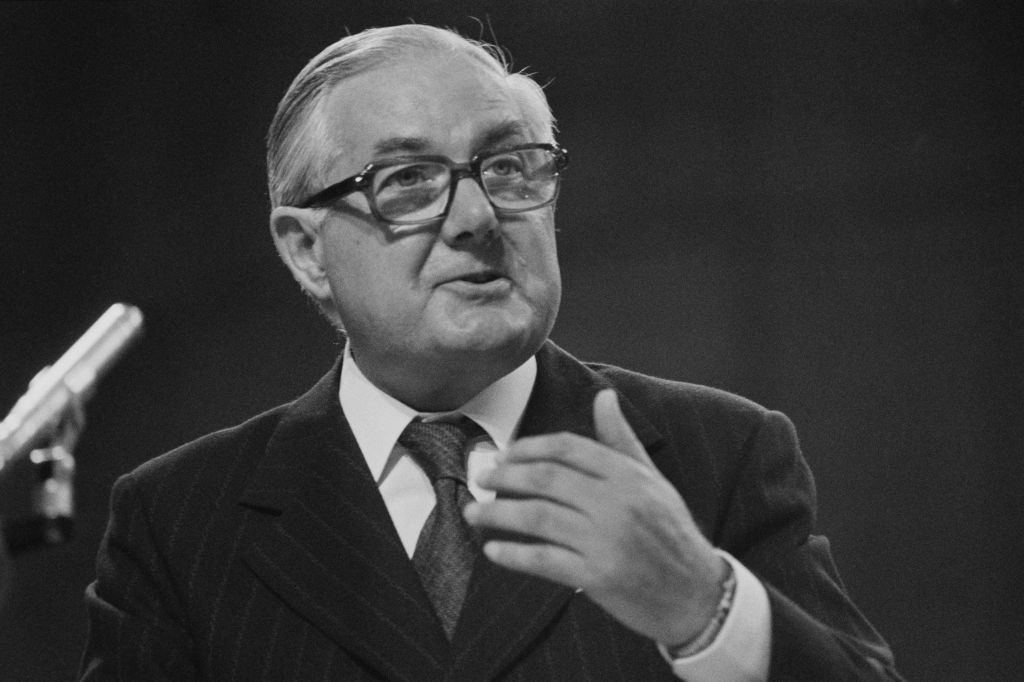
British Labour Party politician and Prime Minister James Callaghan, photographed in 1978.

Margaret Thatcher usually gets the credit (or the blame) for Britain’s neoliberal turn from the late 1970s. But it was her Labour predecessor James Callaghan who took the first key steps away from the social democratic reforms his party had carried out. (Evening Standard / Getty Images)


When Britain’s Labour Party met for its annual conference in September 1976, the government headed by its leader, James Callaghan, was confronting a severe economic crisis. This included the combination of high inflation and unemployment (“stagflation”) and a currency crisis that would, by the end of the year, lead the government to arrange a loan from the International Monetary Fund (IMF). IMF assistance came with the requirement of steep budget cuts.

In this context, conference delegates passed ambitious resolutions that condemned cuts and called for nationalization of much of the financial sector as well as extensive controls over the movement of capital, imports, and company investment decisions.

James Callaghan refused to consider such measures. In a speech that historians often seen as a harbinger of neoliberalism, he told the conference that “the cosy world we were told would go on for ever, where full employment would be guaranteed by a stroke of the Chancellor’s pen” was now gone for good:

We used to think you could spend your way out of a recession and increase employment by cutting taxes and boosting government spending. I tell you in all candour that that option no longer exists — and insofar as it ever did exist, it only worked on each occasion since the war by injecting a bigger dose of inflation.

While it does make sense to see this speech as a major moment in the history of economic policy, there is widespread misunderstanding about the reasons for its significance. Considering the speech on its fiftieth anniversary can help us to better understand the meaning of neoliberalism and its relationship to contemporary politics.

Callaghan and Thatcher

It is standard to divide Western capitalist policy regimes since 1945 into two eras, with the later 1970s as a hinge period. The first was an era of close government management of national economies, often called the “Keynesian” era. In the most popular practical application of Keynesianism, governments used their fiscal powers to manage aggregate demand and maintain full employment while preventing economies from “overheating.” The second era was the “neoliberal” one, in which such government interventions were viewed with much greater suspicion, and economic policies promoted the continuous expansion of market logics.

In most accounts of the transition between the two regimes, a key turning point is the 1979 election defeat of Callaghan’s Labour Party by Margaret Thatcher’s Conservative Party, which then embarked upon a radical neoliberal program. Thatcher’s election was indeed a dramatic and historic moment, and there were very important differences between her approach and that of her Labour predecessors.

Most importantly, Callaghan’s policies were based on efforts to secure agreements with trade unions on wage restraint, whereas Thatcher’s agenda set out to crush the unions through mass unemployment and the exercise of state power. The differences between them ensured that the scale of privatization and deindustrialization in the UK during the 1980s would be exceptional when compared to its West European neighbors.

However, some neoliberal policies had already begun under the 1974–79 Labour governments. This included the prioritization of inflation control over keeping unemployment as low as possible as well as policies to boost profits at the expense of wages and some forms of financial deregulation.

Labour often justified these policies as pragmatic adaptations to the economic crisis and the demands of financial markets. But this did not place it outside the neoliberal mainstream. Indeed, such pragmatic justifications generally served as a more typical pathway for neoliberalism, especially in electoral democracies in the Global North, than the overtly ideological arguments associated with Thatcherism.

However, many interpretations of Callaghan’s speech still present neoliberalism as a quite specific ideological project. The speech’s own framing contributes to this, which could be connected to the fact that it was partly drafted by Callaghan’s son-in-law, the Times economics editor Peter Jay, whom he later appointed as British ambassador to Washington.

The most famous sections were effectively a summary of “monetarism,” the fashionable economic doctrine for which Jay had become a prominent enthusiast. Monetarists argued that inflation was a symptom of excessive increases to the supply of money in the economy as a result of various factors, including Keynesian fiscal policies. In their view, which Callaghan echoed in the speech, this simply increased inflation and the “natural rate of unemployment” that was needed to control inflation.

Monetarism would go on to provide a central economic argument for Thatcherism and neoliberal policies in general. Here, it was already being embraced by a Labour government.

Rethinking the Speech

However, there is often a tendency to exaggerate the nature of the doctrinal shift that the speech implied. For one thing, it did not announce a new policy direction. The government had begun spending cuts a year earlier and already implicitly prioritized control of inflation over unemployment.

The extent to which Callaghan and his government really believed in “monetarism” is also questionable. While they adopted some money supply targets and “rules” that monetarists advocated, they primarily saw agreement with the unions to restrain wages as the main way of reducing inflation. They also returned to some reflationary Keynesian policies, under better economic conditions, a year later.

The idea that governments previously thought they could guarantee full employment at the “stroke of the Chancellor’s pen” was also a caricature. There were long-established understandings that both international constraints and domestic inflation would create difficulties for the pursuit of this goal. This was considered to be especially true under conditions of “free collective bargaining” that British trade unions favored.

For this reason, Labour had come to power in 1974 having already agreed to a “Social Contract” with the union movement, which was then very powerful. Under the terms of this deal, the unions committed to wage restraint in exchange for government measures such as stricter price controls, higher social spending, and new union rights.

Since the beginning of the 1970s at least, the Labour left had also been proclaiming that there was a crisis of Keynesianism. The Labour right had embraced Keynesianism more fully than the party’s left tendency, which saw it as an approach that avoided reckoning with capital’s structural power and crisis tendencies.

For the left, the internationalization of capital and the experience of stagflation in the 1970s were reducing the room for Keynesian policies. They saw this as an opportunity to argue for wide-ranging extensions of state control through nationalizations and planning agreements.

In other words, Callaghan’s speech articulated a doctrine that he did not really believe in, and one that would never guide his government’s policies. Moreover, he presented this doctrine in the guise of a conversion from another set of beliefs that had never really existed. Even so, this was still an important moment in the development of neoliberalism.

Power and Principles

Neoliberalism was never a consistent economic doctrine. While the early Thatcher government also adopted monetarism as a convenient set of tools, it soon abandoned those tools after they proved ineffective, while continuing to pursue the more fundamental goals of privatization, deregulation, and undermining organized labor.

The economic policies of another quintessential neoliberal government, the Reagan administration, also departed from the monetarist template. Enabled by the international status of the US dollar, the practice of Reaganism involved “cutting taxes and boosting government spending” (on the military, in this case) in a way that Callaghan’s speech had declared passé.

The more consistent feature of neoliberalism was its orientation toward capital, particularly the international variety, at the expense of other social constituencies. We can therefore identify the greater significance of the speech not in the specifics of what Callaghan said but rather in why he said it.

He intended the speech to win over international financial markets, where monetarist ideas had become popular. According to Labour’s Chancellor Denis Healey, the government had to speak the language of “monetarist mumbo-jumbo” (as he called it) because it needed to secure the confidence of the markets. Callaghan also wanted to make a virtue of challenging the left-wing activists who predominated among conference delegates.

The Labour government had already used concern about the outlook of international markets to push for a renegotiation of the Social Contract, with stricter limits on wages. These increasingly severe wage restraints eventually led to a wave of strikes in the “Winter of Discontent” of 1978–79. This forced another reversal of government policies but destroyed Labour’s central claim that it would bring about greater economic stability through good relations with the unions.

The speech showed that Callaghan was becoming more responsive toward international financial markets than toward unions or party activists. There was still a fragile balance in the 1974–79 government, which switched between some of the most left-wing government policies of the past quarter-century and early forms of neoliberalism. But it was increasingly pulled in the latter direction as it faced waves of financial speculation. Meanwhile, social movements that had pushed it toward greater radicalism suffered from disunity, and the alternatives they put forward were vague.

End of an Era?

If we understand neoliberalism in these terms, it can also help us as we consider the relationship between neoliberalism and contemporary politics. In recent years, it has become difficult to tell whether and to what extent we are still in a “neoliberal” era, as we see ever more dramatic forms of state intervention.

This has included the resurrection of national industrial policies, the rise of trade barriers, and threats to the political independence of central banks, notably in the United States under Donald Trump. When we compare this cluster of developments to the emphasis of neoliberalism on markets and “rules” that are enforced by technocrats rather than politicians, they clearly mark an important shift.

However, the shift is less clear-cut when we consider the power configurations that were the more fundamental markers of the shift to neoliberalism. The “post-neoliberalism” of the Trump administration, for example, appears in this light more as an amplification of the tendencies that defined the shift from “Keynesianism” to neoliberalism, led by a fraction of capital that is particularly resistant to compromise with other social groups.

On the other hand, the new British government of Andy Burnham may express a stronger rhetorical rejection of Thatcherism than its New Labour predecessors. But the struggles Britain has faced in achieving economic growth, combined with the heightened vulnerability of its governments to pressure from bond markets, mean that the space for social democratic policies is currently more restricted than it was during the era of Tony Blair and Gordon Brown.

At the same time, the sort of countervailing forces that imposed concrete limits on neoliberalism fifty years ago, such as a strong union movement, are still much weaker than in the past. Until the Left can develop the institutional reforms and social movements that would be necessary to challenge neoliberal power configurations, the most important tendencies that Callaghan’s speech signaled back in 1976 will continue to manifest themselves.