Liverpool’s Municipal Socialists Took the Fight to Thatcher
Liverpool’s left-wing council led one of the most important struggles against Margaret Thatcher’s government during the 1980s. If other Labour-run councils had followed its lead, they could have inflicted a major blow to Thatcher’s agenda.
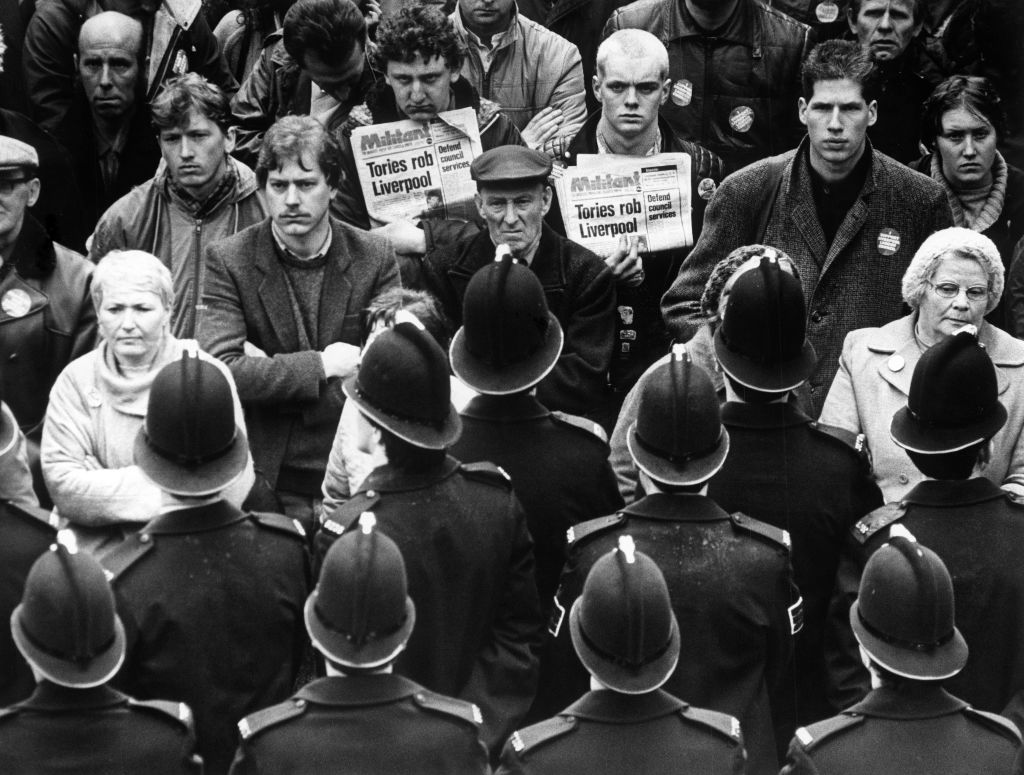
On March 29, 1984, budget day, Liverpool workers hold a one-day general strike where 50,000 marched on the Town Hall to support the council's stand against the Tory government. (Staff / Mirrorpix via Getty Images)
In the annals of British political history, the image of Labour leader Neil Kinnock denouncing the “grotesque chaos” of Liverpool’s local government at his party’s conference in 1985 looms large. According to official memory, this was the moment when Kinnock asserted himself over the hard left, specifically the Trotskyist Militant tendency, whose sectarian antics had subordinated the city’s real needs to ideological dogma.
The speech, delivered in the seaside town of Bournemouth, has acquired a cult status, at least for devotees of British political history. This includes even conservative commentators like Simon Heffer, who included Kinnock’s attack on Militant in his anthology The Great British Speeches. When Keir Starmer railed against Nigel Farage at last year’s Labour conference, one of his supporters could think of no finer praise than to compare it to Kinnock’s intervention four decades earlier.
But Kinnock’s version of events obscures a far more complex and interesting story. While the Militant tendency was certainly an influential force in Liverpool’s Labour Party, it was one part of a wider left-wing movement. Fewer than a third of the Liverpool councillors who were ready to defy Margaret Thatcher’s government in the mid-1980s actually belonged to Militant.
Moreover, Liverpool was just one of the Labour-run councils under left-wing leadership around the country that was ready to take action against Thatcher’s austerity. But Kinnock and his allies worked hard to ensure that when the time for conflict came, Liverpool would stand virtually alone and its council would go down to defeat. Like the miners’ strike of 1984–85, the struggles over local government proved to be a turning point for Thatcher and her neoliberal project, with consequences for British society that are still evident today.
Managed Decline
For centuries, Liverpool had been an industrial powerhouse thanks to its bustling port. But during the 1970s, the so-called New York of Europe started to face many of the same economic problems as its US counterpart. In the decade prior to the 1979 election victory that swept Margaret Thatcher to power, Liverpool had already lost over forty-five thousand manufacturing jobs. Its port workforce was reduced to three thousand from its postwar heyday of twenty-five thousand.
Throughout the 1960s and ’70s, control of Liverpool’s local government bounced back and forth between the Labour Party and Conservative/Liberal coalitions, which were often united by a desire to privatize the city’s sizable public housing stock. The further Liverpool got into the Thatcher era, however, the redder its politics became.
Liverpool’s aversion to the Conservative Party was amply reciprocated by Thatcher and her allies. After riots in the Toxteth district in 1981, the Tory Chancellor Geoffrey Howe privately urged Thatcher to abandon the city to its fate instead of trying to revive the local economy: “I cannot help feeling that the option of managed decline is one which we should not forget altogether. We must not expend all our limited resources in trying to make water flow uphill.”
The local section of the Labour Party campaigned on a radical program in May 1982’s local elections. Its Liberal Party opponents appealed to voters with the simple pitch, “Marxists out, Liberals in,” but Labour gained two seats instead. The following year, while Michael Foot led Labour to a decisive loss in the general election, the party in Liverpool won enough seats to command a majority on the city’s council.
There can be no denying the significance of the Militant tendency in the politics of 1980s Liverpool. An offshoot of the Trotskyist Revolutionary Socialist League organized around a newspaper called Militant, the group surged in membership when Thatcher’s premiership began. In Liverpool, Militant tapped into a rebellious strain among disaffected young working-class people.
Militant’s ideology was decidedly revolutionary. Its leadership structure was also aloof and undemocratic, and its orientation to the rest of the Left was often needlessly sectarian. Militant had little time for movements against forms of oppression based on race, gender, or sexuality. But it continued organizing inside the Labour Party while other British Trotskyist groups were opposing it from the outside, and it benefited from the general rise of the Labour left and figures like Tony Benn in the 1970s.
While it was a distinctive presence on Liverpool’s political scene, most accounts have exaggerated Militant’s role on the local council, and it was more willing to cooperate with others than its ideological dogmatism might suggest. Derek Hatton, who served as the council’s deputy leader, was a proud Militant member, but his superior John Hamilton, the nearest thing to a mayor in Liverpool at the time, was not.
Even Peter Kilfoyle, the party apparatchik who was tasked with purging disobedient councillors from the local Labour Party, conceded that the majority “were not actually members of Militant.” Labour’s council majority from 1983 to 1987 was instead a broadly left-wing formation, unified around a more confrontational opposition to Thatcherite austerity than the national party was willing to tolerate.
Municipal Socialism
When the new council majority took over in 1983, Liverpool had a 24 percent unemployment rate, double the national average. Funding from the national government had also gone down by nearly one-fifth in just three years. The council opened with a provocative message to Thatcher and her party by introducing a budget that was £30 million above the expected limit and accompanied by a set of bold demands.
They charged the Tories with targeting Liverpool for especially draconian cuts and penalties, then requested additional funding for housing and other programs. The optics of this fight didn’t seem to bother the average Liverpudlian. As historians Diane Frost and Peter North put it, “many who were neither close to the council or the Left in general felt that the council had a case.”
In the era of “urban entrepreneurship,” during which British municipalities were prodded into opening their economies up to private investment, Liverpool bucked the trend. Its new council filled the void left by capital by adding six hundred jobs on top of the one thousand layoffs they were able to cancel.
Liverpool was not the only city government pursuing alternatives to austerity. During this period, left-wing Labour councils in London, Sheffield, Manchester, and the West Midlands invested in cooperatives, job training, enterprise boards, and planning agreements that gave unions and the public a say in the wages and conditions of companies if they received city subsidies. These experiments involved several politicians who would later become prominent on a national level, from David Blunkett in Sheffield to John McDonnell in London.
Thatcher responded to these initiatives in 1984 by pushing the Rates Act through Parliament. This gave her government authority over the budget of any city it wished to interdict. The Labour councils under threat banded together with a pledge to “break the law rather than the poor,” in a potentially powerful form of opposition.
Confronting Thatcher
After Labour’s resounding loss in the 1983 general election, the party chose Neil Kinnock to be Michael Foot’s successor. Although Kinnock was a self-described democratic socialist, he was now determined to undermine the hard left, believing that this would make the Labour Party more electable.
When Liverpool’s Labour majority was planning to pass a budget in defiance of the central government’s mandated cap, a group of seven councillors (later known as the “scabby seven” or the “sensible seven,” depending on who you ask) met with Kinnock to plot against their colleagues. Kinnock repeated the advice he had given to other Labour councils: that they should reluctantly comply with Thatcher’s cuts so they could keep their positions and preserve essential services. Kinnock thought his “dented shield” strategy would endear Labour to the public.
On budget day in Liverpool, however, about fifty thousand people gathered outside the city’s town hall in support of the council’s proposed budget, which was £55 million higher than the central government’s edict required. The seven defectors prevented Liverpool Labour from passing the illegal budget, but the May 1984 election results then gave the party extra seats — enough to nullify Kinnock’s loyalists. Thatcher’s government decided it was time to negotiate.
Patrick Jenkin, Thatcher’s environment minister, was put in charge of dealing with Liverpool. At first he refused to cooperate with what he considered to be the council’s unreasonable demands. After the May 1984 elections, however, Jenkin agreed to come on a tour of the city’s dilapidated housing, something he had refused to do previously. The minister was reported to be “visibly shocked”: “I have seen families living in conditions the like I have never seen before.” Jenkin agreed to supply £20 million from central government funds to help plug Liverpool’s £30 million deficit.
The councillors who negotiated on Liverpool’s behalf were asked to keep it under wraps until the deal was ratified, so both sides could take credit, but they couldn’t contain themselves that long. The Labour majority was eager to claim victory against Thatcher, and their public jubilation was humiliating for her government, and Jenkin in particular. The tension grew in October 1984, when Thatcher herself paid a visit to Liverpool and could barely contain her rage when the left-wing Labour councillors refused to stand, forcing her to stoop down to greet them.
Decision Time
The central government’s policy of appeasement may have owed less to fear of the Liverpool council’s strength than to its preoccupation with crushing the National Union of Mineworkers, who had been engaged in a massive year-long strike since March 1984. At the same time, Kinnock was determined to distance the Labour Party from the miners.
Coming into 1985, Thatcher’s government hardened its stance toward Liverpool, cutting the city’s housing budget contribution as a penalty for not “diversifying” its housing stock. But the council, having authorized a new home construction project that was now significantly over budget, went ahead and built it anyway.
Before Jenkin could fully invoke the Local Government Act and assume legal authority over Liverpool’s housing expenditures, the council secured a loan from a French banking consortium. But this could only buy them a limited amount of time, as they would need to pass a budget in spring 1985. The Liverpool councillors pledged not to comply with the cuts the Tories had mandated, along with a number of other left-led councils in London, Sheffield, and Manchester. This move would make their budgets illegal.
Kinnock had no intention of bringing the rebel cities together as part of a nationwide fight against austerity. On the contrary, he wanted to break up their united front. The national party leadership gave the councils until June to pass smaller, legal budgets. With the exception of Liverpool and the London borough of Lambeth, they all gave in. On the Greater London Council, which had launched the most ambitious project of municipal socialism in the early 1980s, John McDonnell bitterly reproached his ally Ken Livingstone for throwing in the towel.
Liverpool’s council soon received an ultimatum from the city’s district auditor: it would either have to pass an austerity budget or else lay off all city employees. Desperate, the council leadership signaled that it was willing to follow the latter course, with an announcement that it was preparing over thirty thousand redundancy notices.
Brinkmanship
The hope behind this exercise in brinkmanship was that it would enable them to get a better deal or, failing that, at least secure the Labour Party’s full support. But this quickly proved to be a miscalculation. Although the council majority never intended to follow through on the layoffs, that didn’t stop the right-wing press from running with the story.
The maneuver also deeply alienated Liverpool’s unions. As it turned out, the main city jobs to be lost were those of the councillors themselves, who were hit with a £106,000 fine by the district auditor and dismissed from office — a move they appealed in court to buy yet more time.
Over the next couple of weeks, Liverpool’s unions considered a citywide strike to agitate against the central government. The city’s rebellious mood was still palpable, but the necessary coordination between unions and the council was lacking, and there were stark divisions within the unions themselves. Following a minimally effective one-day strike on September 25, the council followed through on its earlier threat and issued the redundancy notices.
It is well known that some of the notices were delivered by taxi, but the full context of this detail is less widely understood. First of all, delivering important messages by taxi was not an unusual practice for the city’s council at the time. Secondly, the notices were accompanied by another letter which stated that the layoffs would be canceled if and when the council reached a resolution with Thatcher’s government.
None of this stopped Neil Kinnock from seizing on the moment in his speech at the Labour Party conference in October 1985. While Kinnock spoke for nearly an hour, dedicating much of his time to railing against the “evil” of Thatcherism, the five minutes or so that he spent attacking the “tendency tacticians and gesture generals” of the Labour left are the best-remembered part.
Kinnock didn’t single out Liverpool or Militant by name, but the entire room understood what he meant when referring to “a Labour council hiring taxis to scuttle around the city handing out redundancy notices to its own workers.” He accused the council of playing “politics with people’s jobs,” neglecting to mention how, that very day, Liverpool’s councillors had struck a £30 million deal for housing repair and construction with a group of London stock brokers.
Keeping Faith
As Derek Hatton called out “lies!” from the floor, Eric Heffer, a Labour MP from Liverpool Walton who was firmly on the left, though not a Militant member, walked out. But Kinnock’s speech won him plaudits from the British establishment and served as a preamble for his battle against the Liverpool councillors and a wider war against Militant, which was becoming a stand-in epithet for everyone to the left of Kinnock himself.
On November 22, Kinnock announced his support for sending in commissioners from the Conservative government. The same day, the council reached a deal involving capitalization and new Swiss bank loans. This mattered little to Kinnock, who suspended the Liverpool Labour Party three days later and announced that anyone “associated” with the Militant tendency would be expelled.
Months later, when the councillors who passed the illegal budget had their appeal denied and were finally dismissed from office, only thirteen out of forty-nine were members of Militant. Yet to this day, Militant is said to have “taken over” Liverpool’s Council and set about destroying city services in the name of Leon Trotsky’s revolutionary program. In this version of events, Kinnock had little choice but to act as he did.
Neil Kinnock was (and still is) adamant that he took the necessary steps for Labour to win a general election. But in practice, he went on to lead the Labour Party to two devastating defeats in 1987 and 1992. His main achievement in hindsight was to pave the primrose path to Blairism.
Looking back almost thirty years later on the confrontation between Labour councils and the Conservative government, Marxist writer and veteran of the Thatcher years Mike Marqusee praised the councillors in Liverpool and Lambeth who had refused to bend: “They kept faith with their electorates and their consciences, even when abandoned by their leaders, vilified in the media and threatened with bankruptcy.”
Marqusee identified the defeat of the campaign as “a significant step in the hollowing-out of local democracy and in Labour’s long-term adaptation to Thatcherism.” Despite the efforts of Jeremy Corbyn and his allies, including John McDonnell, Labour’s adaptation to the legacy of Thatcher is still very much in place, as the record of Keir Starmer’s government shows us. That is what commentators are really celebrating when they fetishize Kinnock’s grossly overrated speech.