Why Black Socialists Opposed Marcus Garvey
Marcus Garvey built the largest black movement of his era on the promise of redeeming Africa. But he knew almost nothing about the continent, and his organization had nothing to offer black workers on the things that shaped their lives.
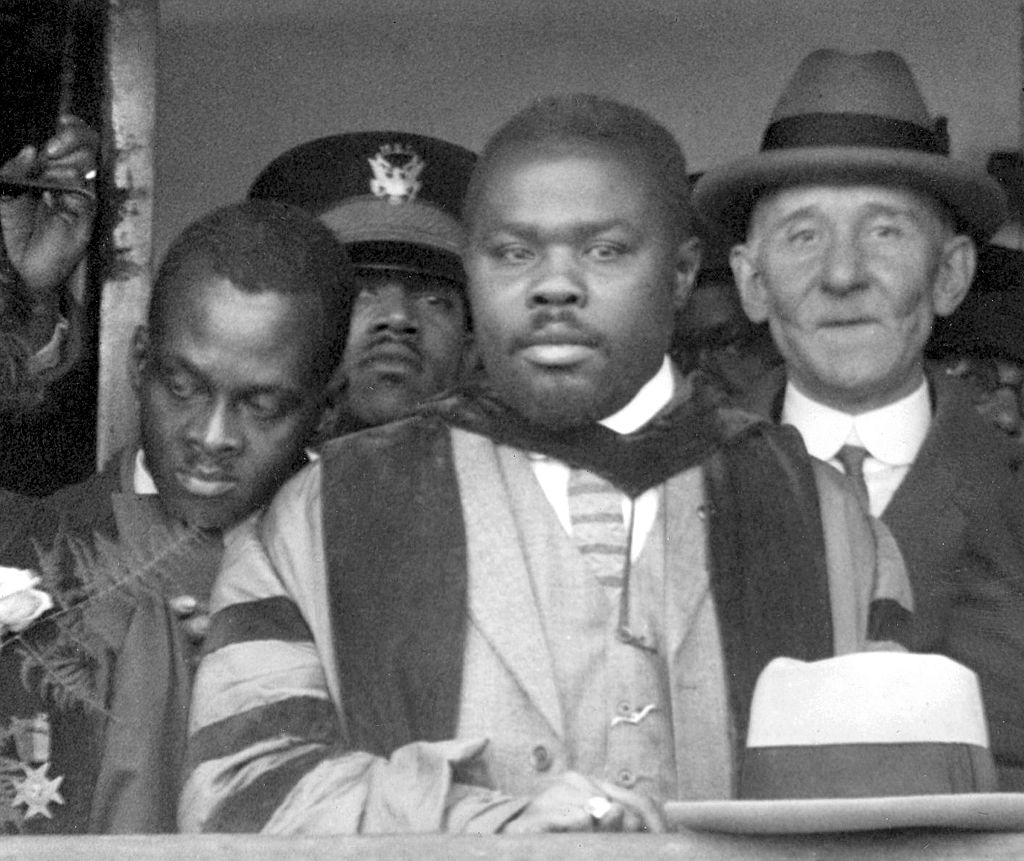
Marcus Garvey’s plan to redeem Africa rested on ignorance of the continent, and his organization asked members to consume rather than organize. His rivals on the black left saw early on that it would not deliver liberation for black people. (New York Daily News via Getty Images)
Africa loomed large in the vision of Marcus Garvey and his followers. In May 1920, the Universal Negro Improvement Association (UNIA) Executive Council decided to send a delegation to Liberia to explore the prospects for settlement and development. UNIA Resident Secretary in Liberia Elie Garcia wrote to President Charles D. B. King that they wanted to “establish trade routes, through a line of steamships, etc., to encourage emigration to build up the country, to transfer its Headquarters to Liberia, to bring with it medical and scientific units, etc.” He asked for “written assurance that every facility will be given it to procure lands for business, agriculture, and industrial purposes. In return the Organization with its vast membership will lend financial and moral support to the Government to help her out of her present economic plight.”
Hubert Harrison got a copy of the August 1920 “Confidential Report” from Garcia, where he saw evidence of conspiratorial plans against the government of Liberia. Garcia recommended that the UNIA hide its real intentions to get involved in political activity. It also indicated the thorny internal politics at play and how reluctant the Liberian government was to seriously engage with the UNIA’s schemes. Garcia characterized the Liberian elite as “degenerated and weak morally” and wary of “American and West Indian Negroes.”
A. Philip Randolph cut through the unseriousness of Garvey’s dream to redeem Africa. He saw no viable pathway toward building up an independent African state by disparate groups of UNIA members. “The redemption of Africa by Negroes who are unarmed, unorganized, uneducated, a minority in numbers to their oppressors, divided, both in and out of Africa by languages, custom, history, and habits, is a will-o’-wisp, an iridescent dream which could only be born in the head of an irresponsible enthusiast,” he charged. The tendency to paper over class and cultural differences among blacks in the United States was even more pronounced in the way Garvey thought of Africa. William Pickens, a prominent National Association for the Advancement of Colored People (NAACP) activist and Garvey rival, quipped that “there is no more in common between South Africa and North Africa than between Texas and Turkey.” In his eyes, Garvey “had not a grammar grade understanding of Africa.” Randolph wrote, “To him every African is a Negro and every Negro is black. To him there is a racial and nationality homogeneity in Africa; all tribes possessing one mind.”