American Reality Is Beyond Parody, but Satire Isn’t Dead
Plenty of contemporary comedy gazes upon American stupidity and concludes that Americans are stupid. The Chapo Trap House anthology Chunks suggests instead that people behave strangely because the world around them has become so strange.
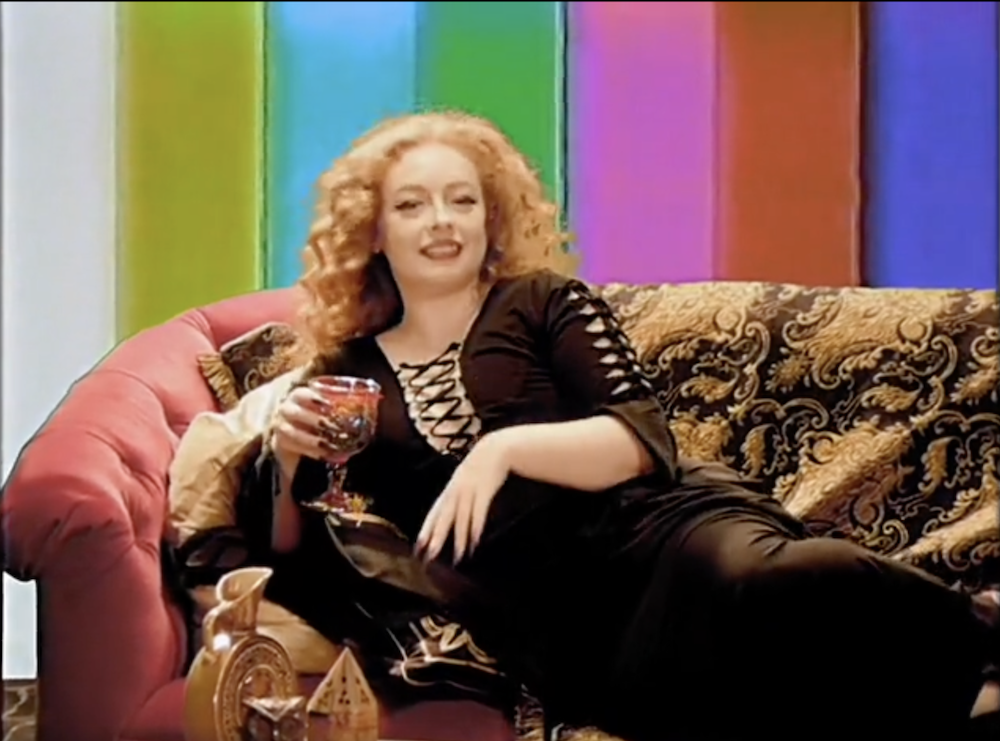
Ruby McCollister stars in 2026 comedy anthology film Chunks. (ColdFeet Films)
A specter is haunting contemporary American satire: the specter of reality. This specter poses an existential threat to comedy as social critique. How do you make jokes in this era of hyperabsurdity?
Donald Trump’s two administrations sandwiched four years of Joe Biden mumbling incoherently as he stumbling around. Corporations speak in the language of therapy, and airlines charge passengers for micro-comforts while advertising travel as an expression of personal freedom. Billionaires promise to colonize Mars while American cities see their bridges collapse.
Streamers make a career out of broadcasting themselves gambling, eating, fighting, shopping, hurling insults, and slowly losing their minds. Kash Patel exists. The late Roman spectacle of a physically repulsive imperial leader planning a massive triumphal arch to honor himself, staging gladiatorial fights for his birthday on his palace lawn, and waging a futile war on Persia.
Although Cory Doctorow coined the term “enshittification” to refer to the decay of user experience on online platforms, it now seems applicable to everything. What is the left-leaning comedic artist to do in such conditions?
Capitalist Realism
Ever in the vanguard, the Chapo Trap House podcast faced this crisis in their first year of existence. From their debut in March 2016, they focused their “dirtbag left” comedic ire on centrist Democrats. During their first live election show in November 2016, they were distraught at Trump’s victory — perhaps not because it harbored a new age of fascism, but because the show’s business model was supposed to be based on dunking on Hiliary Clinton’s neoliberal shit show.
Nevertheless, the Chapos persisted and succeeded. With a decade as one of Patreon’s highest-earning podcasts under their belt, they are moving into other media including comic books and now film.
Chunks, the new comedy anthology assembled by Chapo Trap House’s orbit of comedians, podcasters, and filmmakers, offers one compelling answer to 2026’s satire crisis: stop trying to exaggerate America; reproduce its surreal texture and follow its natural absurdities. The result is a hilarious and unsettling ninety-minute journey into the darkness of the American soul.
Produced through ColdFeet Films, the production outfit spearheaded by longtime Chapo contributor Amber A’Lee Frost, Chunks consists of six comedy shorts joined by interstitial appearances from Ruby McCollister as a fading Hollywood starlet turned Elvira wannabe public access host out of Bakersfield, California. Its contributors include Sandy Honig, members of Podcast About List and Episode One, Cum Town creator Nick Mullen, Saul Crinier, Nate Fisher, Will Sennett, Michael Cavadias, and Pierce Campion.
Chunks moves between animation, live stream aesthetics, public access television, and conventional narrative filmmaking. It’s the jumble of forms appropriate to a country whose citizens increasingly experience reality through competing screens, but also hearkens back to alternative comedy projects such as 1977’s Kentucky Fried Movie and Spike and Mike’s Sick and Twisted Festival of Animation, which toured art house cinemas in the 1990s, as well as Tales from the Crypt and The Twilight Zone.
Held together by McCollister’s outstanding performance, Chunks riffs on late night UHF and then cable television from a bygone era, when viewers flipping channels after midnight might stumble upon a deranged local commercial, a public access eccentric, an old movie, an evangelical preacher, or something whose provenance was completely mysterious. The filmmakers invoke that lost world of public access weirdness. Some of the funniest lines are Amber A’Lee Frost’s off-camera banter with the production crew. Those poor interns are probably still editing.
Stranger Things
But Chunks is not really nostalgic. Its great achievement is recognizing that the disappearance of the old television ecosystem did not make American culture less strange. It made strangeness more centralized, more commercial, and more difficult to escape.
The weird guy who once had a half-hour program on channel 63 now has three million followers. The local crank has become a content creator. The public access psychic has become a wellness influencer. The infomercial has conquered the culture so completely that much of ordinary life now possesses the rhythm of an advertisement.
Chunks works with this brave new world. Its six segments (“Utopia Air,” “The Eater,” “Office of Tomorrow,” “Poker Night at the Pleasure Trove,” “Charming Bears,” and “You Should Feel Better”) sound like channels encountered while insomnia pushes you deeper into the television dial.
Yet their collective subject is recognizably twenty-first-century America: consumption, work, entertainment, technological mediation, therapeutic language, and the bizarre psychological compromises required to survive institutions nobody particularly believes in anymore. The anthology format works so well because contemporary America lacks a coherent narrative. It feels like scrolling.
One moment you are watching footage from Gaza. The next you are being shown an advertisement for sports gambling. Then somebody is explaining their trauma. Then a senator is yelling about declining masculinity. Then DoorDash informs you that your burrito is approaching. Then a billionaire explains that artificial intelligence will liberate humanity from work. Then your employer emails to announce a mandatory seminar on resilience. Then you learn that the most powerful military in global history, which has recently murdered over 150 schoolgirls, will be giving the troops testosterone injections to create a “High-T” fighting force.
Chunks reproduces this fragmentation without simply imitating the internet. Its world is recognizably downstream from television, advertising, podcasts, animation, live streaming, and algorithmic culture, but the film’s comedy comes from placing these forms next to one another until their shared pathology becomes visible.
The Casino Economy
Take the very idea of “Poker Night at the Pleasure Trove,” organized around a live streamed poker game, complete with a lively comments section (take the time to pause the video and read these). Gambling may be one of the perfect cultural forms of contemporary America, as the economy increasingly resembles a casino, while the casino increasingly presents itself as an economy.
Sports broadcasts are saturated with betting lines, and cryptocurrency transformed financial speculation into mass entertainment. Ordinary people are encouraged to conceive of security not through wages, pensions, public services, or unions but through investments, side hustles, and improbable jackpots. Despite the fact that young men are particularly vulnerable to the dangers of online gambling, the gaming industry buys off cash-starved public universities and turns student athlete uniforms into casino advertisements.
Chunks finds morbid humor in how America has transformed risk into leisure because it has already transformed ordinary life into risk. Something similar hangs over the anthology’s take on corporate culture. An animated segment about the private lives of adorable commercial mascots, Nick Mullen’s “Charming Bears,” takes beings created entirely for advertising and asks us to imagine the psychic existence beneath their synthetic smiles.
The absurd premise gets at something fundamental about contemporary culture. We inhabit a society crowded with friendly corporate personalities. Insurance companies have mascots, and fast-food chains have personalities. Brands make jokes on social media and undergo carefully scripted moral awakenings.
These days, capital doesn’t just want our money; it wants a relationship. Mullen’s bears poke at the nightmare of corporate domination dressed as intimacy. However, his comedic genius takes us deep into the lives of these cartoon bears and finds that they share our existential crises, face all too familiar financial precarity, and ultimately find solace in a quixotic act of defiance that is equally scatological as it is emotionally resonant.
Feeling Better
Contributor Sandy Honig proves herself to be a triple threat, writing, directing, and starring in “Utopia Air.” While most of this installment does a spectacular job of lampooning the host of indignities that commercial airlines call “service,” she highjacks the narrative and flies us into the forbidden airspace of transcendental knowledge. Despite moments of horror, Honig assures us that the trip is going to be just fine.
“The Eater,” the work of Patrick Doran, Cameron Fetter, and Caleb Pitts, is a horror mystery that leaves the viewer with more questions than answers. Its atmosphere and critique of consumerism resonate with the best aspects of Fight Club on commodity fetishism.
The final segment’s title, “You Should Feel Better,” could serve as a motto for the current political economic order. America has become extraordinarily proficient at converting social problems into psychological ones. You are not overworked; you need mindfulness. You are not underpaid; you need financial literacy. You are not isolated because public life has been hollowed out; you need to practice self-care. You do not despise your job because work has become degrading and insecure; you need to find your purpose. This is the ultimate neoliberal command: adjust yourself.
Chunks belongs to an older tradition of American left-wing comedy, even though it avoids delivering anything resembling a conventional political lecture. Its politics reside in its eye for quotidian humiliations. The America depicted here is ridiculous because its institutions continually demand that people participate sincerely in situations that are manifestly insane.
That is also why Chapo Trap House turns out to be a surprisingly natural incubator for a film project. Since its emergence during the 2016 election, Chapo’s best comedy has depended less on conventional joke construction than on noticing the ideological content embedded in apparently trivial cultural objects: campaign advertisements, bad newspaper columns, superhero movies, conservative Facebook posts, airport bookstores, LinkedIn language, mediocre restaurants, and the endless artifacts produced by an empire trying desperately to entertain itself as it sinks further into decline and decadence.
Underground Variety Show
Crucially, however, the film does not feel like a filmed podcast. The filmmakers and producers care about filmmaking. This is hardly surprising, as cinema is a constant reference point on Chapo and Will Menaker has an ongoing series called Movie Mindset. The anthology deliberately changes visual languages, including animation, public access pastiche, live stream presentation, and narrative shorts.
The result is closer to an underground variety show than branded bonus content. Even people involved with the production have emphasized the diversity of form across the segments, while ColdFeet’s stated ambition was to provide resources for comedians and filmmakers to make larger projects in a style increasingly absent from conventional television.
That matters politically as well as aesthetically. American entertainment has undergone the same process of consolidation that has affected the rest of the economy. Gigantic corporations spend enormous sums producing material designed to offend nobody, surprise nobody, and remain permanently available as intellectual property.
Streaming promised unlimited choice and delivered menus containing thousands of nearly interchangeable objects. Algorithms, not artistic visions, determine cinema culture. Meanwhile, the economically precarious weirdos who historically made American comedy interesting are told to produce clips.
Chunks offers a modest alternative: give funny people enough resources to make something strange. This delightfully utopian gesture will throw Generation X viewers into nostalgic melancholy. This is what punk was supposed to be. Let a hundred flowers bloom.
The film’s satire is consequently more affectionate than nihilistic. Beneath all the grotesquerie is a conviction that people themselves remain funny, inventive, sociable, and worth watching. What deserves contempt are the systems into which they have been inserted.
Shopping for America
This distinction is increasingly important. Plenty of contemporary comedy gazes upon American stupidity and concludes that Americans are stupid. Chunks suggests something more interesting. People behave strangely because the world around them has become strange.
They gamble because security has disappeared; they retreat into screens because public life has withered. They speak corporate nonsense because employment requires it. They consume endlessly because, ever since President George W. Bush told us to fight al-Qaeda by “shopping more,” citizenship has been reconceived as consumption.
In America, reality has become impossible to parody because the absurdity is structural. This makes Chunks more than an entertaining collection of sketches. The film captures America in the peculiar phase when decline has ceased to feel exceptional and become an aesthetic, even though we can vaguely remember an era when things were less awful.
Everything still works, more or less. The planes still fly, the apps still load, the office still opens. The shelves in CVS are stocked most of the time, but not fully. The commercial mascot continues smiling, and the live stream continues streaming. Somebody somewhere is always telling us that things are getting better, even though we have those intrusive memories of life not being so bad.
As the tradition of all dead broadcasts weighs like a nightmare on the brains of the living, let’s hope that somewhere after midnight, Ruby McCollister is still in front of the camera, introducing the next offering from Chunks.