The Jewish Socialists Who Fought the Tsar and Zionism

Molly Crabapple

Molly Crabapple tells the story of the Jewish Labor Bund, which built a mass socialist movement in the Russian Empire and interwar Poland — fighting pogroms, rejecting Zionism, and insisting that Jewish liberation was inseparable from everyone else’s.
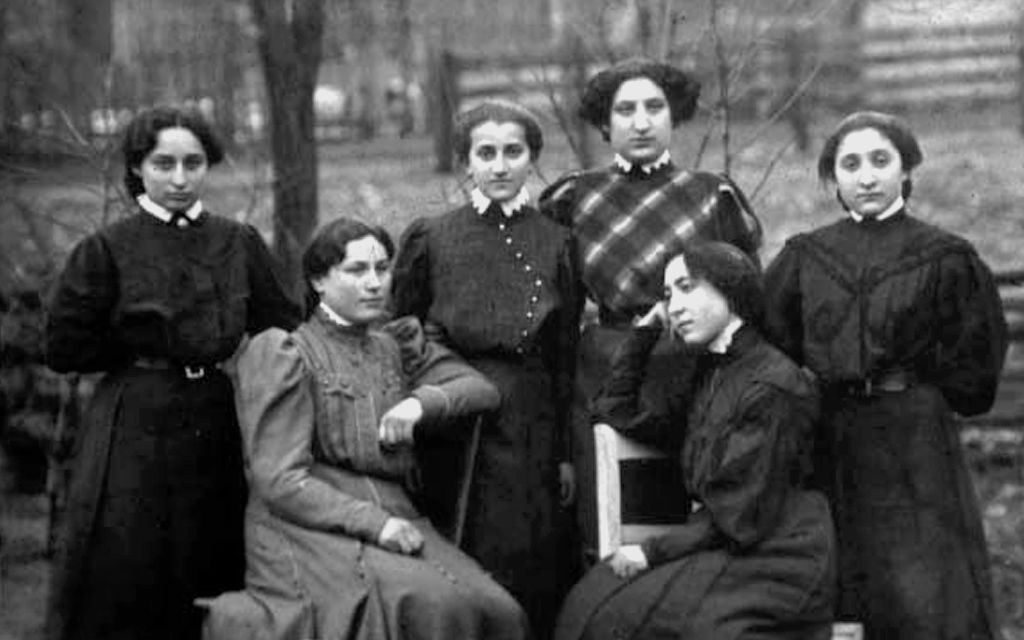
Women members of the Jewish Labour Bund, photographed in 1907.

Women members of the Jewish Labour Bund, photographed in 1907. (Apic / Getty Images)


Interview by
Daniel Denvir

Jewish socialist intellectuals founded the Bund in the Russian Empire in 1897, and it soon became a mass organization of the Jewish working class — a working class confined by law to the Pale of Settlement. From its inception, the Bund and the socialist politics it represented struggled against capitalists and autocrats alongside non-Jewish socialist comrades. It also competed bitterly with its Jewish rivals: Orthodox traditionalists, Zionists, and Bolsheviks.

Amid repression and revolution, the story of the Jews of the western Russian Empire diverges. Huge numbers emigrated to the Americas, and more than anywhere to New York City, where they built a Yiddish-speaking socialist world whose inheritors are in many ways today’s anti-Zionist socialist Jews.

Most of the many Bundists who remained in Europe were annihilated in the Holocaust, murdered on an industrial scale while the United States and other Western countries shut the door to refugees. Bundists remained steadfastly opposed to Zionism to the end. But many Jewish Holocaust survivors, their lives and life worlds shattered, emigrated to Palestine under the auspices of British colonialism to become settlers, and then perpetrators of the Nakba.

For Jacobin Radio’s podcast The Dig, host Daniel Denvir sat down with Molly Crabapple to discuss her recent New York Times bestseller Here Where We Live Is Our Country: The Story of the Jewish Bund and a half-century-long sequence of revolution and reaction that carries lessons for all of us today. You can listen to the first part of this two-part interview here and the second part here.


Daniel Denvir

Before we get to the Bund, let’s begin by discussing the movement’s territory, its homeland: the Pale of Settlement, the territories of the Russian Empire in Poland and thereabouts to which Jewish residence was confined. What was the Pale? How did it come about with the 1772 Prussian, Russian, and Austrian dismemberment and annexation of the Polish-Lithuanian Commonwealth? And what was that world like — the world from which the Bund would emerge at the end of the nineteenth century?

Molly Crabapple

The Pale of Settlement refers to the swath of western provinces in the Russian Empire to which the vast majority of the empire’s Jews were legally confined.

It came about after the partition of the Polish-Lithuanian Commonwealth when Russia, Prussia, and the Habsburg Empire sliced Poland up and each gave themselves chunks of land. Poland, or the Polish-Lithuanian Commonwealth at this time, was home to a massive Jewish population that had come there after Jews were expelled from Germany during the Crusades, after Jews were expelled and kicked out from this duchy and that duchy all over Europe.

They were invited by King Casimir III the Great to settle in Poland, where they played a very typical middleman role, working as tavern owners, small tradesmen, and tax collectors for the estates of Polish lords, and where Jews constructed these small towns called shtetls.

The Russian Empire was an autocracy. It was also an empire that drew a lot of its legitimacy from the powerful Russian Orthodox Church. And as soon as it acquired these territories and their massive Jewish population, it worried, “What are we going to do about these people? What are we going to do about these non-Christian people, people who are working in trades, who might compete with our tradesmen, who have these quasi-self-sustaining communities?”

The tsarist empire developed entire bodies of laws to restrain the new Jewish subjects that they had acquired. The most important one was defining these western provinces as the zone that Jews were allowed to live in.

This didn’t refer to all Jews in the tsarist empire, because there were other, Bukharan Jews in Uzbekistan. There were Jewish communities in Georgia that were called the Mountain Jews. This really was about Eastern European Jews, who were millions of people. So the empire defines this swath of territories that goes from Dvinsk — Daugavpils now — in the north to Odessa in the south. Like, this is where you are stuck.

It makes further restrictions: Jews can’t live in the countryside; they have to live in towns. It makes restrictions on what sorts of jobs they could do. Later there are restrictions on how many Jews could go to gymnasiums, gymnasiums being the Russian Empire version of high schools, and also how many Jews could go to university.

They at one point have a term of military conscription for Jews that is twenty-five years long and starts at age twelve — as opposed to five years long and starting at roughly age eighteen for Christian subjects. The explicit reason for this huge term of military service was to force Jews to convert.

These Jewish communities, these shtetls, were also places that had their own internal hierarchies, and one of the internal means of self-organization was called the kehillah. This was a council of rabbis and pious notables that would adjudicate communal matters while also dealing with the Russian authorities. So it was the kehillah, for instance, that would come up with the quota of young Jewish boys that were going to do military service. It was also the kehillah that, if [the community] heard rumors of a pogrom, would try to raise money for a fat bribe to keep that pogrom from happening.

In these Jewish communities, most Jewish people were quite poor. They worked as small tradesmen or in cottage industries. Working in home-tailoring sweatshops was pretty typical. Brush-making, leather tanning — that was what my great-grandfather did.

Also, there were market days in these towns where peasants would come from the surrounding countryside to sell their crops and then to buy finished goods from Jews and to get really drunk at Jewish-owned taverns. These market days were often an occasion both for relationships and for problems. Because whenever people are arguing about money, that always makes a moment for other sorts of more passionate disputes to break out.

These Jewish communities were also extremely religious. There wasn’t necessarily the idea of a secular identity in the Russian Empire in 1850. A Jewish woman like my great-great-grandmother, Chaya Rochel, could be expected to marry at age fourteen to devote her life to running a kosher Jewish house, having children, and also working. Because the ideal version of Jewish life was one where men would get to study the Torah and Talmud and women like my great-great-grandmother would run a small flour mill and support them. It was almost like a patriarchal grad school.

They were also places that were not cut off from the larger non-Jewish world. Volkovysk, the small town where my great-grandfather was from, was about half-Christian, a quarter Polish, a quarter Belarusian; it had some Muslims in it. These were tight-knit Jewish communities, but it was not something where they never dealt with non-Jewish people.

They were also communities where education was really valued. Boys typically would be expected to be literate, which would not be the case for a poor Russian or Polish boy. The traditional means of education was something called a cheder, which is a religious school where you learn to read Hebrew and then you study the Torah, the Talmud, and the Gemara, and a lot of it was done through rote memorization. Your teacher would beat your ass if you weren’t paying attention.

It was a traditional life that was confined both by the larger Russian government and your own communal authorities.

Two Sources of Hatred

Daniel Denvir

What was the structure of antisemitism in the Russian Empire? What were its origins? What was its logic and function within both the tsarist political order and within Polish and Russian society?

Molly Crabapple

There were two sources for the antisemitism at play in the tsarist empire. The first one is just the classical Christian thing that Jews killed Jesus, and then they didn’t even have the decency to believe in him afterward. That’s old-school stuff that we’re familiar with from Catholicism, and it was no less important in Eastern Orthodoxy.

Another thing is that in the Polish-Lithuanian Commonwealth, Jews — not all Jews, but a lot of Jews — were middlemen. The Polish lord would own the land, but he might employ a Jewish supervisor to go and collect taxes from the peasants who worked that land, who might be Ukrainian, for instance. The Khmelnytsky Uprising in the seventeenth century, an uprising completely foundational to Ukrainian national identity, was also the mass slaughter not just of Polish lords but of Jewish tax collectors, tavern owners, and Jewish people writ large.

The Khmelnytsky Uprising is one of the great mass murders of Jewish history, but it was framed very much in the way that Jews were collaborators of the Poles, which then fed into all of the classic antisemitic stuff about being blood-sucking middlemen. The truth was that the power did not actually lie with these Jewish middlemen. The power lay with the Polish lords.

It was similar with the role of Jews as tavern owners. As an example, in the old-school Polish-Lithuanian Commonwealth, and later to some extent in the Russian Empire, the lords would have the exclusive right to make alcohol on their land, and they would be the ones who profited from it. But they would not be the ones who were cleaning bars and filling glasses at a tavern. A lord doesn’t do that; they get someone else to do that. So, in the Polish-Lithuanian Commonwealth, Jews traditionally worked as tavern owners. But the monopoly and the real profit from liquor was something that the Polish lords had and derived.

This led to anger, in the same way that — it was very classic when I was growing up in the 1980s and ’90s — there were a lot of conflicts between immigrants who ran small convenience stores and poor people in the neighborhoods who would buy from these stores, even though the immigrants were also dirt poor themselves.

This is just a classic way that capitalism, but also early modern, late feudalism, draws divides between people and pits the working class against what you could call a petty bourgeoisie that is also quite impoverished itself. Jews in particular served a really important scapegoat function, because the anger of the peasantry could be diverted onto the Jewish tax collector or the Jewish tavern owner and away from the Polish lord, who was actually the person deriving all of the profits — or away from the Russian lord, for that matter.

The Study Circles Created Hipsters

Daniel Denvir

How did the Bund emerge when and where it did out of the various radical currents you trace circulating across Russia and across Europe during this era? More specifically, how did it emerge from within the society of the Pale — a Jewish community where the maskilim, followers of the Jewish Enlightenment, or Haskalah, were contesting traditionalist Orthodox shtetl Jews for influence and power?

Molly Crabapple

Russia is a hereditary autocracy, and it’s also a country that is shaped by the institution of serfdom, which is not the same as chattel slavery, but it’s certainly a cousin to it. It’s the idea that there are groups of people called serfs who are bound to the land, and when you buy land, you buy the people, and they work on that land, and they do not have the right to leave it and start new lives elsewhere.

They are your workers, whom you more or less own. Serfdom is abolished by Tsar Alexander II in 1861, which is around the time slavery is abolished in the United States. For this, Alexander II is heralded throughout the country as the Tsar Liberator, the Great Reformer.

At the same time as he is ending serfdom — which, by the way, he’s quite inadequate here: serfs literally have to toil to pay the price of their freedom. But nonetheless, he does end serfdom. At the same time as he’s doing that, he is also easing the restrictions against Russian Jews.

By this time, there are a bloc of middle- and upper-class Russian Jews who are followers of a movement called the Haskalah, or the Jewish Enlightenment, which is a movement to put Jews in the same sort of European modernity as their fellow Frenchmen or Germans might have been. It’s the idea that you could be both a modern citizen of your country and a believing Jew. There’s a line by a famous maskil that says, “Be a Jew at home and a man on the street.” Which I always thought, when I heard it — are Jews not men? It makes a dichotomy of being a Jew and being a human.

Anyway, there’s this idea that you can assimilate in a lot of ways into your society while still being a proud Jew, and this is something that you see with Moses Mendelssohn and Rahel Varnhagen in Germany. This idea that you learn to speak your beautiful French or German, shave your face, wear your suit, stop speaking Yiddish, get a respectable job. Don’t be some grubby pushcart trader like your grandfather, and prove that you’re civilized enough to deserve civil rights.

In Tsar Alexander II, Russia’s maskilim really think that they’ve found their champion, that this is going to be the guy who will remove the boot from their face and will let them transcend the confinement of the Pale of Settlement and become equal Russian, Alexander Pushkin–quoting citizens.

But at the same time, the inadequacy of Tsar Alexander II’s reforms is starting to breed massive frustrations, and new radical youth movements are emerging. The most famous of them to history is the Narodniks, a group of agrarian populist socialists who believed that the answers to creating utopia were to be found in an indigenously socialist Russian peasant society.

They’re complete romantics about the Russian peasantry, and by the late 1870s, they do a movement where they decide that they will go to the countryside and try to preach to the Russian peasantry about why they need to do a big-ass revolution and overthrow the tsar. This goes about as well as you might imagine, and the Russian peasantry immediately turns them into the police.

The disappointment of the failure of going to the countryside will lead these young Narodniks in more radical directions. These become the first people I know of in history who refer to themselves, and not just their enemies, as terrorists. In 1881, a group of Narodnik-inspired young people who call themselves the People’s Will assassinate Tsar Alexander II with a series of bombs. One of these young people, the young woman who runs the safe house for these assassins, is a Jewish seamstress from Kyiv named Hesya Helfman.

The assassination of a tsar is a massive shock to Russia. Tsar Alexander III, the ultraconservative heir to the assassinated Tsar Liberator, Alexander II, will draw several lessons from his father’s murder, and those are: crush dissent without mercy; never do reforms — they make you seem weak; and do not trust the Jews.

In May 1882, he brings back all of the old antisemitic laws that his dad has overturned. Not just the pogroms but also the futurelessness imposed by these laws will set off the first great wave of mass Jewish migration out of the tsarist empire. By the time that World War I starts, one-third of all the Jews in the tsarist empire have left, and the majority of them have come to New York City.

The Bund did not emerge from a peasant populist milieu. They emerged from a different tendency, and that was the tendency of Russian Marxism. The young people who would create the Bund were deeply shaped by the ideas of Karl Marx, of Karl Kautsky, and by the first Russian Marxist, Georgy Plekhanov, who had been presiding over courts of worshipful students in his Swiss exile, and many of these students had been smuggling pamphlets back across the border.

The type of young Jews who created the Bund were middle-class kids. They spoke Russian rather than Yiddish, which was the language of working-class Jews. They first came to revolutionary organizing with all of the arrogance and cluelessness that we know so well from a Party for Socialism and Liberation (PSL) chapter trying to set up a book club in Brooklyn.

The theory of how revolutionary organizing was supposed to work in Russia, and the theory that these young Jewish Marxists subscribed to, was that Russian workers were incredibly stupid. They were uneducated. They were backward. There was no way that these dumbasses could possibly make a revolution.

So, what you needed to do is you need to set up study circles, and these study circles would educate workers — make them conscious, in the revolutionary parlance of the day — and then these conscious, educated workers would recruit more workers for your study circles, and then they would recruit more workers, and eventually, when you had enough workers who had attended your study circles, revolution.

It reminds me of the underwear gnomes in South Park. Step one, collect underwear. Step two, . . .  Step three, profit. They were like: Step one, study circle. Step two, . . .  Step three, revolution.

This crew of young Jewish Marxists called the Vilna Group — people like Pati Kremer, Arkady Kremer, John Mill, Luba Levinson — they get their start by holding study circles for workers. These study circles have an additional aspect in that, because Jewish workers spoke Yiddish, not Russian, the study circles also focused on teaching these Jewish workers to be able to read and write and speak Russian, because Russian was the language that you needed if you were going to read theoretical Marxist texts.

This seems like it would be a massively unpopular idea, but because the culture of these working-class Jewish communities in the Pale of Settlement was a culture that so worshipped books and so worshiped education, and because education was something that Jews were highly restricted from — especially, God forbid, if you were poor, if you were working class, if you were a woman — these study circles became massively popular.

For years, Pati Kremer and Arkady Kremer were just instructing groups of young Jews about Charles Darwin and Marx and life in China. But after a half-decade of these study circles, they realized that they were no closer to revolution than before, that the workers they instructed were not organizing a proletariat to overthrow the tsar.

Instead, they were carrying around large books that they could half-read to seem impressive. They were posturing like very fancy intellectuals, and they were trying to take their college-entrance exams so that they could be intellectuals just like these young Marxist teachers of theirs. Basically, the study circles were meant to create revolutionaries; instead, they created hipsters.

The young Marxists decided that they would have to try a different tactic. Now, this may be shocking, but it turns out that workers do not need Marxists to tell them that their wages are too low and that their hours are too long. It turns out workers can figure that shit out for themselves.

At the same time as Arkady and Paddy are creating their coterie of nerds in a variety of attics around Vilna, there are the rudiments of a trade union movement being established by Jewish workers, including young Jewish women. These workers are organizing mutual aid funds where they will pool their meager earnings so that they can have enough money to sustain them through a strike. They’re organizing strikes. They are organizing detachments of burly guys to defend their picket lines.

So the real breakthrough of our young Jewish Marxist heroes is that they turn their eyes away from the study circle and toward the actual working class. They think, “Maybe what we need to do, instead of telling the working class how to be smart, is learn from them, and maybe we need to use our skills to help them do what they want. Maybe we need to use the fact that we’re literate, the fact that we can read the meager corpuses of employment law, the fact that we know people in other cities, other countries. . . . We can print pamphlets. We have all of these skills. Why don’t we use that to help workers organize themselves?”

This move from huffing theory to doing practice is the breakthrough that will make the Vilna group explode and will set the stage for them becoming the Bund.

Oppressed as a Race and as a Class

Daniel Denvir

Nineteenth-century European radicalism facilitated the emergence of a huge variety of socialist ideologies and modes of organization. What sort of socialism did the Bund articulate? What made it particularly Jewish, and what made it not particularly Jewish at all, in that it was emphatically a universalist project for human emancipation? How did their vision emphasize multiethnic working-class unity, rejecting both assimilationism and nationalism?

Molly Crabapple

The Bund emerged in this milieu where Jewish workers basically had three boots smashing on their face. First, they lived in the tsarist empire, an autocracy run by inbred idiots who squandered the country’s money on little diamond eggs that opened to little diamond birds.

They lived in a place with no free press, with no parliament that meant anything. They lived in a place where protests were put down by mounted cavalry called Cossacks, a place where having a reading group could get you sent to Siberia. Everyone in the tsarist empire was oppressed, full stop.

But they also lived in a place where Jews were a racialized minority, where they had a whole body of laws that restricted their lives, and where because they were targeted by the government, they were also targeted by popular hatred and violence, including by pogroms. Sometimes people have this vision of what a pogrom is — I guess it’s from Fiddler on the Roof — where they think it’s just slashing open a duvet and feathers going everywhere. No, these are acts of world-shattering violence that sometimes will lead to hundreds and hundreds of people being slaughtered over the course of several days. These are acts of popular terror that were not organized by the state but where the state certainly looked the other way.

So this position, where Jewish workers in the Russian Empire are oppressed by the autocracy and oppressed as all workers are under capitalism but also oppressed as Jews specifically, leads the Bundists to this insight that Jews are oppressed as both a race and a class.

I’m going to read from an amazing speech by Yuliy Martov, who was a member of the Vilna group before he would go on to be the leader of the Mensheviks. In the speech that Martov gave on May Day 1894 in Vilna, he says that Jewish workers are oppressed both as workers and as Jews, as a race and as a class, and he says, “They cannot rely solely on the Russian or Polish proletariat,” which might sell them out for profit. Instead, they must, “fight as an organized Jewish group alongside other groups for economic, civic, and political liberty.”

What do you have there? You have, first, the notion that Jews as an oppressed and racialized minority have to organize themselves but not as a segregationist or separatist project. They have to organize themselves to fight for their specific rights while fighting alongside other people who are different from them for socialism, for the end of the autocracy, and for the better and more beautiful world.

That is going to be the defining ethos of the Bund. The idea that you can fight for your liberation as a Jewish person, for your freedom from racist laws, for your culture, for your right to speak your own language, while also fighting in solidarity and alongside all of the other people in Eastern Europe for a better tomorrow.

It was a way of balancing the universalist aspirations of Marxism with the reality of who they were as an oppressed and racialized group that had its own language and its own culture. When the Bund is officially founded in 1897 in a Vilna safe house, the founder, Arkady Kremer, says that they need an autonomous organization of the Jewish proletariat.

He says, “That is because Jewish workers suffer not only as workers, but also as Jews, and we dare not and cannot remain indifferent at such a time.” Some months after the Bund was founded, they would join the Russian Social Democratic Labor Party (RSDLP), the first Marxist party in the Russian Empire. They will join it as an autonomous organization of the Jewish proletariat; they will join it as equals.

Daniel Denvir

The story of the Bund ends, in many senses, truly horrifically, with the Holocaust. Nazi ideology, as we’ll also discuss later on, was fundamentally organized around anti-communism and antisemitism, two things that were truly and fundamentally intertwined for the Nazis.

How, in the late nineteenth century already, did European ruling classes and reactionaries begin to associate and conflate socialism and revolutionary democratic politics with Jews? In Russia, I take it that the assassination of Tsar Alexander II was a pivotal moment, but this is a much broader phenomenon that becomes central to reactionary politics across the region.

Molly Crabapple

Absolutely. The majority of Jews in the Russian Empire were not revolutionaries. The majority of any group of people just want to live their lives and don’t usually have any great political view at all. But a very disproportionate number of Russian revolutionaries of all stripes were Jewish, and this is not just the case for the Bund.

This is the case if you’re talking about the Socialist Revolutionaries, who are the populist heirs to the Narodniks. This is the case if you’re talking about the Russian Social Democratic Labor Party writ more broadly, the party that would spawn both the Mensheviks and the Bolsheviks and eventually, through a variety of twists and turns, would become the Communist Party of the Soviet Union. This is the case if you’re talking about anarchists.

Why were so many Jews in the Russian Empire revolutionary? I think it’s pretty obvious. They were revolutionary because they were being victimized by the state, and when you are specifically victimized by a state, when a state specifically has the boot on your neck, you want the boot off of your neck.

The prevalence of Jews in revolutionary movements becomes a way that the tsarist empire will try to discredit those same movements. The Protocols of the Elders of Zion, which was printed on tsarist secret police printing presses and distributed by undercover agents, is one of the many ways that it tried to associate revolutionary and Jew, to make them synonymous.

But it’s also true that many young Jewish people wanted out of the hemophiliac autocracy. They wanted revolution. They wanted modernity. They wanted to create the better and more beautiful world, and they were willing to fight for that. For me, as a Jewish person who grew up in a leftist home, that’s a heritage to be proud of.

A Faith in Solidarity That Was Not Naive

Daniel Denvir

How did the Bund make sense of the place of Jews in an extraordinarily hostile Russian Empire? More specifically, how did it articulate this promise of solidarity with non-Jewish workers who were also so often their persecutors?

Molly Crabapple

The Bund blamed reactionary governments for antisemitism. They thought that antisemitism and racism more broadly were tools used by the ruling class to divide workers and keep them at each other’s throats rather than fighting for their real interests.

The Bund wasn’t alone in that. I think that’s how most socialist groups understood antisemitism at the time. They didn’t think it was something that was just born into non-Jewish people. They didn’t think that people who aren’t Jewish had some switch in their brains that [caused them to hate] Jews. They thought that this was something they were taught by capitalists, by reactionary politicians, by a reactionary church, in order to keep power in power.

When the Bund was looking at the Jewish working class in the Pale of Settlement, they weren’t just seeing people who were victims of antisemitism. They were also seeing people who were victimized by the fact that they were forced to work in industries that were in many ways more powerless industries.

If you are a worker who is working on the railway or the telegraphs, you can grind an empire to a halt in one day by withholding your labor, whereas if you’re working making brushes or tailoring dresses, your power is much more limited. The Bund saw Jews as people who were stuck in poverty because they weren’t allowed to leave the Pale of Settlement, and so they couldn’t go to find better employment opportunities the way that other people could.

But it was also highly critical of the Jewish bourgeoisie. It was highly critical of religious leaders. Sometimes the Bund could be d-ckishly anti-religious; there’s no other way to describe it in the early days.

These are people who would swagger around on Yom Kippur smoking a cigarette with their girlfriend. These are people who would slap up a poster on the wall of a synagogue on Friday night because they knew no one could take it down until Saturday night. These were people who would take over the synagogue at gunpoint to stage debates.

That is the level of challenge, of real youth rebellion, that was embedded in how the Bund operated. They would flaunt eating pork. They were jerks. It came from a specific context; they were also people who, when they were kids, got their asses beat by their teachers in religious school.

These Bundists also saw an immense amount of beauty and richness in Jewish life, in the songs, in the customs, in the language — Yiddish. Yiddish is the ultimate diasporic language. It comes from medieval German. It has Hebrew letters; it has a bunch of Hebrew vocabulary. But it also takes vocabulary from every single place that its speakers pass through.

There’s a line by the Bundist Max Weinreich that a dialect is just a language without a navy, and that is a line about Yiddish — meaning that the difference between a dialect and a language is the ability to inflict state violence at a distance. So even while they were highly critical of traditional Jewish life and traditional Jewish authorities, even as they were incredibly cognizant of the restriction and violence of the empire, they also saw so much beauty and strength in the Jewish working class of Eastern Europe.

And they saw people. In terms of their faith in solidarity, this was not a naive faith. They were not people who said, “We can just hug it out. We can just show what nice people we are, and the Christian workers will love us.” They were not like that. They lived in the real world. In fact, one of their most important institutions in the early years in the Russian Empire was the self-defense groups they made — armed groups, armed with guns and knives, that were formed to beat back pogroms.

But at the end of the day, when I see how the Bund wrote about pogroms — I was reading Di Geshikhte fun Bund, the deadly dull official history that describes in granular detail every single pogrom the Bund fought against between 1900 and 1905 — when I read how this writer, a Bundist writing after the war in New York, talks about these pogroms, they always talk about them as being stirred up by undercover police agents or by the state. They always really emphasize how the state would spread lies about Jews in order to start these pogroms — even spreading lies that Jews were going to burn down churches, or that Jews wanted to replace the tsar with a Jewish tsar. They were utterly committed to defending themselves while at the same time having a larger analysis, and one of the things that they really tried to do was to work with other revolutionary movements that were led by non-Jews, and that’s one of the reasons why they were part of the Russian Social Democratic Labor Party.

In addition to that, they would print pamphlets in Russian, and they would go out and speak to peasants and non-Jewish workers and try to organize, just as straight-up Marxists, based on their mutual interests as working-class people. They really thought that there was a great value in working-class union organizing. They thought that organizing and winning material victories together was something that could overcome racism.

They also believed that one of the ways that Jews would overcome not just the degradation imposed on them by the tsarist regime but also the self-hatred that’s imposed on you when you are so oppressed was by militantly standing up for their rights and fighting for them. They saw their self-defense almost as a way to remake who they were and to assert their dignity.

Blowing Open the Doors to the Universe

Daniel Denvir

The Bund really entailed a social revolution within the Pale. It entailed a social revolution in terms of the pride and confidence and remaking of collective identity that comes with organized self-defense. It was in particular a social revolution for women, whose role and position in society the Bund articulated an extraordinarily different vision of from the traditional Orthodox shtetl leadership.

What did that conflict look like? How did it play out, and how was it experienced by ordinary Jews in the Pale?

Molly Crabapple

When you read these memoirs of young Bundists, you hear constant stories about these conflicts within families. For instance, a young Jewish person from a traditional family sneaking out to the woods on the Sabbath. A young girl from a traditional family making friends with men, dating — dating, oh my God! Forgoing early marriage to eat nonkosher food — just the mere fact of eating nonkosher food.

There was a strictness to the type of Orthodox Jewish life that was lived in the shtetl that I think would be very unfamiliar to most people in America who didn’t come from a Hasidic family. For instance, you weren’t supposed to carry anything on Saturday. If you went around on Saturday carrying a stick, you are a heretic, bad. So all of these things, right down to the most minor detail, like walking around on Saturday with a walking stick, involved a major defiance of familial authority.

Also, one of the things about women in the late nineteenth and early twentieth century in the Pale of Settlement is that they always worked. There was not this idea that girls would be protected at home until they got married and then became homemakers. These women in the Pale of Settlement, these girls, were working in factories to raise enough money for their dowry.

Married women were running shops. They were running stalls. These are sharp-elbowed, tough, confident women interfacing with the world. So it wasn’t the sort of thing that we sometimes imagine in America, where just the act of going off to work would be a huge rebellion.

It wasn’t that. The rebellion was that you were not obeying your father’s authority. You were waiting to get married, not having an arranged marriage. You were violating Shabbos. You were sneaking off to do God knows what, God knows where.

Even reading secular books — and I don’t mean Marxist radical texts. I mean books of math, or like Jules Verne or something. Even that, for a traditional, not maskilim family, but a traditional, pious, normal family, even that was a huge challenge to the established order. I would read stories about Jewish kids from these very pious families sneaking out to go to secular school.

For a young woman, especially a young working-class woman joining the Bund, you were entering into the most exciting subculture in the world. You were radically expanding your possibilities in life. It was like you were blowing open the doors to the universe, intellectually, socially, romantically, everything.

The Yiddish Socialist World of New York

Daniel Denvir

As you mentioned earlier, in the late nineteenth and early twentieth century, a huge number of Jews from across the Russian Empire — about a third — left. Most sailed to the Americas, and they were fleeing economic conditions but also these renewed antisemitic laws and pogroms after the assassination of Tsar Alexander II. Parts of my wife Thea’s family traveled to Argentina. Other parts went to New York City, which is where your great-grandfather, a Bundist, arrived in 1904.

In New York, first on the Lower East Side, then in Brooklyn and across the boroughs, Jewish immigrants from the Pale of Settlement built a powerful Yiddish-speaking socialist politics, really an entire immigrant Yiddish socialist world, with newspapers, labor unions, social clubs of all sorts, and political organizations. What did Jewish socialism look like when it took root and blossomed in New York?

Molly Crabapple

For anyone who’s interested in this, there is an amazing book by Tony Michels called A Fire in Their Hearts that’s kind of the Bible on this. The world of Yiddish socialism really emerges before the Bund. It comes out of this encounter between young Russian Jewish radicals — particularly and most importantly, a guy named Abraham Cahan — who are fleeing the repressions in the aftermath of Tsar Alexander II’s murder. . . .  They roll up in New York City, and for the first time, they are forced to labor alongside a Jewish proletariat that they had read about in pamphlets and of course thought was an agent of history but really preferred to deal with from afar.

At first, Abe Cahan and his friends mostly devoted themselves to giving pompous speeches about overthrowing the tsar and bemoaning the fact that they had to work at sweatshops in this new city, alongside these Yiddish-speaking hicks, basically. Yiddish-speaking workers — not politicized people, just working Joes. But the thing that shifts how they think is that at the same time, there are all of these German socialists in New York who have been kicked out by Otto von Bismarck and his anti-socialist repression. All these socialists are meeting and mingling at café tables and lecture halls.

New York has always been a capital for the radical diaspora writ large: everyone from Chinese radicals to Armenian radicals to Puerto Rican radicals are in New York getting their fundraising on, arguing, and building their strength to bring about the utopia in their respective countries. These Jewish socialists, like Abe Cahan, meet the German socialists, and the Germans are like, “My man, why are you just giving speeches about overthrowing the tsar? That doesn’t really seem like it’s doing much. You are working alongside a massive Jewish proletariat.”

So Abe Cahan and his comrades start [organizing them]. Working in Yiddish, they create Forverts, called The Forward in English, which at the time is a massive publication, and it is the publication of Yiddish socialism. Other Jewish socialists, they start organizing garment unions. They start organizing debate societies, lecture societies. There’s a secular socialist mutual aid society called the Workmen’s Circle that does everything from provide death benefits and health insurance to take Jewish workers on tours of the Museum of Modern Art to expose them to Rembrandt.

They build an entire Yiddish socialist world. In large part, they’re able to do that in America because in America, unlike Russia, Jews have an unprecedented amount of political freedom. They’re not living in an autocracy anymore. They’re living in a democracy. They can organize unions. They can write freely in Yiddish. They can contest for political power and run for office.

Jews in New York will play a huge role in the Socialist Party in America. The Jewish socialist Meyer London will become the second socialist congressman ever in American history — and incidentally, he was running in the same district that Brad Lander, Zohran Mamdani’s ally, is running in right now. History, it rhymes.

This is a world that is capable of leveraging massive strikes; it’s also a world that benefits from the economies of scale. New York City was and is the largest Jewish city in the world. It is and was a massive, rich, cosmopolitan metropolis where even a broke-ass worker probably makes a lot more than they would doing their broke-ass work at home and so can send some money back to fund a revolution elsewhere, which happens then and now.

It was a place where organizing was possible. A lot of this benefited from the fact that while Jews were the official underclass and scapegoat of Tsarist Russia, that was not the case in America. America is built on the genocide of indigenous people and on the enslavement of black people. In a lot of ways, every other bigotry that America holds, and it’s held a million violent bigotries, is really much more subject to geopolitics and economics and is easily shrugged off when things change. That was certainly the case for Jews. When Jews landed in the late nineteenth century, there was a lot of antisemitism, a lot of crap with other immigrant groups. There were quotas in universities or whatever.

But it was nothing like the Pale. One of the strange things that I found when I was doing this newspaper research is that the same newspapers that would indifferently shrug off the lynchings of black people would be writing these stories about the pogroms in Russia, and just being like, “Wow, these poor Jews. Look at the savage Russians.” It was almost like they couldn’t see that the exact same behaviors were being carried out by Americans, just against a different group.

Daniel Denvir

Which Jewish New Yorkers did understand, and which the Jewish press certainly covered.

Molly Crabapple

Yes, the Jewish press covered lynchings, which they called pogroms — the violent white riots that were tearing through the South. It’s so funny: sometimes establishment Jewish places now get so grabby about certain words in Jewish history, like “pogroms.” They’re like, “It’s my toy.” But if you ever read the Yiddish press, you would know that they constantly referred to stuff like Tulsa as pogroms. It’s utterly ahistorical.

The Yiddish press — which, again, was free, it was verbose, it was radical — this Yiddish press was getting smuggled back into the Pale of Settlement, and it was inspiring the Yiddish press there.

At the same time as you have young Jewish Marxists like Pati Kremer running their impotent little lecture groups in the Pale of Settlement, the Jews in the New York garment unions are bringing their entire industry to a halt. That gives you an idea of the difference in power. And also in terms of money.

Jews on the Lower East Side were poor. These are poor, exploited people working in sweatshops, living a dozen people to a room. But even with all of that poverty, they still made enough money that they could send it back home to fund guns for a self-defense group.

1903: How the Bolsheviks Got Their Name

Daniel Denvir

I want to talk about the role the Bund played compared to and alongside other revolutionary forces across the empire, particularly how they fit into the Russian Social Democratic Labor Party. Interestingly, it was the same 1903 Congress of the RSDLP that occasioned the historic Bolshevik and Menshevik split. It was at that same party Congress where Leon Trotsky and Yuliy Martov, two prominent Jewish socialists, denounced what they saw as Jewish exceptionalism in the Bund’s proposal for an autonomously organized Jewish section of the party for Jewish comrades.

It seems like you’re telling a story here that connects these different debates of a very complex party congress, as a moment that privileges cadre over mass, and party over class. What do you make of this moment in the history of international socialism, and of the simultaneous divides that emerged over autonomous Jewish organization and over the role of mass organization and mass trade-union politics in the socialist movement?

Molly Crabapple

I have to give a little caveat about how I approach writing about movement history, which is unconventional and perhaps heretical for a historian. Having been in leftist movements my whole life and having a father who’s a Marxist and who has also been in leftist movements, I believe that there is a huge difference between the text that is read out in the resolution, or the justification that is given in the party newspaper, and the actual reasons things happen.

There are many things that are promoted as matters of high ideals that actually come down to personal beef. I believe that often, you will have someone who f-cked someone else’s girlfriend, and the guy who was cheated on will denounce that guy — not for breaking up his relationship but for being an imperialist. The way I told the story about what went down at the 1903 Russian Social Democratic Labor Party conference is very influenced by my belief that personal beefs are a major force of history.

Let me give some context. In 1903, the Bund was the largest revolutionary party in the entire tsarist empire. They had 30,000 members. They were a mass party. They were also a part of the RSDLP, which had five thousand members, even though it represented everyone in the entire Russian Empire, and the Bund represented a group that made up 2 percent of the empire, tops.

But the disputes between the Bund and the larger Russian Social Democratic Labor Party, and the disputes between the Bund and Lenin and Trotsky, don’t come out of the Russian Empire. They come out of debates in a place that I call “Exile Land.” Exile Land is the term I use to refer to this sort of network of Western European cities where exiled Russian revolutionaries live, fight, spar, have sexual liaisons, print pamphlets, and plot for their glorious return to the homeland.

The people who inhabit Exile Land are intellectuals. They are not foul-smelling young factory workers like my great-grandfather. These are fancy boys and girls — usually boys — who write pamphlets. They are also people who spend all of their time in an incredibly incestuous world arguing with each other and debating.

This is the world they come from. The Bundists, the Russian Social Democratic Labor Party, the Socialist Revolutionaries, the Zionist Polish Socialist Party — doesn’t matter. These are people who have spent so much time in little rooms yelling at each other over theory that they have developed true and deep hatreds of each other, of the type that only people of the most incestuous scenes know.

Now, the Bund starts [articulating] its demand for an autonomous Jewish organization. What they want for Jews is just the removal of racist laws and freedom from racist violence. That’s what they want. But as the nineteenth century turns into the twentieth, Bundists like John Mill, who is very influenced by the Polish Socialist Party, start thinking a little bit differently.

They start saying, “Why do we look down so much on our own language and culture? Look at the Poles. Polish education is banned by the Russian Empire, and look at the pride with which they fight for their repressed language and culture. Why are we so different? Why do we spit on our language and culture like it’s nothing and think it’s better to speak in Russian, the language of empire?”

He starts developing the idea that there should be a positive program for the promotion of Eastern European Jewish culture. This is not a separatist thing; it’s not like we all want to move out to Bialystok and build a wall around it. The idea is that as people living in an ultradiverse, ultramulticultural society, everyone in that society should have the right to speak their own language, to educate their kids in their own culture, to have cultural institutions like newspapers and theaters, to vote in their language, to represent themselves in court in their language — that all of the languages of this vast empire should be treated with equal dignity, and Yiddish should be one of those languages.

They call this principle national cultural autonomy, but in a lot of ways it would be very similar to the sort of multiculturalism that we would recognize in New York, where in my neighborhood I can file a ballot in Yiddish, I can buy a Yiddish magazine; if I wanted to, I could send my kid to a school that was teaching in Spanish or in Haitian Creole. I can buy newspapers from a dazzling variety of languages.

This is an idea that is so common in our daily lives as Americans in diverse cities that it almost doesn’t seem revolutionary, but it really was. Because the other answer for what you should do with the fact that there are all these diverse groups in these big empires is that you should have a whole bunch of bloody border wars where you mutually ethnically cleanse each other until you each have a homeland.

The Bund thought this was f-cking dumb, and they were like, “Nope. Multiculturalism; mutual respect; everyone stays in their homes. They should get state support for the promotion of their own culture, especially if it’s a subaltern, oppressed one, and we fight together for a better and more beautiful world.” That’s the Bundist idea.

At the same time, Russia was also going through some pretty horrific pogroms, including one in 1903 in a city called Kishinev, which becomes a massive international black mark on Russia. Kishinev is a city that’s close to the border, and foreign press is able to come in, and they’re able to photograph the corpses and the desecrated Torah scrolls, and it becomes more than an act of mass murder. It becomes a symbol of everything that is evil and rotten and blood-soaked about the tsarist empire.

This very raw, painful, visceral horror at the violence against Jews is really alive in these young Bundists in Exile Land. So, in various Bundist party congresses leading up to the Russian Social Democratic Labor Party Congress of 1903, they create the demand that the Bund will be considered the sole representative of the Jewish proletariat.

In some ways, this is based on their theories about national culture. In some ways, this is based on their belief that they need to be strong enough to defend Jewish people. But there’s something else, and this has to do with my personal views on how history is shaped.

At the same time as the Bund is arguing about nationalism and arguing about Yiddish language rights, a world-historical figure who is not yet world-historical has made his appearance in exile land, and that man is Vladimir Ilyich Ulyanov, aka Vladimir Lenin. He immediately becomes Plekhanov’s number-one disciple.

He’s so forceful. He is so iron-willed. He is such a f-cking d-ck to everyone who disagrees with him. He is the dictator of the book club. When you read memoirs about what Lenin is like in 1901, 1902, you’re like, “My God, I know that man.” He is the person screaming that you’re an imperialist running dog because you made a different schedule for who washes the dishes afterward. He is someone where it’s his way or the highway.

He and Yuliy Martov, who was a member of the Vilna group but has since gone in a completely different direction, create this newspaper called Iskra. And Iskra devotes a lot of its time to attacking other socialists who they don’t view as being true representatives of what socialism should be. They spend so much time attacking socialists who disagree with them, and the Bund is one of the groups that they are constantly attacking.

The Bundists hate Vladimir Lenin. They hate him on a personal level. You read Bundist memoirs, and they describe him as like a crafty Russian grain merchant with a sly smile as if he doesn’t believe a word he’s saying. They peg him as a tyrant in waiting. They think that he’s a liar, that he is constantly, Machiavellian-ly scheming.

In my opinion, a lot of the reason the Bund is so concerned with being the sole representative of the Jewish proletariat is not actually about the theoretical reasons it claims to be so concerned with. It’s because it views this as a way to shore up its own autonomous power against Lenin and his buddies. Especially when you think about the position of strength it’s in: they have six times as many members as the rest of the RSDLP. It has all the best printing presses. It has a lot more money than the rest of the RSDLP has, because it has all these New York sweatshop workers giving them money. It runs all the smuggling routes.

The Bundists want to consolidate and protect their turf. They’re like, “Why should we fucking subjugate ourselves to these rinky-dink, disagreeable boys run by the most disagreeable boy in the world? No.” So they make up a theoretical excuse. This is my opinion.

So, the second Congress of the Russian Social Democratic Party, which begins in Belgium and, after some terse meetings with the Belgian police, moves to London, is the scene of some momentous splits. Everything about the congress from the first day proves why the Bund hates dealing with Lenin. He has done all sorts of little parliamentary moves to make sure that all of his supporters are stacking all of the committees. He’s made sure that the Bund has way fewer representatives than it ought to have. He has worked with Plekhanov to make sure that the Bund’s status is the first thing on the menu, so everyone is bright and fresh to really argue about it.

So, the Bundists come in. Everything is stacked against them. The first thing that’s brought up is how they should not be the sole representatives of the Jewish proletariat. After six weeks of arguing that is both so dull to read and so mendacious that I get panic attacks from it — I had to suffer through the minutes of the Russian Social Democratic Labor Party. I don’t recommend it. I don’t believe in trigger warnings, but this is like: trigger warning — worst DSA [Democratic Socialists of America] meeting ever.

But eventually, Trotsky and Martov, who are both allied with Lenin at this time, lead the charge for the Bund status as the sole representative of the Jewish proletariat to be put up for a vote. Everyone votes against the Bund except the Bund, and the Bund storms off and leaves.

Now, its storming off and leaving for me represents a fatal weakness in the Bund that it will repeat over and over again. When the Bundists are in moments where they’re dealing with people they loathe, but they’re in a space where they have power, and that power is limited — the power is contested, things are fraught, but nonetheless, they still have some power — they have a real tendency to just flounce out of the room instead and to abdicate their power.

This will become much more significant later, during the Russian Revolution of 1917. But after the Bund leaves, taking its three votes with them, the next issue comes up, which is whether the party should be a mass party like Yuliy Martov supports, or whether the party should be a party of highly disciplined cadre that answer to leadership, aka Lenin.

Without the Bund’s three votes, Lenin’s proposal wins, and this is what allows Lenin to take on the term “Majorityite” for his faction. And in Russian, Majorityite translates to Bolshevik.

Daniel Denvir

It’s fairly clear where your sympathies lie in these debates, but you also have a complex assessment: even though you favor the Menshevik line here, you very much fault the Bund for lacking the practical ruthlessness to stay and fight for its position.

Molly Crabapple

Absolutely. When I think about what leftists can learn from the Bund, there are all sorts of positive things they can learn, but one of them is this: you have got to stay in that room and fight ruthlessly for your position, because if you leave that room, if you flounce out in the name of principle, then your enemy takes the power that you’ve ceded.

Believers in Neither God nor Tribe

Daniel Denvir

Many of the most prominent figures in the European socialist movement as we’ve referenced already were Jews. Julius Martov, Rosa Luxemburg — we can go back to Karl Marx, and so on. This is, of course, a fact that antisemitic reactionaries murderously seized on.

But many Jews were Bundists, and many Jewish socialists were not: you write, “Believers in neither God nor tribe, they denied that there was such a thing as a Jewish people.” What accounts, in your view, for these diametrically opposed instincts among different Jews with respect to their own ethnic and religious inheritance and community and their profound commitment to socialism?

Molly Crabapple

In a lot of ways, I think I personally would fall more on the Rosa Luxemburg part of the spectrum, just in terms of how I live my own life and how I organize. Even though obviously I’m in love with the Bund — no one would spend seven years writing a book about people they didn’t love a bit.

There’s a few things. Some of it has to do with your own personal experience of what being Jewish meant. For someone like Leon Trotsky, he did not grow up in a Jewish community; his father was one of the only Jewish farmers in the Russian Empire. He took part in a farming scheme where he moved out to this part of Ukraine where there were barely any other Jewish people, and he was a Jewish kulak. There was only one, and that was Trotsky’s dad.

Trotsky didn’t go to Jewish religious school. He didn’t speak Yiddish. He’s a very assimilated dude. I think that he probably experienced being Jewish mostly in terms of the racism that people levied against him. Throughout his entire life, even though he didn’t give a lick about his own ethnic identity, he was constantly being referred to as “Trotsky-Bronstein” and painted in these disgusting caricatures with Stars of David on him, as a devil eating blood. He was a figure that attracted so much racism while himself being, in my opinion, very uninterested in matters of anyone’s ethnic identity.

The same with Rosa Luxemburg: She moved in this very cosmopolitan, multilingual European milieu. She was living in Germany. She left Poland fairly early in her life. In the worlds they lived in, what being Jewish meant to them was that people were racist against you, and what they thought would be best for Jews would be if people stopped being racist against them.

They didn’t see it as a positive cultural identity. They saw it more as a caste: something that you were stuck in by dint of medieval prejudice and racism, and that if they got rid of the laws and if people stopped being such bigots, you would assimilate and be like everyone else. Especially because they weren’t religious.

The Bundists came from a very different milieu. They came from a milieu where, even though a lot of them were pretty assimilated themselves when they were young, the people they were organizing spoke Yiddish. They lived in places, sometimes, that were 60 percent Jewish. They lived in these very close-knit Jewish communities, and the idea of arguing about what a Jew was would have been ridiculous to them. They’re like, “It’s that guy. It’s Shloyme over there speaking Yiddish. That’s who a Jewish person is. It’s the Podil neighborhood of Kyiv. What are you talking about?”

I also think a lot of it had to do with the fact that the Bundists were ground-level organizers in Jewish communities. Trotsky himself was an organizer. He was organizing in Odessa when he was young, across all sorts of lines. He was not going to Pale of Settlement towns. He was not going to Bialystok and trying to organize Jewish workers. So, his experience of organizing, his formation as an activist was very different.

I imagine that the idea that Jews had to just stick with organizing the Jewish proletariat, and that this specifically Jewish organization would represent all proletarian Jews must have seemed so constricting to someone like Trotsky, or to Yuliy Martov, for that matter.

There’s a quote from Martov that I thought really summed up the argument against Jewish-specific organizing. Remember, Yuliy Martov in 1895 is a member of the Vilna group, who is intellectually crystallizing the idea that Jews are oppressed as both a race and a class. He crystallizes it two years before the Bund. He’s the innovator of this concept. So the fact that eight years later he changed his mind is quite significant.

This is what he says: “However perfect the organization of that relatively insignificant section which Jews constitute may be, so long as the organization of the vast majority of the proletariat of heavy industry limps on both legs, the most intensive and dedicated work in its own little corner will not yield even a tenth of the result which it could produce.”

He’s saying, Jews are 2 percent of the empire. They work in industries like brush-making, leather tanning, instead of in steel mills or trains. And so even if you organize the Jewish proletariat in the most perfect way possible, and they are so enlightened, and they are so revolutionary, and these are the crème de la crème of activists on the entire earth, even if you do that, it doesn’t matter because they’re 2 percent of the Russian Empire, and they don’t work in any heavy industries. You can’t actually cause a revolution with it.

It’s a very practical way of looking at things. There’s almost a practicality and a concern for building power that I think a lot of people would find anathema today, but I totally see where he’s coming from. He’s quite correct, actually.

In a lot of ways the Bund had an approach to ethnicity that would be more similar to, let’s say, a union organizer in New York organizing dishwashers who are mostly Latino. The union organizer speaks Spanish, they celebrate Three Kings Day, and all of this — versus an intellectual who’s writing about unionization writ large.

Figures of Impossible Authority and Glamour

Daniel Denvir

Let’s turn to the Russian Revolution of 1905. What role did the Bund play alongside other socialist and popular organizations across the Russian Empire in this historic uprising? Did the Bund glimpse, at various moments, its dream of multiethnic working-class power coming true?

Molly Crabapple

In the western provinces of the Russian Empire, the Bund was one of the most important, most powerful forces in the 1905 revolution, whether it was on the barricades of Łódź, or whether it was at the port of Odessa when the battleship Potemkin pulled in. Bundists were orators; they were fighters; they were pamphlet and weapons smugglers.

They were some of the premier ideologues and also the premier fighters in this amazing moment of violence, of tumult, and of hope. I think about Anna Lipshitz. She was a young Bundist speaker; she was in her early twenties. Her sister, Esther, had been tortured to death by the political police. And there she was at the Odessa port as the star speaker.

The press nicknamed her “the Fury.” She was so famous and so iconic that she even gets her own cameo in Sergei Eisenstein’s Battleship Potemkin. He immortalizes one moment when secret police in the crowd tried to instigate against Anna by using racist slurs against her. But instead of this working the way the police had hoped, Anna incited the crowd against them, and they beat the cops to death.

In Łódź, the young Virgil Cahan, a leader of self-defense groups, was essentially the king of the barricade fighting there. In the small town of Krynki, in Poland, Bundists and Polish socialists worked together to literally take over the city. They kicked out the cops. They took over the municipal liquor warehouses and broke open all the crates so that people couldn’t do the usual thing that derailed revolutionary moments and get extremely drunk. They held power for several days until the military was called in to drive them out.

In the old city of Vilna, the Bundist playwright A. Vayter was the most popular man in the city. He led the self-defense forces. He kicked the cops out of the old town. When I read stories of this moment, you can feel the thrill that people must have felt, from the distance of a century.

People talk about these areas — they’re called birzhes. These were workers’ boulevards where people would hang out to try to get day-labor jobs, but also where revolutionaries would organize. These birzhes became temporary autonomous zones. Bundists were authorities in the Pale of Settlement.

They were mediating disputes that rabbis would mediate, like broken engagements. Bundists were figures of almost impossible authority and glamour during those first months of the revolution. And they weren’t doing it alone. They were fighting alongside other socialists.

They were fighting alongside Ukrainians, alongside Poles, alongside Russians. And one of the things that really struck me when I was reading these histories was how important the Bund thought the education of the Christian working class was. They knew that the tsarist empire kept people deliberately ignorant in order to use racism as a wedge.

So, from the earliest days of the revolution, Bundists were like, “How do we fight against that?” They published pamphlets to educate peasants on the fact that it wasn’t the Jews who were f-cking them over; it was the czarist officials and the landlords. They helped Christians organize labor unions.

In Riga, Maxim, a Bundist orator, organized all of the Christian railway workers, an essential thing to taking over the city. They didn’t just fight alongside preexisting socialist groups that were made of non-Jews. They even helped found new ones, because they knew that the thing that you needed to prevent racist violence was an organized working class.

Then the Pogroms Began

Daniel Denvir

And why was the revolution of 1905 defeated? What sort of shape did the reaction take, and what specifically were the consequences of that defeat for the Bund and more generally for Jews across the empire, as revolution was framed as Jewish conspiracy? You narrate the aftermath of 1905:

The pogroms forced Jewish socialists to face the hostility of much of the Christian working class. Jews and Christians had struck, demonstrated, and died together in 1905. They draped their friends’ coffins in red flags and marched to the cemetery together, where they gave speeches about the international brotherhood of working men.

Then the pogroms began, and the Christian workers vanished or joined in.

Molly Crabapple

In October of 1905, after a general strike brings economic activity in the empire to a halt, the tsarist government is forced to make concessions. After four days of a general strike, the technocratic minister Count Sergei Witte convinced Tsar Nicholas II that he was going to have to offer some sort of concession to the revolution.

He forces the tsar to issue this manifesto that’s called the October Manifesto, and it offers pretty middling and petty “rights.” There’s the right to a parliament called the Duma, but the parliament doesn’t really have any power. There’s the right to a free press, except it can be censored. There’s the right to vote for only a few people in limited circumstances.

But this document is enough to buy off the liberal support of the revolution. The release of the October Manifesto is greeted with ecstasy by everyone at first, though. It’s not that the rights in it are so good. It’s the fact that this autocrat, this motherf-cker who thought that he got his power from God himself, had been forced to give up the smallest fraction of his autocracy, and he had been forced to do it by a movement of the working people.

This was huge. And so when the October Manifesto was announced, crowds of revolutionaries all over the Russian Empire — crowds of ordinary people, workers, poor people — they went onto the street to celebrate. And as if it was coordinated, Cossacks and military police shot up those celebrations all over the empire. It was as if the tsar could not make this concession without at the same time showing that he had the power to mutilate and to kill.

At the same time as these mass shootings and attacks on demonstrators are taking place, a wave of pogroms breaks out across the Russian Empire. Over twelve days, pogroms break out in 690 different places, everywhere from tiny little towns to massive cities like Odessa and Kyiv. These pogroms are not a matter of a few people being murdered. These are acts of spectacular and apocalyptic bloodshed that are meant to put Jews in their place, because the tsar blamed Jews for the revolution.

In Odessa, over the course of a few days, nearly eight hundred Jews are murdered. Thousands upon thousands more are made homeless when their houses are burned. And these pogroms are carried out in large part by organizations that are collectively referred to as the Black Hundreds. These are proto-fascist, genocidally antisemitic, pro-monarchy organizations, and the biggest Black Hundreds organization, called the Union for the Russian People, is an organization that is so buddy-buddy with the government that the tsar wears its pin when he goes to parties.

The pogroms alone were not enough to crush the revolutionary wave, and neither were these initial shootings and repressions of protesters. The revolutionary wave is crushed by a combination of things. There is military defeat: armed revolutionaries in Moscow try to take over the government, and the tsarist army puts them down viciously. Hundreds are murdered. There’s also the fracturing of the coalition, as workers get hungry after so long on strike.

There’s a scene in my book where Raphael Abramovitch, who is a Bundist leader, talks to a coachman about why the coachman no longer supports the revolution, and the coachman basically says, “Comrade, human solidarity is all well and good, but a horse needs oats, and the Soviet has no oats to give him.”

After the revolutionary wave is just kind of crushed with this mixture of fragmentation, brute violence, pogroms, racism, the liberals being bought off by minor reforms, there is another wave of arrests and repression because the remaining revolutionaries are exposed. They’re no longer part of this giant mass movement. Hundreds upon hundreds of people are executed. Huge numbers are sent to Siberia, to internal exile or to prison camps, and countless Bundists flee the empire. You only have to cite numbers to see how devastating the failed 1905 revolution was for the Bund.

In 1903, the Bund had 30,000 members. In 1907, it had 609 members. The violence, the repression, the failure — it convinced a lot of Jews, Bundist or not, that there was no place for them in Russia, and many of the Bund’s top orators, people like Baruch Charny Vladeck, labor organizers like David Dubinsky, these people decided, “To hell with this. There is no chance of liberating Russia. It is time to leave for somewhere better.” These people left for New York City, where they became massive leaders in the burgeoning American socialist labor movement.

Exile Land

Daniel Denvir

You dedicate a lot of attention in the book to Bundist leaders’ places of refuge when they recurrently went into exile. There were places of emigration like New York, but there was also this network of locations that you call Exile Land, where Bundists and every sort of radical current fleeing the severe repression in the Russian Empire went: Paris, Geneva, Berlin, even Istanbul.

Often the center of activity for the movement, at least for these leading participants, wasn’t in the Pale or even in the empire. It was wherever they fled to stay safe, conduct meetings, congresses, produce pamphlets, do the work of the revolution, but outside of the place where the revolution was supposed to happen.

It’s rare to read a study of such a place-based organization and movement that’s so thoroughly international, with all of these various hubs of frantic activity distributed across different states and different empires amid shifting borders. Why did those scenes speak to you so powerfully? What does this many-front picture of the Bund teach us about the centrality of internationalism, migration, and exile in the history of the socialist movement? And what sort of internationalism do you feel like it points toward?

Molly Crabapple

The story of exiled leadership and exiled intellectuals is something that’s common to all revolutionary movements. Everyone from Ho Chi Minh to the Ayatollah Khomeini to Vladimir Lenin himself spent major stints in exile. When you’re trying to overthrow a repressive government, whether that government is the shah or the tsar, a lot of times you have to skip town, or else you end up in prison or dead.

That tension between here and there, between the leadership in exile and the movement at home — the Palestine Liberation Organization in Tunis, the Bund in Geneva — whatever that leadership is, this is always a major part of revolutions. Successful ones, failed ones: There’s always an exiled leadership. There’s always an on-the-ground rank and file. The relations between them are sometimes frayed, sometimes tight. Sometimes the exiled leadership swoops in to take over — one might argue steal — a popular revolution. Another common recurring theme of history.

One of the milieus that I talk about a lot in the book is Exile Land, which is this network of Russian radical colonies all over Western Europe. Exile Land is not just a place that the Bund retreats to. This is the stomping ground of all the revolutionaries who will shape the future Soviet Union.

Kamenev is from Exile Land. Grigory Zinoviev, Trotsky, Lenin — utter Exile Land. Nikolai Bukharin, Karl Radek . . . In the context of the Russian Empire, the machinations of thinkers and leadership who were abroad were as important as the on-the-ground organizing inside the empire, sometimes more important.

The Bundists were no exception. Inside the empire, they’re creating labor unions; they are doing self-defense against pogroms. They’re educating shtetls. They’re setting up mutual aid. They’re doing these very practical things. But outside the empire, that’s where they are developing theory. It’s where they are writing these formative texts that will then get smuggled into the empire. It’s where they’re raising money to buy weapons.

Sometimes when Jewish groups are talked about, Bundist or Zionist or whatever, there’s this idea that these groups existed in isolation — that there was a Jewish history separate from a Russian history, separate from a European history. But in actuality, these Jewish groups were part of this diasporic, exiled, multiracial, multiethnic, multireligious revolutionary scene, and they were all interwoven. 

They all slept with each other. They all owed each other money. They all had interminable beefs with each other. They all influenced each other, whether positively or negatively. And the dynamics of these incestuous communities in Western Europe fundamentally shaped how the Russian Revolution would shake out.

The Bund’s Jewish Rivals

Daniel Denvir

The Bund was a powerful pole of Jewish politics, sometimes an extraordinarily powerful pole at certain moments in its history. But it wasn’t the only political and social force engaged in the struggle for political power in the Pale. There were, of course, more Orthodox religious Jews, against whom the Bund was rebelling in many ways. And after 1897, there were Zionists.

What was the balance of power between the Bund and these other forces? What did the struggle for political power look like inside the Pale among Jews? And how did the Bund view its Jewish rivals and enemies through the lens of its own socialist ideology?

Molly Crabapple

Jewish politics — I’m going to say something shocking — has always been pretty disputatious and diverse. In the Pale of Settlement, there were a number of different political actors.

There are bourgeois assimilationist Jews who just want to be fancy Russians at the end of the day. There are Jewish Bolsheviks and Mensheviks. There are Jewish Socialist Revolutionaries. There are Jewish anarchists — Bialystok was a major center for Jewish anarchism.

There are pious Orthodox Jews who have their own disagreements with each other. Not to go on a tangent, but in addition to the Hasidic Jews, there was another very pious Orthodox sect called the Misnagdim, who were founded to say Hasidic Jews were doing sh-t wrong, and that you shouldn’t be doing ecstatic prayer. You should be doing study. There was a lot of dispute.

And there were Zionists. People sometimes imagine that the Zionist movement was a single thing because it was able to act in a cohesive and unified way in the creation of Israel and the Nakba. But the Zionist movement was a divided movement.

You had fancy-pants bourgeois Zionists like Theodor Herzl. You also had a movement that was called Labor Zionism, and Labor Zionism is a very interesting and wacky movement that people like to bring up now when they’re trying to make apologia for Zionism, because they’re like, “The Labor Zionists were socialist.” But I want to talk a little bit about what Labor Zionism was.

Labor Zionism was led by a guy named Ber Borochov, who was in the same milieu as the Bund. The idea was that Jews were not able to develop into economically normal people, because of their position as a minority in Europe. And what did he mean by “economically normal”? He meant that Jews were not doing big-d-ck, manly man, hammer-swinging jobs, like in steel mills or coal mining. Borochov meant that Jews were just doing effeminate and weak jobs, like tailoring or shoemaking.

The idea was that if Jews wanted to become big-d-ck, broad-shouldered, manly hammer swingers, they could not keep existing as a minority in Europe. They had to go to Palestine, and in Palestine, they would set up a Jewish state with Jewish socialists and Jewish workers and Jewish capitalists — Jewish exploiters. And eventually, the Jewish workers would do a revolution against the Jewish exploiters, and there would be communism.

This was the great idea that Borochov had. Borochov did not think that there were going to be issues between the Palestinians in Palestine and Jews who were coming in to colonize, because he thought that they were essentially the same, but that Palestinians were kind of lesser. In order to give an example of what a great situation it was going to be in Palestine, he looked at Liberia, where he was like, “Yeah, the African American settlers, they were like brothers to the Kru people they colonized in Liberia. That went great. It’ll be the same in Palestine.”

Borochov did not go to Palestine. This was a pamphlet-based view. Now, Labor Zionist groups like Poale Zion were major competitors to the Bund, though they were always less popular. Labor Zionist groups also tried to organize labor unions and to organize resistance against pogroms.

But the Bundists were a more powerful faction. In addition to Labor Zionism and the sort of bourgeois, Herzl Zionism, there was also what is called Revisionist Zionism. Revisionist Zionism’s leader was a guy named Ze’ev Jabotinsky. He also came from the same social milieu as the Bund. He, in fact, dated Sofia Dubnova, who would become the wife of the Bund’s leader in Poland.

Revisionist Zionists believed in strength. They believed in cruelty. They believed in military conquest of both banks of the River Jordan, and they believed that the cringing, shrinking Jew of the diaspora — Jabotinsky often used the slur “Yid” to describe this Jew — they believed that this cringing, shrinking, effeminate, weak Jew of the diaspora had to be remade into a big, strong, brutish, tall Hebrew, to use Jabotinsky’s words. Talk about self-hating, right?

Jabotinsky believed that military discipline and violence and conquest was how you were going to remake the Jewish man. In the Pale of Settlement, Zionism was always more associated with the bourgeoisie. The Bundists always thought the idea of socialist Zionism was inane because they were like, “You call yourself socialists, but you can’t actually live for one day in Palestine without getting infusions of cash from bourgeois Jewish organizations.”

Zionism was always intensely dependent on Jewish philanthropy, which like all philanthropy, largely derives from the wealthy. Because of that, it was always in the hock to the elites.

Seeing Through Zionism

Daniel Denvir

The Bund maintained an extraordinarily sharp, very prescient critique of Zionism from the get-go, and it maintained that critique all the way through the Holocaust and then through the foundation of the State of Israel and the Nakba in 1948.

It consistently argued that the imposition of a Jewish state on an Arab majority would require a state of perpetual warfare, which turns out to be true. How was it that the Bund’s ideology equipped it to understand Zionism so quickly and so clearly?

Molly Crabapple

The Bund understood Zionism because it’s actually pretty easy to see through Zionism if you look at what it is and you also consider Palestinians to be equal humans. But I’ll go through the Bund’s critique of Zionism, because they hated Zionists from the start.

I have quotes from 1901, where Chaim Weizmann, who’s the future leader of the Sate of Israel, says that everywhere the Zionist’s hardest struggle is conducted against the Jewish Labor Bund. The same year, Bundists are calling Zionists the most evil enemy of the organized Jewish proletariat. This is the level of oil-and-water hatred between these two groups, and there are a number of reasons for that.

First, Bundists thought Zionism was wildly impractical. The idea that millions of people would leave their homes and become collective farmers in the Levant was an inanity to them.

Second, they hated how, from the very start, Zionist leaders were willing to cut deals with antisemites. There’s a moment in my book where in 1903, the Bundist leader Vladimir Medem goes to one of the World Zionist Congresses as an observer, and on stage, Theodor Herzl brags about setting up a meeting with Vyacheslav von Plehve, who is a notoriously racist minister of the interior that most Jews hold responsible for the Kishinev pogroms. But Herzl doesn’t care. He does not care if the person who he’s trying to cut deals with murdered Jews, because he is purely Machiavellian, and he just cares about colonizing land in Palestine.

Third, the Bund also had a philosophical disagreement with Zionists. At a time when so many powers in Europe viewed Jews as swarthy, Oriental, eternal alien others who ought to get out, Zionists agreed. Zionists also thought Jews had no place in Europe.

In addition to all of these things, Bundists were able to look logically at the situation and say, if you have a place that is almost entirely Palestinian Arab, and you desire to take over land in that place to make that place majority Jewish, you are going to be in conflict with the people who live there.

This is a basic thing that anyone with half a brain cell could realize. If the government of France said that its goal was to acquire even half of New York City and make it so that only French citizens could live there, New Yorkers would be angry at it. No one in the world would like this. No one in the world wants to be kicked out of their homes so that a racially exclusivist entity can be created there. It takes a lot of self-delusion and frankly a lot of white supremacy to not realize this basic fact.

The Revolution and the War

Daniel Denvir

Your book opens up the wide, diverse world of revolutionary organizations operating across the Russian Empire and more broadly across Europe throughout the late nineteenth and early twentieth centuries, leading up to the Russian Revolution — a signal event for the Bund and for every revolutionary organization in the empire and everywhere. Bundists, you write, always viewed the Bolsheviks as authoritarian and demagogic, from the earliest days of the Russian Social Democratic Labor Party. We talked about how the relationship between the Bund and the Bolsheviks started off bad.

How did things get worse leading into 1917? To zoom out, where did the Bund in the months and years leading into the revolution and then through the period of the provisional government fit into the state of competition and conflict with Bolsheviks — and also with Socialist Revolutionaries and Mensheviks and the left and right factions of both of those parties — amid the tumult of the provisional government leading into the Bolshevik Revolution — or, for its detractors, the Bolshevik coup?

Molly Crabapple

The Bund rejoined the Russian Social Democratic Labor Party in 1907, and it became very close to the Mensheviks. In fact, you have a lot of Bundists who are Mensheviks: Henryk Erlich, Mark Liber. These people would both become prominent Mensheviks and keep their position in the Bund, the way that you have people who are big Jewish Voice for Peace leaders who are also Democratic Socialists of America leaders.

The Mensheviks and the Bund were like sister organizations in the same party in the years leading up to World War I. I want to talk for a moment about what World War I meant, not just for the Bund but for Jews in Russia, because it’s really important that listeners understand it in order to understand the position the Bund is in when the revolution breaks out in February. The start of World War I was a calamity for the Jews of the western Russian Empire.

The tsarist army considered Jews to be a fifth column, and there were mass deportations from major Jewish cities like Dvinsk. An entire city that was a third Jewish would be emptied out over the course of a few weeks — people shoved into boxcars with what they could carry and dumped out in the interior of Russia and then having their Christian neighbors loot their homes.

Jewish life was radically dispersed by these deportations. The Pale of Settlement was destroyed in practice, even though it still had the force of law. In addition to the deportations, there were also massive roundups at the start of the war of all sorts of suspected radicals, but particularly Jewish ones. A number of major Bundist leaders find themselves in Siberian exile.

When the war starts, the Russian troops initially have some successes, and they are able to take some land in the Habsburg Empire, where Jews have lived in a state of quasi-equality. Jews in the Habsburg Empire are in a much better position than they are in Russia and largely are extremely loyal Habsburg citizens. When the Russian army sweeps in, they steal these people’s land, they butcher them, they kick them out of their government jobs.

It is a disaster that creates mass refugee waves, toward Budapest and toward Vienna, of Habsburg Jews that are fleeing these marauding hordes. Then the German and Habsburg armies start to win, and as the Russian army flees from the collapsing front, it blames all its military losses on the Jews and start doing a series of horrific pogroms as it’s pushed back.

In this diary by S. An-sky, a major Jewish playwright who’s doing aid during the war, he talks about how in my great-grandfather’s hometown, the Russian army forced men to strip naked and ride pigs, and then shot a bunch of people, just because. The Pale of Settlement becomes an incredibly bloody front line.

Then as the war progresses, Germany and Austria take more land, and major Jewish cities like Warsaw, Łódź, Vilna, and Lublin fall behind enemy lines. The German Army advances farther and farther east, and the areas that they take are the areas of the Pale of Settlement.

So by 1917, a vast percentage of Russia’s Jews are now cut off from Russia. They are under German and Austrian occupation and, frankly, in a much better position than they were before, because for all of Germany and Austria’s problems, they were a hell of a lot better than the tsarist empire. Major Bundist leader Vladimir Medem, for instance, is liberated from a czarist jail in Warsaw by the advance of the German Army.

In the areas that are controlled by the Germans, the Bund is allowed to more or less freely operate. It’s allowed to set up soup kitchens. It’s allowed to set up communal organizations, labor unions. Sometimes it is repressed, but in general, not so much. From the time that these western provinces fall under German occupation, the trajectory of the Bundists there goes an entirely different way than that of the Bundists in Russia.

Now, I want to mention something else, which is that St Petersburg — Petrograd, Russia’s capital, which has now been renamed to sound less Russian — is not a Jewish center, and neither is Moscow. These are places the vast majority of Jews were banned from living in. So, the Bund in these places is essentially a debate society of well-off professionals. It’s a reading group. The Bundists there are largely acting more as Mensheviks than as Bundists.

In my book, I follow Henryk Erlich, who’s a Bundist leader, a labor lawyer, a radical. He’s married to my favorite character, the avant-garde poet and revolutionary Sofia Dubnova. But in terms of what he’s doing in Petrograd in the years leading up to the Russian Revolution, he’s essentially a Menshevik political operator, which is not a contradiction. The Mensheviks and the Bund and the Bolsheviks at this point are all in the same party.

The Russian Revolution, the first Russian Revolution of March, is not a revolution that is led by any revolutionary party. It is a revolution that starts on International Women’s Day, 1917, when the working women of Petrograd decide that they are done at having their men murdered in a stupid meat-grinder war, and that they are done with the famine, and within a few days, that they are done with the tsar that is causing all of it.

The revolution that breaks out is a people’s revolution that owes nothing to any party. It is born of the streets. It is born of poor and working people who attack the troops, who call on each other to overthrow the government that’s oppressing them, and it is also born from the young men conscripted into the tsarist army who do not want to die in a stupid meat-grinder war and who do not want to shoot up crowds of women who look like their mothers.

Within a few days of these massive street protests breaking out in Petrograd, revolutionaries march to the only democratic body that exists in the entire tsarist empire, and that is the Duma, this impotent, powerless, not particularly democratically elected but kind of democratic body headquartered in Tauride Palace. It’s at this moment, when these masses of impoverished women, factory workers, and military deserters converge on Tauride Palace to demand leadership from the Duma, that a young, charismatic, extremely vain socialist lawyer named Alexander Kerensky makes his first appearance in history.

Unlike all of the other bourgeois, vacillating stuffed shirts in the Duma, Kerensky realizes that this is a moment that these previously powerless parliamentarians can now seize the revolution themselves and they can take leadership of it, and Kerensky goes out to greet the masses as heroes. Within about a day, Kerensky and other more or less progressive representatives of the Duma band together, and they create what’s called the Provisional Government, which will be considered by foreign countries and officialdom as the official government of revolutionary Russia.

But another force is also being created. While one group of protesters is converging on Tauride Palace, another group of protesters is going to Peter and Paul Fortress. The protesters converge on Peter and Paul Fortress, where a bunch of political troublemakers, dissidents, leftists, and socialists are locked up, including some guys who have been involved in creating a coordinating council that was particularly important during the previous revolution in 1905.

It was called a soviet. These socialists also hurry to Tauride Palace. Among them is a Bundist named Henryk Erlich. Together these socialists form a coordinating committee and send out delegates to all of the factories and army garrisons to ask for representatives, and all of those people together will create a new soviet, the Petrograd Soviet, which is the actual democratic street-level power of the revolution.

Imagine the scene: On the right side of Tauride Palace is the official democratic body, the provisional government, and on the left wing of Tauride Palace is the actual chaotic street-level, grassroots, cacophonous democracy of workers and especially soldiers. These two bodies, the official one, the provisional government, and the unofficial power, the soviet, will be the twin poles that come together to try to guide the revolution in its early months and that will eventually pull the revolution apart.

Bundists were involved with the Petrograd Soviet from the very start. It was created in part by Erlich. Mark Liber, another prominent Bundist, took a prominent position as soon as he was able to escape from Siberian exile.

In the early months of the revolution, it is a sort of ecstasy for the Bund. First, all laws that discriminate against people based on nationality, religion, or aristocratic rank are rescinded. The Pale of Settlement is destroyed forever. The restrictions on education fall. Jews are allowed to participate in government. The New York Times is reporting with astonishment that a Jewish guy named Mr Epstein is now the police chief of Minsk. For the first time, Jews are equal citizens.

The Bund becomes a legal organization. It takes over an office in Nevsky Prospekt, the fanciest avenue in Petrograd. It marches with its Yiddish flags as an equal party. It hosts its first legal events. There are these very touching moments that I found describing the Bund’s first legal event in Petrograd, where there’s all these old people there, people who were deep friends who’ve been kept apart by years in prison and exile.

They have gray hair now. They’re frail. They’re looking around and they’re like, “Who are all these new kids who joined the party?” They’re trying to pretend that they’re still young themselves, as if all of these years haven’t passed, and they’re in complete wonder.

Also, the Bundist Mark Liber becomes the most charismatic and beloved speaker at Tsinsarli’s Circus, the main speaking joint in the city, someone who’s carried off by Kronstadt sailors on their shoulders. The whole city seems like a noisy, glorious, revolutionary cacophony.

But there is a problem, and that problem is that Russia continues to be involved in World War I. When Russia was the tsarist empire, the Bund obviously opposed the war. But once the revolution happened, things started to look a little bit different.

This is the moment that I find the most vexatious, baffling, maddening, and idiotic in all of the Bund’s history. The Bund decides, through a combination of huffing too much dogmatic Marxist theory and wanting to be seen as respectable by other democratic countries, that it really has to stay in World War I.

I remember reading the minutes of this Bundist conference where Liber is making this passionate speech about how Russia can’t betray its commitments to democratic England and democratic France and can’t abandon poor Serbia and noble Belgium. And I feel like I’m watching every single time in my own lifetime when I’ve seen a progressive candidate I got behind defend the indefensible, because defending the indefensible seemed like what a reasonable adult ought to do.

For the first weeks of revolutionary ecstasy, the Bund continues its crowded schedule of conferences, of planning, of giving idiotic speeches in support of World War I, until their old enemy from exile land, Vladimir Ilyich Ulyanov, rolls into Finland Station on April 16, 1917, gets out of his train car, steps onto the back of an armored truck, and delivers a speech that excoriates every single revolutionary in Russia for their idiocy and their weakness.

And he’s right. Lenin quickly asserts his control over the Bolsheviks like he always asserted his control over everything, and he hammers home the simple message of peace, land, and bread. Unlike every other revolutionary party and most other revolutionaries, Lenin is able to see the simple truth that the revolution was caused by World War I, and that soldiers who are lynching their officers, soldiers who are told to take their boots off the corpses of their friends, are not going to continue doing that just because the government changed its name. Lenin knows that the only way for the revolution to survive is to end World War I.

When I read Bundist accounts of the months up until the October Revolution, there’s a sense of doom. There are these memoirs by Raphael Abramovitch, a Bundist leader who was part of the much smaller antiwar faction, the Bundist Internationalists — he was also a Menshevik Internationalist. The moment he gets back into Russia from exile, all he does is try to persuade the Mensheviks: “Guys, we have to stop being in World War I. If we don’t leave the war, if Russia doesn’t make a separate peace, Lenin is going to take over. We have to make a separate peace. We have to do it while we still have the power.”

There’s this scene that I didn’t put in my book, because I had to cut some things, that was just tearing out my heart. Raphael Abramovitch finally gets an audience with a bunch of these pro-war Mensheviks and pro-war Bundists who are on the soviet, and he gives this speech where he says, “The soldiers are lynching their officers and running away from the front. They overthrew the tsar because he got them into this war, and if you don’t get them out of it, they’re going to overthrow you too. You have to get us out of the war while you still have power.”

And he looks out at the audience, and everyone is just looking at him with blank hostility. He’s desperate, and he stands on stage and says, “Okay, maybe you have a better plan. Tell me, what’s your plan to save the great Russian Revolution?“ And the chairman of the Soviet sort of mutters something about how that’s a big question and they’ll get to it later, and Abramovitch goes off the stage.

Afterward, a bunch of his comrades come up to him privately and say, “You’re totally right.” Abramovitch is horrified, and he’s like, “Why didn’t you back me up then, if I was right?” And they tell him that it would just be too emotionally difficult for them to go against the Marxist theory of historical development that they think obliged them to support a pro-war government. Really, what they mean, in my view, is that they’re too afraid to go against the opinions of their friends.

The Circle of Kosher Socialists

Daniel Denvir

You suggest that the Bund was prescient about the authoritarian form the Soviet Union ultimately took — that the outlines of what happened under Joseph Stalin were visible under Lenin, though you do not conflate the two. What, in your view, did the Bund understand about the Bolsheviks? What, if anything, do you think the Bolsheviks had right about the Bund? 

Molly Crabapple

The truth is, the Bolsheviks were authoritarian from the start. This was a faction that was setting up concentration camps by 1919. They were shooting fellow socialists and padlocking soviets from the very earliest days. They were shooting up workers’ protests. You could argue, maybe they needed that authoritarianism because the world-historical role they were playing was such that they had to suppress other leftist groups who would have prevented them from doing that, yada yada. . . . 

There is no read of Lenin and of the Soviet Union from its very earliest days that does not acknowledge that they were an authoritarian movement quite comfortable with killing people, including their fellow leftists. That’s just the case. Read Victor Serge about 1918. Anything besides that is fantasy, in my opinion.

The Bundists knew the leading Bolsheviks very well. These were people they had spent over a decade living next to in very close proximity. They knew Lenin’s intolerance for dissent.

There’s another interesting relationship between Bundists and Bolsheviks, which is Felix Dzerzhinsky, who would become the first head of the Cheka, the Soviet secret police. He was very close to Bundists when he was young. His fiancée, Julia Goldman, the love of his life, who died in his arms of tuberculosis, was the sister of Mark Liber, a right-wing Bundist leader. He shared a jail cell with Vladimir Medem, who was friends with Liber. He was someone who knew Bundists very well, and Bundists also knew how much the horrific torture he had undergone in tsarist jails had changed him.

This is a man who nearly had to have his legs amputated because the wounds from his shackles got infected. His jaw was permanently broken askew from being beaten so much. These things change someone. This sort of trauma and abuse changes someone, and the Bund knew that because it knew him very well.

So I think that there was an element of personal knowledge that the Bundists had of leading Bolsheviks that influenced how they saw people. But you also have to remember that immediately after the revolution, the Bolsheviks were just really repressive. Bolshevik Red Guards shot up protests in support of the Constituent Assembly, which was in January 1918. This was the most cherished organ of revolutionary democracy historically. This was what everything was supposed to be leading toward, but because the Bolsheviks didn’t win the majority of delegates on the Constituent Assembly, they shot up pro-assembly protests, killed people, and padlocked the building.

When workers protested for the eight-hour day that was promised to them, these workers’ protests were shot up. In the very earliest days of Soviet rule in Russia, Bundists are repeatedly arrested and threatened with death. Sometimes they have to go on hunger strike to get out of jail.

Outside of the centers of St Petersburg and Moscow, in more Jewish cities in the Pale like Smolensk — cities that used to have a lot of Bundists on the soviets — any time Bundists and Mensheviks won majorities of the soviets, those soviets were padlocked. They were shut down. Bundists were executed or sent to concentration camps or simply disappeared. Bundist funerals were shelled.

It didn’t take a genius to see that this was repressive. There’s this great essay by Vladimir Medem, who was in Poland this whole time; he was not in the Soviet Union. He wrote this in 1918, when Trotsky was perhaps the second-most-popular man in the Soviet Union. Medem wrote, “Every day, the circle of kosher socialists grows smaller and smaller. Today Lenin wants to shoot Raphael Abramovitch. Who’s to say that tomorrow he won’t want to shoot Trotsky?”

And while Lenin never wanted to shoot Trotsky, the state that he built sure did. I think that came from the basic insight that if you start your revolutionary project by murdering other socialists, soon you’re going to be murdering each other. I’m sure tankies have a very good reason that they did all that stuff, but for me, my opinions are clear.

The Golden Age in Poland

Daniel Denvir

In the years between the October Revolution and the Nazi occupation of Eastern Europe, the Bund took on a new life within its homeland, within Poland itself, within the former Pale. How would you characterize this chapter of the Bund? What sort of world were they able to create in both small shtetls and big cities like Warsaw? And what did their politics look like?

Molly Crabapple

By 1923, the Bund no longer existed in the Soviet Union. Bundists either were forced to liquidate their party and join the Communists, or else they were repressed, arrested, and killed. But over the border in Poland, which was now an independent country, the Bund would reach its peak. In independent Poland, the Bund, for the first time in its history, had a place where it could openly build, and it built magnificently.

It created an entire alternate world of beauty and of hope for the impoverished Polish Jewish working class. It created Boy and Girl Scouts, a teen movement called Tsukunft, a women’s movement that fought for equal pay and for childcare. It had summer camps. It held hikes.

It created the most popular sports club in the country, Morgenstern. It taught a generation of Jewish kids how to ice-skate and how to swim. It had a sports paper, Worker Athlete, that would cover the friendly games between the Bund’s soccer teams, and it sent athletes to Red Vienna to participate in the Workers’ Olympiad.

It created the Medem Sanatorium, a sanatorium for slum kids who were at risk of tuberculosis — but it was so much more than that. They called it “the Children’s Paradise.” It was created by a pedagogue named Shlomo Gilinsky on principles he derived from reading [Jean-Jacques Rousseau’s] Émile. But sometimes when I read about it, it seems like a Montessori school today. At a time when a Jewish kid in Poland would have lived under real violence, when he might have started working when he was ten years old in a factory, when he could expect to be beaten at school, at home, or by a cop who was having a bad day, this was a place where they didn’t hit kids or even punish them.

The school believed the children needed to laugh. It allowed kids to create their own kids’ parliament and newspaper, and to make decisions in governing the place. It had scientific museums. It taught these slum kids how to raise rabbits and tortoises and how to eat cauliflower and brush their teeth.

It organized entire neighborhoods, and when the men they organized started acting snotty to their wives, the Bundists organized those wives too and told the men to have some feminist principles, as socialists should. The avant-garde poet and Bundist revolutionary Sofia Dubnova became their sex columnist in interwar Poland, where she spoke about the ethics of romance and about women’s right to orgasm.

They had extraordinary success in labor unions. They didn’t just organize standard industries but also heavily mobbed-up ones. Bernard Goldstein, their Warsaw enforcer, talks about organizing teamsters and back porters, as they were called — guys who strapped giant wicker baskets to their backs and hauled huge loads of goods through streets that wheeled vehicles couldn’t get through. The Bund organized them. It protected small Jewish traders from the Mafia.

It fought against evictions. It ran people for city council, and they won. It also ran people for Jewish communal councils, which was counterintuitive because Bundist leaders were atheists. You have Bundist leaders like Henryk Ehrlich running for Jewish communal councils while saying they oppose circumcision.

Bundists had amazing newspapers, both in Yiddish and in Polish. Their Yiddish newspaper didn’t just write about local affairs or Marxist propaganda. They reported about the Scottsboro Boys, about socialists in China, and about the Italian invasion of Ethiopia, and they translated avant-garde literature into Yiddish.

Bundists were deeply involved in the championship of Yiddish literature. There were Bundist poets like the great Mordechai Gebirtig, who created songs and poetry that rang out across all of Poland.

The Bund defended all this because Poland between the wars was a really racist place. Polish nationalism had this very insecure, paranoid, and insane character that I partially credit to the fact that Poles were only a bare majority of independent Poland. Independent Poland had tons of Ukrainians, tons of Germans; it was about 13 percent Jewish. Cities like Warsaw were a third Jewish.

So, a lot of the major political forces in the country were deeply racist. The father of modern Poland, Józef Piłsudski, was an authoritarian nationalist, but he was not racist whatsoever. He was someone who had a multiethnic vision of Poland based on the old Polish-Lithuanian Commonwealth. He was also someone who knew Bundists very well. He had been intellectual sparring partners with Bundist leaders like Arkady Kremer, and he came up from the world of the Polish Socialist Party, even though he broke with them by World War I.

But another major force in Poland was a party called the National Democrats, or the Endeks for short, and this was a Catholic, anti-socialist, anti-leftist, and genocidally racist political party led by one of these masturbatory pamphleteers of the nineteenth century, a guy named Roman Dmowski. You can just imagine these guys crouched over in their dark little dens, pounding out these pamphlets of torrid race science and revanchist border-war fantasy. That’s Dmowski.

The Endeks’ vision of Poland was one that was ethnically pure and Catholic, and from the very start they wanted to deport their entire Jewish population and steal all the stuff they left behind. That was their politics.

To give you an idea of how crazy the Endeks were, in 1922, Poland has its first-ever election for president, and a liberal guy named Gabriel Narutowicz, a friend of Pilsudski, wins. A lot of minorities vote for Narutowicz, including a lot of Polish Jews.

This sends the Endeks into a fury. How dare these Jews exercise their political franchise? They immediately nickname Gabriel Narutowicz “the president of the Jews,” go on days and days of riots, and finally, when Narutowicz shows up at an art exhibit to try to prove that things are normal, an Endek shoots him in the head and kills him, and that guy is celebrated as a hero in the Endek press.

This is the level we’re dealing with: a party that murders the first democratically elected president of Poland because Jews voted for him. So from the very start, the Bund needs to physically defend itself, and to this end they turn to a scar-faced bruiser named Bernard Goldstein — my major crush of the book, by the way, which should be obvious to everyone. He creates what’s called the Warsaw Self-Defense Militia.

I want someone who has experience with being in the military, being in some sort of armed force, to write about the Warsaw Self-Defense Militia, because I think that a lot of things Bernard says about violence are very interesting. The first thing is that he does not allow anyone except top leadership to have guns, because even though he wants to defend his community, he doesn’t want to leave a trail of murdered people. He wants to teach lessons, which he feels he’s able to do with brass knuckles and spring-loaded steel bats.

He is also very concerned with the idea that members of the militia should get special privileges. He really doesn’t want them to be more glorified than other people. He thinks there’s a lot of danger in having a group of armed men who get all of the special privileges and adulation. He thinks there’s the seed of corruption and authoritarianism in there, and so he fights against any sort of special treatment for the militia. Thuggishness, corruption — but also he just doesn’t think that doing violence is more important than other types of work.

There’s this part in the book that’s so touching to me, where Bernard goes to the home of his best friend, a Bundist teacher named Shlomo Mendelssohn, whom he really worships. Mendelssohn is erudite; he’s witty. He’s a very good writer. He’s married to a stage actress. He’s an intellectual. Bernard always goes to his house after he’s been in a street fight.

And one day, he has this outburst where he says, “I wish I didn’t have to be this guy. I wish I didn’t have to be an enforcer. Why am I always the one who has to stick a gun to someone’s head or break his knees?” He says that he wishes he could have had a life where he sat behind a desk and wrote things, like Shlomo Mendelssohn does. And Mendelssohn, like so many intellectuals, has a crush on thugs, and he says, “Now, Bernard, I wish I was tough like you. I wish I could be you.”

Each man kind of wishes they were in the other one’s place, but I think it says something really noble about Bernard that he does not think that doing violence is some elite, cool thing. He thinks of it as a tragic necessity.

Daniel Denvir

And just happens to be good at it.

Molly Crabapple

He happens to be good at it — a lifelong enforcer. He defends his community from the mob, from the predations of landlords. One of their techniques is that if a worker’s being evicted, a bunch of these thuggish Self-Defense Group members show up, and they take all the furniture that the landlord threw on the street, and they haul it right back up the stairs and put it in the apartment, and they stand around until the landlord gets the message.

He also protects his community from Communists, because one of the brilliant ideas — there are so many brilliant ideas the Soviet Union has, and one of the particularly brilliant ones — is this idea called “social fascism.” What social fascism means, according to the Comintern, is that the real enemy of Communist parties is not the actual fascist party that is in power in Italy at that time; it’s actually the social democratic parties who are distracting workers and keeping them from doing the glorious revolution, yada yada. I think anyone who spends too much time on leftist Twitter should be very familiar with this line of thinking.

What this leads to in Poland is a situation that would be extremely funny if there weren’t so many victims of it, where Jewish Communists are shooting and bludgeoning Jewish socialists for control over matzah bakeries’ unions, or for control over the union of a tiny shop making second-rate women’s shoes on Krochmalna Street.

There are communists murdering Bundists over control of the most insignificant and penny-ante industries that anyone has ever been in, because the doctrines of Moscow say that this is the most important battle you could be having at the time. So Bernard is constantly involved in brawls and sometimes even in gunfights with Communists.

Red Vienna Was the Mecca

Daniel Denvir

One of the most striking passages in your book describes the Bund’s participation in, or visits to, Red Vienna, the socialist city at the height of its interwar glory. Culturally, the Bund was obviously distinct from the Austro-Marxists.

Molly Crabapple

Though inspired by them. The whole national cultural autonomy thing was directly inspired by Karl Renner and Otto Bauer.

Daniel Denvir

What was the meaning of Red Vienna as a place, and as a place in a moment, and what was the significance of that place and moment for the Bund? How did the Austro-Marxists influence and interact with the Bund?

Molly Crabapple

The idea of national cultural autonomy was something that was originally developed by Austro-Marxists Otto Bauer and Karl Renner, though ironically, they did not see it as applicable to Jews. It was more for dealing with the fact that they were also citizens of the incredibly diverse, multilingual, polyglottal Habsburg Empire, and they were trying to think of a way that all of these very different groups of people could live together.

The Bund was directly inspired by that, even though they applied Austro-Marxism to Yiddish-speaking Jews, whom the original Austro-Marxists did not see as a separate group. So theoretically, they were super influenced by them.

In terms of Red Vienna — and we’re skipping ahead a little bit in time, because the Bund visited Red Vienna at the end of the 1920s and also in ’31, when they were sending delegations of athletes to the Workers’ Olympiad — Red Vienna was the realization of everything they dreamed of. This city was run according to socialist principles, it was creating beautiful, airy, avant-garde housing estates, it was committed to roses as well as bread, it was sending baby baskets to workers but also creating swimming pools and concert houses — a city where Jews were completely integrated into the government. Like Julius Deutsch, who was Jewish — he was the creator of the Schutzbund, Red Vienna’s self-defense militia.

Also, Austria is so much richer than interwar Poland. There’s a really comical part where Bernard Goldstein, the leader of the Warsaw Self-Defense Militia, is visiting Red Vienna in 1931 as part of the Workers’ Olympiad, a socialist alternative to the bourgeois Olympics. So he’s visiting Red Vienna, and as an honored guest, he’s put up at the home of a railway worker.

When he sees it, he thinks this guy must be a top lawyer or something, because in Poland only an extremely rich person would live in a house that nice. But in Vienna, that’s where the working class lives. And Bernard is just overwhelmed by the city. He talks about all of these kids in the socialist scouting movement, the Red Falcons, calling “Freundschaft!” to him. Freundschaft means friendship; it’s their greeting.

He talks about the vast array of entertainments there, which aren’t just the massive rhythmic-gymnastics pageants telling the story of the triumph of the working class. They’re also bike races and chess tournaments. The whole city is taken over; it’s like a carnival.

He talks about the red flags that are everywhere. He talks about the moment when the Bund takes its place in this march that all of the national delegations of athletes do down the Ringstrasse, and the Bund is raising its red Yiddish banner, and they’re like equals in the family of nations.

Red Vienna is their shining star. That is what they want to achieve in Poland. And when Bundists go to Red Vienna, they’re going to Mecca.

Why Bundists Went Over to the Red Army

Daniel Denvir

We discussed the immediate Soviet repression of the Bund. It was banned along with other non-Bolshevik parties at the outset of the Russian Civil War.

But there were some zigs and zags with Soviet policy during the genocidal Nazi invasion of Eastern Europe. The Soviets would, for a time, release and sort of rehabilitate certain Bundist leaders, and then Stalin would go on to crack down on and murder Bundists again later. But I want to ask about the afterlives of specifically Jewish socialism and communism in the Soviet Union, and the Bund’s influence on all of that.

At one time, Bundists went on to staff the ethnic Jewish, or Yiddish-language, section of the Communist Party of the Soviet Union, the Yevsektsiya. Others in Poland went into the Kombund, the Communist Jewish alternative to the Bund. In some ways, these groups did cultural and political organizing that echoed the Bund’s work, but integrated — whether willingly or not — into a multinational Bolshevik party.

What do you make of these experiments? Was it merely co-optation, or did they in some ways represent the migration of a Bundist logic, a Bundist ideological and organizational DNA, into a new Soviet form?

Molly Crabapple

It’s important to talk about why those Bundists ended up joining the Communist Party, and that starts by talking about what happened in Ukraine during the Russian Civil War. Apologies to Ukrainian historians — I’m going to give a very simplified view.

After the working women of Petrograd kick out the tsar, and socialists in Petrograd set up the Petrograd Soviet, socialists in Kyiv do something similar, and they set up what’s called the Rada, which means council, like soviet, but which quickly becomes a sort of quasi-parliament.

These socialists, who are cosmopolitan, humane, liberal men who envision a multiethnic society, also want Ukrainian independence, and they spend the months of Russia’s democratic revolution trying to get it and being marginalized and talked down to by a bunch of Russians who, for all of their liberalism and socialism, definitely think of themselves as superior to Ukrainians and think that Ukraine is their possession and are not willing to give Ukraine autonomy, let alone any sort of independence.

So when Red Guards shoot up the pro–Constituent Assembly protesters, this sends shock waves through the Rada in Kyiv, and the leaders decide, “F-ck this. If this is how they’re going to treat the great organ of revolutionary democracy, we are leaving. We want independence now.” And they declare independence.

Bundists do not support independence for Ukraine, for a variety of reasons too complicated to get into here, but they are willing to take part in the independent Ukrainian government. The Bundist Moisei Rafes is on the Rada. The Bundist David Lipetz is mayor of Berdychiv. And in the first months of independent Ukraine, it really seems like a place the Bund can work.

Yiddish is even declared an official language of Ukraine. There are these gorgeous banknotes produced in Ukraine that have writing in all of the official languages of Ukraine, including Yiddish. There’s Yiddish on the signage. There’s Jewish cultural organizing. There’s a great Jewish thing called the Kultur-Lige.

But almost immediately, the humanistic, democratically minded, cosmopolitan intellectuals who run the Rada find independent Ukraine collapsing into a killing field, as it’s faced with an invasion by Soviet Russia and with the aftermath of the deal the Rada cuts with Germany to kick out the Soviet Union. Basically, Ukraine becomes the site of wars of everyone against everyone.

The armed forces that are available to the Ukrainian government are barely under their control and are loyal to a Cossack-inspired journalist named Symon Petliura, but even only barely there. These armed forces carry out horrific pogroms. I’m talking one-thousand-people-murdered-in-a-day-type pogroms against Jews. In the years between 1918 and 1921, up to 200,000 Jews are murdered in Ukraine in pogroms that are done by almost every group that is there.

The only groups that are vocally against murdering Jews in Ukraine are the anarchist armies of Nestor Makhno and the Red Army. Even the Red Army does pogroms sometimes anyway, but the Soviet Union is officially an anti-racist country, and also Trotsky is leading the Red Army. It realizes that antisemitism is a very potent tool of the White Army, and it comes out very strongly against it.

People who are accused of pogrom incitement are subject to the death penalty by the Red Army. Lenin is producing wax-cylinder recordings that are being distributed to all the frontline soldiers, saying, “Don’t do pogroms, guys. I know you want to; don’t. Bad idea.” The Red Army is the most powerful force that is against pogroms, even if Red Army groups sometimes do them anyway.

What does this mean for the Bundists who are participating in the ostensible government, the Rada? I’m going to give an example of what happens to David Lipetz, the mayor of Berdychiv. A pretty tough guy; he’s organized self-defense groups before. But a pogromist mob invades Berdychiv, kills a bunch of people, breaks into his home, and mock-executes him and his family, and he’s forced to pay a bribe to save his life — the same sort of thing that an old-timey shtetl Jew would have had to do.

He and his comrade in the Bund, Moisei Rafes, and a delegation of other Jewish socialists go to Kyiv, and they say, “Guys, you have to protect us against pogroms. We are your citizens. We are your government officials. You have to protect us.” The Rada says, “Yeah, sure. Totally, we will.” Then there’s another pogrom, also by forces allegedly tied to the government.

After that, David Lipetz quits his job as mayor, goes to Kyiv, and enlists in the Red Army under the name David Petrovsky. He will become a general in the Red Army, and after the war he will create the entire military education system of the Soviet Union. That same choice that David Lipetz makes is made by the majority of Bundists in Ukraine, and the reason is because they have no one else but the Red Army to protect them from genocidal pogroms. It’s very much a matter of survival.

And there are other reasons. There’s the desire to take part in the first socialist state, regardless of its faults.

There’s the desire to live in the place that you’re from and continue living there without repression. But the real thing that makes Bundists go over to the Red Army is the fact that everyone else wants to kill all the Jews.

That is what leads to the creation of the Kombund in Kyiv by Moishe Rafes. It’s what leads to the majority of Bundists who are in, Minsk in Belarus, but also in Ukraine, to decide that the party needs to officially ally with the Bund, and it’s what leads them eventually to dissolve the Bund and to join the Communist Party.

A number of important, powerful Bundists became leading members in the Jewish section of the Communist Party — most famously Esther Frumkin, who was a passionate advocate of Yiddish and a very forceful person. And all of these people would end up dead in the purges of the 1930s on allegations of Bundism, even though they had rejected it, and even though they had persecuted their former comrades.

“Poland Is Our Homeland”

Daniel Denvir

Let’s turn to the Holocaust. How did the Bund understand what was happening to them as it was happening? Something that was particularly poignant, heartbreaking, and remarkable reading your book is how Bundists held so tightly to their universalist ideology, and the particular insistence that the Polish working class were their brothers and sisters, even as they were being murdered.

Molly Crabapple

The Bund were committed anti-fascists who had recognized fascism for what it was from the days of Benito Mussolini. It had sent people to fight in Spain to defend the Republic against Francisco Franco’s fascists. It had reported on the conditions in Nazi Germany, and former Bundist labor leaders in America had rescued “Aryan” labor leaders from Germany, Italy, and Austria.

The Bund had an analysis of fascism that saw it as not just a threat to Jews but as a threat to the entire world, and particularly to the entire organized working class. At the start of the Nazi occupation, the Bundists clung to that analysis that we are all victims of fascism.

I’m going to read a passage that I found interesting for what it shows about their analysis of this. When the librarian Herman Kruk fled the Nazi advance to Vilna, he camped in Vilna, which was not occupied by either the Nazis or the Soviets yet and was surrounded by every sort of refugee, Jewish and not Jewish — so crowded that just the idea of having a piece of floor big enough to lie on was almost an impossible dream.

Even in this cheek-and-jowl refugee situation, Bundists were arguing with Zionists, and they were saying, “We’re not just Jews fleeing the Nazi advance. We’re political refugees, like our brothers in the Polish Socialist Party.” And there’s a declaration they publish in 1939: “Poland is our homeland, where we are entitled to equal citizenship rights, where our future lies, and any other solutions offered by Zionists or other Jewish groups are wrong and utopian, as they have always been.” That’s the commitment to seeing themselves as socialists and antifascists who are part of a socialist and antifascist movement.

However, the Nazi occupation quickly divides Poland into a caste system. At the top are what are called the Volksdeutsche: these are Polish citizens of German origin who are given all sorts of privileges and basically given the option to be part of the German Übermenschen themselves.

Then there are the Poles. Poland was, I would say, the country most persecuted by the Nazis. It was one of the only countries in Europe without a auisling government, without a Waffen-SS. Such Polish collaborators as there were amounted to a police force called the Blue Police, but it was not a country where you had elite-level collaboration like in France, for instance.

That was because the Poles were viewed as subhuman by the Nazis. The Nazis wanted to transform the Poles into a caste of slave laborers who would work on the plantations and farms of these German “pioneers.” But below the Poles were Jews. And from the very first moments of the Nazi occupation, Nazis sought to separate Jews from their Polish fellow citizens, to degrade them publicly in every possible way, to violently kick them off of bread lines, to stage humiliating spectacles in the street — cutting off rabbis’ beards, forcing Jewish women to clean the streets with their underwear — and to paint them as disease-ridden parasites upon Poles.

One of the things the Nazis did early on, before the ghetto, was stage pogroms. They would get some Polish youth who were poor and drunk and racist, give them some money to go into a Jewish neighborhood and break people’s heads and steal their stuff, get them drunk beforehand, and then follow it with film crews.

The reason that they were doing this was that they wanted to stage propaganda films that showed the drunken savage Pole and the subhuman pathetic Jew and showed themselves as the benevolent colonizer who was keeping order — and who everyone was very lucky to have. The Germans really looked to the technologies of colonialism when they thought about how to deal with Poland.

The Technologies of Colonialism

Daniel Denvir

You mentioned that the Nazi occupation of Poland, and specifically their establishment and governance of the Jewish ghetto in Warsaw, drew on models made by European colonialism. What sort of lessons did the Nazis take from that?

Molly Crabapple

At the start of the Nazi invasion, Poles and Jews fought side by side together on the barricades of Warsaw. Within about a year, they are living in separate segregated spheres, and this is even before the creation of the Warsaw Ghetto.

The Judenrat is another idea the Germans took from old-school colonialism: having a local mediating body that would carry out your dictates, drawn from the community of the people you had colonized and were ruling. The Judenrat originally started as local Jewish community workers, businessmen, respectable men whom the Germans told were responsible for organizing hospitals and food. But very quickly, it became a tool of the German occupation, where the Judenrat would be responsible for rounding up Jews for forced labor and eventually, within a few years, responsible for deciding which Jews went onto boxcars — until all Jews went onto boxcars.

The Bund was forced to give a member to the Judenrat, as were all of the sort of prominent Jewish factions, and the member it chose was a councilman from Łódź named Artur Zygielbojm. When the Germans told the Judenrat that they would be organizing a ghetto, Artur Zygielbojm urged resistance. He spoke in front of a crowd of ten thousand people, telling them to fight going into the ghetto with their bare hands if necessary.

You can imagine the impossible courage of this man. He was smuggled out of the country with the help of the Polish Socialist Party. But the Germans did create the ghetto, and the Jews were forced inside. With that — even though the ghetto would never truly separate Jewish Warsaw from Aryan Warsaw — it was the beginning of the completely separate lives of the two peoples.

I want to read you something the Polish Socialist Party wrote about the ghetto, because I think that the Bund’s faith in human solidarity was not wholly one-sided. It was not something that they were dreaming of out of nowhere. It was something that was nourished by actual acts of solidarity by their comrades.

This is what the Polish Socialist Party wrote in their underground newspaper: “The burden of all wars and subjugation forever falls on the working man, regardless of nationality. How degradingly cynical is the fact that the walls of the ghetto being raised by Polish and Jewish laborers are meant to become a barrier between them, as if different fates awaited them.”

I think that quote also reflects the Bund’s view of what was going to happen. It obviously knew that Jews were being victimized more than Poles, but it also knew that Poles were being victimized in the most savage and horrific ways, that Poles were also having their entire intellectual class murdered. Polish women were being used for medical experiments. Poles were being shot and tortured and enslaved and sent off to labor camps and sent off to work as slaves on farms.

So the Bund was like, “We are all suffering under the boot of this occupier.” Inside the ghetto, the Polish Socialist Party did continue to give solidarity to the Bund. They smuggled themselves into the ghetto. They smuggled Bundists out of the ghetto. They gave people fake papers, hid their kids, smuggled their newspapers all over the country. There was a young Polish socialist woman I found who was sent to Auschwitz for distributing the Bund’s party press; she was caught on a train doing that.

For your freedom and ours: We must declare a fight to the death against the indifference growing within us. Before the world finishes off Nazism in battle, we must win a victory of morality. We must oppose brutality with active empathy, the debasement of man with the defense of his dignity, and the madness of racism with the brotherhood of peoples. I stand in the death district and look upon its people, Poles, workers, brothers of the same shared earth. They build this terrible tomb. I know the powers from hell construct these walls, not Polish workers who are also enslaved.

However, at the same time as the Bund is writing these heartbreakingly beautiful words, they’re also living in an increasingly horrific reality. Even before the deportations to the death camps, over one hundred thousand people had died in the Warsaw Ghetto — of starvation, of typhus, of being shot at whim by German soldier-tourists who would go in and murder people for fun, of being deported to sadistic labor camps where people were asked to clear swamps with their bare hands.

And Jews who tried to escape the ghetto were not met with welcome on the Aryan side of Warsaw. In fact, an entire industry of blackmailers sprang up, who would go around Warsaw looking for someone they could recognize as Jewish, someone they suspected might be Jewish, someone they maybe knew from a previous life. Maybe they just thought the person looked sad, and they were like, “Who would be sad but a Jew?” And they blackmailed these people of every last bit of money they had, and then when those, that person had been sucked dry of all money, turning them in to the Gestapo anyway for a reward. This was a full-scale industry in Warsaw of blackmailing Jews who escaped the ghetto.

Polish police would also routinely catch Jews who had snuck out of the ghetto and turn them back in. So at the same time as the Bundists are trying to hold fast to this belief in universalism, they’re also confronted by a Polish society that not only has not gotten over the racism of the prewar years but has also been subjected to constant Nazi propaganda about Jews as evil, Soviet, anti-Polish traitors — and a Polish society that is also under the most immense suffering and starvation itself.

As we know, starvation and suffering do not necessarily lead to people joining hands. Often they just lead to people fighting each other to live.

One of the fractures that starts happening in the Bund is you have the older Bundists who have these very deep ties with their Polish comrades. They’ve been in jail together; maybe they’ve been lovers; they’ve sometimes even married. But then you have young Bundists who are maybe sixteen years old, and they’ve spent the last two years inside the ghetto. For them, this talk of a brotherhood of solidarity is fanciful. What they see is this walled-off prison where the Jews of Warsaw, and the Jewish youth of Warsaw, are dying before their eyes. That split in life experience was very important for the choices that the adult Bundists and the young Bundists make later.

The Argument Over Armed Resistance

Daniel Denvir

On that note, the Warsaw Ghetto Uprising took place only after a pretty substantial portion of the ghetto had been deported to death camps and liquidated. What were the debates over armed resistance inside the ghetto, within the Bund and between the Bund and other factions, notably including Zionists? Also with their comrades outside the ghetto in the Polish Socialist Party, and with the broader and far more ideologically diverse, often sharply antisemitic, Polish anti-Nazi resistance?

Why did it take as long as it did for Jews in the ghetto to fight back? Would it have mattered if they had launched the struggle earlier?

Molly Crabapple

The first thing about Jews fighting back is that we know in retrospect that the Nazis planned to kill everyone. At the time, the Jews did not know that. The Nazis used every manner of lying, of tricking people, of starving people and then offering them bread and marmalade to get them onto boxcars. They convinced people that they were not all about to be killed; they convinced people that if they were just good workers, that they would survive.

Also, you have to remember that in Nazi-occupied Poland, any act of resistance, not just by a Jew but also even by a Pole, was met with massive collective punishment. Early on in the Nazi occupation, a young Jewish gangster killed — I forget if he killed a Polish policeman or a German — but a hundred Jews were shot after that happened.

So, because Jews at large did not know that they were all going to be murdered in death camps, because this was something almost unprecedented in human history, and also because any resistance they did led to hundreds of unrelated people being murdered, there was a real fear among most average people of any sort of armed resistance.

There were countless instances of very young Jewish resistance members trying to put up posters in various ghettos around Poland, and other Jews saying, “Take that fucking thing down. You’re going to get us all killed.” So I think it’s really important to enter into that psychology, rather than using what someone called — I forget which intellectual coined the phrase — the condescension of hindsight.

But the Bund wanted to do armed resistance, and it wanted to do it in coordination with the Poles and the Polish socialists specifically. That was because the only way it saw armed resistance as possibly working was as part of a plan to liberate Poland from the Nazis. The Bundists’ vision of what was going to happen was that they would be part of a grand battle to liberate Warsaw — not just the ghetto, but all of Warsaw. However, they were not able to get weapons from their Polish allies. The Bund was the only group in the ghetto with Polish comrades, and they were not able to get weapons until basically too late.

Now, I want to talk a little bit about the Polish Home Army. The Polish Home Army was the largest anti-Nazi resistance force that would ever exist in occupied Europe. It comprised all different Polish political factions, from super racist right-wing ones to super left-wing ones.

It had huge buy-in from Polish society and was able to enforce all sorts of dictates over Polish society. It destroyed train tracks. It poisoned Nazis with typhus-infested lice that they dropped into their shirt collars. It murdered collaborators. It published the most popular newspaper in the country, even though having this newspaper could get you sent to a camp. This was a massively powerful and rooted group.

The Polish Home Army did not have any Jewish political party in it. The closest it had was something called the Jewish Bureau, which was basically one liberal Polish lawyer who had a Jewish wife, and he was responsible for interfacing with Jews as a whole. The Polish Home Army was extremely aware of the massacres of Jews, and it was mostly sympathetic to Jews under Nazi occupation and routinely did chide people — “Don’t collaborate with the Nazis” — but you get a very real sense that it did not view Poland’s Jewish citizens as part of its responsibility, that it did not think it was as obligated to save Jews as it would have been to save Poles. Also, it had a huge resentment for Jews whom they viewed as welcoming the Soviet invaders of Poland, which indeed many Jews did, preferring them to the Nazis. This was not interrogated in Home Army publications.

In addition, the Polish Home Army had a plan, and it was a good plan. Its plan was that it would sabotage and murder Nazis where it could. But what it really would do is build up its strength, its men, and its weapons caches until either the Soviets or the Western Allies were close to Poland, and then it would launch a nationwide uprising.

The reason was that it knew, from the bitter experience of trying to defend Warsaw itself during the Nazi siege, that if it tried to do a nationwide uprising and there was no one to relieve it, they would all be murdered. There was no way to do a nationwide uprising in Poland without external help.

That’s where the Home Army was coming from. It also frankly didn’t think Jews knew how to fight or would use guns, and it basically thought it was a waste of resources to give weapons to the ghetto.

Tirst group that starts seriously talking about armed resistance inside the ghetto is a Zionist youth movement called Dror. I think that there are a few reasons why it’s Dror — not the Communists, not the Bundists, not the older, more mainstream Zionists — but this youth movement that decides an armed resistance within the ghetto is needed.

The Communists subordinated themselves completely to the dictates of Moscow, and what Moscow said, after Operation Barbarossa, after Hitler and Stalin broke up their friendship, was that you needed a partisan movement, which meant that you would try to send young people into the forest, preferably young people who had weapons themselves. The Communist movement did not see any real value in trying to do a ghetto uprising.

The older Zionist movements were terrified of having an armed resistance in the ghetto for the same reason that almost everyone was terrified of it. They thought it was an act of mass suicide. When armed resistance was first discussed, the General Zionist Ignacy Schipper, a left-wing guy, was adamantly against it. He says, “This is an act of mass suicide. It’ll just get us killed.”

Dror has three things that predispose it to being the first movement to realize what’s going on, and to know that this Jewish ghetto armed uprising needs to happen. The first is that Dror is a youth movement. It is not a movement with adult leaders controlling it. The cadre running it in the ghetto, the two leaders, are a pair of lovers, Antek Zuckerman and Zivia Lubetkin, and they’re twenty-five and twenty-six respectively, and that’s about as old as people get in Dror.

I really do think that sometimes when you’re faced with something completely unprecedented, experience is a disadvantage. It blinds you. It makes you compare what you’re going through to the past, as opposed to realizing that this is actually new. So, I think young people of all the political factions perceived the Nazi genocide earlier and more accurately than older people did, and I think what Dror had that made it different was that it didn’t have middle-aged leaders who could hold them back.

The second thing is that Dror is a Zionist movement, and so it doesn’t have Polish comrades that it’s worried about. It is a movement for Jews. It’s not trying to coordinate with a Polish party or with the Communist Party in the Soviet Union either.

The third thing is that Dror was a very disciplined left-wing movement where many Dror activists didn’t live with their families. They lived in what they called kibbutzim in Poland, in collective houses. They had a very disciplined and hierarchical way of living already. A lot of times, what prevented young people from going into the woods and joining the partisans was that it meant that you were abandoning your parents. The family structure was really something that entrapped Jews and that even would convince Jews to go to Treblinka. It was that they didn’t want to abandon their elderly parents or their children.

So I think having this movement of young, single people who were not living with their parents in some ways gave them a — I don’t want to say freedom, but it gave them a capacity to contemplate things that would be much harder if the stakes of you doing that are abandoning your elderly mother to die alone.

Antek and Zivia, by my reading — I may be wrong, but by my reading — are the first people who really grasp that these massacres happening in eastern Poland, and also the start of Jews being gassed in the back of vans, are not just massacres like the kind that happened between 1918 and 1920, but the start of a genocide that no one is going to be able to escape. When they realize that, they decide that the only possible answer is a united Jewish armed resistance.

But in order to do that, they need weapons. So they know that they need the Bund, who are their ideological enemies. And in 1942, the young activists of Dror call a meeting of all of the left-wing parties in the ghetto. This includes regular Zionists, I think it includes Communists, and it includes some representatives of the Bund.

They make their pitch. They’re like, “Listen, we’re all going to die. These massacres out east — they’re not isolated. This is not survivable. The Nazis want to murder us all. We need to do an uprising.”

They also say, “Listen, the Jewish police” — because the Nazis didn’t have the manpower to do all the ground-level enforcement inside the ghetto, so inside the ghetto, you have young Jewish men who are designated as police officers. Often these are guys from very wealthy families who paid bribes to do this, because being a police officer exempted you from forced labor. But the Jewish police are armed with rubber billy clubs. That’s it. They don’t have guns. They don’t really have weapons. So Antek is like, “Listen, these Jewish police — we can take them. We can take them with sticks and rocks. It’s time to start fighting back.”

The two representatives of the Bund at this meeting are Mordechai Orzech, a labor leader from a quite wealthy family, a middle-aged guy, and a teacher named Abrasza Blum. When Mordechai Orzech hears this plea from Antek to do a united resistance, he absolutely rejects it. He says, “We are tied with the Polish working class, and we want to do an armed resistance too. But we want to do it united with the Polish socialist movement.” And then he proceeds to engage in some of the most snotty sectarianism that you will ever read in the long litany of snotty sectarianism done by leftists, where he says, “If we weren’t in the ghetto, we wouldn’t even be sitting at the same table as you, and this whole meeting has been a waste of time.”

As you would imagine, Antek Zuckerman is horrified. He’s like, “What is wrong with you?” Most historians, most people reading this, are like, “What is wrong with you?” too. When I read this, I always try to enter the frame that even if people are doing things that are exceedingly stupid and wrong, everyone thinks they’re doing the right and smart thing.

So why would Mordechai Orzech think he was doing the right and smart thing? It was because any uprising that was solely inside the ghetto was doomed, and also because the Bund had been part of the world socialist movement for a really long time, and it had fought alongside it, and it viewed these people as their comrades, and it thought that the socialists owed them something too, and it believed in these bonds of comradeship.

In the summer of 1942, the Nazis begin what’s called the Great Deportation, where the ghetto is deported block by block to the Treblinka death camp. Ninety percent of the ghetto will have been sent to Treblinka by the autumn of 1942. As soon as the Great Deportation starts, the Bund has a change of heart, and the Bund and the Zionists and the Communists again try to meet and again try to make some sort of united coordinating committee.

But by this point, the entire ghetto is just a swarming inferno of Ukrainian kidnapping gangs and gun-toting SS men pulling people off the street and shoving them into boxcars. It’s almost impossible to organize anything inside the ghetto at this point, and every single faction just devotes itself to trying to keep its members and immediate family members alive. 

What the Bund does do during the Great Deportation is . . . it knows early on that these people are not being sent to work camps. The Nazis don’t tell people they’re being deported to a death camp. They say, “You’re being moved to a work camp out east, and here’s some bread and marmalade if you go into the boxcar.” It reminds me of the Gaza Humanitarian Foundation, where starvation was used to make Palestinians in Gaza essentially report for their own murders. That was what the Nazis were doing. They completely starved the ghetto and then promised people food if they went on boxcars that they claimed were going to labor camps. They even got people, when they got to Auschwitz, to write postcards back to their families in the ghetto saying, “It’s great here. You should come on the boxcars. It’s fine,” immediately before they were murdered.

But the Bund realized that people were being deported to their deaths. It immediately put out newspapers and bulletins telling people to hide or to fight by whatever means necessary. It also got a member named Zelman Friedrich — he was a blond, blue-eyed, Polish-looking guy. The Polish Socialist Party dressed him up like a railway worker, and he followed the trains to Treblinka, where he found blood-soaked survivors of the death camp. He did a report on what Treblinka was that would become the first major Jewish report on the Holocaust and would be smuggled abroad to Britain and to America by the Polish Home Army courier Jan Karski.

But by September, almost all of the ghetto had been liquidated, and the people who remained were largely the young, whom the Nazis thought could work. The Bund’s adult leaders by this time were largely either dead — Mordechai Orzech was arrested by the Gestapo during a mission into the Aryan side of Warsaw — or else in hiding, so they weren’t in a position to tell anyone what to do.

This left the Bund’s youth movement largely on its own, and it was the Bund’s youth movement that decided to unite with left-wing Zionists and with Communists to create what was called the Jewish Combat Organization. There was also another Jewish group in the ghetto called the Jewish Military Union, made up of right-wing Zionists, which did not unite with the left-wing groups; in fact, they had shootouts with each other inside the ghetto. So even this unity was not a complete one.

The Jewish Combat Organization at the start received five pistols from the Polish Home Army, because the Polish Home Army did not believe that it would use them.

The Warsaw Ghetto Uprising took part in two distinct stages. The first was in January 1943, when Nazis invaded the Warsaw Ghetto for another round of roundups. They came at dawn. They caught everyone by surprise, and most of the Jewish Combat Organization’s fighters were away from their weapons caches.

In addition to those guns, they also had light bulbs filled with battery acid, guns they got on the black market, and primitive weapons like homemade hand grenades. But the January uprising caught everyone by surprise, and the only group that was near their weapons was the young Zionists around the Hashomer Hatzair movement. These are young leftist Zionists whose leader, Mordechai Anielewicz, had been elected leader of the Jewish Combat Organization.

They hid their guns under their clothing, wove themselves into a column of Jews being herded toward the collection point for deportation, and at a signal they began shooting. This completely took the Germans by surprise. They had no idea that Jews could fight back.

In the moment it takes them to get their heads together, Mordechai Anielewicz manages to wrestle a gun away from a German and disappear into a bunker in the ghetto. By this time, I should say, people in the ghetto had already started to dig bunkers and hiding places for themselves to escape the labor roundups.

So he disappears, but the rest of the people are gunned down, and clashes break out all across the ghetto. There are very few Germans killed that day, and not that many weapons are seized, but the shock of the fact that Jews had fought back with guns changes everything.

First, it scares the shit out of the Germans, and they will not come back for a while to do more labor roundups. Second, it impresses the Polish Home Army, because previously the Polish populace had really looked down on Jews for not launching an armed resistance and for “going passively: to their deaths. It’s incredibly cruel, the way this is described in Polish underground papers, and obviously they do not note that the Polish Home Army neglected to give Jews any means to defend themselves. They just chide them; they chastise them for not fighting back with their bare hands. But when Jews do fight back, that changes things, and the Polish Home Army thinks, “These people might be useful to give guns to.”

But most important, it changes the psychology inside the ghetto, because for the first time people see what looks like an effective resistance, and the Jewish Combat Organization becomes the kings of the ghetto, the undisputed lords and masters of it. The Judenrat by this point has no power. No one is listening to them. They’re listening to these young people with guns.

For the next several months, the Jewish Combat Organization prepares in every way it can, and the people of the ghetto start obsessively building bunkers. And these bunkers are not just holes in the ground. People who still have money, who’ve managed to hold onto their jewelry or whatever, chip in. They hire engineers who are inside the ghetto. These bunkers have water hookups; they have power hookups. Some of them have phone lines. They have stores of food. This is an attempt to construct an underground city beneath the ghetto, to weather the apocalypse.

They also often have weapons caches, because by this time Stalingrad is happening, and there’s a whole crew of utterly psychologically broken German soldiers returning from Stalingrad, where they have just seen hell at the hands of the Soviets, and they are selling their weapons very cheaply to buy alcohol and hookers. In this time, the civilian population of the ghetto prepares.

The young fighters of the Jewish Combat Organization train obsessively. They receive fifty guns from the Polish Home Army; they receive a machine gun; they receive weapons training. Michael Klapholz, my friend Irena’s father, a young Bundist engineer, receives advanced bomb-making training, and he becomes the head bomb-maker of the ghetto and starts up all these bomb-making workshops.

Basically, the ghetto prepares itself for what’s going to be the final battle. The young people in the Jewish Combat Organization do not think they will survive. They do not see this as them doing a military blow to liberate Warsaw. They see this as a way for them to die on their own terms. They don’t want to die in a gas chamber. The civilians are trying to survive; that’s why they’re building the bunkers. But the Jewish Combat Organization — they want to die as martyrs.

The uprising, the real uprising that people talk about, begins in April. It begins on Passover, because the Nazis liked to do horrible things on Jewish holidays. This time, when the Nazi tanks roll into the ghetto for more roundups, the Jewish guerrillas are waiting for them, because they have lookouts everywhere. As soon as they see those tanks roll in, they shower them in Molotov cocktails, and they start shooting.

This again completely takes the Nazis by surprise, and they flee the ghetto. And the young fighters see dead, broken Nazi bodies on the street, and they strip those bodies for weapons.

This uprising humiliates the SS- und Polizeiführer of Warsaw, Ferdinand von Sammern-Frankenegg, who was completely humiliated by the fact that there was, again, Jewish resistance under his watch, and he is demoted. He’s replaced by an utterly ruthless motherf-cker named Jürgen Stroop. And Stroop quickly realizes that it’s a bad idea to try to roll his imperial army into this urban enclave that is completely filled with tunnels and passageways and booby traps and land mines, and that he has no idea what it is. It’s never even been mapped. It’s been built up into this almost Lovecraftian warren.

He’s like, “We can’t go in there. We can’t go into a tunnel and fight these people. We’ll get killed.” So he says, “What we’re going to do is just burn it all. We’re going to burn everyone alive in it. That’s what we’re going to do.”

That’s how the Nazis put down the Warsaw Ghetto Uprising. They don’t do it by fighting a battle. They do it with incendiary bombs, with gas, with flamethrowers, and they burn everything.

I want to talk a little bit about the Poles and what this means for the other side of the city. Because the Warsaw Ghetto is not like the Treblinka death camp. It’s not somewhere else that people can’t see. The Warsaw Ghetto is in the center of Warsaw. There was a footbridge in the Warsaw Ghetto where Jews would cross over an Aryan market. There was an Aryan tram that went through the ghetto.

Everyone knew what was happening in the ghetto. It was right there. It would have been like if it was in Central Park. So when the Warsaw Ghetto starts to burn, what this looks like is a column of hellfire in the center of Warsaw, with the sky a demonic red and ash floating over the entire center of the city.

Poles, citizens, soldiers of freedom, amidst the smoke of fires, dust, and blood of the murdered Warsaw Ghetto, we prisoners of the ghetto send you sincere fraternal greetings.

We know that with heartfelt pain and tears of sympathy, you are looking on at this war, which for many days we are carrying out with a vicious invader. Know that every threshold of the ghetto has been and continues to be a fortress, that we may perish in the struggle, but never surrender. Like you, we breathe with desire for revenge for all the crimes of our common foe. This battle is being waged for your freedom and ours.

How did the Polish city return this solidarity, this outstretched hand? The Polish Home Army had agreed to try to attack the wall during the ghetto uprising, and it did try. Two Polish Home Army teenage soldiers were murdered by the Nazis trying to attack the wall. And it did get guns — albeit fifty, but it did get guns. But it also refused to meet with the Jewish command during the Warsaw Ghetto Uprising, and it never truly committed to the uprising.

As for the Polish Socialist Party, it had given explosives training. It hid people in their homes. It hid children in their homes at a time when doing that meant death for your entire family. It tried its best to get guns for its comrades.

But like the Home Army, it agreed that the rebellion should not spread to the Aryan side of the city. The reason that both of these groups, the Home Army and the Polish Socialist Party, thought the rebellion shouldn’t spread to the Aryan side of the city was that the Americans had not yet landed in Europe, and the Russians were still at Stalingrad. By their reckoning, if the rebellion spread, there would be no one to save the Poles, and the Nazis would just crush it. And it made a brutal calculus that the Jews in the ghetto were doomed, but the Poles outside the ghetto were not. So the Polish Socialist Party watched while its friends were burned alive in the center of Warsaw.

It tried to save people; it tried to help people. Outside the ghetto walls was a park, and in that park was a merry-go-round. And as we know, Passover is at the same time as Easter. And while the ghetto burned, Polish people celebrated Easter by whirling around on the merry-go-round outside of the flaming walls. That’s the story of how the Warsaw Ghetto Uprising was crushed.

But at the same time, I want to say that the Warsaw Ghetto Uprising was the first urban revolt in occupied Europe by anyone. The young Jews, armed with fifty pistols and homemade land mines, held off the Nazis longer than several countries did. And the ghetto uprising would be an enduring symbol whose significance was spread in poetry and in songs around the charnel house of occupied Poland, and which inspired other uprisings. Some of the young Jewish fighters, including young Bundists like Marek Edelman, were able to escape through the sewers from the flaming shell of the ghetto, and they fought until the end of the war as partisans.

But I want to say something else about the Warsaw Ghetto Uprising, which is that a year later, the Red Army had defeated the Nazis at Stalingrad and had rolled through Ukraine. It had liberated Auschwitz. It had gone into Poland, and it had gotten all the way to Praga, which is a Warsaw suburb just on the other side of the Vistula River. And when it was there, it released radio broadcasts calling on the Polish population to rebel against the Nazis, and the Home Army did.

The Home Army heeded the call, and it launched a giant citywide rebellion in Warsaw. After that rebellion kicked off, the Red Army did not go to Warsaw to save those fighters. It waited on the other side of the river, and it watched. The reason it did that was that Stalin did not like the Polish Home Army, and he was quite happy for it and the Nazis to kill each other off and save him the trouble.

So the Red Army watched while the Nazis brought in reinforcements to liquidate the Warsaw city rebellion, and while they burned Warsaw, the Paris of the East, and bulldozed it block by block. Then after Warsaw was destroyed and its entire civilian population was rounded into transit camps, the Red Army rolled in to take the wreckage.

“They Have to Refuse”

Daniel Denvir

What, then, is the significance — historically and morally — of this uprising that was doomed to fail?

Molly Crabapple

I think the significance of it is that it was the most defiant act of the human spirit possible: people who knew that there was no chance of survival and so demanded to set the terms for their own death. But I think there’s something else about it too. It’s not just about the Warsaw Ghetto Uprising; it’s also about what it meant that the Home Army did not support it, and what it meant that it made that sort of brutal calculus.

By the time one is thinking like that, it’s almost become too late. At so many moments, different choices could have been made. The French and the British could have upheld their treaty obligations and fought back against Germany when it decided to invade Poland. That’s one thing.

The Polish population at large could have resisted the ghettoization of Jews, as opposed to largely going along with it and sometimes cheering it on. The Polish Home Army could have brutally punished the blackmailing industry from the start, the way that it punished people who snitched out Polish Home Army soldiers.

The Polish Home Army could have given Jews in the ghetto guns before 90 percent of them had been murdered. At every single moment, there was a chance for different choices to have been made, even though at each moment those choices became more and more constricted. But for me, the lesson of the Warsaw Ghetto Uprising is that people cannot let it get to that, and they have to refuse.

They have to refuse to allow their neighbors to be taken, to be thrown in jail and concentration camps, to be shut off from them. When I look at Minneapolis, where so many white American citizens risked their lives to get out into the streets and physically, with their cars and with their bodies, prevent their neighbors from being taken to concentration camps — and two white American citizens were shot in the head doing this — that’s, I think, what is needed. It’s that refusal from the start, before it’s at the point where all you have is young people committing an impossibly valiant act of mass suicide.

Suffering Sanctifies No One

Daniel Denvir

It’s not just millions of individual Jews who were murdered. The Nazis destroyed an ancient Jewish civilization in Europe. They destroyed European Jewish socialism as a place-based social world and political project.

In doing so, they remade the fabric of the Jewish people from what was disproportionately, though not exclusively — we’ve talked about all of the various factions in Polish Jewish life — a left-wing revolutionary force into, in the case of those people who moved to Palestine, settler colonialists, people who today in Israel often hold fascist beliefs, ideologies that in many ways echo those of the Nazis. You note in your book that veterans of the Warsaw Ghetto Uprising were just a few years later undertaking the ethnic cleansing of Palestinian villages.

How do you begin to think through the profound imbrication of the Nazi Holocaust and the Zionist foundation of the State of Israel, and thus also the Nakba upon which it was premised? Then there’s also a third catastrophe, a far less murderous one, that spills out of this sequence, which is the end of the Arab Jewish world, a destruction of a lifeworld for which I don’t even think there’s a particular word.

Molly Crabapple

In some very profound way, I feel like the Nazis won — in the sense that they ended European Jewish civilization. When I was researching my book, I’m going to places like Latvia, Lithuania, Poland, Ukraine, and I’m going to these places like Bialystok. That’s near where my great-grandma was from. This was a 60 percent Jewish place before the war. Lviv was 35 percent Jewish.

Jews were not a small minority in these areas. Often they were the majority of these cities, and that’s gone. Not just the people, but even the architecture — the wooden synagogues, a beautiful Jewish architectural art form, just burned en masse. These places had their guts and heart pulled out.

While there are efforts, and while there are still Jewish people in Poland, and in Ukraine obviously — Ukraine has a Jewish president; there are actually lots of Jews in Ukraine — there’s still a strong Jewish community in Riga. . . .  It’s not the same. It’s not at all the sort of intrinsic part of these societies that it was. It’s not the huge percentage of cities that it once was. Poland had 3.3 million Jews before the war, and I think it has seven thousand Jews now.

For me, visiting these places, it was sitting with that loss and devastation, which is something I also felt very strongly when I was in Jaffa and I was seeing all these beautiful Palestinian homes that are now Israeli-owned hotels and restaurants, because the Palestinians of Jaffa were ethnically cleansed and forced to go into boats under mortar fire, forced from their homes.

Lifeworlds can be destroyed and not come back. I had some real moments when I was in Eastern Europe sitting with that, and also when I was in Palestine, in places like Lod, where there was a very famous massacre. But the thing that sometimes will anger me is that people will tell me, “How can the Jews, of all people, who have been through a genocide — how can a state that calls itself the Jewish state perpetrate a genocide after Jews have been through a genocide?”

The implication is always that having been through a genocide ought to have made you better, that it ought to have made you good and understanding and humanistic and compassionate. But anyone who looks at postcolonial countries knows that is not true. Anyone who looks at places that have suffered under the boot of unrelenting violence and oppression knows that it didn’t turn all the people in those places into saints and prophets. It usually just makes people profoundly f-cked up and often narrowly concerned for their own survival.

There’s no story about the Taliban that does not include the brutal Soviet invasion of Afghanistan. There’s no story about ISIS that does not include the murderous American invasion of Iraq. There’s no story about the violence of partition that doesn’t include the violence of the British Empire.

We’re able to understand that all of these things are not because of the intrinsic depravity of Iraqis or Afghans or Indians, that they’re refractions of the shattering violence that these societies went through. I think Zionism is very much the same.

It is exactly the sort of violent supremacist movement that deeply traumatized people in refugee camps so often adopt, because it promises them dignity through strength. It is no different from any of the other f-cked-up exclusivist supremacist ideologies adopted by shattered people, except insofar as it won.

At this point, while there are still Jews living all around the world, the two main Jewish centers of the world are Israel and America. And Jews in America are still to this day largely liberals, whatever f-cked-up beliefs they hold. That’s their orientation. They’re not Trumpy fascists.

Jews in Israel, by and large — even though obviously there are valiant, brave people fighting this, I’m not saying there aren’t — by and large, their orientation is fascist. It’s not just a problem of Benjamin Netanyahu. It’s a problem of a deeply supremacist and sick society.

It’s obvious that these two communities are headed for a divorce. Because believing in liberal democracy — and I’m not even talking about radicalism, I’m not talking about socialism, I’m not talking about anti-colonialism, I’m just talking about believing in basic liberal values — is incompatible with believing in an ethnostate where KKK-style lynch mobs are rampaging around the West Bank shooting kids in schools.

These are not compatible things. And I think there is a fundamental reckoning that is already happening over that, and that is about to become much louder soon. But the Holocaust fundamentally changed European Jews.

It’s not just the Holocaust; it’s also the failures of solidarity by other countries. It’s not just that Nazis murdered Jews in the most savage fucking ways and then harvested their fat for soap or harvested their gold teeth to put them in Swiss bank accounts. It’s also that they did this while many powerful countries, including our own, chose not to even do the basic bare minimum of letting in refugees, because they were racist.

I think it’s that global failure of solidarity — the failure of solidarity of Europe, the failure of solidarity of America — that leads to this feeling of abandonment so complete that it allows this sort of violent supremacist “I will get mine” ideology to achieve hegemony. This is one of the many reasons solidarity is so important: because if it is not extended fullheartedly and adequately, why wouldn’t the victimized people turn to violent supremacist ideologies?

You’ve seen it happen over and over again in history. And the blame for Zionism also has to be laid at the feet of Europe and of America, for their horrific failures. And I think the real thing you can see from this is that all of us have the seeds of the perpetrator and the victim inside of us. There is no group of people that is noble on the basis of their culture, that is noble on the basis of their suffering. Suffering sanctifies no one.

Daniel Denvir

Thinking of Olufemi Taiwo’s work there.

Molly Crabapple

Exactly: suffering is not a finishing school. The sooner we realize that — the sooner we stop saying that there are the goodies who are the oppressed of history and the baddies who are the perpetual perpetrators of history, and instead start looking at humans in all of their f-cked-upness and capacity for greatness and violence — the sooner we can have some realistic hope of changing the world.

Did the Nazis Settle the Argument?

Daniel Denvir

Perhaps the most profound contradiction that your book surfaces for me is that while the Bund was clearly morally in the right, it’s the Zionists who can argue, in a sense, that they were historically right about Europe: that there where they lived, in Poland, was, it turned out, not their home; that Jews were surrounded by people who would, in many cases, help the Nazis murder 90 percent of them. How do you untangle this twisted way in which the Nazis settled the debate in the Zionists’ favor?

Molly Crabapple

There are two things. The fact that the Jews of Poland were murdered and that the Jews of the Yishuv, the Jewish community in Palestine, were not does not come down to anything more than historical contingency. The reason the Jews in Palestine were not all murdered by the Nazis was that it was a British colony, and the British — not the Jews, the British — were able to stop the Nazi General Erwin Rommel at El-Alamein in Egypt. And if the Nazis had been able to take Palestine, which they wanted to, they would have murdered every single Jew there, and there was no plan to prevent that.

Perhaps people with the condescension of history would later look at that and think how stupid it was to concentrate an entire community that was the target of genocide so close to Europe, in one little place. To me, it’s contingency, and I don’t believe in making your political and life philosophy based on something so utterly contingent.

In terms of whether Poland, Ukraine, and Lithuania were so racist that there was nothing you could have done — that these were just incomprehensibly racist places. . . .  and ok, there were good people there, there were comrades; no group is entirely one way or the other. But was the society as a whole so racist that Jews would never be able to make a decent life there?

To this, I want to talk a little bit about what happened after the war. After the war, a Soviet-backed dictatorship was installed in Poland, and a nationalist insurgency arose against it, and that nationalist insurgency murdered a thousand Jews in the war’s aftermath, equating Jews with Communists — including an extremely famous incident where dozens of young Jews were burned in a hostel in Kielce, Poland, on false accusations that they were using blood to make matzah.

Ninety percent of Polish Jews were murdered, but that meant that about three hundred thousand Polish Jews survived, which was the largest community of survivors in Europe of any country. Within a few years, most of those will have fled the country because of the grinding racism that still remained and the murders — which sometimes were about the conflation of Jews and Communists, but sometimes were just murders of Jews who went back to their house and found that someone else was living in it.

It would be extremely hard for me to look at that and say, “Wow, people who left were dumb.” I think it’s amazing that people like Marek Edelman, the great Bundist, did stay. He stayed his entire life; he took part in the Solidarność movement that overthrew the Communist dictatorship. He died in Poland in 2009, and the Bund’s anthem was sung over his coffin.

Daniel Denvir

And he was not invited to the anniversary of the Warsaw Ghetto Uprising that the prime minister of Israel at the time attended.

Molly Crabapple

Yitzhak Rabin. Edelman was not permitted to speak because he was not a Zionist. An honor to his memory.

But by the same token, most Bundists fled Poland after the war — most Bundist survivors, including people in my book like Bernard Goldstein, who ended his life in the Bronx. It was that combination of the political repression of living under a Stalinist dictatorship, the constant racist murders, and the horror of living in a place that was essentially a graveyard for the Jewish people of Europe.

The thing I want to add to complicate it is that it’s very hard for people to know. There have been many minorities — I think about black Americans — who have been subjected to the most foul and murderous and evil types of violence again and again and again and yet still have fought not to colonize Liberia, but to have decent, dignified, free, liberated, and equal lives in the land where they were born and the land that they helped build.

I don’t think anyone could look at them and say that they were naive or that they were wrong or that they were doing anything but engaging in the basic human right and duty to insist that here where you live is your country. And the shame, for me, is on Europe. It’s not on Jews who thought that they could fight to make Europe better.

Books About Revolutionaries Who Have Bodies

Daniel Denvir

I want to ask about how you wrote the book, because this is not an ordinary, let alone academic, history. It’s got incredible narrative verve and detail and heart. It is a political history, but it’s told through these poignant personal stories of so many Bundist figures. What sort of archives informed your research, and how did those archives survive? And how did you convert these incomplete, and sometimes nonexistent or destroyed, archives into these fuller stories?

Molly Crabapple

First of all, I’m not an academic. I didn’t even go to academic college. I never wrote a term paper. I don’t come from this world, and so I had no desire to put on the drag of an academic and pretend to be something that I’m not. I’m an artist and a writer.

I also believe that history is everyone’s birthright, and I know that the vast majority of people do not read academic books. They’re not interested in reading them. They find that the prose style makes their eyes go blank.

So, when I was writing this book, I was like, “How can I write this in a way that my tattoo artist friend will read it? How do I write this so my burlesque dancer friend will read it? How do I write this so that people who think history books aren’t for them will read it?” I always thought about that. I was like, how do I make this something that will be worth the while of people who don’t usually read history?

There were a few choices that I made. The first was that I would do a character-driven book, because people relate better to the stories of individuals than they do to big theoretical tomes. I’m not saying that big theoretical tomes aren’t important; I’m just saying that they will never have a mass audience. I’m just like, I’m going to do something personality-driven.

The second decision I made was that if I was going to embark on this, I would follow the things that interested me. And I hate conferences; I hate leftist meetings. I am a DSA member who avoids them at every moment. I also think that often the real things that happen, the real dynamics, are not the official decisions of the meeting but rather the things that happen behind the scenes.

So, I’m like, I’m not going to write this book and make it just a list of sh-t that was decided at conferences, because I don’t think it’s real, and I also don’t think it’s interesting. I was like, what am I interested in? I’m interested in friendship, sex, danger, love, people being ridiculous, betrayal, internationalism.

I’m interested in the physical world. I am someone who thinks that so much of the fabric of being in a movement is waiting outside a jail cell to give someone cigarettes after they’re out, or marching in the cold when your feet are really cold and the wet is getting through the soles of your shoes, but you’re holding your friend’s hand. It’s staying up really late to hand-paint banners.

It’s a very physical thing to be in a movement. It’s not just a head thing. So, I was very concerned with this book being something that was set in the physical world. My father said it was one of the only books he’d read about revolutionaries where they had bodies.

The other thing I will say is that I went into this with a huge sense of inferiority. And because I felt this huge sense of inferiority, I was like, I have to know everything. I cannot just read the Bund archives and the academic books.

I have to read what their enemies said. I have to read what the Bolsheviks said. I have to read every book about the history of Poland. I have to know what tangos they were listening to in 1930. I have to know what people would eat for breakfast. I have to know how people dressed. I have to know the type of chair they sat on. I want to know what the Siege of Warsaw looked like. What did peasants do with their cows, and were they selling the milk? They were.

I wanted to know everything. So I did an amount of research that was psychopathic and lunatic. I wrote a thousand-page book at first — or a thousand-page mess, I should say, not book — and then cut that thousand-page mess into the 380-page book we have now, excluding many, things.

Now, in terms of the research I did, I learned to read Yiddish. I studied for two years at this amazing summer program at the YIVO Institute for Jewish Research. It’s a twenty-hour-a-week, six-week, beat-Yiddish-into-your-donkey-brain type of program. I read all of the Yiddish Bundist canon, like Di Geshikhte fun Bund and Doyres Bundistn. These are big biographical dictionaries, so boring, and the official history, the worst-written official history in all of official histories.

I read all these memoirs. I was also very concerned with women, because the Bund had a lot of women in leadership, but for some reason a lot of the women’s memoirs didn’t end up getting translated into English. So, you get the impression that it’s a much more male movement than it is. Even if you read the biographical dictionary, which is filled with women — filled to the brim with women, women who are physicians and fighters and orators and theorists.

Also, because I decided this book was going to be character-driven, I largely chose who my main characters would be based on who had good memoirs, because I wanted to have a sense of people’s interiority. It’s very hard to get a sense of someone’s interiority if all they left you is economics texts that they wrote.

That’s one of the reasons that Sofia Dubnova — who was a Bundist, a poet, and a sex columnist, and the wife of the Bund’s leader in Poland — one of the reasons I really focus on her is that she wrote an amazing memoir called Bread and Matzah that gave you such a view of what kind of woman she was, what kind of mother, what kind of artist.

It was the same with Vladimir Medem, one of the Bund’s theorists. He wrote an amazing memoir, and then his wife wrote a bitchy memoir too that sort of supplements his and fills in some holes in it. Because I wanted to write inside people’s heads, I had to read what they said was inside their heads.

I read lots of stuff by Russian writers, like the Nikolai Sukhanov book about the day-to-day of the February Revolution, and Kerensky’s pompous and self-justifying memoirs. I read stuff by Bundists who became Bolsheviks, like Moisei Rafes.

I read stuff by Zionists. I read the Zionist press denouncing the Bund. And then I read biographies of Zionists, like Tom Segev’s biography of David Ben-Gurion, A State at Any Cost. That was the book that gave me the anecdote about Ben-Gurion in the synagogue losing an argument and then threatening to shoot the Bundists down like dogs. Segev was the one who surfaced that one, not me.

In terms of the archives, a lot of it was looking for stuff about Volkovysk, my great-grandfather’s hometown. Also, there are these things called Yizkor books. These are crucial for anyone doing this type of research. They’re combination oral history and amateur sociology books that were compiled after the Holocaust about pretty much every town in Eastern Europe. They’re amazing, because they’re just people’s memories of this town.

Many of the most vivid passages in my book, like the part where there’s a fight on Yom Kippur in front of the synagogue, are from the Yizkor book. I find them to be the richest, most amazing resource. I always tell Jewish people who are trying to do family history that if they know the hometown their family came from — if their family came from a town in Eastern Europe, and they know what it is — look at the Yizkor book. That’s where you want to go.

I also looked at a lot of regular press archives. If you ever want to think about the degradation of print media, know that in 1905, the Brooklyn Daily Eagle had a correspondent in Łódź reporting on the revolution on the ground. So many of the most vivid things I got were from the Associated Press wire, or The New York Times, or the Herald Tribune. The part when all of these revolutionaries in Siberia who’ve just been freed by the new government are racing to get home to beat the frost, and one of the guys is still in his leg irons because the blacksmiths are all on strike — that’s from the Associated Press. That was from an interview that guy did with AP, who were trying to get to Siberia to interview these political exiles.

I also looked at the black press a lot. The New York Age is an amazing resource, and it’s all digitized. I don’t understand how you have this press archive that’s all digitized, all text-searchable, in English, and it’s not constantly being referred to for what the black press thought of things. It really enriched my history, being able to not just quote the Times, but to quote the Age. What did they think about the pogroms? What did they think about revolution in Russia?

I also I tried hard to look at photographic archives. For the Siege of Warsaw, for instance, there was this American photojournalist who was in Warsaw when the Nazi invasion started, and I think he was one of the last foreign journalists to be evacuated, and there’s a photo book of his photos from Warsaw, showing daily life under the siege.

There’s a march I talk about that Sofia Dubnova is on in May 1917. She described it in her memoir, but I also looked at other descriptions of the march, and then I found there was silent video footage of the march, which is amazing.

Then I would really try to look into the world that people were part of. Because ok, you’re a revolutionary, but you’re also someone who’s listening to music, and going to the movies, and wearing clothing. You’re part of your society. I got really into Polish tango, for instance, because it’s so cool — Polish interwar tango, a lot of which was released on a Jewish-owned record label called Syrena Rekord.

I found out that one year the hit song was called “Suicide Tango,” by Mieczysław Fogg. And I was like, “This is so cool.” I was imagining someone listening to “Suicide Tango” on the gramophone during this actual incident where Bernard Goldstein and Polish socialists smash up a Polish nationalist restaurant. I was like, “What would have been playing? Imagine if it was this song,” because it was the year’s hit song.

Modernity’s Double Edge

Daniel Denvir

It’s striking, reading the book, that it was the very same modernity that allowed Bundists and their socialist and communist comrades — and rivals, and enemies — to imagine a world of universal brotherhood, equality, and peace. It was that same modernity that facilitated racist, industrial, fascist mass murder on a scale theretofore unimaginable.

If the Bund was premised on an excessively optimistic vision of modernity, have we perhaps now, in the wake of the Holocaust and so many other twentieth-century horrors, reverted to an excessively pessimistic understanding of modernity and of what sort of future might lie ahead?

Molly Crabapple

I don’t know. When I look at what sort of future might lie ahead, as imagined by our Silicon Valley tech lords, all they’re promising us is dystopia. A healthy skepticism of the idea of universal progress is probably good, because I think buying into the idea that technology and progress are always good is what enables people to be such suckers for the promises of fascist Silicon Valley dweebs.

But it is also true that there are things about modernity that are . . . almost every week I think about how lucky I am to be a woman born at this time. I think about how even in my mother’s generation, she couldn’t get a mortgage. In my grandmother’s generation, her husband didn’t let her drive a car. All of these huge things that at every level you just had to overcome if you were a woman.

Obviously, I’m fully cognizant of sexism. But by the same token, if I wanted to, I could drive a car, and a man does not have to give me permission. I’m allowed to get a credit card. I’m allowed to travel abroad. I am able to have control over reproduction, even though obviously the government’s desperate to take that away — but nonetheless, it’s still the truth. It’s funny — I have gotten into some arguments about this with some of my radical male friends who have told me, “Nothing is better for women.” And I’m like, “No, it is. Truly.”

The Jewish Left in America, Then and Now

Daniel Denvir

Zooming back to look at this century-plus of US Jewish history, these émigrés and exiles contributed to the foundation of the twentieth-century labor movement, with all of its drama, promise, and failure. But an explicitly socialist — let alone non-Zionist or even anti-Zionist — Jewish left receded very dramatically throughout the latter half of the twentieth century. Many parents and grandparents of today’s younger anti-Zionist socialist Jews became liberal Zionists and loyal liberal Democrats.

How would you trace the arc of the Jewish American left from the early twentieth-century Lower East Side to today, and where does the revival of a youthful, socialist, anti-Zionist Jewish American left fit into that arc, and what does it tell us about what might lie ahead?

Molly Crabapple

There are a few fundamental things that really were blows to the postwar Jewish left. The first is McCarthyism. The Left in America did not merely fizzle; it was brutally crushed.

The International Workers Order, which was an amazing, huge Jewish leftist group, a sort of Communist-linked organization, was liquidated by the government. Even some Bundist survivors — I asked their kids, “Why didn’t your parents do anything politically after the war? Your parents were so politically active in Poland.” And in addition to all of the reasons you would imagine, like that they were impoverished and psychologically destroyed refugees learning a new language and a new trade — one reason is that they were afraid of being deported as communists.

We cannot overestimate the damage that McCarthyism did to the Jewish left. And when you look at the types of people who were called before the House Un-American Activities Committee, it will not shock you that they’re disproportionately Jewish.

Another thing is that America has never been antisemitic in the way that Europe was. This doesn’t mean there wasn’t bigotry. It doesn’t mean there weren’t quotas and racism. But America’s fundamental structural racism is anti-blackness and anti-indigenous racism. And all the other forms of racism are largely dependent on geopolitics, in my opinion, and are malleable. But it’s not a place that is built on hating Jews because of the false accusation that they killed Jesus, the way Catholic Europe was.

Because of that, there were so many opportunities: people had the chance to go to college, enter the middle class, move to the suburbs. Most people don’t want to be factory workers, and they don’t want their kids to be factory workers. Being a factory worker is really hard. If they’re a factory worker in a garment sweatshop and they have the chance for their kid to become a college professor, they would rather their kid became a college professor. In general, people would largely prefer to do less backbreaking and higher-paid work rather than extremely low-paid work that also destroys your body. And America gave Jews an opportunity to do that in a way that, by and large, they did not have in Poland.

Obviously, Zionism and the hegemony of Zionism, especially after 1967. I think the movie Exodus is responsible for warping so many boomer minds.

Also, every immigrant group in America loses its language. The grandchildren and great-grandchildren of Italian immigrants today, by and large, don’t speak Italian. The great-grandchildren of the Irish immigrants of yesteryear, by and large, don’t speak Gaelic.

Some do, but by and large they don’t. America is just this machine for stripping people of their language and culture, especially during the years when such a premium was placed on assimilation. Even though the Bund tried very hard to inoculate Yiddish into its children, it was no match for America as an imperial project.

By and large, the descendants of the Eastern European Jewish immigrants who were socialists or communists or anarchists, or just plain old sweatshop workers, in 1903 — by and large, their boomer and Gen X descendants became liberal Democrats. Another reason was also Franklin D. Roosevelt and the New Deal and the amazing amount of loyalty they generated. That peeled a lot of people away from the Socialist Party.

But in general, the descendants of the Jewish radicals of 1903, by 1970, were probably in the majority middle-class liberal Democrats with jobs in the professions. But we’re also going through a moment where the old liberal-Democrat, secure-a-job-in-the-professions lifestyle is being destroyed — and not just for Jews, for everyone.

And while the grandchildren of the Bundist sweatshop workers might have become the Democratic-voting doctors living in the suburbs, their grandchildren are quite likely to be the downwardly mobile adjunct getting paid $12,000 a year and sharing an overpriced apartment with three other people despite the fact that they’re in their thirties. I think the same trajectory that’s leading so many precarious young people to socialism is having the same effect on Jews as on everyone else.