Who Killed Asylum?

Since the fall of the Soviet Union, the US government, across Republican and Democratic administrations alike, has been slowly dismantling what was once the most generous asylum system in the world.
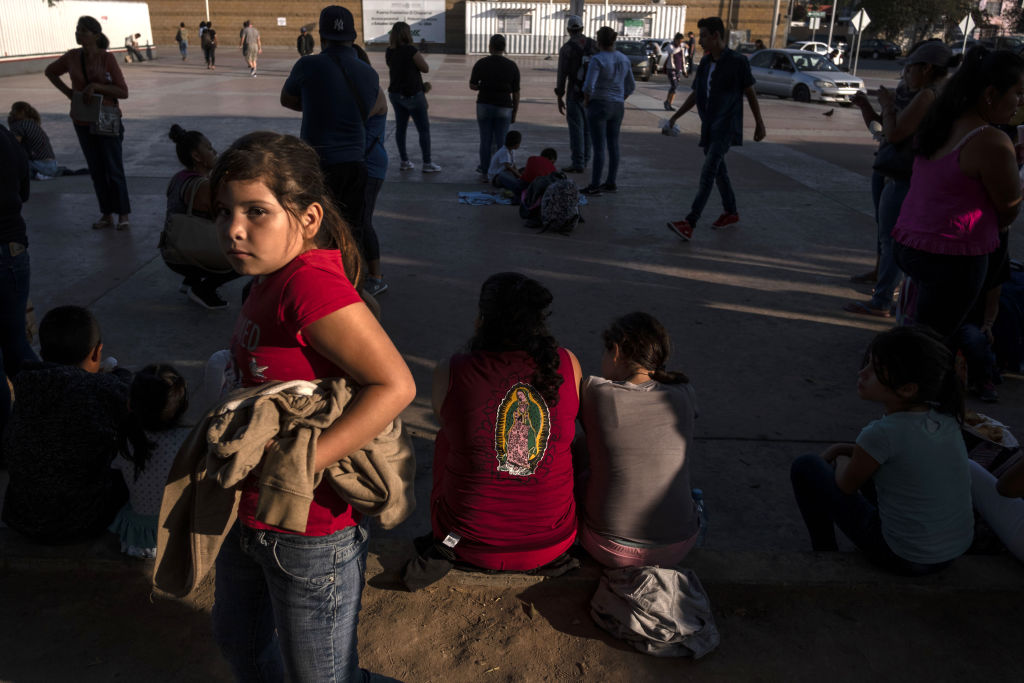
Asylum seekers gather at El Chaparral port of entry in Tijuana, Mexico, on August 10, 2018.

The US asylum system has heavily favored applicants from communist countries while systematically rejecting those fleeing US-backed violence. With the demise of the communist threat, the government has all but completely dismantled it. (Guillermo Arias / AFP via Getty Images)


Asylum as we know it is basically dead. The immigration system has been so systematically hollowed out that, for the vast majority of the world’s poor and displaced, it might as well not exist anymore.

A brief list of what’s gone wrong:

First, asylum approval rates have plummeted to historic lows, falling below 20 percent in 2025, compared to 55.5 percent in 2012.

Second, the process is slower than ever before. A backlog of over three million cases frequently forces potential asylees to wait five or more years before finally appearing in court. In 2012, there were only about 300,000 cases on the docket, less than one-tenth of today’s, and wait times of just a year and a half.

This backlog has led to a third problem. As asylum seekers are forced to twiddle their thumbs for half a decade, the Trump administration has invented increasingly elaborate ways to deny them a green card. In the meantime, asylum seekers cannot work legally or travel freely in the very country they are seeking protection in. This used to be a common and expedient part of the asylum process, but now asylum seekers must indefinitely put their lives on pause, something most cannot afford to do.

Just weeks ago, in fact, the Trump administration moved to block asylum seekers’ right to reside inside the country while they pursue their cases, which, if implemented, could be asylum’s death knell. The once great universal value that every human being on the planet has a right to seek refuge would basically be no more in the United States.

There are several reasons for asylum’s disappearance. One is the rise in xenophobic and racist rhetoric among elected leaders. Another is a lame-duck Congress that has been loath to halt the executive office’s attacks on citizens’ rights, let alone its attacks on the rights of poor foreigners who can’t vote or donate to campaigns.

There is, however, a third, less obvious reason for the end of asylum in America: the fall of the Soviet Union.

Refugees of Communism Only

The modern concept of asylum was established in the aftermath of the Holocaust by what is known as the 1951 Refugee Convention. During the rise of the Third Reich, large numbers of Jewish émigrés fled Europe but were turned away by other countries, including the United States. Many later died in concentration camps. After World War II, asylum law was created to ensure that such a thing never happened again; anyone fleeing for their life would be guaranteed the right to seek protection in any other country on earth.

Except that’s never how it worked. Instead, the asylum system was driven by Cold War geopolitics to push an anti-communist, pro-capitalist agenda.

In fact, the USSR actually declined to sign the 1951 Refugee Convention, stating that it was simply another ideological tool “dictated by Western countries” to discredit socialist states. This was in essence correct. From 1951 to 1979, the US government overwhelmingly granted refugee status to people “from any Communist or Communist-dominated country or area.” This included some seven hundred thousand Cubans, four hundred thousand “Indochinese” (decamping after communist victories in Vietnam, Laos, and Cambodia), another four hundred thousand Eastern Bloc Europeans, eighty thousand Soviet dissidents, and almost no one else.

It wasn’t until the passage of the Refugee Act of 1980 that the US asylum system became what we are now accustomed to, with migrants applying individually on a case-by-case basis. Crucially, this new asylum was available to anyone unable to return to their country of origin or the country where they last resided due to “persecution or a well-founded fear of persecution on account of race, religion, nationality, membership in a particular social group, or political opinion.”

Still, throughout the 1980s, asylum approvals heavily favored applicants from communist countries while systematically rejecting those who were fleeing US-backed violence. Whereas refugees from Cuba and the USSR had 70 to 80 percent approval rates, Salvadorans and Guatemalans displaced by massacres and genocides funded by the Reagan administration had less than 3 percent.

It’s worth noting that, under Ronald Reagan, the United States resettled more refugees than all other countries in the world combined. Even Reagan’s border enforcement policies look alien compared to contemporary anti-immigrant legislation, with the vast majority of the border left loosely guarded in the 1980s. It was common knowledge at the time that the United States relied on undocumented Mexican seasonal labor to harvest its crops and did not need a hard border to discipline labor’s movement.

This likely informed Reagan’s decision to sign a bill that granted approximately 2.9 million migrants mass amnesty instead, the vast majority of them Central Americans and Mexicans. The decision had less to do with helping the victims of his disastrous Latin American policies than normalizing the labor market. While anyone who had entered the country before 1982 was allowed to remain in the country, farmworkers that had been employed for at least ninety days could also be legalized. Many of those amnestied were Salvadorans and Guatemalans who had already been denied asylum. As individuals, they were not worthy of asylum, but as an employable group, they were welcome to stay. The bill also put more money in border militarization initiatives and stricter employment guidelines.

Far from an act of kindness, this was again a calculated political one. Having burned much of Central America to the ground in the name of fighting communism, Reagan had no choice but to accept some of the people he had displaced.

At its core, then, the US asylum system has always been an ideological tool. Since the dissolution of the Soviet Union in 1991, and with it the gradual demise of the communist threat, the United States has been slowly dismantling it. Unlike the immigration system writ large, there is no serious material interest for capital in maintaining asylum.

Without the threat of socialism’s Second World, the capitalists of the First World no longer had to buy off supporters in the Third. And now that capitalism has no overt global competitor, and the United States has abandoned any effort to legitimize its role in the world, it no longer needs to respect the human rights it previously claimed to be protecting on behalf of the so-called free world.

Asylum’s Thirty-Year Decline

The great unwinding of asylum did not happen immediately. In fact, asylum approval rates actually grew from 1991 to 2012. At the beginning of this period, the system was working at full capacity in order to put ideological pressure on a faltering USSR, whose migrants, fleeing the last gasps of the Soviet Bloc and the steep decline in living standards accompanying its transition to capitalism, were met with open arms.

Indeed, rising rates of asylum seekers accompanied the growing instability of a freshly capitalist-dominated world. After 1991, there was a steady increase in globally displaced persons due to “persecution, conflict, violence, human rights violations or events seriously disturbing public order.” By 2013, there were over fifty million displaced people worldwide, many of whom were forced to flee due to proxy wars started by the United States. In 2025, that number had climbed to nearly 120 million, reflecting a level of worldwide conflict not seen since World War II. And that doesn’t even account for the millions of people displaced by climate change, driven largely by Western extraction and consumption.

In response, there has been a bipartisan effort across five presidencies — those of Bill Clinton, George W. Bush, Barack Obama, Joe Biden, and Donald Trump — to keep out the people displaced by failed neoliberal policy and US intervention abroad. Each did so not by eliminating asylum outright but by slowly eroding the rights that asylum is supposed to grant.

One of the first blows to asylum came in 1996, under Clinton, when Congress passed the Illegal Immigration Reform and Immigrant Responsibility Act (IIRIRA). Whereas migrants were previously guaranteed the right to ask for asylum at any time, they were now made to file for asylum within one year of arriving in the country. After that, their universal and enduring right to seek refuge from persecution would, paradoxically, expire. It was a wholly artificial barrier that served no purpose except to limit asylum protections. Clinton signed the law without hesitation.

A decade later, in 2005, Congress passed the REAL ID Act. Under the auspices of preventing “terrorists from abusing the asylum laws of the United States,” the act demanded that asylum seekers provide concrete documentation of persecution in their home countries. The problem, of course, is that people fleeing for their lives across thousands of miles are often unable to maintain such documents. Nor do murderers normally warn their victims in writing that they are about to kill them.

Though there was no evidence that terrorists had ever abused US asylum in the first place (none of the men involved in the 9/11 attacks were asylum seekers), the Bush-era policy set a precedent that asylum law was now a threat to national security. No longer needed to bludgeon communists, asylum was weakened to advance a new ideological war, and refugees became potential terrorists.

But asylum really began to weaken under Barack Obama. After asylum rates hit all-time highs in 2012, Republicans ramped up pressure on Obama’s reelection campaign by falsely claiming that he had created “open border” policies flooding America with undocumented migrants. Rather than stand his ground, Obama capitulated almost immediately, deporting over 407,000 people in 2012 alone and 3.1 million across eight years, more than any other president in history, including Trump.

Like Reagan before him, Obama specifically targeted Central Americans following failed US interventions in the region, most notably the Honduran coup supported by then–Secretary of State Hillary Clinton. Under Obama, the court system was increasingly pressured to no longer recognize migrants fleeing gang violence as having a “credible fear” of losing their lives. As a result, gang violence, the main reason the vast majority of Central Americans sought refuge in the United States, no longer counted for asylum.

Perhaps Obama’s most insidious innovation, however, was the creation of the Southern Border Program (SBP) in 2014, which paid Mexico to catch and deport migrants before they could ever reach the United States. The logic was brutal in its simplicity: After 1980, in order to apply for asylum, migrants needed to be physically present in the United States. So if they were intercepted in Mexico first, they’d never have a chance to ask. In its first decade, SBP quietly denied millions of migrants the chance to apply, without impacting official asylum statistics.

Far from breaking from Obama, Trump continued down the path his predecessor paved. In 2018, Trump-nominated Attorney General Jeff Sessions ruled that gang violence no longer counted as “credible fear,” codifying what Obama had done out of sight. In 2019, the administration launched Remain in Mexico, which built on the logic of SBP by demanding that migrants had to first “apply to apply” for asylum, so to speak. Migrants would have to declare they wished to apply for asylum while still in Mexico, then wait there indefinitely until they were permitted to enter the United States and apply a second time. For most, waiting in a third country without access to work, social resources, or housing — especially in dangerous border cities — was an impossible demand. What Obama once did quietly, Trump did publicly and with relish.

Relatedly, in 2019 the Department of Justice also passed what is known as the “third country bar.” In short, the bar allows the United States to pass the asylum buck onto Mexico by requiring that migrants who travel through a third country (that is, not their home country, and not the United States, but an intermediary between the two) apply for asylum there first. Geography dictates that this almost always means Mexico. Now US immigration judges can immediately deny an asylum claim if they feel that a migrant did not do enough to seek asylum there, even though Mexico is still actively catching and deporting migrants under SBP. This policy continues to implicitly favor those few migrants still fleeing communism — Chinese and Cuban migrants are much more likely to travel directly to the United States by sea and so have no third country requirement.

Though liberals celebrated Biden for ending Remain in Mexico in 2022, less attention was paid to the fact that it was functionally replaced with a new phone application known as CBP One, which formalized and expanded the demand that migrants apply to apply for asylum. As soon as migrants entered Mexico, they were expected to download the CBP One application and take a geolocated photo of themselves daily in order to remain in the digital asylum line. Miss a day and they would be sent to the back of that line, which quickly grew to a wait of over six months. Migrants reported that the app frequently malfunctioned and crashed, losing their data and forcing them to start over after months of waiting in the third country.

When Trump was reelected in 2024, he immediately closed CBP One without creating a replacement, leaving tens of thousands of migrants stranded indefinitely in Mexico. This was especially heinous because, due to an agreement with the Mexican government, migrants who enrolled in CBP One were granted a one-year visa in Mexico. When CBP One was suddenly cut, everyone was made illegal overnight. There are no available records of how many people have been deported from Mexico as a result.

Weeks ago, the Supreme Court ruled to allow the United States to functionally eliminate all asylum protections for those fleeing US imperialism and intervention in Latin America. In Mullin v. Al Otro Lado, the court blessed the government’s use of a new “metering policy.” First invented and employed by the Obama and Biden administrations as another means of sidestepping asylum obligations, the policy permits an arbitrarily low number of migrants to enter the United States. Once that number is reached, the government can then refuse others to enter the country, and Trump can use images of those left behind to bolster his false claims of invasion.

The transformation of the refugee program from granting benefits (including labor market access) to denying them has created a pressure cooker at the border, with tens of thousands of people concentrated in Mexican border towns. A key aspect of refugee resettlement was that it strategically distributed refugees to stabilize rural and postindustrial depopulation. Its dismantling was a disaster that set the stage for localized anti-immigrant backlash. The image of the refugee was transformed from a neighbor building a new life next door to a faceless mass clamoring at the border, providing grist for Trumpian immigration panic.

Today only migrants from the last vestiges of communism stand a reasonable chance of receiving asylum in the United States. Venezuelans had a 72 percent approval rate in 2025, and Chinese applicants a 58 percent rate. Compare this to Indians’ 18 percent, despite Narendra Modi’s government, which is virulently anti-Muslim, being a key Trump ally.

Asylum’s Last Gasp

In 1990, as it became increasingly clear that there was serious instability within the Soviet Union, the US Congress created a new legal doctrine known as Temporary Protected Status (TPS). Unlike asylum, which is an individualized process that guarantees recipients protection for the rest of their lives, TPS, as its name suggests, was meant to provide temporary refuge — six to eighteen months at a time — for people fleeing particular dangers or disasters in their home countries.

Once the country’s conditions are determined by the secretary of Homeland Security to have improved, however, the status is revoked and everyone gets sent back. This tool, like asylum before it, has been used as an ideological weapon to attack countries at odds with US foreign policy. For example, in 2021, the Department of Homeland Security granted Venezuelans TPS status, citing the corruption and repression of the Maduro administration. Importantly, US allies long known for human rights abuses — such as Saudi Arabia and Qatar — have never been designated as having sufficiently dangerous conditions. TPS was, in short, a way to sidestep the responsibilities and guarantees that come with asylum while retaining its ideological benefits.

Now Trump has done away with even this. In August, the administration suddenly announced it was canceling TPS for Haiti, putting around 350,000 Haitians at risk of detention and deportation.

The announcement followed the termination of TPS for twelve other countries, including El Salvador, Honduras, and Afghanistan. The Trump administration rescinded TPS for Venezuelans at the end of 2025, just months before kidnapping its president, Nicolás Maduro, in order to illegally seize control of the country’s oil reserves. Now that the United States is in control, and the communist threat has been vanquished, it is likely that asylum requests from Venezuelans, as with past allies, will plummet.

This does not mean that Venezuelans and other migrants will stop trying to come. They will just have to come in a form useful to capital: as undocumented workers.