What to Do When Your Union Contract Is Voted Down
The answer to union contracts being voted down is not for organizers to lower workers’ expectations. It’s to seize that vote as an opportunity to organize those expectations into collective power.
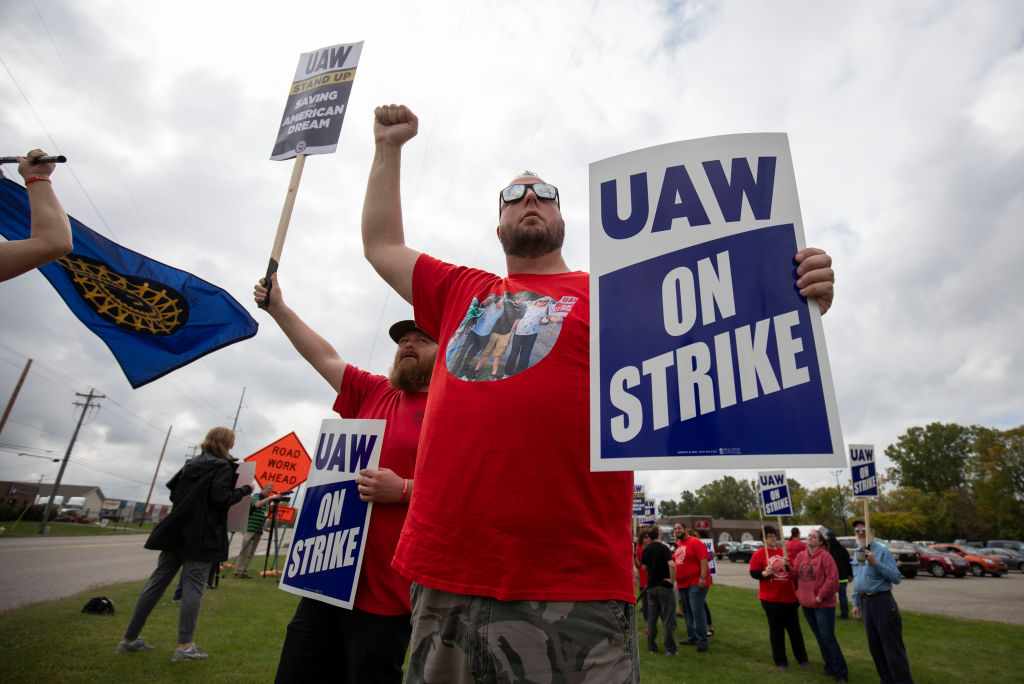
Workers who are making company executives sweat by voting down bad union contracts should be saluted. But those same workers need to be serious about translating anger at concessionary bargaining into a fighting force that can win something better. (Bill Pugliano / Getty Images)
Like stumbling across a yeti or flying saucer, I was experiencing the seemingly impossible: a conversation between HR executives was warming the depths of my heart and giving me hope for the future.
It was December 2022, and I was attending a convening of company executives and labor leaders hosted by the Massachusetts Institute of Technology’s Sloan School of Management. A line of corporate bigwigs from long-unionized Fortune 500 companies were heatedly voicing their exasperation over the new bargaining climate in the country.
Apparently, all of these companies were suffering from the same affliction: tentative agreements were being voted down by union members. In some cases, contracts went down by large margins several times before finally passing.
“It’s especially bad with the young workers, who have completely unreasonable expectations,” said one HR executive from a company that would go on to make nearly a billion dollars in net income that year.
“They want the return of cost-of-living adjustments and pensions. It’s completely unrealistic with where the economy is today,” added another executive from a company with a market capitalization of more than $30 billion. “The union leaders are often just as upset as we are about how out of touch their membership is.”
For years now, workers’ expectations have been rising across the country. As they should be. Corporate America rebounded after the Great Recession, and corporate profits have soared over the past decade, reaching an all-time high in the first quarter of 2026.
In a recent article headlined “Corporate profits were already at historic highs. They shot even higher in Q1,” Yahoo Finance journalist Ben Werschkul writes that “US business profits are booming no matter how you measure it,” with corporate balance sheets remaining above historic norms for more than a decade.
For the working class, the story is very different. Our standard of living has declined under the combined pressure of stagnant wages and rising prices. Income inequality in the United States has reached heights not seen since the Great Depression.
According to the Wall Street Journal, inflation-adjusted corporate profits increased by 50 percent between the end of 2019 and early 2026. Hourly wages increased by a pathetic 3 percent over the same period.
Workers everywhere should be demanding more — and that is especially true for unionized workers at highly profitable companies. I applaud workers who are making company executives wring their hands over their refusal to accept that status quo in bargaining. But just because we demand more does not mean we can easily win it. And we can’t afford to be naive about how asymmetric the power imbalance is between workers and employers, or how unprepared many unions are for a real fight.
There are real dangers when a tentative agreement is voted down. Workers might go out on a long and painful strike only to return with an offer little better than the one they originally shot down. The experience can divide and demoralize both the membership and the bargaining team. Bargainers can feel abandoned by the members who elected them. Members can feel betrayed by the bargainers they elected. In the end, the union feels weaker, and the boss appears stronger.
One of my proudest accomplishments as the United Auto Workers’ (UAW) top strategist was creating the Department of Bargaining Strategies. We didn’t know it at the time, but one of the new department’s top priorities would quickly become assisting locals whose contracts had been voted down. Time and again, we saw two interrelated problems driving no votes: local bargaining teams were not ambitious enough in bargaining, and they had not built the high-participation campaigns necessary to win more.
Thankfully, the road to winning a stronger contract and building a more powerful union is also the road to winning enthusiastic and overwhelming contract ratifications.
Through this new department — staffed with a combination of experienced bargainer-organizers hired from other unions and some of the most talented staff from the rank and file — we showed bargaining teams and members that a contract rejection does not have to become a source of division. It can instead become an opportunity to change how the union bargains and fights. By making negotiations more transparent and turning the entire membership into active players in the fight for a strong contract, a local can lay the foundation to win more while building greater trust between the bargaining team and the shop floor.
The Three Axioms of Bargaining
After more than a decade of bargaining, I have boiled down the basics to three axioms that I repeat over and over when training bargaining teams:
Bargaining Axiom no. 1: Bargaining is when we go to the table with proposals to improve our working conditions, pay, and benefits, and management says no.
Bargaining Axiom no. 2: What we win at the table reflects the power we build in the workplace. Our power is rooted in our unity and our ability to act collectively.
Bargaining Axiom no. 3: Meaningful progress in negotiations most often happens when we create a crisis for the employer — typically through a credible strike threat.
The first axiom is my definition of bargaining, but don’t take it too literally. Management rarely just says no at the bargaining table. They’re often more sophisticated than that.
Instead, employers prefer to cultivate a bargaining environment of exhaustion and isolation. The company stretches out negotiations, warns that ambitious demands will cost jobs, and portrays a potential strike as reckless. At the same time, management tries to confine the bargaining process to a small room occupied by professional representatives. The more isolated the union’s bargaining committee becomes, the easier it is for management to persuade negotiators that nothing better is possible — and for members to conclude that their own negotiators failed them.
The phrase “collective bargaining” is often treated as a legalistic term. It should instead describe how negotiations are actually conducted: collectively, with members shaping the goals, tracking the fight, and taking responsibility for building leverage. Members are far more likely to support an agreement when they helped decide what the union would fight for, understood how management responded, and participated in the pressure campaign that produced the final settlement. Under those conditions, ratification is the conclusion of a collective struggle rather than a blind vote on a document negotiated behind closed doors.
Famed UAW President Walter Reuther once said that “power is the ability of a labor union like the UAW to make the most powerful corporation in the world — General Motors — say ‘yes’ when it wants to say ‘no.’”
His point is well taken. Ask anyone who has served on a union negotiating team, whether at a zealously anti-union manufacturing plant in the South or a supposedly bighearted nonprofit hospital in New England, and they will tell you that making persuasive arguments to management won’t get you anywhere. Unless unions collectively build the capacity to make management’s refusal costly, the boss can and will keep saying no. And workers may ultimately blame their own negotiators and union leadership as a result.
Member participation is not merely a good idea or the right thing to do. It is the source of our power.
How to Build a Powerful Contract Campaign
The second axiom of bargaining is that what we win at the table depends on the power we build in the workplace. That power is not built in a day and can’t be rushed in the final days before contract expiration. A strong contract is won by a membership that has been involved long before bargaining begins and continues to play a meaningful role until the agreement is ratified.
We do this by organizing a contract campaign. A contract campaign is a collective action plan with a beginning, middle, and end, organized around specific demands that workers are trying to win. It has a target: someone who has the power to give us what we want. And it involves a series of escalating actions that progressively turn up the heat on that target and create the conditions for victory.
Those actions should be timed to support what is happening in bargaining. Ideally, they build in intensity and participation, culminating at the union’s peak of strength.
This is where the third axiom comes in. We build enough power to finally make the boss say yes when they want to keep saying no. We do that by creating a crisis for the employer, typically (though not always) by organizing a supermajority strike.
Returning to the UAW’s “stand-up strike” as an example: this strike kept the union at the peak of its strength, using the credible threat of additional strikes over and over again to drive concessions out of Ford, General Motors, and Stellantis. It was a unique strategy that kept the companies guessing, captivated the media’s attention, and forced politicians to pick a side (resulting in then President Joe Biden walking a UAW picket line, a historic first in the United States). Ultimately, though, this strategy brought the companies to their knees because of the power of UAW members who were ready and willing to walk off the job at a moment’s notice — and proves the point that our power in negotiations rests on our power in the workplace.
Through the UAW’s Department of Bargaining Strategies, we started training locals to think of the bargaining team and the shop floor like jumper cables: they only work when they are connected. That connection has to be maintained through representative structures, constant two-way communication, and workplace actions that have an effect that members can see at the bargaining table.
We can build those jumper cables by democratizing the bargaining process.
Don’t Keep Negotiations Behind Closed Doors
Keeping members in the dark about bargaining is a recipe for disaster. Bargaining teams should never agree to ground rules that bar them from talking to the membership or the public about the status of negotiations. That language only helps management. Management knows everything that is happening in bargaining — they’re in the room! So secrecy simply denies workers on the shop floor the information they need to organize around what is happening in negotiations.
Transparency strengthens trust between negotiators and the membership, and demonstrates to management that the bargaining team genuinely speaks with the authority of its coworkers. And it helps move members to take the actions necessary to win stronger contracts.
Survey the Membership
Before bargaining begins, use a survey to have members rank their top issues, define their priorities, and generate ideas for new proposals. Surveys should systematically gather input from a large majority of the bargaining unit. Bargainers should not just be collecting ideas for proposals but having their coworkers rank their priorities, so negotiators can accurately assess what matters the most. It is critical to know the difference between a demand that a supermajority of workers will strike over and another that might be popular but most aren’t willing to miss a paycheck over.
Crucially, it’s important to not merely pass out surveys but also to use them as conversation starters. The bargaining survey is often the first opportunity to identify and recruit volunteers who can help write proposals, distribute future bargaining updates, and organize potential actions.
Recruit Subject-Matter Experts
The “official” bargaining team may be limited in size, but anyone and everyone can be involved in developing bargaining proposals. Recruit coworkers into working groups to hammer out proposals addressing issues that are widely and deeply felt in the workplace. Then have those workers present their proposals directly to management at the bargaining table.
Is there a particular group of workers — cafeteria workers at the school, photographers at the magazine, lab techs in the hospital — who feel like they are always overlooked in bargaining? Have them collectively present their demands to management, and keep those demands as a highly visible union priority throughout negotiations. This not only can help restitch long-standing holes in the quilt of workplace solidarity but publicly reinforces to the boss that the workforce is united and invested in the bargaining process.
Clearly Communicate Bargaining Goals
Workers should know what the union is fighting for before negotiations begin. Some unions go so far as to distribute their bargaining proposals to members before presenting them to the company, then keep workers informed about how management responds.
During the stand-up strike at the Big Three, UAW President Shawn Fain repeatedly used Facebook Live to explain the union’s demands and the companies’ responses. Members knew why they were being called on to strike and why they were being asked to stay out on the picket line. When management responded to the UAW’s initial proposals with an insulting first counter, Fain famously “filed” them in a garbage can on video. Members around the country began making memes of that garbage can. One local actually built him one and presented it to him for use in future negotiations.
This is the kind of buy-in and member-initiated activity that good communication generates. Members come to understand that winning a strong contract does not fall solely on the bargaining team or union leadership. The fight belongs to all of us.
Ironically, many longtime bargainers are afraid of publicizing the union’s demands and making ambitious proposals, because they fear their coworkers will vote it down for falling short of the union’s shared goals. This has it all backward. Our coworkers aren’t crazy or unreasonable. When workers are asked to make a decision without any insight into what was being demanded or how hard we had to fight to win it, it makes sense that they would make decisions based on the information they do have: comparing the employer’s massive profits and rising executive salaries against their own paltry wages and benefits.
By that logic, it makes total sense to vote down every contract — exactly the situation I was happily listening to company executives complain about at the Sloan School event. The only way to cultivate mature, strategic judgment is through the kind of deep participation that a contract campaign with clear communication provides.
And not for nothing, the fear of fighting for more has produced a vicious downward spiral of concessions in many unions. The only way we will raise standards in our industries is by abandoning the old philosophy of “aim low and settle lower” for a new approach: aim high, unite, and fight like hell to get everything we can.
Send an Energizing Update After Every Session
Bargaining updates — often written distributed through emails and flyers — should be short, informative, agitational, and persuasive. The purpose is not merely to report on a specific article that was tentatively agreed to or describe the boss’s latest hijinks at the table. Every update should help members understand what is at stake and what they can do next. It should be a call to action.
Use Bargaining Caucus Time to Communicate With Coworkers
Bargaining often involves a lot of downtime. Put it to use. Identify the key message members need to hear, create a phone tree, and use caucus time to call them. Or send out mass texts. Or write that shop paper to send out to everyone. Just make sure these communications are a two-way street. They should allow the bargaining team to gather feedback and help their coworkers understand the relationship between the actions they are taking on the shop floor and the company’s reactions at the table.
Bring Members to Bargaining
Allowing members to attend negotiations is often called “open bargaining,” an increasingly popular approach to negotiating a contract. Open bargaining shows management that the union is united, it shows members that their union has nothing to hide, and it provides a valuable learning experience for workers by giving them the opportunity to hear firsthand what management thinks of their own employees — and what they think our labor is worth.
When possible, bargain at the workplace and invite members to attend before or after their shifts or during lunch breaks. This allows workers to move in and out of the room without losing an entire workday. Members who attend should follow a common set of rules: keep a straight face, do not speak unless it is part of a prepared plan, and follow up with negotiators afterward with questions.
Pack Bargaining at Pivotal Moments
Even when bargaining is always open, there may be dozens of sessions in a typical campaign. The union should identify pivotal moments when it makes sense to mobilize their coworkers in a show of force.
Pack the first bargaining session. Turn the opening session into a bargaining kickoff. Systematically gather commitments to attend from the entire bargaining unit. Use the opening of negotiations for the bargaining team to explain the union’s priorities and why they matter. This demonstrates that the membership is united behind its goals and starts to signal how far everyone is willing to go to win them.
Pack bargaining when members present an important proposal. Prepare workers who care deeply about a particular issue to speak at the table, and mobilize their coworkers to attend in support. This shows management that the proposal is not the personal project of one negotiator but a widely shared demand.
Pack bargaining when management presents an important counterproposal. Do not allow management to insult only the bargaining team when it rejects workplace improvements or meaningful raises. Give the boss an audience. Force management to look a sea of their employees in the face while explaining why they are not worth what they are owed.
What if management refuses to let members attend? How we bargain is as much a reflection of our power as what we bargain. I’ve seen employers refuse to attend sessions when large numbers of employees were present, then try to turn the membership against their own negotiators by claiming the company would discuss wages if only the bargaining team stopped “irresponsibly” insisting that coworkers be allowed in the room.
Unions have the legal right to decide who serves on their bargaining team — even if that means the entire bargaining unit. But anyone waiting for the National Labor Relations Board to enforce that right anytime soon is likely out of luck. If management refuses to enter the room when employees are present, then how we bargain becomes the first test of the union’s strength. Turn that refusal into an organizing opportunity. Bargaining on our terms — at the worksite, open to members, and without unnecessary secrecy — may itself require escalating action. The union has to unite everyone around that fight and keep them moving forward together.
When You’re Stuck, Talk to Your Coworkers
Bargaining is hard. We cannot always anticipate every trick management will use to confuse, divide, and demoralize us. Whenever negotiations get stuck, put your trust in your coworkers by holding one-on-one conversations, organizing department meetings, or hosting a town hall. Our collective intelligence and creativity are greater than those of any single individual. Collective problems require collective solutions.
Strength in Solidarity
A tentative agreement is most likely to be voted down when members feel disconnected from the bargaining process, distrust the people negotiating on their behalf, or believe the union settled for less without building the power necessary to win more. The answer is not to lower workers’ expectations. It is to organize those expectations into collective power.
Through surveys and conversations, workers can develop proposals that address the most widely and deeply felt issues in the workplace. But winning those demands requires much more than strong arguments or powerful worker testimonies. We have to fight. And the bigger the demands, the bigger the fight, and the more powerful our union needs to be. That’s why contract campaigns are essential not only to winning strong agreements but to building stronger unions.
When members help establish the demands, understand the obstacles, participate in the campaign, and experience the fight together, the final ratification vote is not treated like a referendum on how well the bargaining team did. It becomes the culmination of a struggle the membership helped lead.