Union Organizing Needs Leadership Density

Two former United Auto Workers organizers make the case for what they call a “leadership density” union organizing model. That model was central to recent UAW breakthroughs, and we should accept no substitutes in similar campaigns.
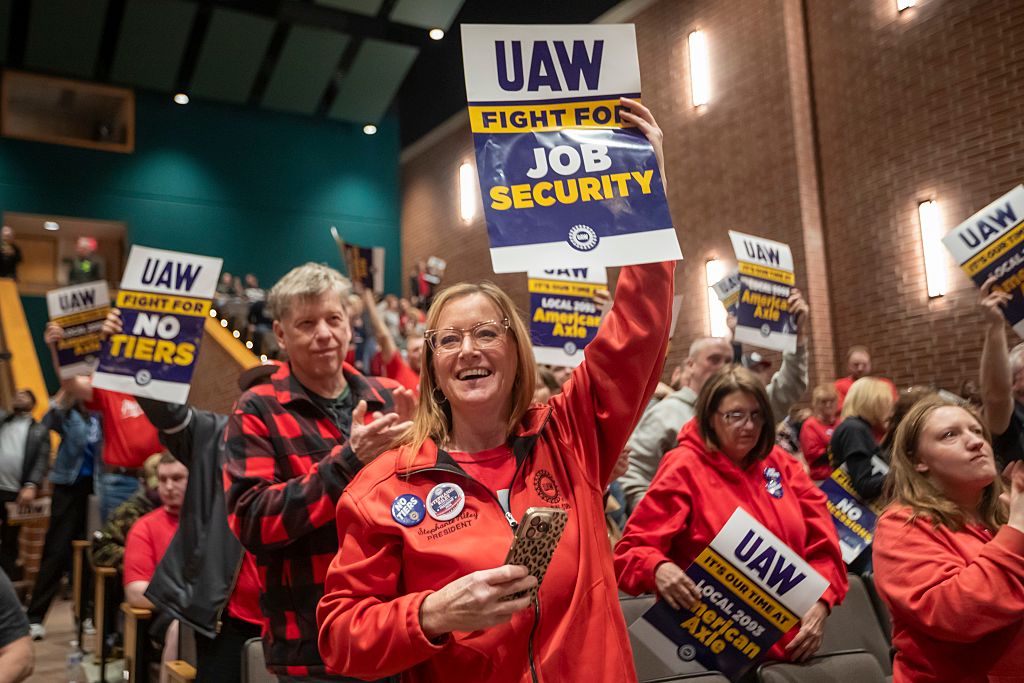
UAW Rally Kicks Off Contract Talks with American Axle

Good union organizing is rooted in adherence to a long lineage of organizing fundamentals, argue two union organizers who helped the United Auto Workers win recent breakthrough campaigns. (Jim West / UCG / Universal Images Group via Getty Images)


The recent organizing breakthroughs of the United Auto Workers (UAW) in auto manufacturing in the South, major nationwide strikes, and decisive contract successes raise questions about what lessons we can and can’t draw from the last few years’ record of wins and losses. Following the March 2023 change in union leadership, in which reform candidate Shawn Fain won the union’s presidency, the UAW took a harder-line stance in bargaining. The 2023 "stand-up strike" in auto won historic gains, including up to a 25 percent wage increase, restoration of cost-of-living adjustments, and an end to differentiated wage tiers for some workers, changing the previous strategy of taking a less aggressive stance in bargaining with the Big Three automakers.

What of these victories can we chalk up to shifts in messaging and organizing approach from the union’s international leadership over the last few years? What was the outcome of campaign practices honed in some sectors of the union’s organizing department over the last decade and a half? And what was the result of different conditions on the ground — industries that are “easier” to organize, relatively pro-union locales, less hostile bosses, or general upsurges of worker confidence and indignation? The stakes to figuring out how to win, massively and on tough terrain, are high. Having worked for years on some of the recent UAW unionization efforts in the South, as well as in higher education, we learned an organizing approach that laid the groundwork for the recent UAW victories in manufacturing.

The successful 2024 union drive at Volkswagen (VW) in Tennessee, after two unsuccessful votes over the previous decade, and the 2025 win at BlueOval SK in Kentucky, built on a specific approach to deep leadership development. The unsuccessful vote at Mercedes in Alabama in 2024, only weeks after the VW vote and despite the momentum many had hoped the stand-up strike at auto’s Big Three would create, was a blow. For some of us involved in these campaigns, though, this loss was not so surprising, given that it was not building on the same kind of leader-dense, structure-based organizing foundation that had carried the day at VW and BlueOval SK.

Three strategists, the late writer and organizer Jane McAlevey, former UAW chief of staff to President Shawn Fain Chris Brooks, and labor historian Nelson Lichtenstein, all speculated that the success at VW and failure at Mercedes can be linked to the difference of the ferocity of the boss’s anti-union campaign. McAlevey argued that the UAW did not accomplish key campaign benchmarks such as community engagement, filing for an election without the union’s own public benchmark of 70 percent support, and no majority of the entire unit public showing support for forming a union. Brooks argues that the difference in the bosses’ pushback across different campaigns was more important but also claims that the momentum from the stand-up strike, coupled with the lack of the ferocity of the boss fight at Mercedes, allowed VW to be successful. Brooks has also made the case that “trigger events” — inspiring messaging about strikes and election filings — can create the kind of “momentum” that allows workers to turbocharge their will to unionize and bypass the expensive and slow normal “spadework” of organizing, and attributes the loss to the intensity of employer-class opposition in Alabama.

We draw different conclusions. The primary difference between these wins and losses was the structured approach to building power at the worksite. It was how leaders were trained, how workers were recruited to help form their union, and in general the structure of the organizing method.

Michael was the lead UAW organizer at Volkswagen for sixteen months during the committee recruitment and development stage, before the union filed for an election. He was also present for the last two weeks of the Mercedes election and then at the BlueOval SK election. Carla was the UAW supervisor that oversaw the VW campaign in the final push and the entirety of the BlueOval SK campaign. Both came into these campaigns having worked on numerous higher education sector campaigns while at UAW.

We want to emphasize the decisive importance of a particular form of structure-based organizing — a flexible but systematic approach to leadership development and density building — in each of the recent manufacturing union election victories. It is an approach that was developed in the higher education sector of the UAW organizing department over the past two decades and that was adapted into some of the manufacturing campaigns in the last few years.

This is an effort to learn and grow from the reality of what it takes to move workers. In short, it is about the leaders — what the leaders do, how many there are, where they are in the plant, how they come across in campaign communications, how they talk to their coworkers, and what tools they have to be successful in those conversations.

The Approach

The organizing model used on the VW and BlueOval SK campaigns were adapted from the approach used in most of UAW’s higher education campaigns. We did not develop the approach, nor do we claim ownership, but we did witness its progression and success and participate in its ongoing development. We refer to this approach here as a “leadership density” model.

This approach requires wide recruitment and development of leaders. The definition of a leader is a worker who is willing to fight for the union, receptive to feedback on how to speak with coworkers, and capable of moving their coworkers into action. Leaders are those who are public and willing to speak to their coworkers when the time is right. Throughout the campaign, leaders are given a steady flow of training and tools to better answer their coworkers’ questions. This approach is grounded in a belief that workers in any industry can understand and make complex strategy decisions and are able to have difficult organizing conversations with their coworkers. This helps confront the “third-partying” so common to the union formation process, in which the boss scares workers away from organizing their union by speaking of the union as an outside third party instead of a group of coworkers coming together to collectively bargain with their employer, for it depends on lots of workers engaged in fact-based conversations about the union.

Leadership recruitment and development is not a new idea in the labor movement. But our approach insists on a flexible and layered understanding, allowing different workers to engage in the campaign at different levels. Workers take on the role of organizers in the plant. They must be able to have complicated conversations with coworkers to fight the boss’s anti-union misinformation campaign. The approach prioritizes leaders at every level of the workplace carrying out a series of public actions of union support so that workers on the fence see that the unionization effort is coming from their coworkers. The importance of public-facing support is more complex than asking a majority of a worksite to put on a pro-union sticker. This approach is less tightly limited than models where staff organizers focus their energy on a few central “organic leaders,” a worker who already has respect in the workplace and becomes the face of the union campaign, but also not as passively “activist” driven as models that rely on the die-hard few who spontaneously rise up.

Staff’s primary role is to train the broad organizing committee (OC) to have difficult and strategic conversations with their coworkers. There is repetitive and constant training on how to explain the power of coming together to negotiate a collective agreement with their employer. Workers help agitate their coworkers around framing the choice between the status quo and collective bargaining.

Higher Education Lessons Learned

The success of this model at making huge and repeated breakthroughs in tough fights in higher education has been downplayed by Brooks. Brooks states, “Employer opposition is minimal in most cases. Universities often remain neutral or only engage in modest anti-union activity.” In our experience, universities fight hard. Like other employers, they similarly hire outside union-busting consultants, email workers with anti-union talking points, and hold captive audience meetings. Universities are not neutral employers. The difference between lost and won campaigns was not primarily whether or even how the administration fought back, but whether we succeeded in preparing the OC of workers to build a structure with leadership density across nearly all components of the workforce. This is something organizers learned by reflecting on and refining the approach over time in the face of some stiff defeats.

In 2012, workers at the University of Minnesota lost their fourth election, with 62 percent voting against representation by the UAW. A strong majority of graduate employees had signed authorization cards when UAW filed for the election, but that majority melted in the face of the employer’s relentless barrage of anti-union emails, supervisor one-on-ones, captive-audience meetings, and preferential treatment for workers who partook in the anti-union efforts.

On reflection, the campaign found its key weakness was that its OC consisted primarily of a small group of self-selecting die-hard union activists concentrated in only a few departments. Without identifying and developing leaders covering most units on the campus — which takes some flexibility in allowing pro-union workers to participate in the campaign with varying levels of time and dedication onboarding — a supermajority can wash away quickly in a boss fight.

This revision to the approach allowed UAW higher education organizers to face down similar challenges at some of our biggest and worst shops — private Ivies like Columbia and Harvard — that had united in hiding behind a 2004 National Labor Relations Board (NLRB) decision that blocked the certification of graduate student unions. Columbia in particular fought tooth and nail by holding captive audience meetings in departments and orchestrating fearmongering by professors in the engineering department (a department made up largely of international workers who are dependent on their student and employment visas to remain in the country). Employing the modified leadership density approach, organizers managed to build leadership coverage for 95 percent of the entire unit, consolidating responses to the university’s fightback campaign into opportunities to recruit and develop a broader swath of leaders for a more resilient OC.

Columbia University UAW filed for a union recognition vote with 60 percent of the unit on cards and grew our support by the time we voted to ensure that 72 percent of the workers voted yes. When Columbia tried to spread feelings of futility by refusing to bargain, this broad-based OC was able to move a majority of the bargaining unit to go on strike for recognition and successfully forced the administration to the table. With a strong and systematic leadership structure, it was possible for workers to beat back a boss fight determined to block a precedent-overturning breakthrough.

Any deep dive into the dozens of current organizing campaigns and contract fights on university campuses across the country will show a range of boss fights and employer opposition. Bitter campaigns by other higher education unions at Duke and Yale sputtered for decades under challenging boss fights and eventually won after reformulations of their own approaches to structure-based organizing, according to our conversations with organizers.

We believe this willingness to learn and refine a structure-based approach to building leadership density is why UAW remains the leader in the sector, with over 150,000 higher education workers organized in the union. While we could say that these breakthroughs created a general mood of momentum in the sector, the most important thing was that we were developing a systematic way of equipping workers to equip each other to withstand a boss fight. Our experience has led us to disagree with Brooks’s theory that momentum is created outside of structured-based approaches to organizing. The real “momentum” in higher education was in the doing.

Bringing Movement to Southern Manufacturing

The UAW had not won a union election in a foreign-owned auto manufacturing in the South since 1941. The massive excitement around the 2023 stand-up strike, where workers at the Big Three auto plants waged a highly successful contract campaign, showed companies and workers that the UAW was ready to fight. Some even referred to the public start of the campaign to sign union election authorization cards, set off a month after the end of the strike, at VW and at other “original equipment manufacturer” plants in the South, as “Stand Up 2.0.”

It’s tempting to understand the ensuing victories as driven primarily by this momentum. By April 2024, workers at VW in Chattanooga, Tennessee were able to vote for their union in a huge victory with a 73 percent yes vote. In August 2025, workers at the BlueOval SK battery plant in Kentucky voted to form their union in a narrow victory of 51 percent yes vote. Between those two, however, a campaign of workers at the Mercedes plant in Vance, Alabama lost their election with a 44 percent yes vote, only a few weeks after the victory in Chattanooga. How should we understand this difference?

Brooks argues that UAW's alliance with German industrial union IG Metall helped “keep the company from playing from the same playbook they used in 2019.” In 2019, IG Metall union and the Global Works Council, which represents workers at VW in Germany and across Europe, similarly publicly supported workers at the VW Chattanooga plant in their campaign to organize and even sent representatives to the plant, though management did not allow them access. For the 2024 campaign, IG Metall similarly supported the workers and asked VW to be neutral. The difference between 2019 and 2024 was not the support from IG Metall, but the widespread leadership support and development within the plant.

The key difference was neither momentum nor the intensity of the boss fight, but the version of structure-based organizing applied in each case. This is true for a few reasons. First, the UAW had been building its presence at nearly every single major nonunion automotive factory across the country from 2021 on through a campaign called “Uniting Auto Workers,” well before the Big Three strike. As part of that campaign, workers from the different organizing committees at major nonunion auto plants met together in Birmingham, Alabama, in July 2022. There was no doubt an uptick in activity, but it was not spontaneous.

The spontaneous character of the poststrike organizing surge takes away from the complicated presence the UAW has had at these auto plants for decades. As Sam Gindin has argued, fetishizing spontaneous organizing, which implies a time-saving approach with less work put into structure, can obscure “the complex, essential debates on how to organize” between upsurges so that momentum, when it arises, doesn’t get crushed. To this point, it’s important to recognize which kinds of structure-based approaches were most successful when the wave hit. The only nonunion auto plant to win its election in the wake of the strike was a location where workers were organizing with the leadership density model prior to dropping election authorization cards. That was the VW Chattanooga plant, where workers had been executing the approach honed in higher education since June 2021. By the time of the 2024 strike, 63 percent of the areas of the plant were covered by a trained leader, at a ratio of one leader for every twenty-five workers, while an additional 14 percent of the plant had one OC leader for every fifty workers. By election time, we had pushed that one-to-twenty-five coverage to 90 percent, with over one hundred workers specially trained in how to identify and push back against anti-union campaigning by management.

At a worker committee training just over a week before the Mercedes election, UAW staff hot off the VW victory were brought in to support, but it quickly became clear that much of the Mercedes committee did not have the tools to answer basic questions from their coworkers about what it meant to form a union. This canary in the coalmine was one of many indications that, despite the appetite and enthusiasm among the core supporters for the union, without skill development and systematic leadership building, the committee was not prepared to beat back an aggressive and sophisticated multilayered attack.

We shouldn’t minimize the brutal union-busting campaign workers endured at Mercedes, which was indeed more intense than the one faced at VW. At the same time, the structure the union busters were up against had been built a different way. As Brooks wrote in New Labor Forum, the UAW filed for union recognition with only 41 percent of workers having signed cards and an incomplete list of the workers in the plant.

This narrow reach of leaders and lack of an accurate list would not be possible if the campaign had plant-wide leadership density as its North Star. As a result, OC members’ coworkers were unfortunately more susceptible to the anti-union campaign because there were not enough leaders in every corner of the plant able to push back or clarify misinformation. The loss at Mercedes was not, as Brooks asserted, about “verbal assessments” or “private conversations” between workers. It was about a lack of leaders with tools to successfully push back on a misinformation campaign.

Learning from this heartbreaking loss should point us to methods that have withstood boss fights and refusals to bargain. After the loss at Mercedes, workers at the BlueOval SK were able to narrowly win after a long boss fight and a doubling of the number of workers in the unit, and they won likewise because they organized with the leadership density model. We see this as a particular proof of the method, because like Mercedes, these workers endured a grueling fight. A complicated factor at BlueOval SK is that since it was a new plant, workers were constantly being hired, with no strong relationships or networks. Having this map to guide the integration of new hires, new parts of the plant opening, new shifts, and new production lines into our plan allowed us to consistently account for shifts in the ratio of trained committee members to their coworkers.

These workers faced a seven-month onslaught of daily, high-quality union busting. The company hired a litany of law firms and consultants for their campaign, including Frost Brown and the National Union of Labor Relations. Workers experienced firings of leaders, multiple consulting companies, training management, countless captive audience meetings, and a broad social media campaign. Most notably, the company was able to sequester new hires at a separate location for weeks on end, far away from worker leaders, where they put on daily anti-union talks. Moreover, Hardin County, where the plant is located, is over 60 percent Republican. The boss fight continued after the election, for it delayed the election results through a series of legal charges filed with the NLRB and padding the list with firefighters who were not part of the original election petition.

The victory at BlueOval SK shows that even in the face of a dirty boss fight, workers can win. The debate we have at hand is not “structure-based” organizing versus momentum, but one of what type of structured organizing is working and which is not. We are not losing because of a lack of training. Perhaps it is time we reflect on what is in the training, what it means to agitate, what a leader looks like, and what structure we are building.

We disagree with Brooks’s assertion that “the win at Volkswagen was hard-earned and defied the cautious tenets of structure-based organizing.” As we saw it, structure-based organizing is actually what explained the win at VW. Elsewhere, as at Mercedes, where the campaign relied on the theory that the win at VW would put workers in motion to build the union, what actually happened was unprepared workers were thrown to the wolves of some of the highest-paid anti-union law firms in the country. We believe that those workers were given minimal support to be able to push back effectively, because the momentum model relied on believing that “trigger points” such as filing for the election would galvanize support. Again, this did not happen because of a lack of structure in leadership, which is needed to help take advantage of moments like this on a campaign. For those of us who have been organizing for decades, the Mercedes campaign was a repetition of the shortcuts our mentors warned us against.

The Decisive Factor

Times are dire. After so many defeats in the labor movement, there’s good reason to propose big thinking and a change of direction. At the same time, misreading the recent past might lead us to draw lessons that don’t prepare us for the challenge we face. Workers need access to the organizing methods that will equip them to withstand the kinds of boss fights that an emboldened employer class is only going to keep escalating.

From our firsthand experience working on these trend-bucking campaigns, the decisive factor enabling workers to win or lose their union was not the amount of external messaging momentum or the intensity of the boss fight, which was always there. It was whether organizers executed an adaptive but systematic plan to build a sufficiently dense structure of identified and developed leaders across every unit of the workplace. If there was momentum, they could amplify it. As the boss fight turned vicious, they could hold their coworkers together, fight futility, and keep people’s eyes on their collective power.

It is not glamorous or a catchy new rallying cry. It’s the outcome of a long lineage of organizing fundamentals. The refinement of this approach in the last fifteen years of hard-won fights setting new precedents in private higher education allowed it to enter these manufacturing campaigns, build a powerful foundation to withstand serious headwinds, and win what had seemed impossible. Where we didn’t have this scaffolding, we did not stand a chance to win.

Building our power across the manufacturing sector and the labor movement as a whole is going to be decisive because of the power that companies have. Even after the win, BlueOval SK announced a temporary plant closure as ownership of the plant transferred to Ford. We agree that the key challenge we face is scaling up these wins: building a density of organized workers across the country that can go toe-to-toe with employer power and break the appeal of the far right. But what we’re scaling up matters, especially if we expect that organization to take on the massive task we’ve set for it.