The Rise and Fall of the Elite University
Twilight of the Dons, historian Colin Kidd’s dazzling study of Britain’s elite universities, opens a window into a lost world in which, for a brief period, mass democracy combined with the idea of scholarship as a vocation open to anyone.
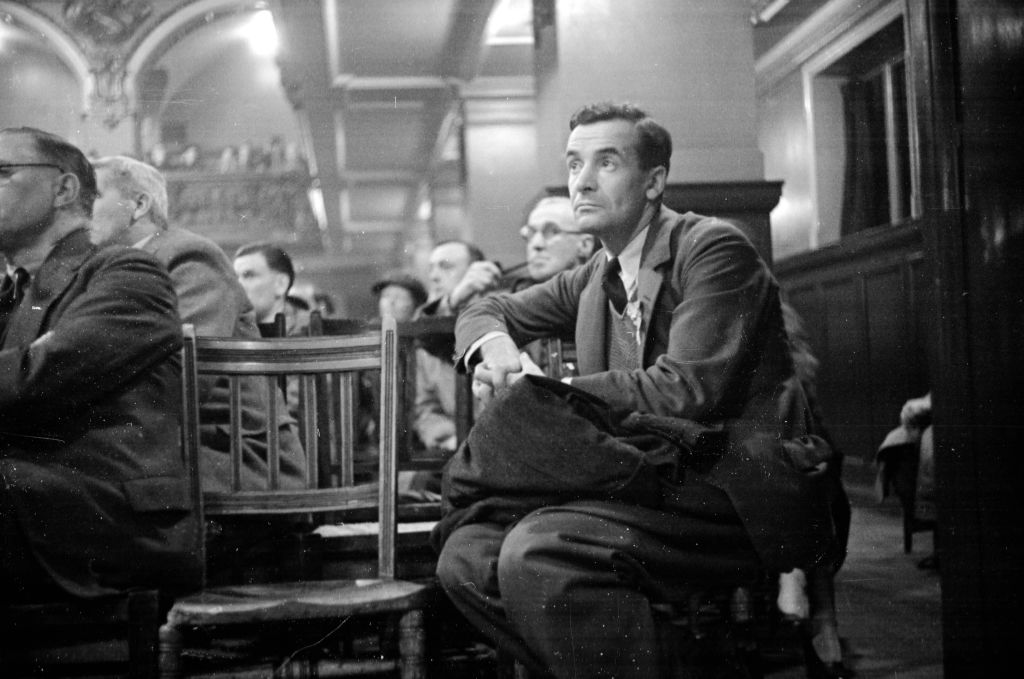
It has become fashionable on both the Left and the Right to attack universities as bastions of the elite. But at their best they are a model of a world driven not by narrow demands for efficiency or profit but curiosity and the leisurely pursuit of ideas. (Kurt Hutton / Picture Post / Hulton Archive / Getty Images)
“Their air of moral superiority is really an assumption that someone else will always cook their dinner,” wrote the historian A. J. P. Taylor in 1957 of the British establishment, a group he often referred to as “The Thing.” To no one was this term more aptly applied than the dons of Oxford and Cambridge. Those two universities, after two world wars and decades of social upheaval, still pave a path to membership in the country’s elite.
Disgust at Oxbridge for being a wellspring of snobbery, the humming engine of the British class system, or a finishing school of its imperial overseers has been routine since well before Taylor’s writing. Yet Taylor was writing as an insider, and his critique was one made in the spirit of warm familiarity. He was a don himself; he took his daily seat at high table at Magdalen College, Oxford, for almost forty years. He proposed that Magdalen’s chapel should be turned into a swimming pool and (more successfully) that women should be admitted, first to eat and then to study at the college.
His “iconoclasm” did not prevent his horror on returning postretirement to discover that dinner at the college had been reduced to a meager three courses. The son of a Comintern member, Taylor caused a scandal in the early 1960s by writing a book attributing World War II to diplomatic accident rather than Adolf Hitler’s bid for global domination. This scholarly belief in the historical power of bungling drove him to become a founding member of the Campaign for Nuclear Disarmament, dedicated to preventing the annihilation of the world through similar rake-stepping.
Figures like Taylor, treading heterodox paths through both ancient institutions and public life, are the center of Colin Kidd’s new history of the twentieth-century don. Kidd’s book is a rare thing: a generous and measured history of a subject that is capable of driving British people insane. A target of both Left and Right, the legend of the dons tends, as Mary Beard observes, to “simultaneously bolster nostalgia for a leisured intellectual world that we like to imagine we have lost, and fuel a crude anti-intellectualism that would eradicate all such superfluous luxuries.” Kidd manages to sidestep this pitched battle. Instead, he covers a history from the immediate postwar period of vitality and confidence through the student movement and Thatcherite austerity that succeeded in diminishing the role of the don and Oxbridge itself in British society by the 1990s.
The War Establishment
For much of the twentieth century, Oxford and Cambridge bore little resemblance to modern universities. As in much of continental Europe, a PhD was not a prerequisite for university teaching, and many of the dons were installed because they had shown promise as undergraduates. Both universities fetishized classics; Latin and Greek were required even for students of the hard sciences until 1960. Residential education retained the form, if not the actual content, of a monastic religious life. Until the 1880s, dons were prohibited from marrying, and social pressure to maintain the life of a bachelor remained strong well into the last century. Women had a much harder time dealing with these expectations. “If you must have children, kindly ensure that you have them in the University Vacation,” one lecturer at St Anne’s, Oxford, remembers being told in the early 1950s.
The war, however, launched the dons into the world. The philosopher Michael Oakeshott led a reconnaissance squadron in the Netherlands. The classicist Peter Fraser’s impeccable modern Greek allowed him to survive Gestapo interrogation when he was arrested while organizing guerrilla resistance in the Peloponnese. J. L. Austin, of ordinary language philosophy fame, meticulously mapped the topography of Normandy in advance of D-Day and wrote a classified armed services guidebook to northern France with the thoroughly donnish title Invade Mecum (a play on the seventeenth-century Latin term for a guidebook, vade mecum, or “go with me”). Less dashing service was no less central to the British war, including at its ugliest: the physicist Frederick Lindemann, who set up the Statistical Section at Downing Street, was the most prominent voice for the area bombing of German and Italian civilians.
The dry expertise of scholars was suddenly brought to life at an international scale: Guy Chilver, an Oxford scholar of ancient food history, was assigned to the Ministry of Food, where he was joined by his fellow Oxonian, the agricultural economist Keith Murray. Glyn Daniel offered his expertise in interpreting aerial photography as an archaeologist searching for monumental ancient structures to the Royal Air Force. His interpretive skills were so successful that he was sent to India to set up an entire training school for the Asian theater.
The war made the “impact” (as modern academia now requires us to phrase it) of the medieval universities obvious. With scholars of dead languages breaking codes at Bletchley and parachuting onto Crete behind enemy lines, the ivory tower came to look more like a frontline observation post. Military objectives and scholarly inquiry intertwined: Hugh Trevor-Roper’s blockbuster book The Last Days of Hitler was a product of his work for MI5; concerned about the political effects of rumors that Hitler was still alive, British counterintelligence sent Trevor-Roper to Germany to reconstruct the Nazi leader’s final days.
All of this produced an intellectual class unusually intertwined with political elites. Moving smoothly in many cases between government ministries and lecture halls, the dons constituted, says Kidd, “a highly unusual caste,” unique among the otherwise oppositional intelligentsias in the rest of Europe in their coziness with the ruling classes. The prewar leftist politics of many dons were effectively neutered by their war service, with dire consequences for the British left as a whole.
Kidd paints a collegial picture of postwar religiosity in the Oxbridge colleges. The Anglicanism woven into the corporate structure of the colleges and into everyday social life — the requirement to attend chapel, for example — was needled only by the occasional dissenting atheist or Catholic, but both groups understood that the true governing creed was politesse. The classics don and Labour politician Richard Crossman observed that one either paid “lip service” to Anglican rites, or “you went away and dug a hole for yourself.” J. H. Plumb, a committed atheist with rooms in earshot of the chapel, contented himself with running his bath and flushing his toilet during mass. What condition this might have created for non-Christians at college, especially Jews, who remained visibly outside these central events of social life and spatial accommodation, remains between the lines of Kidd’s account.
Balliol-by-Sea
The 1960s came on gently for the dons. Television held particular fascination. The Cambridge historian of political thought, Peter Laslett, whom Kidd identifies as one of the most ambitious figures rethinking British higher education at mid-century, set up the Cambridge University Television Committee, experimenting in closed-circuit television broadcasts of lectures to other universities and two-way broadcast interfaces for simultaneous research. Laslett and his compatriots specialized in new, conceptual forms of the university that they gave a series of increasingly metaphysical names: “Invisible College Cambridge” (known less evocatively as the National Extension College) ran adult courses by correspondence, while the Open University, originally proposed by Harold Wilson as the “University of the Air,” got up and running on television.
The Open University was preceded by the “Dawn University,” a set of televised 7:15 a.m. lectures on “the mathematics of violence.” Both were followed by the “University of the Third Age,” a nonhierarchical university of the elderly, in which aged students could offer their lifetimes of experience as both teachers and students. Balliol, in particular, seeded dons at a number of new institutions. A. D. Lindsay, who had been the college’s master, relinquished his comfortable position to become head to the University College of North Staffordshire, where he modeled the curriculum on Oxford’s “modern greats.” The philosopher John Fulton also left to lead the University College of Sussex (later the University of Sussex), where he implemented the teaching of philosophy, arts, history, classics, and languages in a civilization-centered approach that gave the new university the nickname “Balliol-by-sea.”
By the ’60s, enough American money was sloshing around to finance many of these expansion schemes. Isaiah Berlin’s friendship with Arthur Schlesinger Jr, a product of academic visits to Harvard, turned into an acquaintance with the Kennedy brothers, whom he tutored in Russian intellectual history. With the Kennedys came an introduction to the Ford Foundation, which would finance Wolfson College, Berlin’s project of a new postgraduate college at Oxford. The stream of dons trotting to America cap in hand did, however, give Berlin pause: “I really do feel we have become absolutely venal Greeks, going to Rome at every possible opportunity,” he wrote to Noel Annan in 1964.
Two Oswalds
The transatlantic fascination didn’t stop at their checkbooks. A riotous detour in Kidd’s account covers a period in which Oxbridge dining clubs and common rooms became a reservoir of alternative theories of the John F. Kennedy assassination. Prominent dons joined a British chorus of Warren Commission critics, pushing the theory that Lee Harvey Oswald had not acted alone, while the American academic establishment largely adhered to their domestic mood of national unity. An aged Bertrand Russell (Trinity, Cambridge) chaired the British “Who Killed Kennedy Inquiry” set up in 1964, whose members included Herbert Read, Kenneth Tynan, Michael Foot, William Empson, and Hugh Trevor-Roper.
Trevor-Roper went further, becoming the face of British Oswald skepticism. He published questions about Kennedy’s autopsy notes and erroneously accused the police of destroying Oswald’s paper gun-wrapping in the Sunday Times, the New York Review of Books, and the French L’Express, drawing the rebuke of his fellow historian John Sparrow (All Souls, Oxford), who quipped that “it is not the first time that a respected figure has come a cropper in public through slipping up on a paper bag.” Former Don Stuart Hampshire, on a sojourn at Princeton, promoted the “two Oswalds” theory that the shooter’s doppelgänger had been spotted in a number of significant locations in the months before the assassination.
The British debate spilled onto the American pages of Playboy, in which the most prominent domestic critic of the Warren Report, Mark Lane, asserted that Trevor-Roper had received a note from Bobby Kennedy telling him to “keep up the good work” in questioning the lone shooter consensus.
Embarrassingly, the note never existed; even worse, the gossip that Lane was repeating had come from none other than Lady Alexandra Haig, Trevor-Roper’s wife. Trevor-Roper wrote privately to Sparrow asking personally for the issue of Bobby’s phantom note to be laid to rest, given that the story was sparked by “an indiscreet observation, not by me but by another person in my presence who had got the facts wrong,” a request Sparrow honored. Even as the dons were savaging each other on the issue in ballooning numbers of words in the international press, they were also true to form, clubbily mending fences and equivocating behind the scenes.
The dons, as outsiders, could serve as a counterweight to the American consensus in the new postwar political environment, yet their own small villages remained the true center of their world.
What Exactly Do You Mean?
The highest value in this insular world was style. Kidd is a precise observer of the value of quick conversational wit in the intellectual culture of the dons. One’s field was not to be discussed at high table; linguistically imprecise or boring conversation invited the question “What exactly do you mean?,” a tic Kidd attributes to ordinary language philosophy. Quick-wittedness was as important and academic competence. This tradition of verbal sparring, from tutorials to lectures to the British Broadcasting Corporation serves to compensate, at least in part, for other tendencies toward academic hierarchy. Years ago, I was catching up with a Cambridge-trained friend who had returned from a conference of American PhD students. “But why,” he asked, “are they all so afraid to talk?”
The book carefully subordinates the personal foibles of the dons to his larger historical and structural account. And yet their eccentricities are one of the book’s great pleasures. Here is anthropologist Rodney Needham, whose priggish sartorial devotion moved him to cross the street to avoid tieless colleagues, taking the nudity of their collars as a signal they wished to avoid public contact. Here are dons with passions for hot-air ballooning, tarot cards, and Princess Margaret.
Kidd approaches even (perhaps especially) the most extreme cases of self-caricature with gentleness; the Cambridge historian J. H. Plumb is first introduced appearing for his entrance examination in 1929 only to realize that he is dressed, in his lower-middle-class finest, exactly like a college porter, giving his later devotion to violent snobbishness a mild pathos. Kidd’s is a theory of history attuned to the vagaries of his actors’ hearts, egos, and stomachs; Hugh Trevor-Roper’s boredom with his pack lunches while on sabbatical at the Clark Library in Los Angeles drives him to seek out the thrills of the Kennedy assassination controversy.
It was not only habits of behavior but habits of mind that united the dons, at their apex in the postwar decades, in a decisive unity. Classics remained the central intellectual preoccupation of both universities. The burgeoning field of sociology met strong resistance, judged a mix of obvious observations of the unwashed dressed up in deadly boring jargon, an inelegant and politically dangerous mix of “sex and socialism.”
The reception of the French structuralism of Claude Lévi-Strauss was far messier. The relationship of empirical fact to the French anthropologist’s theoretical architecture was a problem his English defenders, most notably Needham (Merton, Oxford), and Edmund Leach (King’s, Cambridge) set about studiously resolving through pedantic hairsplitting over the differences between prescription and preference in cousin-marriage practices. Yet it was Lévi-Strauss himself who turned on his English followers, baffled by their obsession with terminology. He declared open war on his coterie of English translators, whom he felt had fundamentally missed the point of his theoretical project. Eventually, his fiercest defenders rejected him as well, turning Oxbridge into a stronghold of resistance to French structuralism in general and Lévi-Strauss personally. Mary Douglas, the Oxford-trained anthropologist of religion with her own theory of taboos, would say Levi-Strauss hovered somewhere between “phrenology and the Piltdown man.”
Leaflets and Overnight Guests
Dons drew battle lines on both sides of the political scuffles of 1968. Student uprisings on both campuses lacked the vehemence of Paris and Berkeley but shook long-standing norms nonetheless. In June of that year, as students of the Sorbonne were running Charles de Gaulle (temporarily) out of town, two hundred Oxford students occupied the Clarendon Building, seat of the university’s disciplinary office, to demand the right to leaflet without prior authorization. The nastiest clash saw the historian Penry Williams thrown down the stairs of the Faculty of Modern History building in February 1974 by a group of students demanding a central student union (Williams was hardly a reactionary, spending the last years of his life assisting local asylum seekers).
It was the military dictatorship in Greece that provoked the largest clash at Cambridge, when, in 1970, a crowd charged the Garden House Hotel to disrupt a junta-sponsored tourism event for local travel agents. A fellow on proctor duty was hit by a brick, and eight student demonstrators were sentenced to prison time. At trial, students were supported by a number of members of the faculty, including the historian John Vincent, who had opened his rooms at Peterhouse to the students’ loudspeakers for the demonstration. Links to the classical world remained stronger than the dons had feared when they relinquished the Greek language requirement, though perhaps not in the precise sense intended.
The government, however, was moved by a fear of student radicalism wildly out of step with the movement’s limited successes; in a shameful incident, the German socialist activist Rudi Dutschke, who had come to Cambridge for doctoral research to recover after surviving multiple gunshots to the head in an assassination attempt, was deported over unfounded panic that he might be plotting a revolution in between seizures (Dutschke would drown in the bath during an epileptic episode in Germany eight years later).
On the whole, student demands at Oxbridge remained trivial — the easing of dress codes, noise regulations, and the evergreen issue of sex in the form of overnight visitation rights. As Kidd observes, pushback was as often a function of town-and-gown disjunction rather than reactionary institutionalism; at Queens, Cambridge, it was the working-class bedmakers who objected to overnight guests in college rooms.
Much Oddness
Kidd arrives at his titular twilight in the 1980s. By the Thatcher years, the understated Christian socialism of many of the dons had curdled into the “outlandishly baroque” phenomenon of Tory Marxism, whose adherents adopted the methods of materialist historical analysis in the interest of retrenched state power. Roger Scruton, John Casey, and Maurice Cowling, in the vanguard of the Cambridge right, pushed back on the fetishization of the market, identifying what they saw as a fundamental error in Friedrich Hayek’s acceptance of liberalism’s elevation of the individual over institutions.
As the confidence brought on by the dons’ wartime service dissipated, so too did the consensus opinion that the war itself had been a triumph. Correlli Barnett (Churchill, Cambridge), for example, keeper of no less than the Churchill Archive, accused wartime social idealism of enabling a sluggish, disorganized economic culture that would have been no match for the Germans had the Americans and Russians not intervened.
For Kidd, the rise of the Cambridge right is of interest less for its meaningful influence on British politics than as a symptom of “a turn away from the postwar consensus and the previously unchallenged authority of an omnipresent donnish liberalism.” Yet even the most flamboyantly conservative dons remained staunch defenders of Oxbridge’s privileges, pushing back against government attempts from outside to meddle in university business. Maurice Cowling’s loathing of his liberal colleagues did not prevent him from writing that if British higher education was to have any intellectual heft, “much oddness has to be put up with.” The culture of the dons might have been maddeningly hidebound, but it was a necessary precondition of interesting thought.
The dons’ resistance to being corralled came to a head in January 1985, when Oxford’s Congregation voted two to one to deny an honorary degree in civil law to Margaret Thatcher, previously a routine accolade for Oxford-educated prime ministers. The incident was pilloried in the press as a sign of a dangerously left-wing university culture. But as Kidd shows, the anti-Thatcher campaign’s success rested on the desire to send a message on a quotidian and specific issue: funding cuts to higher education.
By the mid-’80s, rumblings of major restructuring by the Conservative government were audible. The University Grants Committee, which had genially loosened the spigots of government money for seventy years, allowing for little interference from above, hung on in diminished form through major cutbacks in 1981 and 1985, before it was finally abolished in 1989. By 1992, a number of Oxbridge colleges faced major shortfalls and were forced to launch public appeals for funds. With the end of the cooperative model of resource sharing among British universities, even Oxbridge found itself competing for students and funding in a cutthroat market. With more of their time consumed by ballooning research responsibilities and out of fashion on both the Left and the Right, dons have seen doors close to them in the corridors of power, should they even bother to knock.
What Kidd’s history clarifies is the way in which these changes have perverted Oxford and Cambridge’s relationship to the broader system of higher education in Britain. The introduction of entrepreneurial imperatives has in fact led to less innovation and accessibility for students. Before universities were forced to eat each other’s lunches, Kidd shows the dons as a driving force for the broad expansion of higher education that would meet the needs of students who were often radically different than those who had traditionally gone up to Oxbridge.
In many cases, talented scholars gave up coveted positions to guide new institutions, experimenting with new educational approaches. Ironically, it is the jargon of entrepreneurial competition that has destroyed much of the diversity, dynamism, and quality of UK universities and created a situation in which the dons, still undeniably the most privileged actors in British academia, rarely poke their noses above their own parapets.
Stefan Collini has pointed out that the continued visibility of the rituals of the British class system at Oxford and Cambridge today serves as a convenient smoke screen for the new financial oligarchy’s rise to power. While the robed academicians are easy to hate, Kidd’s history is a reminder that something risks being lost in the dons’ cultural sunset. Hugh Trevor-Roper warned in 1951 of a “party of darkness” within the university, producing only “efficiency and dullness.”
Such a description is instantly recognizable in the current crisis, with its senseless waste of academic talent, curiosity, and interpersonal devotion, threatening to eliminate both particle physics and French as fields of human knowledge in Britain, sacrificed at the altar of an entirely manufactured scarcity. Darkness could, in the words of the don, only be countered by a “party of light,” clear-eyed in its pursuit of a university that was a place not only of learning but also, in terms even more radical today than they were half a century ago, “of pleasure.”