In Peru, Keiko Fujimori Promises Order, Not Reconciliation

Keiko Fujimori has become Peru’s president after another narrow election runoff. While in past contests she tiptoed around her father’s authoritarian record, this time she capitalized on his strongman image.
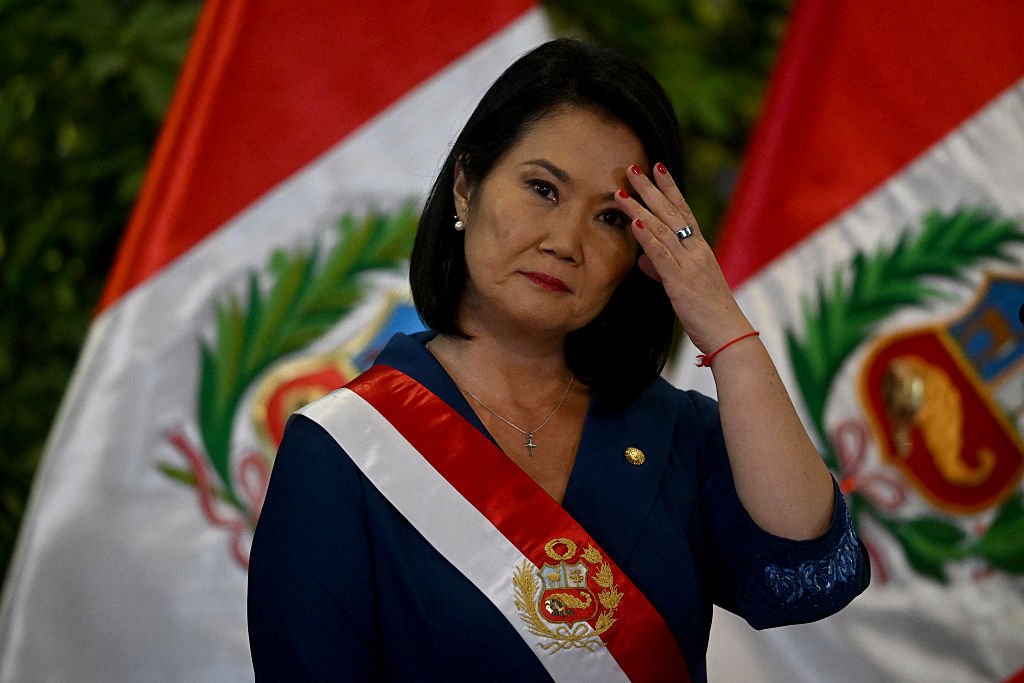
Peru's President Keiko Fujimori gestures during the swearing-in ceremony of the new cabinet at the Government Palace in Lima on July 28, 2026, following her inauguration ceremony.

Peru’s new president Keiko Fujimori has often euphemistically been called a populist. In practice, this means combining free-market reforms with more powers for the military and attacks on legal protections. (Connie France / AFP via Getty Images)


The polling stations had not long been open when Keiko Fujimori reached the cemetery with her younger sister and her teenage daughters. Dressed uniformly in starch white blouses and blue-wash jeans, they proceeded across the lawn, each carrying a sheaf of roses and carnations. The elder women knelt at their mother’s grave and placed the blush pink flowers in a vase. Heads bowed, they lingered a short while. Then, hand in hand, they walked another twenty paces among the headstones. For her father Alberto, who was Peruvian president from 1990 to 2000, Keiko had brought an arrangement in the national colors of red and white. She led the family in prayer before turning to smile at reporters. Later that day, she cast her vote in a presidential election where, at the fourth time of asking, she won the country’s highest office.

Keiko’s visit to her parents’ tombs was a belated response of sorts to Alberto Fujimori’s detractors, who derided a president without any forebears buried in Peruvian soil. Fujimori was merely the son of Japanese migrants when he burst onto the political scene upon his first election in 1990. His surname had no precedent or meaning. Shortly after arriving in Peru in the 1930s, Alberto’s father had adopted a new name. Fujimori translates loosely to “wisteria wood.” It was a fitting choice. He would go on to open a florist business in his adoptive country where Alberto worked as an adolescent, delivering spectacular sculptures on his bicycle to the modernist mansions of Lima. From humble beginnings, Fujimori rose far and fast. Further still he eventually fell, sentenced in 2009 to twenty-five years in prison for human rights abuses and corruption.

Now Fujimori bones lie deep in Andean earth. Even so, Keiko’s lineage surely remains controversial. For two generations, Peruvians have followed the elaborate plotlines of dramatic family feuds, beginning with the spat between her father Alberto and her mother Susana Higuchi, who was also part of the Japanese community. Their widely publicized conflict emerged in 1992, when Higuchi accused her husband’s family of misappropriating charitable donations sent from Japan. Keiko first came to public view during their acrimonious divorce: when she was just nineteen, her father, as president, invited her to replace her mother as First Lady. A successful businesswoman and twice member of Congress, Higuchi would aspire to the presidency herself, though her ambitions were extinguished by a vengeful campaign orchestrated by her ex-husband to block her nomination. She retaliated by claiming that she had been tortured on Fujimori’s orders. The tumultuous relationship between Susana and Keiko has long been a subject of speculation. This squabbling has not played out in their favor. Peru is a conservative nation that places great value on integrity and discretion, especially among the elite and the influential.

Alberto Fujimori died in 2024, age eighty-six, shortly after his compassionate release from prison. His demise gave Keiko new freedoms in her latest presidential campaign, not least the chance to rewrite her family’s story featuring a reconciliation between her parents on Higuchi’s deathbed. Similar olive branches have, according to Keiko’s staging, been extended among members of the wider family. At Fujimori’s funeral, Keiko embraced her distraught brother, Kenji, whom she had expelled from her Fuerza Popular party back in 2018 after he refused to support her attempt to impeach sitting president Pedro Pablo Kuczynski. In return, Kenji won Kuczynski’s pardon for their father (although this was promptly reversed by the Supreme Court, postponing his release for six more years). Keiko justified her opposition to Kenji by stating that Fujimori should be fully absolved by the judiciary and not simply exonerated by the executive. Critics pointed out that she was putting the political stakes first, rather than really trying to liberate her ailing father. In 2022, Keiko announced the end of her eighteen-year marriage, though emphasized an amicable separation. This February, Keiko’s own daughter attacked her antiabortion policies to over four hundred thousand followers on Instagram. Keiko attributed the post to healthy political debate and not familial tensions.

Keiko’s message of unity is not only a private affair. Peru’s first elected female president has also promised to unite a polarized nation. The past four elections have split votes almost exactly down the middle: each time Keiko has lost, it has been by a tiny margin. Ultimately, she too barely edged the contest, after votes from Peruvian emigrants tipped the balance in her favor. At home, her base is concentrated along the urbanized Pacific coast, coming from industrial cities like Chimbote, Chiclayo, and Trujillo. In the runoff, she captured conservative votes in metropolitan Lima from its flamboyant former mayor, Rafael López Aliaga, a business tycoon and Opus Dei member. Rural districts in the Andes and in the Amazon, meanwhile, lent their backing to leftist Roberto Sánchez. Running for Juntos por el Perú, Sánchez campaigned to redraft the constitution, promoted state-led development and police reform, and promised justice for victims of state repression during the armed struggle of the 1980s and ’90s. More symbolically, Sánchez’s candidacy represented vindication for his ally, Pedro Castillo, who was president for sixteen months before his impeachment in 2022 and who is currently serving eleven years in prison for attempting to close Congress. In the end, Sánchez’s leftist program was trumped by Keiko’s pro-market, strong-state agenda that endorsed hard-line security and the expansion of the army while downplaying the social legacies of the civil conflict.

Peru With Order?

Unity, in this sense, does not mean true national reconciliation but rather the consolidation of a right-wing populist coalition around the Fujimori surname. Indeed, it is Keiko’s tough stance on crime that has galvanized her supporters, some applauding her father’s violent crusade against Maoist armed group the Shining Path that resulted in their almost total obliteration and put an end to the internal conflict. Whereas in her previous presidential campaigns Keiko had tiptoed away from her father’s legacy, in this attempt she capitalized on his reputation as a strongman. This strategy resonated with residents of informal urban communities in particular. Crime rates in Peru have surged over recent months, becoming a major source of fear. Gang violence has reached unprecedented levels across the country. Low-income neighborhoods are blighted by street theft and extortion. Since 2019, the homicide rate has increased from 7.4 to 10.7 per 100,000 inhabitants. Running under the slogan “Perú con orden” (Peru with Order), Keiko has prioritized public safety and has pledged to dismantle the transnational criminal networks that operate within Peruvian territory. Her security policies state that she will deploy soldiers in high-crime areas, increase prison capacity, reform the penitentiary system, and strengthen the policing of international borders. Championing national defense forces, she also seeks to empower national intelligence agencies, increase the military’s autonomy from the courts, and withdraw from the Inter-American Court of Human Rights. Such authoritarian tendencies suggest that, at least in the war on crime, Keiko’s rule pursues a continuation of Fujimori’s internal politics.

Still, Keiko steps into a very different kind of government. In 1990, her father won by a landslide. Two years later, he closed Congress and suspended the constitution before instituting a unicameral constituent assembly designed to condense power in the executive. Keiko has no such mandate. This year marks the restitution of a bicameral chamber after it was dismantled by her father. Fuerza Popular does not have an absolute majority in either the Chamber of Deputies or in the newly established Senate. In order to govern effectively, Keiko will be obliged to form cross-party coalitions. Her legislation will be doubly scrutinized. She will be urged to engage in dialogue by a weary electorate desperate to overcome a decade of hamstrung governance. Peru has seen ten presidents in as many years. Most of these have resigned, have been removed, or have been imprisoned. Some, like late-2010s President Pedro Pablo Kuczynski and then Castillo, have fallen as a result of Keiko’s schemes to utilize congressional powers in pursuit of her own agenda. This weaponization of Congress pays testament to a political system that allows the ambitions of individualistic leaders to congeal in partisan organizations. Yet Keiko is not immune to these machinations either. She has fallen victim once before, jailed for sixteen months when undergoing an investigation for corruption that was later dropped but that might yet reemerge. She will be incentivized, then, to negotiate.

Keiko’s broader interpretation of democratic freedom is yet to be seen. On July 28, hundreds of men and women traveled from across the country to the center of Lima to protest her inauguration. Among them were relatives of people killed during the widespread demonstrations against Dina Boluarte, Castillo’s vice president, who came to power with backing from Fuerza Popular after his removal. In the tumultuous months that followed her ascent, Boluarte deployed the military to dissipate protests in southern cities, resulting in the deaths of at least forty-nine civilians. The protesters accuse Keiko of complying with state violence by protecting those responsible for the killings, viewing her election as an indication that Peru endorses a culture of impunity. This pro-Castillo group joins forces with families of those murdered or disappeared by the military death squads that were overseen by Alberto Fujimori in the 1990s. Marching alongside students, socialists, and trade unions, they have resurrected an iconic flag-washing ritual that was used to denounce corruption during the president’s final year in office. In the past, Keiko has largely ignored this popular articulation of the anti-Fujimori movement. This may change, as she too sets out to cleanse Peru.