Israel Has Robbed Gaza’s People of Their Homes
Israel has systematically destroyed 135,000 buildings across the Gaza Strip, an orgy of vandalism that has continued since the declaration of a ceasefire. It is obstructing all efforts at reconstruction with the aim of making life in Gaza impossible.
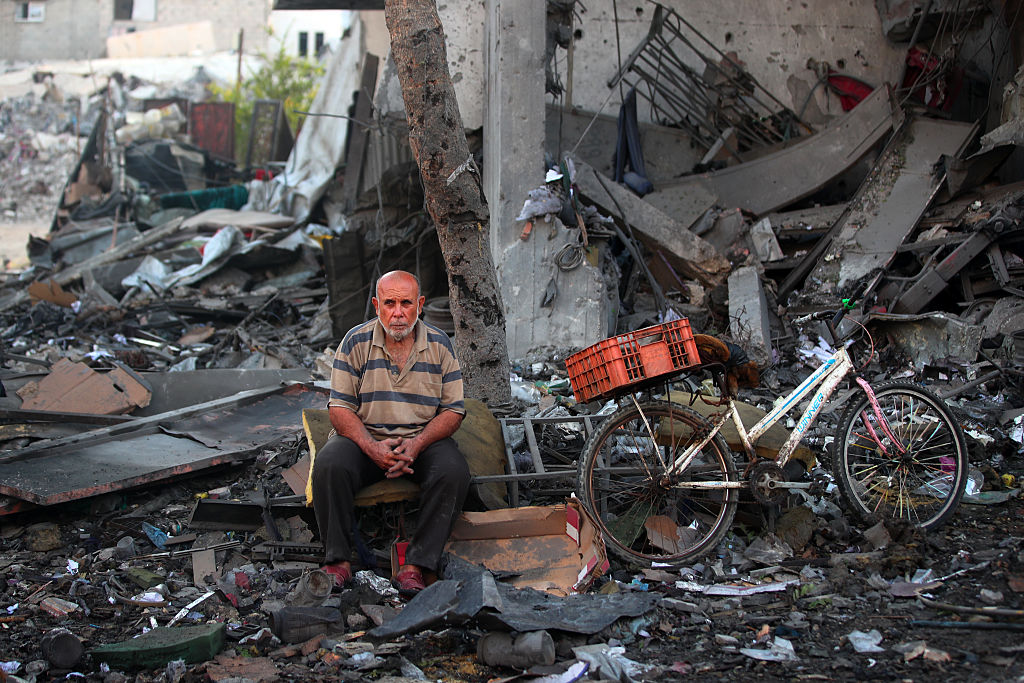
After breaking the Gaza ceasefire in March 2025, Israel massively increased its destruction of Palestinian homes. In just seven months before another ceasefire in October, it destroyed as many structures as it had in the previous year and a half. (Majdi Fathi / NurPhoto via Getty Images)
One year ago, on August 3, 2025, Israel destroyed my family’s house in El-Tuffah, a neighborhood in Gaza City. Israel did not bomb the house or demolish it with artillery shells. A remote-controlled vehicle packed with explosives drove down our street before detonating.
That is how Israel destroyed a house that stood for four generations. During the genocide, our house became shelter for four families. But when it was destroyed, barely any rubble was left.
I know how our house appears in the destruction data, because I helped trace and visualize it. At GazaIndex, we trace the data: 134,422 destroyed structures across the Gaza Strip; 34,666 in Gaza City; 2,575 in El-Tuffah. One of them is ours.
But what this record does not convey, besides the sweat and tears, is how many families it sheltered during the genocide. It does not tell us that it was the only thing standing between them and a tent. The record of Gaza’s destruction, so far, cannot tell us what was actually destroyed.
This blind spot is about to shape Gaza’s future. Every reconstruction plan, from that of Oxfam to Donald Trump’s Board of Peace, is built from this record. Meanwhile, Palestinians appointed to plan the rebuilding are still not allowed to enter Gaza. Before the reconstruction begins, it is worth asking what the record counts, and what it has refused to count so far.
What Did a House in Gaza Mean?
A house in Gaza was never just a house. For many Palestinians, a home represents generations of sweat and tears. Under occupation and blockade, Gazans cannot put their savings into pensions, 401(k)s, or similar funds. Many families, including mine, invested everything in building a house that could carry us through the good days and the many bad ones.
Our house in Gaza stood firm for four generations, carrying our memories and us. My grandparents always talked about how it took them years to build one floor that housed them and my (young) father at the time. My father continued the tradition, renovating the house when it came to hold me and my sister. It was our safety net, our safe space. For many in Gaza, a house was what preserved a family’s pride through the suffering the blockade and occupation produced.
Since October 7, the relationship of Gazans with their homes has gone somewhere deeper. For many, the house became a memory, because Israel destroyed it. Others, like my family, evacuated Gaza. Leaving did not make the house mean less.
Our house survived months of bombardment and became a shelter. My aunt and her extended family moved in over the first year and a half of the genocide. However, Israel kept attacking the area, often issuing repeated evacuation orders. My aunt and the three other families living there would leave, wait, and return once the Israeli army moved on from the area. Returning always meant going back to more death and destruction. The last time they returned, much of our house was damaged.
But in Gaza, half a house is still plenty of house. Our half meant my aunt’s family had a roof above them. They could sleep without fear of catching cold, and winter would not overwhelm a tent. Theirs was the story of many families in Gaza during the genocide. But that story did not last.
What the Record Can’t See
In January 2025, a ceasefire paused the bombings for two months. More than a million and a half Palestinians walked back to their homes and neighborhoods. Many found their houses destroyed. Many others found half a house still standing, and, as I have said, half was more than enough.
People told news crews they would live among the rubble, in the one room that survived. The scenes coming out of Gaza in those two months were ones of hope and resilience. Israel learned the lesson.
On March 18, 2025, its forces broke the ceasefire, and this time they had a goal in mind. In February 2025, the record showed 70,436 destroyed structures in Gaza. By October 2025, the number passed 123,400, an increase of 75 percent. In just seven months, Israel destroyed as many structures as it had in the previous year and a half.
Israel will argue, again, that it was attacking Hamas. But my house tells a different story, and so do tens of neighborhoods like ours. The Israeli military packed remote-controlled vehicles with tons of explosives, drove them into residential streets, and detonated them.
Entire neighborhoods vanished. Our third-floor house barely had any rubble. They destroyed it as if it never existed. Despite the ceasefire since October 2025, Israel has continued to destroy structures in Gaza. Since October 2025, the proportion of affected structures has increased by 1.5 percent, while that of destroyed structures has increased by 9 percent — the damage is deepening rather than spreading
This process of destruction is among the most documented in modern history, from satellite imagery analysis to millions of videos uploaded from Gaza. The data can tell us which structures were affected, which were moderately damaged, which were severely damaged, and which were destroyed.
I know this record well because I helped trace it and show it. At GazaIndex, the destruction data can go from the Gaza Strip (134,422 destroyed structures) to Gaza City (34,666 destroyed structures) to my own neighborhood of El-Tuffah, with 2,575 destroyed structures, one of which is my house. The record can show if a structure stood on that street, and if it no longer does so today.
But what it cannot know is that a house, like ours, sheltered four families. Nor can it know what those structures meant. They didn’t mean rocks. They meant shelter, water, Wi-Fi, a way to generate electricity (when there was any). They meant a possible future.
There is no data field that can trace that. This blind spot is not a flaw in the record. It is the shape of the record.
Rebuilding From a Blind Record
The record of Gaza’s destruction is not only a way of remembering the past. It is also a question of how the future is being planned, since this record is the very raw material of every reconstruction plan.
The chain of this process is simple: satellite assessments classify buildings by their physical condition; classifications feed data points to the current damage estimate; and the estimates become cost figures. This figure decides where the money goes. A recent report by Oxfam states that the total physical damage in Gaza is estimated to be $35.2 billion, a figure produced by counting structures.
Every step in this chain suffers from the same blind spot. A plan built from the structure count can rebuild a set number of housing units and ensure that the progress toward rebuilding Gaza is underway. But Gaza, as we once knew it, has changed.
Nothing in those plans ask how many people lived in each house. Was it one family or five? Were they relatives or neighbors? Were they both relatives and neighbors? What if that family has left Gaza? Or worse, was that family killed by Israel?
Who decides upon the plan matters as much as what it counts. Earlier this year, the Board of Peace, created by the Trump administration to administer Gaza, appointed fifteen Gazans to the National Committee for the Administration of Gaza (NCAG). While the committee members were chosen by Palestinian factions and vetted by Israel, they are yet to enter Gaza. So far, Israel has not allowed them to begin their work, even though they have been vetted and despite the move by Hamas to dissolve its government in Gaza.
How is this related to reconstruction? It means that the NCAG will continue to plan Gaza’s reconstruction from outside, using the data that have clear blind spots. It will not be able to work with experts on the ground, consult families, and plan a reconstruction that ensures that Gazans are not pushed out of it.
So far, the Board of Peace has gone from a declared aim to rebuild the entire Gaza Strip to a far more limited one of rebuilding parts of Rafah, the city on the border of Egypt, just to satisfy Benjamin Netanyahu. Once again, Israel wants to push Gazans to Egypt, but this time by not allowing the reconstruction of their homes.
This process that disregards Gaza’s close family relationship and rebuilds no more than a small part of the Gaza Strip will certainly result in ethnic cleansing. Gazans have suffered enough to go through this, again.
Rebuilding
A record built by Palestinians would start from a different question. Not “What was destroyed?” but “What has to exist for people to stay?” The first thing it would count is shelter, not structures. The data we need is no longer only about which structures still stand. We also need to ask who currently has a shelter and how we can shelter more people in less time.
But in order to do this, Palestinians have to be allowed to start working on counting this data. The NCAG must be allowed to start this long-delayed process of asking the right questions in order to plan Gaza’s reconstruction. Every day that passes without its entry into Gaza is a day closer to ethnic cleansing.
The suffering in Gaza continues. Israeli bombings have not stopped. Prices are 150 percent higher than they were before October 7, and the majority live in tents. This cannot continue. We should continue to pressure our local governments and elected officials to ensure that the Palestinians are the agents of their reconstruction, not real estate agents from New York City like Steve Witkoff.
On the day I learned our house was gone; I sent my father four words: we will rebuild it. Let’s ensure that all Gazans get a chance to do that.