Ireland’s Left Should Lead the Campaign for Irish Unity

Ireland’s conservative parties are weaker than ever, but the forces of the Irish left haven’t been able to cohere around an alternative. A campaign for Irish unity based on radical change in both parts of Ireland could help break the logjam.
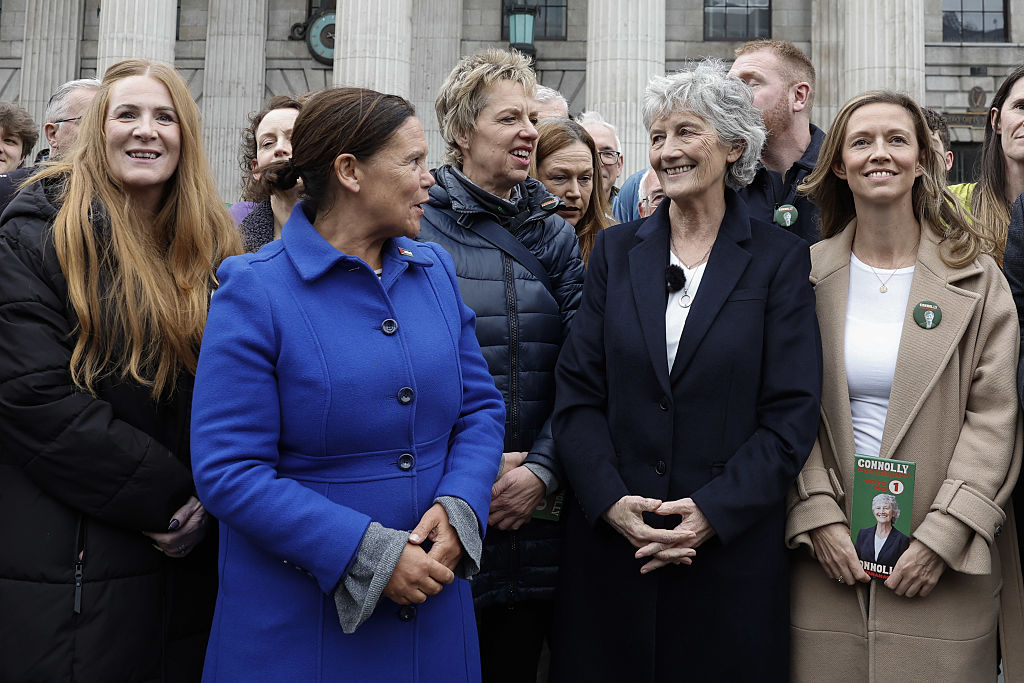
Irish presidential independent candidate Catherine Connolly on the campaign trail in O’Connell Street, Dublin, with supporting politicians from other political parties, including Councillor Janice Boylan, Mary Lou McDonald TD, President of Sinn Fein, Ivana Bacik TD, leader of the Labour Party and Holly Cairns TD, leader of the Social Democrats, on October 5, 2025.

An unprecedented alliance of Irish left-wing parties, from social democrats to Trotskyists, came together to elect Catherine Connolly as president last year. Translating that unity into a push for Ireland’s first left government is proving much trickier. (Conor O’Mearain / PA Images via Getty Images)


Earthquake elections are rare under Ireland’s unique form of proportional representation. Trends unfold slowly, and elections yield identikit governments, coalitions after coalitions that do little more than tinker with economic and social policy. But two parliamentary by-elections in May this year did capture a clean snapshot of the country’s main electoral dynamics.

In Dublin Central and Galway East, Fianna Fáil suffered some of its worst-ever election performances, less than two years after it returned to power as part of the latest coalition government. Stuck on a similar path of secular decline, Fine Gael won the Galway West seat by a slender margin in a rebuff to doomy predictions, but its candidate only defeated the ascendant right-wing party Independent Ireland with the help of vote transfers.

Daniel Ennis, a former footballer who entered politics to oppose racism in his inner-city community, took the Dublin Central seat for the Social Democrats, edging past Sinn Féin. His party, known as the Soc Dems, is a rising force in Irish politics and particularly popular with young people.

Some jumped to claim this as a scalp for the “Connolly coalition.” This is a loose network of parties, stretching from the radical-left People Before Profit (PBP) to the centrist Green Party, that came together last year to campaign for the presidency of Catherine Connolly.

For PBP’s Paul Murphy, the combined 60 percent vote for the broad left showed that a formal transfer pact and preelection agreement on policy — an organized “left alternative” to the century-long governing project of the two conservative parties whose roots go back to the Irish Civil War — will be both feasible and popular come the next general election in 2028.

Rituals of Unity

Yet there has been a certain ritualistic quality to these overtures and their inevitable rejections. When almost anything happens in Irish politics, PBP can be heard bellowing about the need for transfer pacts to bring about a first “left government.” When Sinn Féin underperforms or fears an underperformance, it reasserts some form of “left-republican cooperation” as a guiding principle, flirting with the idea of a common left platform. Outside of tense election phases, however, the party sweeps the idea neatly under the rug.

When Labour ponders its abysmal current standing and even more abysmal likely future, it beckons for a soft-left bloc alongside the Green Party and the Soc Dems, a negotiating vehicle that could enter government talks directly with Fianna Fáil and Fine Gael after the next election, free of the Marxist taint of PBP and the baggage of Sinn Féin’s republican past. But these unprincipled power-seekers would discard even such a bloc-within-a-bloc if a future seat total gave them enough heft to prop up yet another center-right government.

And when the Soc Dems, originally formed as a breakaway group from Labour, heed the views of their most radical supporters, they conjure radiant visions of a united front, eager to talk up the prospect of a left government and careful to invite the radical left to meetings from which Labour sought to exclude it. Yet the party leadership has unequivocally ruled out formal cooperation while inconsistently and half-heartedly promoting informal voting agreements. In short, all parties bar PBP treat the concept of left unity as window dressing.

The Connolly Coalition

One of the buzziest postelection stories — at least for bored political correspondents who enjoy cozy relationships with politicians — has concerned the frailties of the previously vaunted Connolly coalition. There are, we are beginning to be told, unbridgeable differences between its constituent parts. In the wake of a stream of “public criticisms,” a well-briefed reporter even declared the burgeoning alliance dead.

PBP, Labour, and the Soc Dems have all repeatedly voiced concerns about Sinn Féin’s opportunistic drift right on immigration. The center-left parties also fret over the party’s “populist” opposition to certain forms of taxation. Tentative signs of unity have, however, been visible at least three occasions.

After the latest coalition government was formed in 2024, the parties of the Left spoke as one to vociferously oppose a plan to hand pro-government independents the speaking time of opposition Teachtaí Dála (TDs). They have also united at various points to push back against attacks on Irish neutrality and to support a full ban on trade in both goods and services with Israeli settlements in Palestine.

Somewhat miraculously, these parties canvassed and campaigned together as part of the joint presidential campaign for independent socialist Catherine Connolly, who ended up winning 63.4 percent of the vote — the largest vote tally and share for any presidential candidate in the state’s history.

Sinn Féin leader Mary Lou McDonald hailed this “historic political effort which, for the first time, brought together the combined Opposition to present a positive alternative to the jaded politics of Fianna Fáil and Fine Gael.” Unwilling to allow the momentum to dissipate, PBP called for “a major conference of the left to discuss the next steps of continuing and deepening left co-operation.” For her part, Soc Dems leader Holly Cairns opted for a vacuous Obamaism: “Change doesn’t stop here.”

But the presidential election was not a good bellwether for the promise of a left government. Before long, talk of a unified candidate in the Galway West by-election came to nought.

Connolly’s own election campaign had focused on the issue of neutrality, and the coalition behind it was fragile and ramshackle. Sinn Féin appeared to back Connolly only because of a dearth of suitable internal candidates and her increasingly outspoken views on reunification, while Labour only got on board reluctantly due to Sinn Féin’s presence.

Despite the kumbaya optics of the Connolly campaign, it is unrealistic to suggest that any of these forces has ever desired an unconditional form of “left unity.” Attempts at unity have foundered on questions of ideology, strategy, personality, and policy.

This degree of fractiousness may seem absurd, but behind it lies a crude rationale. The electoral system often rewards small parties with seats, minor influence, and — if you play your cards right — ministerial berths. And perhaps nobody understands this fact better than Sinn Féin, which is desperate to escape the cordon sanitaire it has been placed under by the establishment parties.

The All-Ireland Agenda

After his party’s disappointing performance in the 2024 general election, Sinn Féin Chairperson Declan Kearney’s postmortem analysis repeated the customary out-of-election plea for, in his Corbynite phrasing, “a political axis representing the many, not the few.” When it was already too late, here was a member of Sinn Féin’s inner sanctum making the case for an opposition manifesto to buttress a “progressive left republican bloc which respects the independence and autonomy of cooperating political parties, and other TDs.”

But this kind of intervention was nothing new. Back in 2003, a fresh-faced Eoin Ó Broin, now the party’s erudite spokesperson for housing, made a similar call for his party to target working-class voters as part of a “left/green/republican alliance” that exists both “inside and outside of political institutions.” In the pages of the party’s newspaper, he was responding to a public debate that had erupted over Sinn Féin’s ideological direction, after accusations it had dialed down the socialist component of its self-professed ambition for a thirty-two-county socialist republic.

In this context, we should read Kearney’s comments in 2024 not as an attempt to galvanize support for a left-wing government — something his party doesn’t advocate for these days — but as a repackaging of its decades-long reunification agenda. Sinn Féin’s long journey to the center began, after all, early in the peace process, not when it started recycling talking points on immigration from Ireland’s far right in the mid-2020s.

A party that once made strident anti-capitalist arguments, proposed a radical decentralized federal reunified state, and called for the revolutionary overthrow of the island’s two partitionist statelets was, in the post-peace-process era, snookered by the White House and the British state into becoming a more familiar — and less dangerous — kind of constitutional nationalist party.

Eager to be accepted by the Irish electorate and trusted by capitalists (foreign or domestic), it decommissioned Irish Republican Army weapons, accepted British institutions of law and order, and entered a power-sharing executive with the Democratic Unionist Party in the North. It also supported juryless trials that were used historically to persecute its own militants, condemned modern republican groups as “traitors,” and expunged democratic socialist ideas from its programs.

In the early 2000s, the party pursued a fresh constitutional strategy aimed at reuniting Ireland, which became known as the all-Ireland agenda. National unity could be achieved, it felt, through an extension of the various cross-border bodies the Good Friday Agreement had created. Sinn Féin could also erode the border by turning electoral strength into a border poll and using these “republicanized” all-Ireland structures as the foundations for what it grew to call an “Ireland of equals,” a thoroughly liberal vision of a thirty-two-county state.

Tactics included campaigning to secure the right for Northerners to vote in Southern presidential elections. But this strategy mainly involved creating the conditions for economic and political integration, in an approach that is best termed as technocratic anti-partitionism. Sinn Féin believed that effective cross-border bodies would pave the way for a thriving all-island economy, which would in turn be the prelude to a united Ireland. In the decades before Brexit, the party consistently claimed (without evidence) that the agreement’s implementation bodies were making the border redundant.

Technocratic Reunification

Later Sinn Féin made impressive electoral advances in the South when it deployed anti-austerity rhetoric after the 2008 financial crash. In the North, it progressed simply by continuing to exist as the nationalist face in a power-sharing system, patiently reaping the rewards of demographic change. Meanwhile, it proved its managerialist mettle by cutting education and health care funding, endorsing private finance initiatives, and incessantly calling for cuts in corporation tax.

By the start of this decade, the party was dominating oppositional politics south of the border, and it became the most popular party in the 2020 general election with one-quarter of the vote. This seemed to mark the arrival of a long-standing objective of the Irish left: a realignment of party competition along a clear Left-Right axis.

Sinn Féin’s support rose even higher during the pandemic, with an average polling score of around one-third of the vote from early 2021 until late 2023, at which point it started to lose ground. Its eventual result in 2024 was more than 5 percent lower than its 2020 vote share.

One could explain this decline in part by reference to the new salience of immigration as a political issue. However, it was also related to a perception of the party as an already exhausted government-in-waiting, an ineffectual perma-opposition worn down by a prolonged stint on the sidelines, bruised by forces to its left and right.

As PBP likes to point out, Sinn Féin’s unwillingness to develop a preelection left-wing compact potentially holds its vote back. But its single-minded focus on a confusingly technocratic vision of reunification further confuses workers in need of systemic change.

Despite all the shrill rhetoric from conservative opponents about its supposed threat to the state’s economic model, Sinn Féin’s approach to Southern politics in particular has been characterized by equivocation and triangulation, particularly over abortion, climate change, immigration, and trans rights.

In 2022, the Sunday Business Post revealed how the party of aging revolutionaries was beginning to ingratiate itself with various sectors of the Irish state, from corporate lobbyists to senior civil servants. It recounted a charm offensive to the American Chamber of Commerce by Mary Lou McDonald, who had also recently met with senior Silicon Valley executives. By 2024, the investment group Davy was advising its clients, following discussions with Sinn Féin politicians, that its economic program was “more ‘New Labour’ than ‘Corbyn Labour.’”

The Contradictions of Left Unity

On the radical left, there are broadly two schools of thought on left unity: People Before Profit’s call for a “left government,” and a more revolutionary posture from its Solidarity partners, based on steering clear of a reformist government to focus on building independent working-class power.

According to PBP’s Paul Murphy, writing after Catherine Connolly’s victory last autumn, the party should only enter a government that “commits to a people-power strategy of mobilizing from below to overcome the opposition of the powerful capitalist class and deliver ecosocialist change.” Murphy acknowledges that a strategy of that kind is not likely to be on offer from the other parties that supported Connolly and is open to supporting a less radical government from the outside:

We want a left government, even on a programme far weaker than the ecosocialist one we would advocate. We want this government and the approach of reforming capitalism to be tested before the masses. We are therefore open to participating in this dynamic towards a left government, including committing to vote to allow this government to be formed, despite the very significant limitations of the likely programme.

Many on the Irish left agree, seeing potential for a local incarnation of France’s New Popular Front: a mass political electoral alliance that develops and relentlessly promotes a joint policy program promising rupture with the status quo, not merely “change.”

For its part, Solidarity accuses its Trotskyist rivals of “sowing illusions in Sinn Féin” and drafting a “recipe for demoralization,” as well as avoiding the difficult question of stating “red lines” for involvement in any left government. Another critic of the left government strategy makes the salient point that it unhelpfully zeroes in on Fianna Fáil and Fine Gael and delays the fostering of popular power to the moment when there is an unavoidable capitalist backlash to modest reforms.

Unity for Unity?

As Ireland’s traditional two-and-a-half party system disintegrates, the ultimate beneficiary of disunity will be the Irish establishment. At the same time, “left unity” in the Dáil isn’t the only thing on offer. Outside parliament, there are disconnected communist grouplets and republican organizations, tenants’ unions and community campaigns, rank-and-file trade unionists and social campaigners.

Existing political tensions between members of any left alliance are not going to disappear. Yet most of these forces share a belief in a progressive form of reunification. Perhaps the path to rupture lies through a dismantling of the partitionist order around a radical project of national refoundation.

As things stand, reunification, if it happens at all, will be an elite-driven process controlled and shaped by career politicians, lawyers, political scientists, economists, and senior civil servants. Citizens will merely be asked to play a consultative role, while the Irish and British governments will, with the aid of Washington and Brussels, negotiate the finer details with corporate and governmental elites.

Even the economic vision of Sinn Féin, the supposed party of reunification, effectively amounts to “partition is bad for business.” The Irish left must begin to challenge these bleak technocratic assumptions by imagining and organizing toward a wholly new political and economic order. The legendary socialist republican Peadar O’Donnell once remarked that the Left needed to decide why, beyond platitudes, it wanted reunification.

The aim of reuniting the island was, according to O’Donnell, “a confused thing in the minds of many people,” because constitutional nationalists have neither “made up their minds why they want unity” nor decided “how policies should be applied to that aim.” In words that we should remember today, he suggested that there was a “real working-class reason” for wanting Irish unity: “Such a nation could then play a far more effective role in the fight against capitalism and Imperialism everywhere.”