Irish Unity Is Now a Realistic Goal, but There’s Still a Long Road to Travel
Sinn Féin has become the largest party on both sides of the Irish border. But the party’s effort to eliminate that border for good will have to overcome some powerful obstacles that stand in the way of a united Ireland.
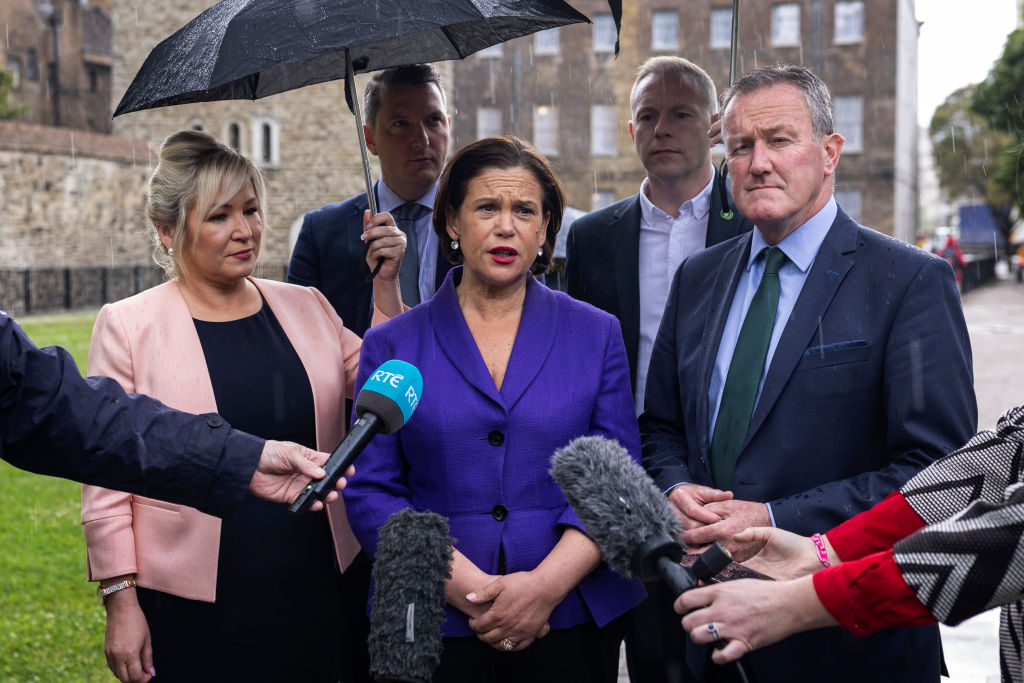
The Sinn Féin leadership of Mary Lou McDonald (C), Michelle O’Neill (L) and Conor Murphy (R) talk to the media on May 24, 2022 in London, England. (Dan Kitwood / Getty Images)
Does the long-term fallout from the Brexit crisis mean that a united Ireland, Sinn Féin’s overriding political objective, is now within reach? After last year’s Northern Ireland Assembly election, Sinn Féin is now the largest party on both sides of the Irish border — a scenario that seemed utterly far-fetched little more than a decade ago. Yet it is still easier to imagine a Sinn Féin first minister in Belfast greeting a Sinn Féin taoiseach in Dublin than it is to picture their respective jurisdictions becoming one.
Two books published recently map out the contours of Sinn Féin as a party and the wider political landscape on which it has to operate. Rebels in Government by Agnès Maillot is the first detailed study of Sinn Féin to have appeared since it won the largest vote share in the Republic of Ireland’s 2020 election (although the book preceded its more recent breakthrough in the North).
Northern Ireland a Generation After Good Friday is a collective work by four academics at British and Irish universities. It is narrower in geographical scope than Rebels in Government, which looks at Sinn Féin’s development in both Irish states, but more wide-ranging thematically, with chapters on, inter alia, the changing status of women since the peace process began and Northern Ireland’s unorthodox political economy.