German Greens Bet the Future on More Weapons Spending
In their heyday of radicalism in the 1980s, Germany’s Greens were a pacifist, ecological voice. Now the party backs higher military spending not just as a defense strategy but as the linchpin of Germany’s economic revival.
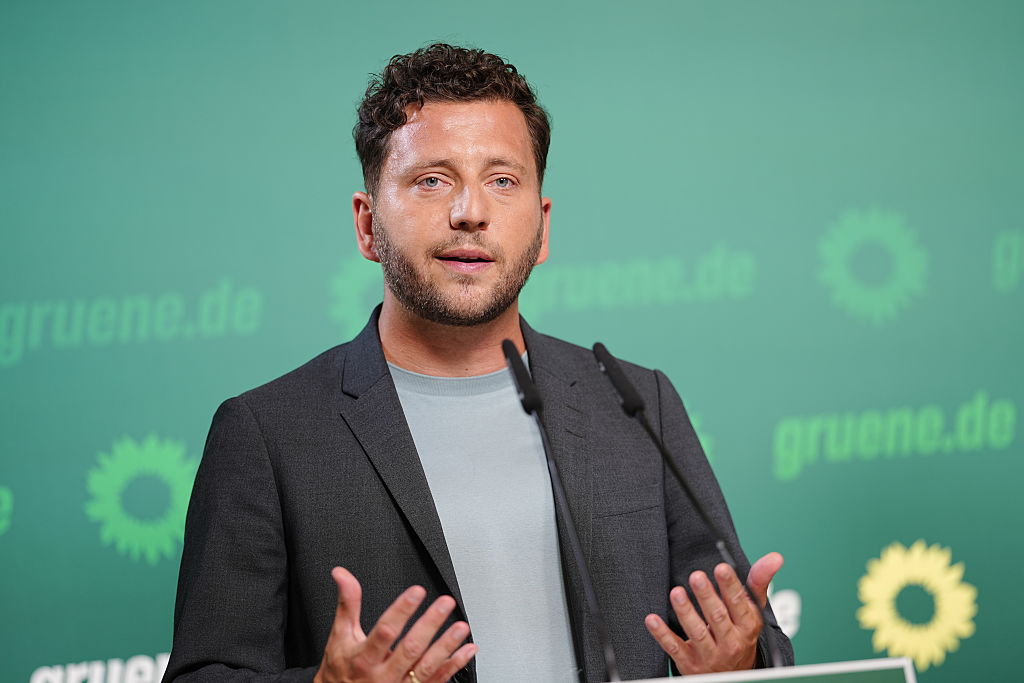
Where German elites once cast the green transition as the path to job creation, now they’re counting on arms production instead. No longer pacifists, the German Greens have thrown their support behind this ecologically destructive industry. (Kay Nietfeld / Picture Alliance via Getty Images)
According to the famous “garbage can” model of political decision-making, there isn’t much rationality in politics. Minted in the 1970s, this model resists the idea that collective choices are the outcome of political professionals intentionally looking for optimal solutions for well-defined problems. Rather, it casts these choices as the result of contests between different elite factions who try to convince citizens — and each other — that their preferred “solution” can at least beat their competitors in answering whatever issue presents itself.
Half a century later, this model still explains many striking and long-enduring political phenomena.
First, that policies never disappear but reappear again and again, zombie-like — or, to stick to the metaphor, reappear as if spewed out by an overfull garbage can. Second, that policies can constantly be adapted to changing political winds by being relabeled and rehashed. Third, at the end of the day, nothing ever seems to be solved at all. Ultimately, the success of an elite faction in peddling its preferred “solution” depends not on it actually solving anything but on its being able to endlessly identify problems that it can at least claim to do something about.
The “garbage can” metaphor appears particularly apt in times of fundamental policy shifts like we are living through today. In Europe, issues of sustainability and global warming have suddenly been replaced by a gospel of war, defense, security, and geopolitics, even in the mouths of the same elites who just a few years ago presented themselves as the ultimate climate warriors.
Take the latest report on defense and industrial policy, produced by the policy advice branch of Germany’s Green Party. This document on Defense as driver of innovation is meant to help the party give its own subtle twist to the “Zeitenwende” or “historical turning point” announced by then Chancellor Olaf Scholz in February 2022.
Turning On the Tap
In response to the Russian invasion of Ukraine, on February 27, 2022, a majority of the German Bundestag decided to shed the country postwar constitutionalized pacifism and transform it into Europe’s largest and most lethal fighting machine. A goal that, in view of twentieth-century European history, should make a chill run down the spine of everyone with a modicum of historical sense.
Reaching this goal first meant abandoning Germany’s ordoliberal insistence on balanced budgets (the “black zero” rule). This was followed three years later, after some hair-raising parliamentary chicanery, by the abandonment of the “debt brake” that constitutionally required the federal government to keep aggregate German public debt at 2009 levels — a fixture comparable to the US debt ceiling.
Open went the spigot: defense spending rose from $56 billion in 2022 to $67 billion in 2023 and $88 billion in 2024. The federal government aims to increase this to $152 billion in 2029, by which time Germany should be able to withstand any Russian attack without US aid. As long as, that is, Russia sticks to the script of conventional warfare only.
The German Greens have long forgotten their pacifist heritage (the party’s founding manifesto back in 1980 had preached nonviolence and the dissolution of both NATO and the Warsaw Pact). Yet while this latest report takes for granted the need to counter the Russian threat, in fact its attention lies elsewhere.
The real focus here is industrial decline and economic depression. As the document’s first paragraphs summarize, the German economy is in dire straits, with its industrial core hemorrhaging 15,000 jobs per month, its famed “Mittelstand” (the manufacturing backbone of Germany of small family-owned firms) closing by the thousands every year, and its GDP flatlining for four years now. All this is spawning the material conditions for potentially huge victories for the nationalist Alternative für Deutschland (AfD) in September’s three state elections. In Saxony-Anhalt, a state in the former East, the AfD is expected to take over 40 percent of the vote, while even in Berlin, long a progressive stronghold, it appears to be on the verge of becoming one of the largest parties, polling at 17 percent.
How to ensure that the massive uptick in defense spending does not fill the coffers of American arms producers alone but instead serves the average German voter? How to turn it into a “smart” industrial policy 2.0 for Germany itself? That is the key question the report tries to address.
Here is where the “garbage can” origin of the report becomes clear. It joins geopolitical security concerns and industrial policy at the hip in an attempt to bring on board also those who remain unconvinced that the surge in defense spending is worth the inevitable costs in terms of social security, environmental policy, and public infrastructure.
The subtext of the report: even if you are not convinced that the Russians are coming and the Americans are exiting, you may well support us, the Greens, because we are going to make sure that our increased defense spending will ultimately benefit us all.
It is neoliberal “trickle-down economics” all over again.
Or in the report’s own words:
History shows that increased defense spending can trigger waves of innovation: GPS, the early internet, or modern material sciences all came out of military research funding. Whether similar spillover effects happen today is still unclear. More money alone isn’t enough. It depends on what it’s used for.
Innovation Speak
It is not hard to see, in this, a repetition of Mariana Mazzucato’s wildly popular argument about the entrepreneurial state. In her 2011 book, she uses examples of civilian spin-offs from US defense projects to debunk the neoliberal claim that only markets are innovative while the state is always a drag on growth. Although true in the abstract, we might question whether her examples were such a happy choice. These were, after all, part of defense packages that have brought death and destruction to civilians across the Global South, for which the mixed blessings of the internet and the smartphone have been a meager offset, if any at all. Moreover, reasoning that imitates Mazzucato’s now increasingly serves as a fig leaf for former progressives across the European Union to back an arms race that is not going to make the world more secure and will make citizens much poorer.
The nub of the question is the claim that, while more money is surely not enough, the problem is all about how it is spent. Here the report gets into its stride and starts to read like your average consultancy think piece. It abounds in terms like “spillover,” “ecosystems,” “innovation agents,” “start-ups,” “system integrators,” “feedback loops,” “dual use technologies,” “strategic multipliers,” and more, plus the necessary paeans to artificial intelligence.
The same is true for its list of recommendations. They range from inserting “security” as a key requirement for national research-funding programs to better incentives for academics to turn to defense and security issues and directing research money to “dual purpose” defense projects. It also proposes a lower defense vetting threshold for SMEs (small and medium businesses) by setting up “onboarding programs,” drawing on dedicated “High Tech demand and supply maps.” It further offers full-fledged state guarantees for private business and cofinancing schemes along the lines of infamous public-private-partnership (PPP) models. It always boils down to the same thing: the privatization of gains and the socialization of risks and costs.
The language reflects a deep belief in what Thomas Frank in his forthcoming book, The Creativity Con, has identified as a cosmetic innovation speak that itself has a dual use. Indicating that one knows how to talk the language of capital is the first one. It is a goal that is particularly important to the once rebellious German Greens, former outsiders who were invited in and who, now in opposition, want to get back in as soon as possible. Becoming insiders in European politics, as is well known, depends on three commitments: embracing the EU, accepting NATO, and speaking the language of capital to indicate a belief in the sanctity of liberal property rights, the cornerstone of capitalism.
Insider Status
The Greens had become insiders at least as early as 1999, when party grandee Joschka Fischer, as German foreign minister, backed the illegal NATO bombardment of Kosovo and Serbia, which, according to Human Rights Watch, killed at least five hundred people. More recently was its participation, from December 2021, in the “traffic light” coalition headed by the abovementioned Olaf Scholz of the German Social Democrats and its support for the “Zeitenwende” he announced two months later. The Greens have even ruled with the center right in several states.
The Greens’ insider status is clearly reflected in the roster of participants in the working group that signed off on this report. As the German daily Berliner Zeitung revealed, many of the largest German and European arms producers are among its members, including luminaries such as Airbus Defence & Space, Heckler & Koch, Hensoldt AG, and Safran Electronics & Defense. This would suggest that this is not so much a neutral public-policy document but a lobbying report, much like consultancies the world over produce.
As for average voters, they find themselves in a Germany slowly but gradually moving toward further military escalation, funded by severe cutbacks to the supposed foundation of modern Europe, namely the much-cherished welfare state.
For that is the most striking part of the report: what it does not mention.
In the sanitized world of the professional-managerial class that populates the German Greens, war is at worst a game and at best a managerial problem that can be solved by some brainstorming, the right incentives, a spreadsheet, and a bit of cross tabulation. That these weapons are designed and built to maim, kill, and destroy is cosmetically obscured by the euphemistic consultancy speak.
The report likewise ignores the massive literature that throws doubt on any claim that defense spending has an economic upside. The political economists Robert Pollin and Heidi Garrit-Peltier had already in 2009 calculated that the employment gains of defense spending are half those of any dollar spent on health care, education, public transport, or construction. And of course, this is referring to the United States, which is home to the largest defense sector in the world.
It is in line with the econometric quantification of the “multiplier” (i.e., how much does one unit increase of public spending add to GDP) by mainstream macroeconomists. A Dutch meta study indicates that the multiplier is near zero. That means that an extra dollar or euro spent on defense adds next to nothing to GDP. This is why economists continuously refer to defense spending as “dead consumption,” not investment, meaning that it does not generate a quantifiable return like when states “invest” in education, health care, or infrastructure. And why, whenever you hear politicians relabeling it as “investment,” you know you are being manipulated in a way that comes straight out of the playbook of NATO’s cognitive warfare program.
Ramping up arms spending is a shameful waste of scarce public resources and an environmentally destructive one. Disgracefully, the Greens have totally forgotten this. Given that the party is nominally left-wing, we can only hope that some of its disappointed members will pick through the garbage and find its founding manifesto. That document was all about how peace, détente, diplomacy, and the abolition of NATO will help save the planet. The Greens would do well to rediscover this, before disaster strikes.