When Elites Scheme Behind Closed Doors
The history of the Veiled Prophet Society, the St Louis secret society whose origins are in white supremacy and the suppression of worker organizing, is a window onto elite capitalist society and how it operates to protect its own interests.
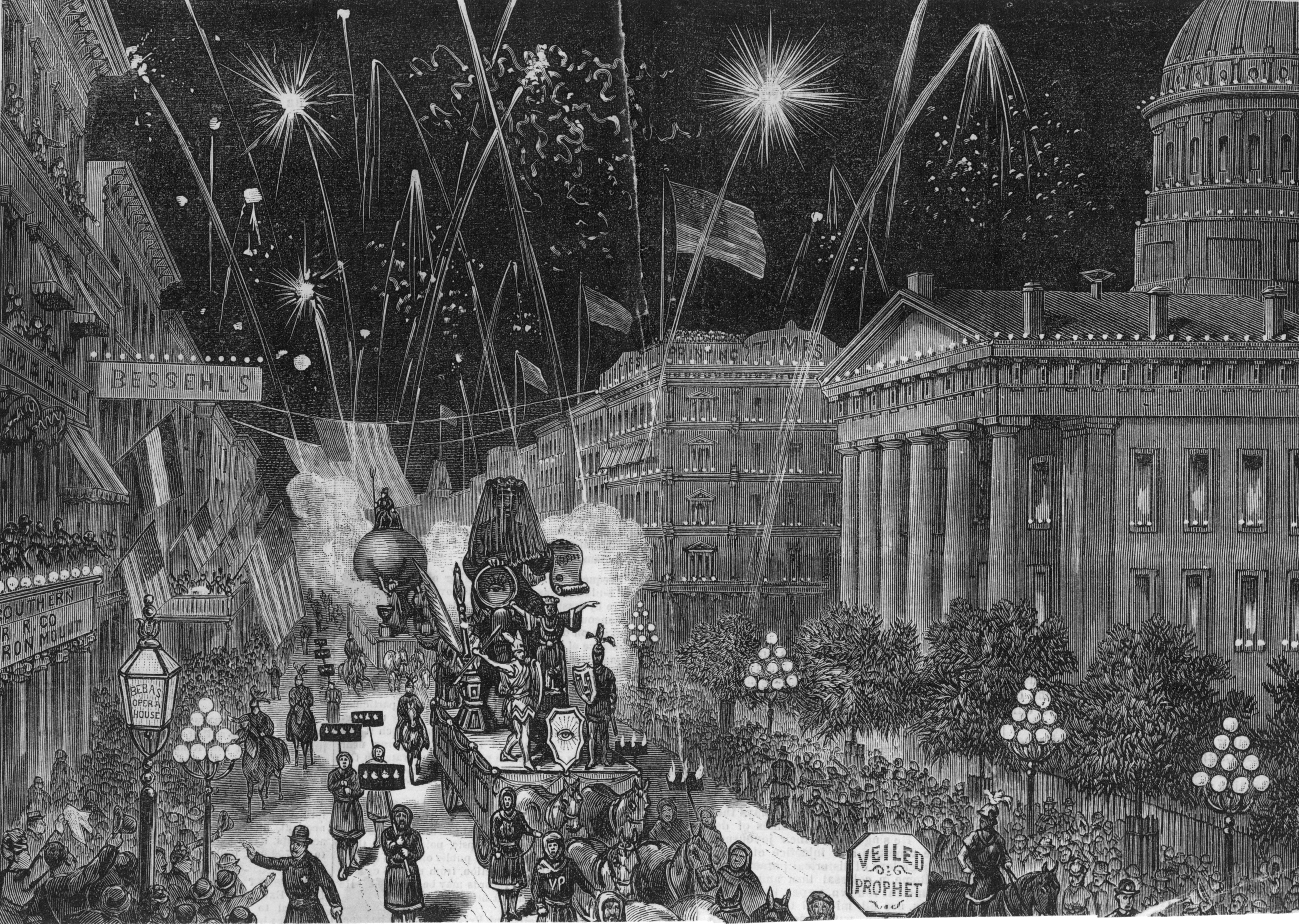
An illustration of the 1878 Veiled Prophet parade in St Louis. (Missouri Historical Society)
In the recent Democratic primary in Missouri’s first congressional district, which includes all of St Louis and much of northern St Louis County, including Ferguson, the American Israel Public Affairs Committee (AIPAC)–funded incumbent Wesley Bell bucked national trends. Whereas AIPAC support has become an albatross for many candidates running in Democratic primaries, Bell easily defeated former congresswoman and Israel critic Cori Bush.
Although the money AIPAC funneled into the primary indicates Middle East politics played an outsize role in the struggle to control a black-majority Missouri district, deeply rooted local concerns seemed weightier. This is not surprising: the political careers of both Bell and Bush began in 2014 with the protests that engulfed Ferguson in response to the police murder of Michael Brown. Bush supporters, thus, not only brought attention to Bell’s ties to AIPAC, but also to his Deputy Chief of Staff Jordan Blase’s controversial past as a Veiled Prophet debutante. As a local activist said on Instagram, after spotting an album of photos on Blase’s Facebook page dedicated to the annual Veiled Prophet Ball, Blase and her family “have been attending their white supremacist ball for decades.”
What in the hell is a “Veiled Prophet,” you might ask? And why is Blase’s history with it controversial (though not controversial enough to tilt the race in favor of Bush)? For answers to these questions and many more about the history of St Louis elite society, we turn to Devin Thomas O’Shea’s fascinating new book, The Veiled Prophet: Secret Societies, White Supremacy, and the Struggle for St Louis.
Reconstruction and the Great Railroad Strike
The Veiled Prophet Society, a purportedly secret organization with a highly exclusive membership that hosts an annual parade and a debutante ball, was founded in 1877 for the explicit purpose of shielding the local bourgeoisie from an increasingly militant proletariat. It was no coincidence that the Veiled Prophet Society was created in the smoldering aftermath of the Great Railroad Strikes of 1877, or that it was established in St Louis, where workers not only walked off the job but also organized to take control of the city. The Veiled Prophet Society was formed to destroy the specter of working-class solidarity that momentarily sprang to life in what contemporaries called the St Louis Commune, comparing it to the more famous 1871 Paris Commune.
The St Louis Commune, led by the short-lived Workingmen’s Party of the United States (WPUS) — the first Marxist party in the United States — briefly took power in East St Louis, the section of the city on the east side of the Mississippi and a rail hub and industrial loading dock. The Great Railroad Strike, which began in West Virginia and fanned out across multiple states, disrupting the nation’s circulation of goods, was a violent affair. In response to workers burning down railroad facilities, the companies, enlisting private militias, local and state police, and federal troops, put down the strike with malice, killing about 150 workers. Unlike strikers elsewhere, St Louis workers refrained from destroying property, since their objective was to expropriate it for their own use. They were successful for about a week, before the forces of capital took back control of the city.

To protect their interests in the face of an assertive proletariat, the St Louis bourgeoisie created the ironically named Committee for Public Safety, which, unlike the original French revolutionary committee of the same name, was designed to crush rather than defend hard-won republican rights.
“The strike,” O’Shea writes, “was an effort to crown the workers as the masters” of the enormous wealth that flowed through St Louis in the nineteenth century, such abundance owing to the city sitting along the largest inland waterway on the continent, at the crossroads of both the nation’s east–west and north–south frontiers. “The city’s financial interests used racism, and the barrel of a gun, to quash that effort.”
The racism of St Louis elites is central to O’Shea’s story. One of the keys to the brief success of the St Louis working class in 1877 was its interracial solidarity. And one of the lasting features of the Veiled Prophet Society, which was formed out of the Committee for Public Safety and has been in existence ever since, has been its white supremacy.
The founder of the Veiled Prophet Society, St Louis native Alonzo Slayback, is prima facie evidence of O’Shea’s argument about white supremacy being the establishing principle of the organization. Slayback was an officer in the Confederate Army and a true believer in the cause of the South, slavery. After the United States defeated the Confederacy, Slayback followed notorious Confederate General Jo Shelby south to Mexico City, where they hoped to escape punishment for their treason.

Shelby, Slayback, and company solicited help from fellow reactionary elite, Emperor Maximilian I, the Austrian archduke reigning over the so-called Second Mexican Empire. As a member of the European ruling class, Maximilian was closely aligned with the potentate of the Second French Empire, Napoleon III (known to posterity as Karl Marx’s object of mockery — in The Eighteenth Brumaire of Louis Bonaparte, Marx famously described Napoleon III’s ascension as a farce).
The account of defeated Confederates in Mexico City seeking help from a soon-to-be executed European monarch (Maximilian met his death by firing squad in 1867) is one of many stories of unhinged conduct common to the rich, powerful, and reactionary men of the Veiled Prophet Society. Such elite vulgarity will seem familiar to twenty-first-century readers. From Elon Musk’s (alleged) ketamine-induced displays of neurotic Nazism to Peter Thiel’s (confirmed) obsession with the Antichrist, repugnant behavior is a timeless characteristic of rich, powerful, and reactionary men. We can only wish our current oligarchs were, like their Confederate predecessors, on the run, seeking shelter in a foreign capital.
Little did Slayback know when he traveled south of the border, that a full pardon awaited him upon his homecoming. (One of the biggest political mistakes in US history is letting those who committed treason in defense of slavery off the hook so easily.) Slayback returned to St Louis in 1866 and started a law practice. He had rejoined an elite class of Americans that by 1877 wished to turn the page on the Civil War and Reconstruction and instead focus its attention on capital accumulation. The ultimate objective of the Veiled Prophet Society was protecting its members’ wealth. Upholding racial hierarchy was a secondary, though interconnected, goal.
The Veiled Prophet, the society’s mysterious mascot annually paraded before the St Louis rabble, wears a Ku Klux Klan–inspired mask and robe that double as odes to the Irish poet Thomas Moore’s orientalist tale, Lalla Rookh. The Veiled Prophet was intended to evoke awe of the local elite among the working-class masses who lined the streets of St Louis each year and watched as the wealthy paraded by them. O’Shea describes what motivated Slayback and his fellow elites to concoct such an absurdity:
The Veiled Prophet Society would be a Mardi Gras club for white men to parade their power in the streets of St Louis, communicating their message to the proletariat — that Americans are white and civilized and that the rest of the world is barbaric and Black; that the threat of Southern plantation violence was not dead, but lay dormant in everyday life; but most of all, that commerce reigns supreme and should operate freely without checks or restraints.
The mascot often stimulated ridicule, even anger, especially among black locals who rejected the parade’s nostalgia for plantation slavery. The Veiled Prophet was frequently the target of various projectiles along the parade route.
Yet despite bouts of mostly harmless resistance from local proles, the Veiled Prophet Society was apparently successful in reversing the republicanism that had made its home in St Louis during the Civil War and Reconstruction.
Elites overturned a widespread radical sensibility, nicely expressed by Marx’s German ’48er comrade Joseph Weydemeyer, a colonel in the Union Army who was placed in command of forces defending St Louis during the war. In an 1866 essay promoting black suffrage, Weydemeyer argued that, in the struggle against capital, workers needed to join forces “regardless of what ancestry they have to thank for their skin color.” Weydemeyer advocated for the very same multiracial working-class formation that W. E. B. DuBois later mourned in his monumental 1935 book, Black Reconstruction in America.
Into the 20th Century
In the book’s interregnum of sorts, O’Shea narrates a gripping tale that turns out to be a serious plot twist. On October 13, 1882, Slayback barged into St Louis Post-Dispatch editor John A. Cockerill’s office. The former Confederate general was outraged over the rough treatment the newspaper had been dishing out to his law partner and fellow Veiled Prophet Society member James Broadhead, who was running for local office. An angry Slayback arrived armed and loaded, but Cockerill got the jump on him, shooting and killing him. Convinced the newspaperman had acted in self-defense, local authorities never charged Cockerill with a crime.
The founder of the Veiled Prophet Society was pronounced dead at the age of forty-four. But the secret organization did not perish alongside him. The king is dead, long live the king.
As The Veiled Prophet Society moves into the twentieth century, we learn about the growing prestige of the group during the era of its close kin, the second Ku Klux Klan, when the “club commanded the attention of presidents, and robber barons like Jay Gould were compelled to attend the ball.” We also learn about the larger history of St Louis and its segregated and easily exploited industrial workforce, part and parcel of ongoing racial violence which at times exploded, such as in a 1917 racial pogrom that left around 150 black residents dead.
Resistance to the Veiled Prophet Society was sporadic at best, only truly gaining momentum in the 1930s, a time when the organization was more “severely out of touch” than usual. Until then, the club had acted as a symbol of elite unification and working-class fracture. But in the age of the Congress of Industrial Organizations, when even the normally taboo Communist Party USA experienced rapid growth, it was more difficult for an older, venal bourgeoisie — the exact type that constituted the Veiled Prophet Society — to preserve its hegemonic grip on the political culture. Yet in St Louis, as elsewhere in the United States, the ruling class adjusted to new circumstances.
One of the better indicators that the old elite remained dominant, even during the postwar age of high Fordism, was in how it dictated the terms of urban renewal, which was all the rage in postwar American cities. Urban renewal policies transformed St Louis, but not for the better, especially for the black working class.

Several newly constructed highways carved up the heart of the city, clearing out historically black neighborhoods. A massive housing project, Pruitt-Igoe, opened its doors in 1954 to thousands of displaced and impoverished residents, only to be demolished after two decades of severe neglect. None of which is to say that a public housing project is an inherently bad idea. But public goods must be nurtured if they are to be, well, good. Meanwhile, as Pruitt-Igoe was starved to death, the Veiled Prophet Society resumed celebrating high society, emphasizing its annual ball, where its luckiest daughters were honored as brides of the Veiled Prophet.
Another sign that the Veiled Prophet Society, an inherently reactionary entity, retained its mojo even at the high point of American liberalism was when President Harry Truman, a Missouri man, brought a Veiled Prophet contingent with him to Washington, DC. Most notable among them was Clark Clifford, who helped establish the Central Intelligence Agency in 1947. Clifford went on to serve in several Democratic administrations, including briefly as Lyndon B. Johnson’s secretary of defense. Another Veiled Prophet Society member, Tom Dooley, operated as a spy in Southeast Asia prior to the Vietnam War. Dooley gained notoriety as author of the anti-communist screed Deliver Us from Evil, an ostensible dismantling of Ho Chi Minh that was in fact a total fabrication.
During the Cold War, the Veiled Prophet Society had joined what C. Wright Mills labeled “the power elite,” the overlapping network of government, business, and military brokers who ruled the United States and, by extension, much of the world.
Does the Ruling Class Need Secret Societies?
The Veiled Prophet Society is a fun and informative book, especially for sickos like me who never tire of reading about the American class struggle, even though the struggle almost never tilts in favor of the working class. But O’Shea’s overarching analysis is too heavily reliant on assuming the historical agency of the Veiled Prophet Society.
The not-so-secret club is a window onto elite capitalist society and how it operates to protect its interests. It is not a mechanism, or at least not the mechanism, for defending modern capitalist hierarchy. O’Shea’s book is excellent in describing the strange manifestations of the American class struggle from the perspective of the elites who had a lot to gain from maintaining capitalist arrangements. But the existence of a secret society itself, even one so embedded in a specific location, is not a smoking gun. There is no conspiracy other than the grand conspiracy of capitalism that has been known to us since Marx and Friedrich Engels wrote about the “new conditions of oppression” in The Communist Manifesto.
O’Shea’s skill in narrating a tale, alongside his somewhat upside-down analysis, is evident in his half-hearted conjecture that the Veiled Prophet Society was possibly responsible for the assassination of Martin Luther King, Jr — a possibility that was investigated by the House Select Committee on Assassinations in the late 1970s and dismissed. O’Shea begrudgingly admits that the evidence connecting the club to the murderer, James Earl Ray, who spent a significant amount of time in St Louis and was born nearby, is at best speculative. But he also implies that the connection is true in the way good fiction is true. “It makes sense,” he writes, “that a narrative developed around King and the Prophet. One is royalty of the African American struggle, the other is the monarch of the cut-throat white business classes; two entities at war with one another for the soul of America.”
The civil rights movement in St Louis forced the Veiled Prophet Society on its heels with a campaign of constant harassment. The elite club responded by shutting down its parade, which had become an easy target of backlash, and by instead hosting an annual fair under the shadow of the Gateway Arch. Anodyne music acts, generic food vendors, and plenty of Budweiser replaced the Veiled Prophet and its racist baggage. Eventually organizers even ditched the Veiled Prophet Society moniker, as the club tried to hide its controversial identity as sponsor of the fair. The Veiled Prophet Society’s efforts to clean up its image also led to incremental efforts to diversify its membership. The first black member was admitted to Alonzo Slayback’s club in the early 1980s.
By 2014, the year of the Ferguson uprising, the Veiled Prophet Society was a shell of its former self. And yet the elite are in firm control of St Louis and almost every other American city. The Left is doing better than it has in a while, but capitalism is far from threatened. Secret societies and similar such elite clubs are hardly necessary for continued ruling class domination. One question that O’Shea’s book raises: Were they ever?