When St Louis Workers Seized Their City
At the collapse of Reconstruction, black Americans and workers of all races found themselves facing an increasingly authoritarian capitalist political order. In response, they took over St Louis.
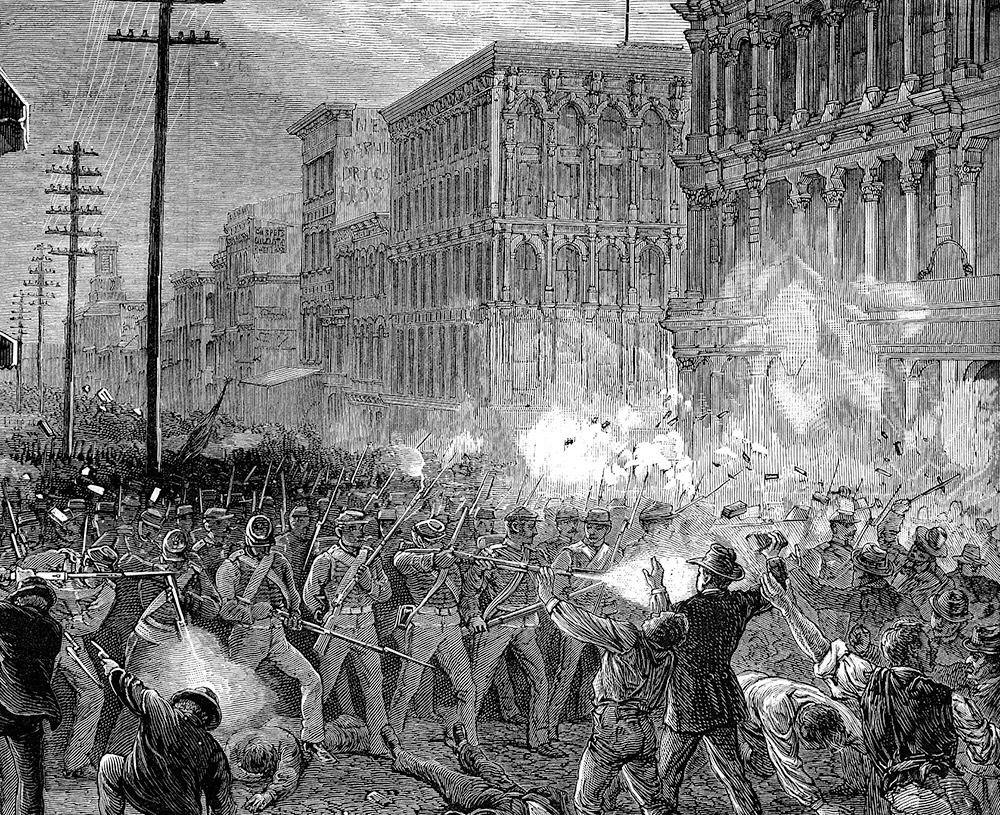
Amid the upheaval of the summer of 1877, militia units in Baltimore opened fire on crowds of demonstrators assembled in support of the Baltimore and Ohio Railroad strikers.
In summer 1877, Reconstruction of the postbellum American South entered a crisis phase. The previous winter’s disputed presidential election between Rutherford B. Hayes and his Democratic rival, Samuel J. Tilden, had, by early spring, been settled in Hayes’s favor. In April, Hayes moved to withdraw federal troops from the South’s remaining Republican strongholds, leaving hard-won black political rights exposed to rollback by white supremacist reaction. With Northern forces receding, so too did the promise of Reconstruction. The fragile experiment in multiracial democracy born of the Civil War unraveled.
The collapse of Reconstruction is widely and correctly acknowledged as a watershed in American history. Less often recalled is that the year 1877 also marked one of the most explosive periods of labor agitation in the country’s “long nineteenth century.” The Panic of 1873 had touched off skyrocketing unemployment, and throughout the 1870s, workers from Chicago and Philadelphia to New York City assembled to demand government relief, public employment, and an end to the yawning inequality of the Gilded Age. As Jacob Riis, a well-known chronicler of New York City’s working classes, wrote during the period: “The sea of a mighty population . . . heaves uneasily in the tenements. . . . If it rise once more, no human power may avail to check it.”
Riis’s words may have had the ring of prophecy, but the events of 1877 would also reveal their limits. In July, railroad workers rose up in what was at the time the largest and most militant strike in the nation’s history. More than a hundred thousand workers across ten states joined the Great Railroad Strike — seizing depots, blocking tracks, and clashing with police and militias from Baltimore to Chicago.