What American Doctor Saw in Gaza's Hospitals

Poh Si Teng

The director of American Doctor talks to Jacobin about her documentary on three US volunteer physicians who worked in a besieged Gaza hospital — and the wall of disbelief that met them when they came home and told others what they saw.
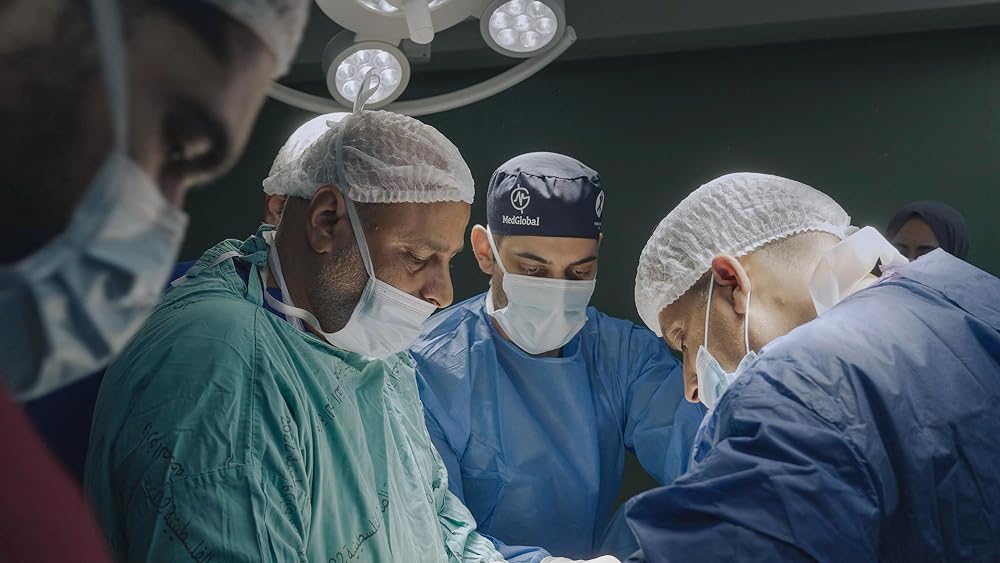
A still from the 2026 documentary film, American Doctor.

“What happens to an American doctor who tells the truth about Gaza? He gets ostracized. What happens to a Gazan doctor who does? He gets kidnapped or killed.” (Tiny Boxer Films / Watermelon Pictures)


Interview by
Ed Rampell

American Doctor is a kind of cinematic Hippocratic oath. Its subjects are three US physicians who, as genocide rages, volunteer to go above and beyond the call of duty to treat Gaza’s beleaguered residents. Having seen the carnage with their own eyes, the trio then set out to inform a callous Congress and a supplicant press about what is really happening inside the enclave’s hospitals — and to the medical workers who staff them.

The three could hardly be less alike. Thaer Ahmad, a Chicago-born emergency room physician, is a Palestinian American Muslim. Mark Perlmutter, an orthopedic surgeon based in North Carolina, is Jewish. Feroze Sidhwa, a trauma surgeon near Stockton, California, is Zoroastrian, of Parsi background. All three worked at Nasser Medical Complex in Khan Younis. Shot by Gaza-based crews who filmed on the condition that the footage make it out of the enclave, the ninety-one-minute film follows the doctors into the operating theater and then home again, into a country that would rather not hear what they have to say.

American Doctor’s director, Poh Si Teng, was born into an ethnic Chinese family that practices Buddhism and raised in Malaysia. She came to the United States two decades ago to study journalism at San Francisco State University. She has worked as a camera operator, writer, and staff reporter for the Associated Press, Agence France-Presse, the Wall Street Journal, the New York Times, and Al Jazeera English, among others. She produced Flirting With the Islamic State (2015), was Oscar-nominated for St. Louis Superman (2019), and won an Emmy for Patrice: The Movie (2024).

American Doctor opens in New York on August 14, in Los Angeles on August 21, and in San Francisco on August 28. Poh Si Teng was interviewed via Zoom. This interview has been edited for length and clarity.


Ed Rampell

Tell us about American Doctor.

Poh Si Teng

American Doctor is a film about three American doctors who couldn’t be more different. One is Palestinian American and Muslim, one is Jewish, one is Zoroastrian. Dr Thaer Ahmad is an emergency room doctor, born in Chicago. Dr Mark Perlmutter, the white Jewish doctor, lives in North Carolina. Dr Feroze Sidhwa is Zoroastrian, some people call it of Parsi background, and he resides near Stockton, California. Three friends.

All of them went to work in Gaza. They volunteered their services there. They have worked at Nasser Medical Complex. We follow them in their lives as they work in a besieged hospital in Gaza and then return home to the United States to try to spread the message of what they saw — and the message from the health care workers there — into the halls of Congress.

Ed Rampell

Israel has refused most foreign correspondents access to Gaza. Were you yourself inside during the filming of American Doctor?

Poh Si Teng

Mark Perlmutter, the eternal optimist, told me early on in the production, “I’m going to train you as a scrub nurse and then I’m going to take you into Gaza.” I told Mark, “That’s never going to happen. Israel is working the borders, and anybody who does a cursory search of my name — the New York Times, Al Jazeera English, ABC/Disney is going to pop up. I’m not a legit scrub nurse.”

So it dawned on me very early that we were going to have to work with teams in there. Fortunately, I’d worked at Al Jazeera English, and I had a wonderful colleague who was also a documentary commissioner and producer of our film. She worked with a director of photography and a coproducer. They had made a film that was incredible cinéma vérité, and we thought “We want to work with this team.” So we approached them, and they said, “Yes, we will film it for you — on condition that whatever we film, you bring it back to the United States.”

Ed Rampell

You directed the scenes with the doctors back in America?

Poh Si Teng

It’s not an interview-based film. We’re immersed in their lives. It’s cinéma vérité, so we’re just watching as things unfold. And yes, I was there for all of it in the United States. In fact, I pretty much filmed all of Dr Feroze’s scenes myself. It was such a great privilege to be let into their lives and into their homes. For me it was important not just to see what they were trying to do in Gaza, but all of the resistance they were getting back home in the United States.

Ed Rampell

Like foreign correspondents, the volunteer doctors who go to Gaza also have trouble entering. What happens to them?

Poh Si Teng

Some of them don’t get let in. And a lot of them, whatever supplies they’re trying to bring — because Israel has limited or just stopped basic supplies, even food and baby formula — when these doctors try to bring it in, they get thrown out. So that is the condition of what happens to them.

But it is nothing compared to the Gazan health workers and what they are facing, inside these hospitals and also outside, in their own lives. For a lot of them, that is their lives. Not only are they treating their patients, and they’ve done this with so much dedication and very limited resources — they’re living through it as well, in the midst of genocide.

Ed Rampell

American Doctor has scenes shot by your Gaza-based counterparts in the operating rooms that are horrific, very graphic at times. But it is also a film about journalistic ethics.

Poh Si Teng

I want to speak to what you just said about the graphic images, because as a documentary filmmaker, producer, and executive, I’ve watched a lot of war documentaries. American Doctor doesn’t even come close to any of those. It doesn’t. It’s interesting that a lot of people say, “Oh, the images are a lot,” because we pulled a lot back. And I wonder sometimes — and this is me thinking — is that because it’s got to do with us? Because this has got to do with our taxpayer money? Is there some guilt involved in what we see, as opposed to when we see images in documentaries coming out of Ukraine and other parts of the world? It’s something I’ve been thinking about a lot.

The second thing you mention, the journalism of it all: as a former journalist who worked in a lot of different newsrooms, it was not lost on me, the pummeling the doctors were getting from media institutions. All Mark, Thaer, and Feroze were trying to do was save lives. I was there with them. All they were trying to do was tell the world what they saw and convey the messages of their friends and colleagues.

Ed Rampell

Ahmad, Perlmutter, and Sidhwa are eyewitnesses. And yet when they relate what they saw in Gaza with their own eyes to reporters who were not on the ground there, they are met with pushback. Video footage of Nasser Hospital in Khan Younis being bombarded repeatedly is even shown on-screen. But Perlmutter muses that the reporters are “just believing Israel,” as opposed to what an eyewitness is telling them.

Poh Si Teng

It’s interesting — what happens to the doctors when they try to speak the truth? They get pummeled, they get ostracized. What happens to Gazan journalists and doctors when they try to speak the truth? Dr Hussam Abu Safiya [the Palestinian pediatrician who directed Kamal Adwan hospital] is kidnapped and tortured without trial. All these camerapeople, all these journalists in Gaza — what happens to them? They are killed. And all for what? Because they are trying to tell the world what is happening. That’s why I felt it was very important for us to get this film back to the United States as soon as we could, because our colleagues and people that we know and our friends, whether they are Gazan filmmakers or health care workers, are running out of time. And they’ve been running out of time for two-plus years.

Ed Rampell

On an Israeli TV program, a news presenter insists to one of the doctors, a guest on the show, that there are Hamas tunnels under the hospitals — which the doctor, the eyewitness, says he has never seen. The presenter is adamant about having seen images of the tunnels. But it turns out those images are AI-generated.

Poh Si Teng

That’s right. It says so much about the imagery and propaganda out there that makes people think something is real when it is not. There are no tunnels under the hospitals. Our doctors never saw that. And yet people still believe.

Israel aside, let’s come back to the United States. I was recently doing a personal recap of all the films that have promoted Islamophobia and racism against Arabs and Muslims over the past two or three decades, and it’s unbelievable. If we think all of this misinformation — people getting confused — is just the result of media in the past two-plus years, we have to go back much further. We’re talking about the movie industry, we’re talking about newsrooms in general, for decades and decades. I hope this film will illuminate a little bit of what these three very good men and their colleagues are trying to do here. It’s just to speak truth.

Ed Rampell

In American Doctor there are shots of Palestinian ambulances riddled with bullet holes, some of them wrecks. How many children are estimated to have been killed by the Israeli military?

Poh Si Teng

I was listening to an interview Feroze did this morning, and I think the official number is something like twenty thousand. But the actual number, with bodies unaccounted for and kids who have gone missing, he said is closer to seventy thousand. And it comes back to the United States: Is that what we’re about? Is that what we’re okay with? Are we okay with the slaughtering of seventy thousand children? If that’s not what we’re about, then we better stand up and do something, and there’s no waiting. We hope this film can offer some of the path forward.

Ed Rampell

Your tax dollars at work. As of now, how many Gaza hospitals have been bombed by the Israel Defense Forces?

Poh Si Teng

I don’t know. I don’t even have the numbers, because I’ve lost count. But they’ve all been targeted, and targeted again and again — like Nasser Medical Complex. Even in the making of the film, I remember telling our crew members, our friends there: “Film everything, every person, like it’s the last time.” Because we didn’t know. We didn’t even know if our film was going to be distributed. We were trying very hard to make sure we finished it. But at least we’d have a record that there were people who stayed, and they lived.

Ed Rampell

How many health care workers in Gaza have been killed?

Poh Si Teng

According to the UN, more than seventeen hundred have been killed in the two-plus years in Gaza alone.

I’ll say this, Ed: What are numbers? Numbers cannot even tell you the worlds that were lived, the lives that were lived, the loves that were had. That’s why we wanted to make American Doctor. It wasn’t just a news report about numbers. These are real people. They want to live just like we want to live. They want to love just like we want to love. It was very important to show the reality of what was happening on the ground in Gaza, but also the doctors’ banter, the friendship, the camaraderie, the jokes. Because they’re no different from us in many ways — even though they are so resilient and have had to live through something most of us wouldn’t be able to live through. We wouldn’t be able to survive it. It is really up to us to fight for them.

Ed Rampell

Your film is dedicated to the health care workers in Gaza. As we touched on earlier, once the American doctors leave Gaza they try to lobby against the bombing of Palestinian hospitals at conferences and in Washington, DC. Tell us about that.

Poh Si Teng

That part you’re talking about, us filming in the halls of Congress and in those congressional offices, was at the end of January 2025. I was following Mark, Thaer, and Feroze and a contingent of health care workers who had gone to Gaza, walking around the Capitol. It was miserable. All the doors were shut for them.

Ed Rampell

Do you remember the names of any of the members of Congress or senators they spoke with, or their staffers?

Poh Si Teng

I have to be honest with you — it’s all a blur. Everything was just . . .  it wasn’t going anywhere. The doors were shut. They were only meeting with junior-level aides. And yet Thaer was like, “Well, let’s go to the next office. Let’s go to the next office.” Mark was just appalled — they were all appalled, but Mark took it pretty badly.

Now fast-forward to today. That was just 2025. What has happened? Just last month alone, House Democrats voted against supplying more military aid to Israel. That’s a big shift, and it gives me a lot of hope about what’s to come. That doesn’t just happen, Ed. That is happening because people in the United States are seeing what is happening in Gaza for what it is, and they are calling their congressional reps.

I hope our film can continue to just show the truth and be real with folks. Like, hey, if you didn’t know what was happening before — well, now you know. And here’s a way forward. You can be like Thaer, who is strategic about politics. You can be like Mark, who doesn’t mince words and wears his heart on his sleeve. You can be like Feroze, who is always open and eager to convince the most difficult of audiences.

Ed Rampell

Mark Perlmutter might be the most outraged of the trio. At one point he is so enraged by an Israeli action that he calls them “chicken f–kers.” I don’t even know what that means; I’ve never heard the phrase before. Interestingly, he is the only one of the three doctors who is Jewish. What does Perlmutter embody about the Jewish tradition?

Poh Si Teng

Mark knows there’s a privilege from being who he is and he can say things perhaps that Dr Thaer Ahmad and Dr Feroze Sidhwa perhaps cannot. It was part of the lesson for me, learning from them. Who gets to say what? Who is going to be taken seriously? Whose voice is going to cut through the noise? It was very interesting and also inspiring to watch all three of them communicate so differently and yet so effectively, each in their own way. It was very encouraging.

Ed Rampell

Have any of the doctors tried to return to Gaza?

Poh Si Teng

They want to. They have tried. And they will continue to try.

Ed Rampell

Mehdi Hasan has an executive producer credit on American Doctor.

Poh Si Teng

Mehdi is one of many executive producers. The ones who have really been there from the very beginning are Simon Kilmurry, my former boss at the International Documentary Association who stood by my team from the very early days, and Hamza Ali and Badie Ali, the cofounders of Watermelon Pictures, the film’s distributor. These three have been with us from very beginning. I’m honored that we’re on this ride together.

Ed Rampell

Poh, are you also a singer? Are you the vocalist on “Astral Light,” the song heard over the end credits?

Poh Si Teng

Wow, you caught that!

Ed Rampell

You sing, “Will they forget us too?” Is your documentary an attempt to make sure the Palestinians — and their heroic doctors — are never forgotten?

Poh Si Teng

I think it’s a reminder for myself, actually, not to forget. And I hope it will be for others as well. Because — [sighs] — speaking for myself as somebody who’s not Palestinian and who pays American taxes, I don’t know if there’s any redemption for me. There’s so much blood on my hands. But I just want to remind myself: don’t stop trying. You see these doctors trying? Don’t stop trying. When it’s hard, that’s when it matters the most. And it won’t even come close to how hard it is for the people we’re inflicting this violence on.

Ed Rampell

You’ve been so immersed in this subject matter. Do you ever have nightmares?

Poh Si Teng

[Pauses.] Do I ever have nightmares? I think there was a time — I’ll say this: whatever I’m going through, I’m not living it. I’m not there. But yes, there were times when it was very hard. There’s a lot that we shot that we can never include in the film.

Ed Rampell

Why?

Poh Si Teng

I’ll just say this: there are certain things I can’t eat anymore, because they resemble certain body parts. And I remember how hard it was after watching hours of that — which didn’t go into the film. I was having a hard time getting out of bed and doing the work. As a filmmaker you have to watch it all; it’s your duty, because you have to parse through it with the editor. Bless the editors, who also watch everything.

I really don’t want people to think that what’s happening in Gaza is over there, that what’s happening in the West Bank is over there, that what’s happening in Lebanon and Iran is over there. We are directly connected to it. We are in so many ways complicit, if not responsible. That means there’s a lot of work ahead, pushing this film to as many theaters and audiences as we can.

I’ll be honest with you: when I made this film, I was so angry. Because I thought, “Why don’t people care? Don’t they know? They must know.” As we were traveling across the country, I realized a lot of people actually don’t know, or they only know a little bit. I hope this film helps them know and helps chart the way forward.

I have a five-year-old daughter. In five years, she’s going to ask me: “What was this genocide that happened? And what did you do?” And I want to be able to tell her: “I think I tried my best.”