I Am Not to Blame for Unemployment Hell, and Neither Are You
No matter how many books about Marxism you may have read, a bout of unemployment may find you blaming yourself for your condition. Jobless workers: resist the siren song of self-castigation.
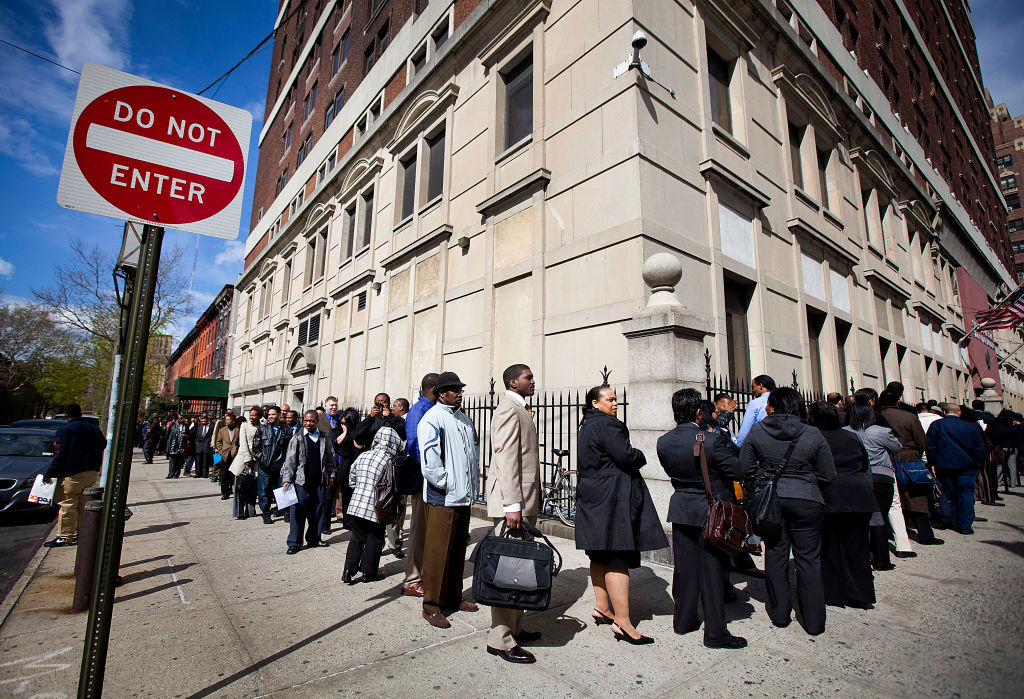
It’s always tough being unemployed, and under Donald Trump and our new artificial intelligence overlords, it’s getting worse. (Michael Nagle / Bloomberg via Getty Images)
In 2025, employers laid off 1.2 million workers. It’s the highest number of layoffs since the start of the pandemic and nearly the same as seen during 2008. This puts the first year of Donald Trump’s second term on par with the first year of the global financial crisis in the scale of its disastrous impact on the US workforce. The greatness to which Trump is returning the country seems to be that of the Great Recession.
But rest assured, 2026 is proving to be more hopeful, as long as you don’t need to work to make a living. This is the miracle of the “jobless recovery,” and I am one of its many victims.
Last fall, I was laid off from a staff position in higher education along with the rest of my team due to budget cuts. Seven months and one hundred applications later, I still do not have a job, and my unemployment benefits have expired.
It’s a distressing situation. It’s also not exceptional. The number of workers who have been unemployed for twenty-seven weeks or longer, a category known as “long-term unemployment,” has grown to nearly two million and now constitutes 25 percent of the total unemployed population. Many workers are giving up on finding a job altogether. In June, the unemployment rate actually went down, but only because seven hundred thousand unemployed workers stopped searching and are no longer included in the official count. The crisis has been worse for black workers, who are disproportionately represented among the unemployed.
Despite this trend, neither Congress nor the White House have discussed expanding unemployment benefits, as was done during the 2008–2009 financial crisis and the pandemic. Instead of addressing the problem, Donald Trump tried to hide it by attacking the Bureau of Labor Statistics, cutting the federal agency’s funding and firing its commissioner in hopes of pressuring the bureau to publish positive job reports that make him look good.
As is the case for most burning political issues, gaining greater protections for the unemployed will require building a mass movement that can demand it. But there is a major obstacle to such a movement’s formation: the unemployed in the United States often blame themselves for their job loss. This culture of self-blame is not only self-destructive but also prevents workers from joining together to demand political interventions that will alleviate their suffering. Few workers are immune from beating themselves up over losing their job. I, too, am one of them.
Class Injuries, Visible and Invisible
The irony of the job search is that you’re expected to sell yourself during a time when you’re probably feeling your worst. The psychological toll of unemployment is well documented. People facing job loss express less satisfaction with their lives and are more likely to report psychological problems compared with those who have a job.
Outcomes are worse in countries with weak social safety nets. In the United States, our benefits end much sooner than other countries (in France, they last upward of two years); we receive a lower percentage of our previous paycheck; and stricter eligibility requirements mean that many workers don’t receive any unemployment benefits at all. The absence of universal health care, so common elsewhere, means that many workers also lose their health insurance when they lose their jobs. All of this makes the United States a leading producer of poor mental health for the jobless.
My ability to sleep well at night has become tethered to my productivity writing cover letters and submitting applications. I have always been a social person, but there have been periods when I don’t want to see anyone because I feel especially hopeless or embarrassed. Friends and family ask me how I’m doing, and I listen to myself give gloomy answers and get irritated when they say it will all work out. I’m becoming one of those characters in a nineteenth-century novel whose malaise can only be cured by a medically prescribed trip to the sea.
In my mid-thirties, I’m at an age when many of my friends are getting married, having kids, and doing well in their careers — a crucial period that sets people up for future financial stability. Meanwhile, my partner and I have had to postpone discussions of marriage while we cut back on expenses to live off of one income. I can feel bitterness creeping into my heart.
This chronic stress manifests physically too. It can cause a number of ailments, including high blood pressure, heart disease, and stroke. When I lost my job, I was in physical therapy, and I noticed that any progress I made was reversed when my anxiety spiked during the ups and downs of the job hunt. I am tense, and that tension is leading to headaches, stiffness, and pain. Health insurance is needed to treat these issues, but Trump’s attacks on Medicaid have made it risky for someone like me, with a chronic medical condition, to navigate the marketplace. So I’ve opted to burn half of my unemployment checks on wildly expensive COBRA payments to ensure continuity of coverage.
Those are just some of the visible challenges facing the unemployed. More sinister are the hidden injuries of class.
In their book of that name, first published in 1972 and reissued by Verso in 2023, sociologists Richard Sennett and Jonathan Cobb interviewed hundreds of workers and discovered a deep-seated conflation of class and self afflicting them. These workers felt it to be true that they were their own makers. If they lost a job, it was not a matter of bad luck or systemic pressure but a reflection of their individual talent, ability, and worth. “A move downward,” they write, “more often had a moral overtone.”
Subsequent studies have confirmed Sennett and Cobb’s original research. The culture of self-blame is fairly unique to the United States and continues to hold a powerful grip on its workforce, white- and blue-collar alike. Commenting on the continued relevance of their insights, Sennett, in the recent reissue, argues that the decline of unions and civic life, growing inequality, and shrinking opportunities have put a greater burden on the self and resulted in more internalization of blame.
I first learned about this tendency not from reading Sennett and Cobb’s book, but when I woke up one night in a panic. I’m not sure what I was dreaming about — maybe a self-made man or some other cryptid of capitalist folklore — but I emerged from it midway into a self-interrogation. I laid awake for hours questioning past choices, finding new flaws, cultivating fresh regrets about my life. This has happened several times now, usually after a round of interviews ends in rejection, which are always vague and leave me guessing why I didn’t get the job.
As someone who has read an inordinate amount of Marxist literature, this was perhaps the most humiliating part of the experience. I am well aware of the structural forces that I am up against these days. None of that knowledge prevented me from beating myself up.
Talking Cures and Political Solutions
My encounter with Sennett and Cobb’s work was a turning point in my ability to break away from the culture of self-blame. In naming the experience, their work created some distance between myself and what I was feeling, which in turn diminished the power that these feelings had over me. This is one of the goals of talk therapy, and it points to the value of talking more about the experience of unemployment. We need to drag these hidden injuries out into the open and reveal them for what they are: mass-produced misery.
Some unemployed workers speak up on social media, and I’ve benefited from hearing their stories. They’re joining Facebook groups, discord communities, and substacks like Laid Off for support. On TikTok, people candidly share their experiences with financial precarity, housing insecurity, and declining mental health. Even LinkedIn offers a version of doomscrolling these days. The professional social media network is typically where you go to congratulate yourself for a promotion, not admit you’re struggling to find work. But my feed is now dominated by announcements of layoffs and expressions of anger and frustration at demoralizing job hunts.
The most common refrain of these discussions is that workers are applying to hundreds of jobs without hearing back. Those who do get interviews are experiencing an uptick in the number of rounds. In my own experience, an employer checked my references after a final round — which everyone around me assumed was a guarantee that I got the job — only to find that they were checking references for multiple finalists. Some workers have even been ghosted after a final round, a degrading practice made possible by a hypercompetitive job market where employers have more power. Other issues include entry-level jobs that require niche skill sets with no on-the-job training, and job postings that read like three jobs in one. In one interview, I was told my only coworker would be Claude or ChatGPT. Employers are also using AI to screen cover letters and resumes, creating new challenges for applicants to navigate.
As the National Employment Law Project argues, the lack of robust unemployment benefits brings down every worker’s well-being. In their absence, employed workers are less likely to demand higher wages or better working conditions, and vulnerable unemployed workers are forced to accept lower-paying jobs or lower compensation for the same work when offered.
The pandemic showed that it was possible to change this situation, but it also revealed how eager employers are to maintain the status quo. The passage of the CARES [Coronavirus Aid, Relief, and Economic Security] Act in 2020 increased the amount of unemployment checks, extended how long workers could collect, and eased restrictions on eligibility. But this lasted barely eighteen months.
Making these boosted benefits permanent would be the first step in overhauling a draconian unemployment system. Modernizing the system’s infrastructure to facilitate an easy rollout of benefits and prevent it from crashing as it did during the early pandemic is also needed. Universal health care will ensure that workers can address their physical and mental health needs with professional doctors and therapists rather than ignoring these needs or self-medicating. And investment in workforce development can help workers retrain or update their skill set for a new job market. A similar proposal was included in the Green New Deal for workers in extractive industries but could be generalized to support any worker who has been laid off.
It may be surprising that at a time when public opinion of our unendingly greedy oligarchs is at its lowest, that these demands have not broken into the mainstream. But Sennett and Cobb have something to say about this too. Not all of the workers they interviewed respected the authority of the employer who laid them off: “Rather, a sense of self-doubt intervenes to make them unsure they have the right to fight back.” Low approval ratings will not lead straight to rebellion. First, unemployed workers need to gain the confidence to demand better conditions for themselves. We deserve that just as much as the jobs we are seeking.