Turkey’s Key Role in NATO Is No Contradiction

Turkey, which hosts this week’s NATO summit, has the alliance’s second-largest army. Its strategic role in a US-dominated world order has long outweighed any concerns about its lack of democratic standards.
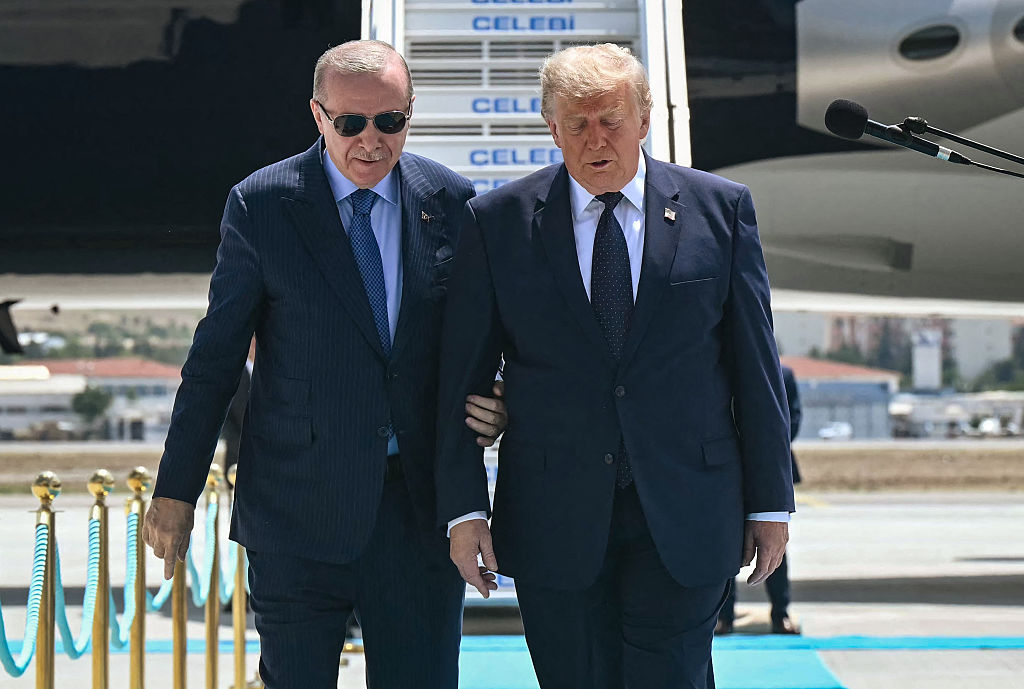
Recep Tayyip Erdogan welcomes Donald Trump upon his arrival at Etimesgut Air Base near Ankara, on July 7, 2026, before attending the 36th NATO Heads of State and Government Summit.

Hundreds have been arrested in Ankara ahead of this week’s NATO summit. The crackdown in the Turkish capital is less a contradiction in NATO’s professed values than a show of how militarization trumps democracy. (Saul Loeb / AFP via Getty Images)


The North Atlantic Treaty Organization (NATO) Summit this week in the Turkish capital began in familiar circumstances: police repression of anyone dissenting against the alliance. Ahead of the meeting, Ankara was placed under what amounted to a quasi–state of emergency. Without formally declaring emergency rule, the governor’s office banned virtually all forms of protest and public political expression from June 28 to July 10. Road and park closures, emptied student dormitories, special security arrangements, and accreditation barriers for journalists turned the capital into a securitized zone where political expression and ordinary urban life were temporarily suspended.

Officials repeatedly emphasized the security risks surrounding the summit. But the scale of the crackdown pointed to something more revealing: hundreds of people were detained in pre-summit operations, including academics, journalists, lawyers, trade unionists, and civil society figures.

These figures reveal not only the erosion of the rule of law in Turkey but also Ankara’s continuing importance within the alliance. Indeed, while NATO leaders often say that the bloc is built on shared values of democracy and the rule of law, repression in Turkey has rarely threatened the country’s standing inside the bloc. It’s not hard to see why. Turkey possesses NATO’s second-largest army, controls access between the Black Sea and the Mediterranean, borders the Middle East and the Caucasus, and retains diplomatic leverage from Ukraine to Syria. Its strategic value has long outweighed liberal concerns, and it is again today proving its importance to the bloc. Turkey is hosting the NATO meetup as the war in Ukraine, the devastation of Gaza, and the escalating conflict around Iran, are reshaping regions directly connected to one of the alliance’s most strategically important members.

Turkey’s key role in NATO should not be treated as a contradiction or a temporary embarrassment. Its record shows that the alliance’s southeastern flank has often depended on the mutual reinforcement of external security priorities and internal authoritarianism.

From the Cold War onward, Turkey’s role as an anti-communist frontier state helped consolidate a security apparatus directed not only against foreign enemies but also against the domestic left, trade unions, and other forms of dissent. This apparatus did not operate only through abstract ideology: it was sustained by military aid, bases, intelligence cooperation, officer training, and an anti-communist security doctrine that linked Turkey’s internal enemies to the global Soviet threat.

To understand Turkey’s place in NATO today, one must return to the origins of that relationship: the making of a frontier state in the early Cold War.

Turkey as NATO’s Anti-Communist Frontier

The official Turkish story of NATO membership is usually told as a story of strategic necessity and the country’s Western calling. The republic made a “historic choice” after World War II by siding with the “free world” and the Western bloc, a choice “crowned” by NATO membership in 1952. From that moment on, NATO became, in official rhetoric, the cornerstone of Turkey’s defense and security policy while Turkey itself assumed the defense of the alliance’s southeastern frontier throughout the Cold War.

There was a material basis to this narrative. Turkey emerged from the war diplomatically isolated, economically strained, and militarily vulnerable. In 1945, the Soviet Union terminated the two countries’ 1925 Treaty of Friendship and pressed Ankara on the future of the Turkish Straits; Turkish leaders also feared demands for military bases and territorial revisions in eastern Anatolia. These fears helped push Ankara toward Washington.

Yet this founding story has always been politically loaded. For decades, the “Soviet demands” operated in Turkish official memory as a near-mythical origin point: proof that Turkey had no choice but to enter the Western military system. Recent historiography has complicated this picture. Onur İşçi shows that the Turkish leadership genuinely felt exposed in 1945–46, but he also challenges the older official narrative that treats NATO membership as the inevitable response to a simple Soviet threat. The threat was not invented out of nothing, but the decision to join was also motivated by Turkey’s own search for a place inside a new, US-led imperial architecture.

The Korean War made this logic explicit: Turkey’s decision to send troops was presented as a sacrifice for the “free world,” but it was also a bid for admission into the Atlantic alliance. By 1952, Turkey had become not merely a beneficiary of Western security but a militarized frontier state. Its value lay in its manpower, its anti-communism, and also its geographic proximity to the Soviet Union, the Balkans, the Caucasus, and the Middle East.

The Turkish Left Against the Alliance

In March 1968, Behice Boran, one of the leading figures of the Turkish left, concluded an article titled “Why We Must Leave NATO” with a striking formulation: “Underlying the previous governments’ dependence on the United States, their entry into NATO, and the present government’s insistence on remaining in NATO are not military reasons or considerations, but political and economic ones.” Turkey’s domestic bourgeoisie, she argued, had opened the country to foreign capital, external loans, and the military and political influence of the states behind them. “The bilateral agreements and NATO,” Boran wrote, “are the military front of Turkey’s economic and financial relations with the capitalist world.” For Boran, NATO membership represented more than just a security arrangement; it was the military form of Turkey’s dependent capitalism.

The 1960s in Turkey were marked by the rapid growth of the Left. The military coup of May 27, 1960 — or the “May 27 Revolution,” as many left-wingers then called it — produced a new constitutional order that opened limited but real space for socialist politics, trade unionism, student activism, and public debate. The Workers’ Party of Turkey, the first socialist party to enter parliament in republican history, won seats in 1965 and became the most visible expression of this new socialist current. Boran would later lead it in the 1970s.

As the Turkish left gained momentum, a nationalist-conservative, religious-conservative, and anti-communist reaction grew alongside it. Backed by sections of the state, the right-wing press, and Turkey’s Western allies, this reaction cast left-wing workers, students, and intellectuals as agents of the “Moskof” — an old derogatory term for Russians, repurposed for Cold War propaganda. Anti-communist associations and religious-conservative educational networks helped turn this politics into a social infrastructure, producing cadres who, from the 1970s onward, would enter parties, ministries, municipalities, business associations, and eventually the commanding heights of the Turkish state. NATO and the United States were presented as the only barriers against a renewed Russian threat, linking contemporary anti-communism to older memories of Ottoman-Russian conflict.

Yet this period also saw the first major rupture between Turkey and the alliance. The Cyprus question, which still hangs over Turkey’s relations with the West, showed both the Turkish state and ordinary citizens that NATO membership did not guarantee automatic support. The Johnson Letter of 1964, sent by the new US president, made this painfully clear: Turkey could be restrained by its principal ally even when facing a crisis involving another NATO member, Greece. For the Turkish right, however, this did not fundamentally alter the strategic picture. The greatest threat was still imagined as coming from the north, in the Soviet Union.

Despite the strength of anti-communist propaganda, the Left could not be fully contained by the military memorandum of 1971, forcing an authoritarian turn. Repression was severe, but not enough to kill off left-wing politics and trade union militancy. By the end of the 1970s, however, political violence, economic crisis, and Cold War polarization had created the conditions for a more decisive intervention. What appeared as street violence was also a struggle over the future of the state, labor, and Turkey’s place in the Cold War order. On September 12, 1980, the army intervened once again. In the oft-cited phrase attributed to CIA Ankara Station Chief Paul Henze, “our boys” had done it.

Political Islam and Capital

The military coup of 1980 did not simply crush the Turkish left. It also completed a long transformation in the ideological foundations of the republic’s anti-communist order. Doğan Avcıoğlu and many militants of the 1968 generation located the decisive break not in 1980, but in the post-1950 consolidation of a pro-American, anti-communist, dependent capitalist regime. Their reading could sometimes idealize an earlier republican project, but it grasped something essential: by the late Cold War, the Turkish state’s dominant ideology was no longer national-developmentalist republicanism, but a right-wing synthesis of military tutelage, neoliberal capitalism, NATO loyalty, and religious conservatism.

The late Marxist theoretician Yalçın Küçük grasped this transformation with unusual clarity, even as it was taking shape. Writing on the eve of the 1980 coup, he argued that Turkish capital, faced with worsening inequality and the defeat of the organized left, would need not only military repression but also a deeper religious discipline. The army, in his view, could repress Islamist parties as political competitors while simultaneously adopting a more intensified version of religious conservatism. This was the paradox of the post-1980 order: not the victory of Islamism over the state, but rather the state using Islam to anti-communist ends.

In this sense, Küçük anticipated, in a specifically Turkish register, Samir Amin’s later argument about “political Islam in the service of imperialism”: political Islam could grow not outside Western security structures but inside a Cold War order that armed the military, tied Turkey to NATO, and bound its ruling classes to international capital. This also changes how we should understand the later rise of Recep Tayyip Erdoğan’s Justice and Development Party (AKP). From the Turkish-Islamic synthesis of the post-coup years to neoliberal conservatism, the path to the AKP was prepared inside the post-1980 settlement. The party did not represent a clean break with Turkey’s NATO order, however much its rhetoric sometimes clashed with the West. It was the most successful political form produced by that settlement: pro-market, anti-left, socially conservative, and capable of translating the old anti-communist state into a new Islamist-conservative hegemony.

Bargaining Power

Turkey no longer occupies the same position it held in the early Cold War. It is not simply NATO’s southeastern outpost against the Soviet Union, nor merely a military frontier guarding the Bosporus, the Black Sea, and the approaches to the Middle East. Today Ankara operates as a bargaining power inside the alliance: a difficult and often disruptive force but still an indispensable one. Its value lies in its ability to move between theaters — Ukraine, Syria, Iraq, the Caucasus, the Eastern Mediterranean, Gaza, and Iran — where Western power is either overstretched or dependent on regional intermediaries.

This is why Turkey’s periodic tensions with NATO have rarely produced a real rupture. From the S-400 crisis to Syria, Ukraine, and NATO enlargement, Ankara has repeatedly turned tensions with the alliance into leverage. Erdoğan’s governments have understood this well. Their foreign policy has often appeared to oscillate between East and West, for instance with rhetoric about Palestine, but this balancing act is not anti-imperialism. It is bargaining from within the architecture of empire. The AKP’s anti-Western rhetoric should therefore not be mistaken for a break with the NATO order. Its novelty lies elsewhere: it translated the post-1980 synthesis of security-state authoritarianism, neoliberal capitalism, and religious conservatism into a durable regime.

This week’s securitized Ankara summit has brought this story full circle. A meeting presented as a gathering of democratic allies required the crushing of basic civil liberties in the city where it is taking place. This was not an accidental contradiction but a reminder of the deeper continuity in Turkey’s NATO history: external security has repeatedly provided the language justifying internal repression.

The story of Turkey’s NATO membership is thus not simply a history of foreign relations but also a history of regime formation. NATO helped shape Turkey’s anti-communist state, its suppression of the Left, its post-1980 neoliberal and religious-conservative turn, and its later emergence as a difficult but indispensable regional power. Turkey entered NATO as an anti-communist frontier state; it now operates as a bargaining power inside the same alliance. Its place in NATO has long been secured not despite authoritarianism but often through it.