Want to Organize the Working Class? Learn Spanish.
Millions of workers in the United States are Spanish speakers. Socialists who can’t talk to them can’t organize them.
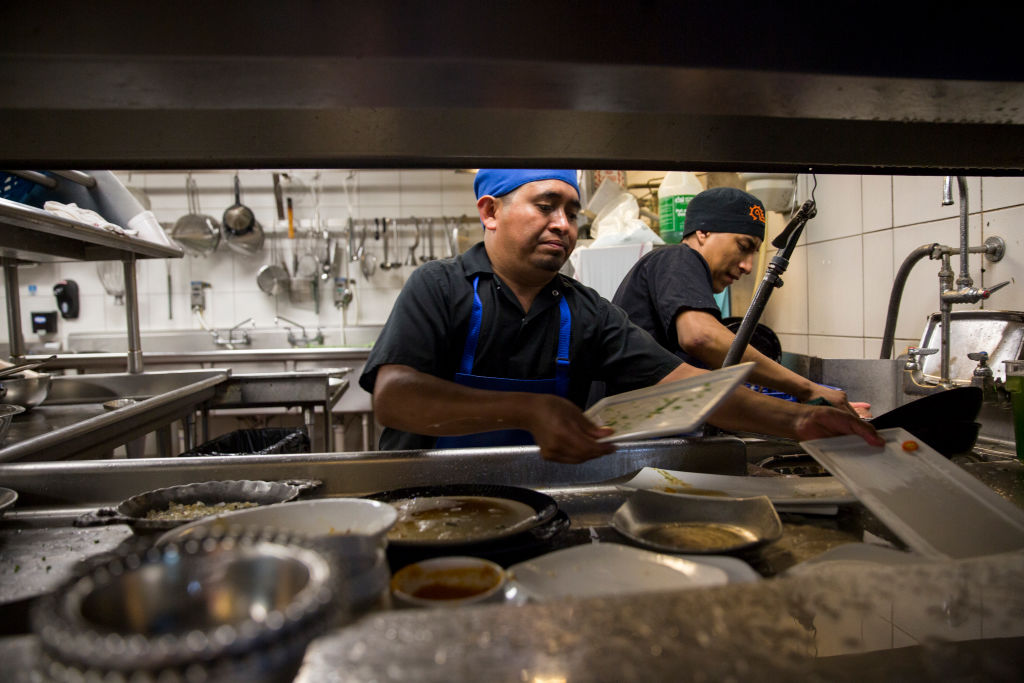
The US labor movement has a language problem. Millions of workers are Spanish speakers, and many organizers can’t communicate with them. That has to change. (Scott Dalton / The Washington Post via Getty Images)
In Paul Thomas Anderson’s latest film, One Battle After Another, there’s a scene I still think about at least once a week.
About halfway through the movie, the main character, Pat Calhoun (Leonardo DiCaprio), is on the lam and seeks refuge with his daughter’s karate teacher, Sergio “Sensei” St Carlos (Benicio del Toro). Unfortunately for Calhoun, Sensei is using his apartment building as a kind of underground railroad for undocumented immigrants, and he has arrived right in the middle of an Immigration and Customs Enforcement raid.
A fascinating combination of tension and hilarity ensues as the two men attempt to escape. Calhoun, calling his revolutionary comrades for backup, cannot remember the series of passwords necessary to identify himself. Frustrated, he begins to berate the phone operator for not giving him the rendezvous point, to which the uppity operator chirps, “Okay, this doesn’t feel safe. You’re violating my space right now.”
The moment would be a bit too on the nose — another shallow depiction of supposedly maladjusted leftists — if not for Sensei. As Calhoun moans and pleads for help, unable to communicate on even the most basic level with someone who is supposed to be his comrade, Sensei is continuously whisking through the maze of his underground railroad station, calmly instructing a well-oiled machine of community members how to safely hide the people in their care.
Sensei often speaks entirely in Spanish, and his lines are not translated for the audience or Calhoun. Yet the message could not be clearer: English, the primary language of the movie and its protagonists, the language of the old-guard revolutionaries, has somehow gotten stuck, revolving around an increasingly rigid set of social and intellectual passwords to the point that nothing meaningful can be said at all, even in the most dire of circumstances.
Meanwhile, unbeknownst to us or Calhoun, a new underground has sprung up to continue revolutionary struggle. It just doesn’t look or sound like what we have come to expect.
Despite Hollywood’s obvious limitations, a poignant portrayal of contemporary American class politics has emerged anyway in One Battle After Another. What is depicted is not the conscious answer to our political predicament but one of its most pressing questions: How can we possibly organize the working class if we don’t even speak their language? And what if, rather than simply “us” organizing “them,” they could actually teach us something instead?
A Working Class Primed to Reject the Status Quo
It’s no secret that traditional labor is on the ropes. In 2024, union membership in the United States hit all-time lows, slipping below 10 percent of all workers nationally, and the top 1 percent of our country owns more wealth than the bottom 90. The stakes could not be higher. We are losing. It’s time to get creative.
Fortunately, as One Battle After Another so concisely depicts, there has been a secret weapon sitting right under our noses this whole time: undocumented workers. There are somewhere between eleven and fourteen million undocumented people in the United States today, nearly all of them Spanish speakers. They conduct our most essential labor — the country’s cooking, the cleaning, the growing and harvesting of our food, constructing and maintaining our infrastructure, even raising many of our children — and they are paid the bare minimum for it.
Normally, a group like this would be the perfect target for labor organizing. If you get these particularly important workers to stop working, the entire country shuts down. But even very left organizations often treat undocumented laborers in the United States as mostly an afterthought. This is largely due to two legitimate obstacles.
The first, of which much has been written, is that undocumented workers have comparatively fewer labor protections; going on strike, despite laws against retaliation, can lead to deportation. It is incredibly difficult to ask people to risk so much for so little promise of reward, an enduring structural problem of our political era.
The second obstacle, however, can be addressed much more immediately. And yet it is also, bafflingly, mostly not grappled with on the organized left: few of us speak Spanish. If we are serious about addressing the first obstacle, we need to address the second. Spanish is the language of America’s underclass, its most essential proletariat. We cannot reasonably expect to organize this proletariat if we cannot speak their language.
Moreover, the Spanish-speaking workforce extends well beyond undocumented workers alone. As of 2019, there were forty-one million people in the United States who spoke Spanish natively. This includes undocumented immigrants but also precariously documented people (such as Deferred Action for Childhood Arrivals [DACA] recipients or those on work visas) as well as permanent residents and citizens, most of whom are likely first- or second-generation immigrants whose families came to the United States to work.
Spanish speakers, then, are much more likely to understand, even if only on an unconscious level, that their belonging in a society is directly related to the labor they conduct for it. They are also more likely to have some memory — either through family members or their own experiences — of more radical approaches to labor struggle in Latin America than what has existed in the United States for the last half century. In short, there is huge political potential in this population, not just for how we can organize them but how their struggle can organize our own. Yet it’s just sitting there, largely untapped.
Spanish speakers are not a monolith, however, and significantly more Latinos voted for Donald Trump in 2024 than 2016. Two common but incorrect analyses of this fact are that Latino voters are simply more “macho,” and therefore cotton readily to Trump’s strongman politics, or that, relatedly, they are less educated, and so more susceptible to right-wing propaganda.
But as René Rojas and Mirabel Tineo make clear in “The Latino Rebuke,” a material analysis of working-class Latino voters shows that they shifted right in 2024 not because Trump was particularly appealing but because the Democrats had given them nothing to show for their decades of loyalty.
“Latinos,” they write, “are the United States’ working class. They embody crucial transformations in working-class structure and the material insecurities that result, and they suffer from the general political abandonment of American workers. . . . Latinos’ experience as workers battered by decades of class warfare shapes their political behaviors.”
Once drastically declining wages and worker protections are factored into the equation, Latinos — who often experience these inequalities first and most viscerally — deciding to no longer back centrist Democrats who smooth over anti-worker policies starts to make a lot more sense. Rather than dismissing them as bad voters, as some in the liberal commentariat have, we should start seeing them for who they actually are: perfectly primed workers ready to reject the status quo.
Latinos also account for the majority of the nation’s total population growth — approximately 71 percent between 2022 and 2023. By 2050, nearly one in three Americans will be Latino. If socialism is the science of the future, that future speaks Spanish. If the labor movement got serious about learning it — not just outsourcing pamphlets and trainings to translators but committing to spending the next several years boosting Spanish fluency within their own organizations across the board — the entire horizon of labor organizing in this country could expand drastically.
The Makings of a Mass Movement
How to implement something as complicated and time-consuming as learning a new language at scale? By tying language classes to organizing classes, and tying those classes to practical actions that help organize worker power.
We already have historical precedent for something like this. In 2006, Wisconsin Republican Jim Sensenbrenner proposed the draconian anti-immigrant bill H.R. 4437, which would have classified immigrants without papers — and those acting in solidarity with them — as felons. In response, Latino groups around the country organized a May Day march known as A Day Without Immigrants. Somewhere between four and five million people walked out of work in over 160 cities that spring. As Eric Blanc writes, “You don’t have to imagine what a nationwide strike in defense of immigrants could look like. It’s already happened.”
A Day Without Immigrants is likely the closest thing we’ve had to a general strike — labor’s holy grail — in recent US history. Now United Auto Workers President Shawn Fain has announced that his union is shooting for a 2028 coordinated strike, which seems unlikely to develop into an actual general strike, given low union density and the lack of worker consciousness in the United States right now.
What could get us closer to a general strike, however, is declaring another Day Without Immigrants in conjunction, and coordinating with the immigrant rights networks that made the first one so successful. What if, over the course of these next two years, as a strategy to build up consistent momentum for May Day 2028, this partnership offered free Spanish-language classes for English speakers in the movement, and free English-language classes for Spanish speakers?
These classes are not the goal in itself but the means. Free English classes give the Latino working class a concrete and practical offering while also integrating them more deeply into labor organizations. Free Spanish classes do the same from the other end, providing a long-term goal and structure for organizing-minded people to continue showing up on a regular basis.
Another historical example that backs up this idea is the Justice for Janitors campaign, which began in 1980s Los Angeles when the majority-immigrant workforce saw their real wages significantly cut after being reclassified as contract workers, placing them at the bottom of a two-tiered compensation system. Despite perceptions of immigrant workers as difficult to organize, Justice for Janitors eventually spread from Los Angeles to Houston, Boston, and Miami, winning successful wage increases in each city. This was in large part because the campaign was effective at blending the language of social justice (immigrant rights) with the language of building rank-and-file union power (worker rights).
Friend or Foe?
Justice for Janitors becomes even more convincing considering their successes in relation to someone like César Chávez. Long before his sexual abuse scandals came to light, the supposed ur–“Latino organizer” had another dark mark on his record: he continuously villainized undocumented migrant workers. Throughout his United Farm Workers (UFW) leadership, undocumented migrants were framed as stealing American jobs, as scabs, as driving down the negotiating power of the union.
Of course, there is some truth to this. US farmers often attempted to break UFW strikes by hiring undocumented workers. To stop them, Chávez actively called for their deportation. Union members were even encouraged to collaborate with immigration agents, overtly intertwining union power with capitalist policing and militarized borders.
It was a huge mistake. In retrospect, UFW members and undocumented workers had far more in common than whatever they believed divided them; broadly speaking, they shared an ethnicity, a culture, a language, and an identity as workers. This was a historical crossroads where everything could have gone differently. The border was not yet heavily militarized, and being undocumented was far less criminalized. It was a chance for Chávez to use workers’ commonalities to UFW’s advantage — perhaps even impeding, or at least slowing, the rise of the mass deportation regime — instead of dividing them based on immigration status.
But Chávez did not choose this path. Ultimately, farmers weren’t deterred from hiring undocumented workers (they make up at least 40 percent of the agricultural workforce today), and by casting them as the mortal enemy of the citizen worker, Chávez immediately foreclosed any possibility of building power with them collectively.
Fifty years on, we now know that the real problem, as American workers have so painfully discovered, is not undocumented workers themselves but the conditions that allow them to be so deeply exploited. Mass deportation plays a crucial role in capital’s ability to discipline labor, undocumented and citizen alike.
As Suzy Lee shows, today the Trump administration has effectively conflated undocumented immigrants with immigrants as a whole to further its mass deportation campaign.
“For decades now,” she writes,
the status of undocumented or unauthorized migrants has been treated as a form of criminality in public discourse, if not always de jure. The Trump campaign did not correct this slippage. More important, most of Trump’s ire seemed to be directed toward migrants who were technically neither undocumented nor unauthorized but were admitted under temporary humanitarian programs or paroled into the country while awaiting adjudication of their asylum claims.
Chávez’s protectionism, then, plays right into the political logic of Trumpism. Every time labor replicates this stance, it does the same, aligning itself with the very capitalists it professes to be fighting. And as I have written previously, the Trump administration hasn’t stopped there, conflating undocumented immigrant with immigrant in order to then go one step further, conflating both with anyone deemed to be politically dissident. The point is to first erode undocumented people’s rights, normalize this erosion, and then erode everyone else’s as well.
On Speaking Spanish Poorly
Language classes in themselves, of course, will not magically solve these deeply structural problems. But there is, again, an example from history that proves that the acquisition of language and collective power can go hand-in-hand.
In 1912, one of the most famous strikes in US history occurred in a textile mill in Lawrence, Massachusetts, which came to be known as the Bread and Roses Strike. Mill bosses had strategically hired thousands of immigrant workers — approximately half of them teenage girls — specifically in the hopes that they would not be able to communicate with each other. These workers were not merely divided by two languages but over three dozen. A Polish woman would be placed beside a German, who would be placed beside an Italian.
In response, workers formed a strike committee that, despite having very few resources, was able to translate all of its meetings and communiqués into the language of essentially every worker. The strike was brutal — three workers were killed and over three hundred more arrested — but in the end they won nearly all of their demands.
Learning a new language is, of course, difficult. It demands years of time and effort, and it is embarrassing to speak poorly, to sound ignorant. But that is exactly why it is so effective.
Learning another’s language, however imperfectly, implies that you care enough to have sacrificed something significant in the name of understanding them better, of speaking the way they speak. This is how trust gets built. It is a demonstration that one is willing to labor for the other, often at great cost. Language, like organizing, is ultimately about exchange. You’ve got to give something to get something.
This is the real truth of internationalism: it is knowing that the world is always already at your doorstep. It is not only believing in proletarian struggle in far off places, but also that the struggle for the entire world is here right now, right in front of you.