Israel Is Deliberately Targeting Lebanon’s Journalists
The list of civilians deliberately killed by Israel in Lebanon includes journalists trying to report on the invasion. The Union of Journalists in Lebanon is campaigning for justice while the US works to shield Israel from accountability.
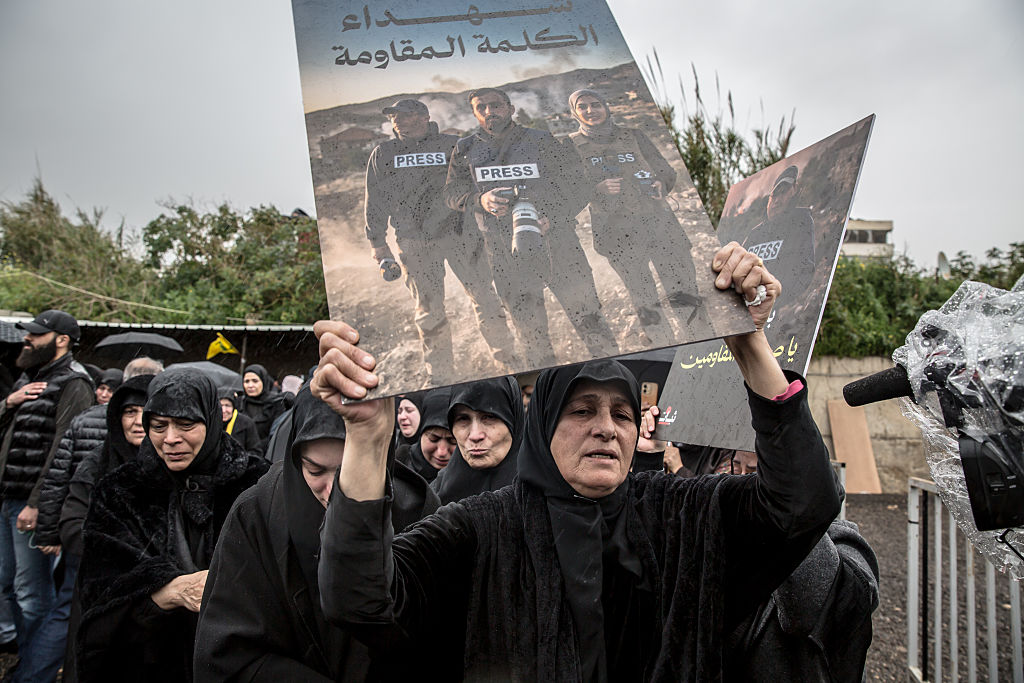
A woman holds up a poster of three journalists killed the previous day by Israeli air strikes, during their funeral ceremony in Choueifat, south of Beirut. (Sally Hayden / SOPA Images / LightRocket via Getty Images)
The ongoing Israeli invasion of Lebanon has displaced more than a million people — around one-fifth of the country’s population. Between March 2 and June 19, the Lebanese Health Ministry reported 3,980 deaths resulting from the conflict.
Lebanese journalists have been in the firing line. Since October 2023, Israeli attacks have targeted at least eleven Lebanese journalists: Issam Abdallah, Farah Omar, Rabin Maamari, Wissam Qassem, Ghassan Najjar, Mohammad Rida, Zeinab Faraj, Amal Khalil, Mohamed Sherri, Ali Shoeib, Fatima Ftouni, and Mohamad Ftouni. All but Faraj, who narrowly survived with serious injuries, were killed.
According to a special report from the Committee to Protect Journalists (CPJ), 2025 was the deadliest year on record for journalists, largely thanks to Israel’s track record in Palestine and Lebanon:
This is the second consecutive year-on-year record for press deaths. Israel was responsible for two-thirds of all press killings in both 2025 and 2024. The Israel Defense Forces (IDF) has committed more targeted killings of journalists than any other government’s military since CPJ began documentation in 1992.
The Union of Journalists in Lebanon (UJL) has been leading the pursuit of justice for the journalists killed or injured by Israel. The UJL has assisted with investigations into the killings, coordinating with survivors and witnesses, that produced six independent reports with a common conclusion: Israeli forces deliberately targeted journalists and committed war crimes. The union has also worked with regional and international organizations demanding the formation of an investigative committee to examine these cases.
Support System
In addition to seeking justice, the UJL has provided direct assistance to journalists including protective equipment, housing, workspaces, and psychological support. Fatima Shoukair, a working journalist and UJL communications manager, describes the union as “much more than a professional organization for me — it became a real support system and a community”:
In my view, the union was ahead of many other professional bodies in Lebanon in recognizing that mental well-being is not secondary during war: it is a necessity. The support I received helped me continue balancing my own daily struggles as someone impacted by the conflict with my responsibility as a journalist who had to keep reporting. It allowed me to remain stronger and more grounded, to continue my work and my mission without being completely overwhelmed by the consequences of war.
Forms of mental health support that the UJL has facilitated include individual and group sessions with mental health professionals as well as awareness campaigns and webinars targeting frontline journalists.
“The majority of journalists in Lebanon and in our union are freelancers, often working without stable income or institutional protection,” observes UJL President Elsy Moufarrej:
Some have moved into collective shelters while continuing to report on the war. We are therefore seeking support to provide rental assistance, enabling them to live in conditions that allow them to continue their work with dignity and safety.
A survey conducted by the Maharat Foundation confirms Moufarrej’s assessment. The foundation is an organization based in Beirut and led by women that focuses on freedom of expression across the Middle East and North Africa (MENA) region. Four-fifths of the Lebanese journalists consulted for the survey said that their employers do not provide insurance coverage for the risks they face while engaging in war reporting. The same proportion said that they had received no training on how to cover wars or crises.
Political Familism
Lebanese journalists already face a challenging landscape as they go about their work. Writing for the Media Diversity Institute last fall, Lebanese freelance journalist Layla Bartheldi argued that the sectarian system on which the country’s political structures are based also shapes the Lebanese media:
While the system claims to balance power among the country’s diverse communities, it often deepens divisions, limits cross-sectarian cooperation and reinforces clientelism. The media are no different in this regard. Most Lebanese media remain in the hands of a few dozen powerful families from all political affiliations. The close ties between media owners and ruling elites have pushed Lebanon to the bottom of global press freedom rankings.
The Media Ownership Monitor Lebanon has documented family connections and audience concentration across media formats, a pattern that researchers have described as “political familism.”
In addition to these internal pressures, Lebanese journalists have lost the support of Western media institutions. As Zahra Hankir noted in an article for the Colombia Journalism Review, twenty US media organizations closed their foreign bureaus between 1998 and 2011, leading to a drastic contraction in their international reporting teams.
For Hankir, the consequences were apparent in their recent coverage of events in Lebanon: “During the 2024 war, reporters with outlets including the BBC and Fox News toured southern Lebanon alongside Israeli forces, producing what one Lebanese legal watchdog described as ‘carbon copies of the Israeli army’s videos.’”
According to Afeef Nessouli, a Lebanese American freelance journalist based in Beirut, what little remains of the Western media presence in Beirut amounts to periodic visits from foreign “bigwigs” who rely on indigenous Lebanese journalists as “fixers, stringers, and assistant producers.”
A New Entity
Originally founded as the Alternative Press Syndicate, the UJL saw its early mission as being to defend media workers against arbitrary dismissals and physical assaults. It initially faced hostility from Lebanon’s official Editors’ Syndicate before rebranding as the UJL and affiliating to the International Federation of Journalists in 2025.
Jad Shahrour is a spokesperson for the Samir Kassir Foundation, named after a prominent Lebanese journalist who was assassinated in 2005. He says that the creation of a new representative body for media workers was essential: “In 2019, when the country was trying to evolve on the political level — on the freedom of expression level — there was a need to connect like-minded journalists to come together and create a body.”
According to Shahrour, the change of name was prompted by legislation that prohibits the formation of syndicates outside those that are controlled by the state. The Samir Kassir Foundation is a participant in the Media Ownership Monitor Lebanon project. Shahrour says that while little has changed in terms of traditional media in recent years, online, independent journalism has grown.
Shahrour was also involved in the formation and development of the UJL: “Journalists needed a new entity — to trust that it understands their work, or their field.” The union fought to protect the right of journalists to organize and challenged the existing media associations that sought monopoly control of the press. In the face of a major economic crisis, the union helped workers resist job and pay cuts.
Holding Accountable
As the Lebanese crisis deepened, so did the pressure of state repression against journalists, who were subject to intimidation campaigns and trumped-up charges. The UJL handled more than forty such cases, arguing that they should be referred to Lebanon’s Publications Court rather than the state prosecutor, as the Publications Law requires.
UJL President Elsy Moufarrej was herself dismissed from her job with broadcaster Murr Television in 2025 because of her union activities. She hopes that the UJL will secure broader international recognition for its efforts to expand freedom of expression throughout the region: “We value ongoing engagement — helping amplify our voices internationally and advocating for the protection of journalists before decision-makers and in international forums.”
The most immediate threat to efforts to hold Israel accountable for its targeting of journalists now comes from the framework agreement that the Trump administration brokered between the Israeli and Lebanese governments last month. One clause requires “the cessation of all hostile or adverse actions in international political or legal fora.” The International Federation of Journalists warned that this would “prevent Lebanon from bringing Israel to international tribunals for violating international laws during the war, particularly through the direct targeting of civilians and journalists.”
Moufarrej also condemned this provision of the agreement:
The Lebanese government has conceded a right that is not its right: the right of the victims to pursue and hold accountable. This right does not belong to the state. This is the right of the people who lost their loved ones, whose homes and memories were destroyed. This is the right of those who performed their duties despite the dangers, like journalists and emergency medical workers.
As the UJL seeks to hold Israel accountable for its crimes, international support for its work is vital.