Lebanon’s Communists and the Disarming of Hezbollah
In 1980s Lebanon, the Communists were often targets for rising Islamist forces. Yet today the weakening of Hezbollah offers little opening for left-wing politics.
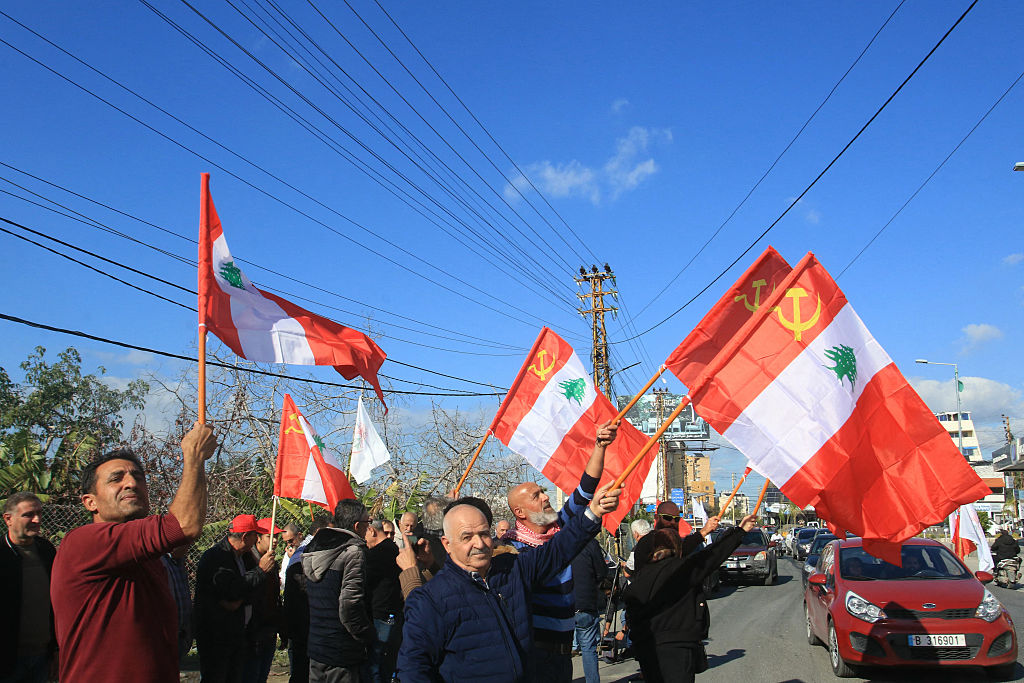
Members and supporters of the Lebanese Communist Party wave the national flag embossed with the communist hammer and sickle symbol as they rally on the highway that leads to the southern town of Naqura in the area of al-Hosh on December 19, 2025, to protest against Israeli attacks on Lebanon. (Mohamoud Zayat / AFP via Getty Images)
In the east and south of Lebanon, Israel continues its bombing campaign. After the latest attacks, in which several Hezbollah members were killed, the group has raised its rhetorical pitch. It has again vowed to fight back, despite being severely weakened after the 2024 war.
For the last four decades, Hezbollah had held an effective monopoly on Lebanese resistance against Israel. But it was neither the first to pick up arms nor to support the Palestinian cause from Lebanese soil. So Hanna Gharib, general secretary of the Lebanese Communist Party (LCP) tells me, at the party’s headquarters in Beirut. “We started the resistance,” he points out.
Even before the foundation of Israel in 1948, the Lebanese Communists fought side by side with Palestinian left-wingers against Zionist right-wing militias. When the civil war broke out in Lebanon in 1975, the Communists again joined the fight. “We liberated three-quarters of the territory when Israel invaded in 1982. We began in Beirut and then continued south,” he tells me.
But the Communists were fighting an uphill battle. “Before the fall of the USSR, we received our weapons from the Soviets,” Gharib continues.
But when the Soviet Union fell, arms deliveries stopped.
At the same time, Iran had advanced its positions in Lebanon. A loosely organized group called “Islamic Amal” carried out several massacres of LCP members. In 1985, Hezbollah was officially founded. In 1987, over forty Communists were killed within ten days.
“First, they killed our leaders and then the intellectuals in the party. They attacked us because we were a national resistance. We had members from all religions. They wanted a monopoly on the resistance and to impose their ideas and values on everyone,” says Gharib.
Faltering Resistance
When the genocide in Gaza began on October 7, 2023, Hezbollah was more powerful than ever. Since 2006, when a short but intense war with Israel raged, it had grown stronger. With confidence and heavy arms, Hezbollah attacked Israel in solidarity with Hamas. For almost a year, a low-intensity war raged.
But in mid-September 2024, Israel detonated thousands of pagers belonging to Hezbollah members. Just over a week later, the longtime leader Hassan Nasrallah was killed with eighty tons of bunker-buster bombs in Beirut’s southern suburbs. Entire neighborhoods were replaced by deep craters.
Since then, the demands that Hezbollah be disarmed have been turned into an official plan, following pressure from the United States and Israel. When authorities in Beirut announced that the first phase of the disarmament was finished, Israeli premier Benjamin Netanyahu said that it was “far from sufficient.” In this phase, all arms and military infrastructure south of the Litani River have been dismantled, which Hezbollah has agreed to. The Lebanese government says that the next phase has begun, meaning that Hezbollah’s arms north of the river will be confiscated also. This is expected to take four months, although the group’s unwillingness to cooperate further might complicate that.
For the Lebanese Communists, the situation is complicated. Hanna Gharib avoids giving any clear answer about his party’s position on Hezbollah’s weapons, even when asked multiple times. As recently as summer 2025, LCP condemned continued “Zionist aggressions” against Lebanon.
“When the state does nothing against the occupation, to liberate the land that is occupied, people will resist. We have a dialogue with Hezbollah. We are against the occupation, and in that way we agree with each other, but that does not mean we are with them.” He adds, “Historically, we are a resistance party, a national resistance. They are an Islamist resistance. So, we cannot be together. I want the state to resist. But the problem is that it does not.”
History of Repression
On the wall of Nabih Awada’s office, there hangs a map of historic Palestine, including what is today called Israel. His hair is thinning, but he still has the smile of a young boy when he recalls how he, as a thirteen-year-old, was eavesdropping through the door to what he calls the “secret room” in his childhood home. He fell straight into the room, which his mom had banned him from entering: “The room was full of Communists! After seeing this room, the fighters who were hiding in there, everything changed for me.”
It was the mid-1980s, and the family was fleeing the Lebanese Civil War and the Israeli occupation of Southern Lebanon. For several generations, his family had belonged to the secular left in the region. The community of Aitaroun that they hail from was early on known as a stronghold of left-wing resistance. “My grandfather was the first Communist in the village in the 1930s,” he explains.
At sixteen, Awada carried out his first mission for LCP. The operation failed. “When they arrested me, they came toward me with a stark light. I thought it was a nightmare, that I was killed already.”
He was taken to Israel and was not released until a decade later. By then, he had been tortured, subjected to sexual abuse, and spent long periods in a pitch-black isolation cell. He had also become more ideologically convinced than ever and had come to know Palestinian fighters who would later become known as the masterminds behind the Hamas attack on October 7, 2023.
Awada spent the longest time in the Ashkelon prison, in north Israel. “I used to play ping-pong with Yahya and basketball with Marwan. The relation between prisoners was very strong, also between atheists and Islamists. We had the same purpose, so it was easy to be friends.”
Both Yahya Sinwar and Marwan Issa were killed by Israel during the Gaza war. The video of Sinwar’s final moments was widely circulated. Severely injured, he sits in an armchair in a bombed-out house and waves a stick at the Israeli drone.
“Yahya was a very social guy. He was not only close to Muslims but to everyone. Marwan liked to debate and talk. He was a very funny guy. and he always talked loudly.”
Released again in 1998, Awada soon noticed that everything had changed. The Communist Party had stopped resisting, but the occupation continued. “I didn’t understand, because when your country is occupied you have to fight. I saw that Hezbollah was doing it. That was enough for me to say, ‘Okay, I support them.’”
National Resistance
Hezbollah was founded amid civil war in Lebanon.
“Iran began sending fighters to Lebanon; from 1982 they fought together with Lebanese and Palestinian soldiers. It was a good opportunity for the Iranian regime to increase its influence,” says political analyst Amine Kammourieh.
Iran primarily increased its presence in Shiite Muslim areas, which had been the most neglected ever since Lebanon’s independence from the colonial power France in 1943. It was also there that the LCP would enjoy — and still enjoys — its strongest support. Hezbollah and the Communists have, from day one, had both a close and a complicated relationship.
“You can think of it as small groups or cells. Iran placed fanatical and indoctrinated individuals in all the groups. These are the people who later founded Hezbollah and became its first leaders,” says Kammourieh.
Up until the end of the 1980s, it was the Communists who carried out the most operations against Israel: “They may not have been the most spectacular resistance. But they were the foundation of the national resistance and the most effective,” the analyst adds.
The American political scientist Robert Pape has argued that socialist and Communist fighters were responsible for 75 percent of suicide attacks during the Lebanese Civil War. It was also Communists who were most often taken as prisoners of war.
Regional Power
Ahmad Ismail was released in the same prisoner exchange as Awada in 1998. He sits down in front of a green screen at the offices of Janoubia News in Beirut. The socialist online newspaper is a vocal critic of both Israel and Hezbollah.
When the civil war was raging and Israel started its occupation of South Lebanon, Ismail was a young man. “We received no salary; we had no cars or any luxuries. The most important thing was to defend our country.”
Ismail took part in several battles and carried out many operations before he was imprisoned in the late 1980s. He was often afraid and saw many friends getting killed. “When Hezbollah was founded, everything changed.”
For the Lebanese National Resistance Front (LNRF), the goal was to liberate Lebanon from the occupation and then build a strong, secular state. Hezbollah was the opposite of this: sectarian and religious. Ismail lights a cigarette. The smoke slowly curls toward the ceiling as he compares Hezbollah to other national resistance movements.
“You carry out operations; you capture someone and place a bomb somewhere. But you don’t need an arsenal as powerful as Hezbollah’s. They are stronger than the Lebanese army. And why do they need long-range missiles? We quickly understood that Iran’s agenda is to dominate the region. Their weapons are used in Syria, Iraq, and Yemen.”
According to Ismail, Hezbollah is solely an extension of Iran. “They became a regional army,” he states, and continues: “Hezbollah’s slogan is that they are a resistance against Israel. But it is a cover.”
Sectarian Peace
When the civil war in Lebanon came to an end, many Communists were still detained in Israeli cells. In Gharib’s office, it’s as if time stood still. “We still have nine members who are prisoners in Israel,” he says. New members are still joining, but the Communists are affected by the same trends as the rest of Lebanon: ”All the young people that can are leaving the country,” Gharib tells me. Political deadlock, economic crisis, and repeated wars with no end in sight all contribute.
The accords that put an end to the civil war, the Taif Agreement, divided political power based on religious sects. In practice, many warlords became politicians. Secular parties were pushed even further to the margins than before the war. “The Communists did not understand where they were supposed to go; there was no place for them,” says Kammourieh.
Like the other sectarian militias, Hezbollah became a political party. But unlike other groups, they refused to disarm and continued the fight against Israel. Not until 2000 did Israel withdraw from Lebanon.
The withdrawal has been described as a “crowning moment” for Hezbollah. This despite the fact that when the Israelis left, the disputed Shebaa Farms remained occupied. In 2006, a new war broke out between Hezbollah and Israel. It ended after thirty-four days, with United Nations Security Council Resolution 1701. Both Hezbollah and Israel declared themselves the winners. Hezbollah went on to become one of the most powerful militias in the world.
But Israel’s departure from Lebanon in 2000 was also the result of an election promise, not only Hezbollah’s resistance. Israeli prime minister Ehud Barak had, before being elected, promised to “bring the boys back home.”
No one mentioned the Communists, the pioneers of the resistance. “They are the biggest losers,” says analyst Kammourieh.
Like the Communists, Hezbollah has depended on support from powerful allies. The fall of Bashar al-Assad’s dictatorship in Syria has been a hard blow, and Iran’s increasingly desperate rulers are struggling for survival after recent protests. In the past weeks, the United States has moved an unprecedented amount of military assets and personnel to the region. Just as when the Soviets fell, an American attack on Iran will have major consequences in Lebanon, according to Kammourieh. “We have to wait and see the extent. But it’s clear that there’s no way back.”
Deadlock
Hezbollah’s leader, Naim Qassem, said this week that it is a “grave sin” for the Lebanese government to focus on disarming them while Israel’s attacks continue apace. Israel alleges a continued Hezbollah threat. After the last war in 2024, five hilltops in South Lebanon have remained under occupation. Israel seems to be in no rush to leave these “strategic” locations. The situation has reached a deadlock — but in reality, neither Hezbollah nor the Lebanese government holds the power over the next step.
Ismail and Awada fought for the same party and were released in the same prisoner exchange. But since then, they have made completely different analyses. Ismail welcomes a Hezbollah without weapons. “It will reduce the risk of war,” he says.
Awada has ordered a whiskey at the Abo Elie, often called the ”Communist bar.” The LCP flag hangs from the ceiling, but it has been a long time since he left the party. He gestures at the alcohol in front of him: he does not agree with Hezbollah on everything. But he is convinced that armed resistance is still necessary.
The room he stumbled into as a teenager has become a metaphor:
The “secret room” has not been closed yet. Israel’s nature means that I must continue to keep a “secret room” open within me. Even when we liberated Southern Lebanon [in 2000], we knew it was not over. We have continued to wait for the next war. The “secret room” has moved from one place to another. As long as Israel’s nature does not change, we will need secret rooms of resistance.