Jewish Socialists Helped Build Multiracial Democracy in America
In the early 1900s, the Jewish People’s Fraternal Order fought for multiracial democracy and Yiddish culture, building solidarity across ethnic and racial lines — until it was destroyed by the Red Scare.
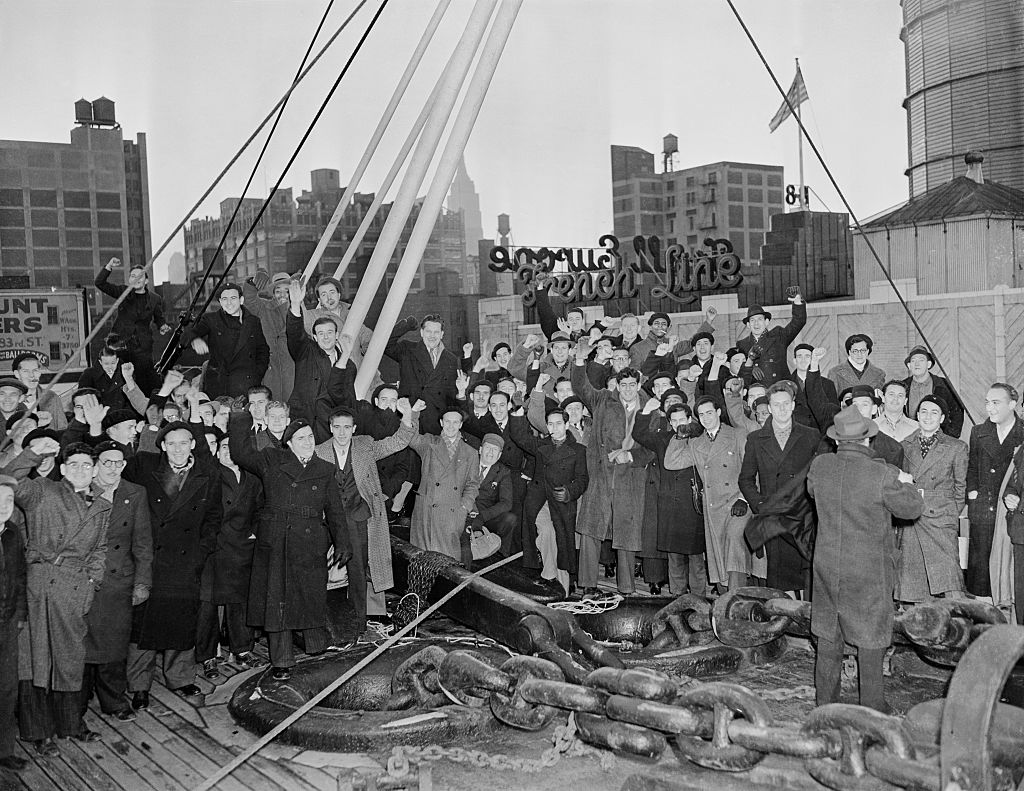
Some of the 149 members of the Abraham Lincoln Brigade, just after they arrived in New York on the S.S. Paris, December 15, 1939, from service in the Spanish Civil War. Perhaps the most heroic and effective act of the International Workers Order was to help organize money, support, and especially volunteers for the fight against fascism as part of the brigade.
If I were to describe an anti-Zionist Jewish socialist organization with tens of thousands of members, Yiddish schools, and arts clubs, which operated under a climate of severe state repression until it was finally disbanded by force and its leaders jailed, you might be forgiven for thinking I had a European organization in mind, the Jewish Labor Bund. But the International Workers Order (IWO) Jewish section, otherwise known as the Jewish Peoples’ Fraternal Order (JPFO), was one of the largest Jewish socialist organizations in the world for the two decades of its existence.
While the Communist Party and the Bolshevik revolutionaries were historically at odds with the Jewish Labor Bund of Eastern Europe, in the United States, the rise of “Bundish” politics was not isolated to a single tendency or organization on the Jewish left. The IWO was formed in 1930, following a series of internecine and sectarian ruptures with the Arbeter Ring, or Workers Circle, a socialist-aligned mutual aid society started in the late nineteenth century by newly arrived Yiddish-speaking Jewish socialists, who blended their socialism with advocacy for Jewish language and cultural autonomy.
Like many new immigrant mutual aid societies, or landsmanshaft, the Ring administered low-cost health and burial insurance and served as a social club for Jews who must have found America to be a strange and bewildering country. Yet unlike other mutual aid societies, the Arbeter Ring took its socialist and culturalist politics seriously.
It supported the growing Jewish labor movement in the garment industry and formed the Jewish Labor Committee, which was aligned with the Jewish Socialist Federation. These groups assisted with strike support, rent boycotts, and socialist elections and strengthened the growing socialist movement in urban centers. The Ring also helped found what was to become for many decades the most widely circulated once-socialist Yiddish- and English-language newspaper, the Forward.
Culturally speaking, the Ring was heavily influenced by early Bundish thinkers, such Chaim Zhitlovsky, who in a series of articles argued with the often conservative, bourgeois Jewish establishment that assimilation into whiteness should not be the goal for the Jewish labor movement. Organizations such as the newly formed Anti-Defamation League and American Jewish Committee were heavily influenced by the eugenic ideas of the early twentieth century and believed that only by embracing not only the English language but other forms of Waspish middle-class probity (including anti-communism) could Jews hope to thrive in the United States.
Such attitudes were likewise not uncommon among socialist labor leaders, who both looked down on Yiddish as a peasant dialect and believed, often on pragmatic grounds, that assimilation was the best course for American Jews. The Yidishe Kulture movement not only embraced the Yiddish language; it offered a source of cultural pride in a society dominated by often racist and antisemitic views of new immigrants.
The first major rift occurred in the Ring over the Bolshevik revolution. This split, which had parallels across the wider left and which precipitated the rise of the American Communist Party, was felt keenly on the American Jewish left. The Bund backed the prime minister of Russia’s provisional government, Alexander Kerensky, and the war, while others sided with the Bolsheviks who wanted an immediate peace with Germany. The pro-revolution faction of the Ring, Di Linke, unable to wrest control over the organization, eventually started their own newspaper, Morgen Freiheit (Morning Freedom), and began running their own Yiddish schools.
In ways that may seem quite resonant with the present, the final rupture between Di Rehkt and Di Linke was over Palestine. The Hebron massacre of 1929, a product of simmering tensions since the 1917 Balfour Declaration and increased Jewish settlement in Jerusalem, split the Jewish left. The Forward denounced the attacks as instances of antisemitism, while Morgen Freiheit defended what it saw as an anti-colonial revolt. The truth of the Hebron attacks was perhaps somewhere in between. While the uprising was undeniably provoked by militant Zionist settlers, including a march by the far-right Ze’ev Jabotinsky, the Jewish Hebron community attacked in the revolt preceded Zionist settlement: they were more often hid by their longtime Arab neighbors than attacked by them. Either way, it was undeniable that a split over Zionism as well as other issues was long on its way in the Jewish socialist movement.
The IWO Charts Its Own Path
As Joseph Stalin consolidated power in the Politburo in the late 1920s, he ordered the “Bolshevization” of foreign communist chapters, particularly targeting the language clubs for absorption into the larger party. However, from Canada to Latin America, Jewish sections of communist parties charted their own path. They refused to disband, and refashioned themselves as the International Workers Order, aligned with and led by Communist Party members, although they remained by and large independent organizations.
While this act of resistance to Stalinism would be remarkable on its own, what made the IWO a truly groundbreaking organization is that it expanded the model of Yiddishkayt Jewish organizing — socialist in content and Yiddishist in form — to other language and ethnic clubs in the communist orbit. While the Jewish section of the IWO (renamed the Jewish People’s Fraternal Order in the 1940s) remained the largest section with over 50,000 members at its peak, the IWO included Finnish, Hungarian, and Carpatho-Russian societies, as well as the pan-Spanish language Cervantes Society, the African American Lincoln-Douglass Society, the Polonia Society, a Czech society, the Italian Garabaldi Society, and many others.
At its peak, the group had two hundred thousand members before its demise during the Second Red Scare. While IWO chapters existed as semiautonomous clubs with their own summer camps, halls, and cultural events, the IWO would often hold interracial dances, theater performances, beach picnics, and softball games. The group also mobilized around campaigns in support of the Scottsboro Boys, black teenagers falsely accused of raping two white women; the Spanish Republic; and opposition to the invasion of Ethiopia.
From Popular Front to Cold War: The Interracial Left and the International Workers Order, 1930–1954, a collection of essays by fourteen historians and labor and ethnic studies scholars, places the ground-breaking nature of the IWO’s interracial organizing at the center of the book. As historian Paul Mishler frames it, while “previous left-wing ethnic societies were imagined as being temporary way stations for immigrant workers until they and their families learned English, the IWO saw . . . ethnic identification as a road to radicalism, rather than a hinderance to it.” The IWO took the lessons of Yidishe Kulture movement, connected them to nascent black and brown power movements, and threaded them together within a socialist, Marxist framework that emphasized cultural diversity and particularity, yet within a wider working-class whole. As editors Ellissa Sampson and Robert Zecker put it, the IWO practiced “intersectionality” as a working structure long before the word and come into common left use some eight decades later.
“No Jim Crow in the IWO”
In 1952, W. E. B. Du Bois delivered a speech at the 1952 Jewish Life magazine’s Warsaw Ghetto Uprising commemoration, an event cosponsored by the IWO. Du Bois’s speech recounted how he was mistaken for a Jew by a cab driver in 1930s Western Ukraine and taken to the Jewish quarter for lodging. This experience of mistaken identity leads him to reflect that racialization is not only a question of the “color line,” as he had written in The Souls of Black Folksome half-century before, but rather that race “cut across lines of color and physique and belief and status.”
Du Bois concluded his talk by remarking that the “problem of slavery, emancipation, and caste in the United States was no longer in my mind a separate and unique thing as I had long conceived it.” This experience “enlarged” Du Bois’s sense of race and also solidarity. The Civil Rights Congress (CRC), another organization very much tied to the fate of the Communist Party and IWO, modeled its “We Charge Genocide” petition on the United Nations Convention on Genocide, taking its insights to claim that African Americans faced violent erasure as a people in the United States. The core mission of the IWO was to use Marxism to draw these analogies between Nazism in Europe and racism in the United States and to create a multiethnic mosaic of organizations that could support such “intersectional” struggles.
While the JPFO founded the IWO, the core of the collection is four essays each about a singular figure on the African American left and their profound relationship to the shaping of both organizations: W. E. B Du Bois as mentioned above, Langston Hughes, Paul Robeson, and Louise Thompson Patterson. Of the four, probably the least well known is Thompson Patterson, who was the longest-serving cochair of the organization, along with Max Bedacht. The two did more than any other figures on the Left to make the IWO into an organization that advocated for black freedom. Raised into a middle-class family in Chicago and then Harlem, Thompson Patterson first encountered black radical politics on hearing Du Bois speak at the University of California, Berkeley. After leaving her teaching position at small historically black college in Virginia, she moved back to Harlem, where she met Langston Hughes, Aaron Douglas, and other figures in the Harlem Renaissance.
Like many African American radicals in the 1930s, Thompson Patterson turned to the Communist Party as the party placed the struggle for African American self-determination at the center of its theory of American capitalism. Claiming African Americans are an “oppressed nation” not only appealed to former black nationalists; in more practical terms, it dignified the struggle against racism as equivalent to, or even more important than, the struggle against class exploitation.
Thompson Patterson organized support for the Scottsboro trial, was arrested in an early demonstration against segregation organized by the Communist Party in the 1930s, returned to New York to for fight for the Costigan–Wagner anti-lynching bill, and wrote about the “Bronx slave markets” in which mostly African American women were hired for domestic day labor. This prompted Thompson Patterson to be the first to theorize the “triple oppression” of black women, declaring that black women are oppressed by race, gender, and class in complex ways simultaneously. “Intersectionality before intersectionality” as the editors of the collection write — its difference lay in her observation that capitalism was the structure that bound all three. This observation opened the door for solidarities while not erasing difference or specificity and became, one could say, the logic behind the IWO’s structure and organizing philosophy.
Thompson Patterson also convinced her longtime friend Langston Hughes to get involved with the IWO, inviting him to direct the Harlem-based “Suitcase Theater,” housed and sponsored out of its 124th Street offices. As part of the popular theater company, Hughes staged a half-dozen plays, including many of his own, one of which, Em-Fuhrer Jones, became a major film starring Paul Robeson. Like Hughes, Robeson was involved with the cultural life of the IWO, singing before integrated audiences at Camp Wo-Chi-Ca (which may have been perhaps the only fully integrated summer camp in the United States at this time) and even singing in Yiddish at the JPFO’s Camp Nitgedaiget (Yiddish for “No Worries”). As Felicia Bevel puts it in her essay, to the multiethnic IWO, Robeson “was their hero,” and he would sing folk songs dedicated to the many nationalities represented by the order, bringing the message of multiethnic socialism with him wherever he performed. Indeed, one of the IWO’s final public acts of protest was to organize self-defense squads at Robeson’s concert in Peekskill, New York, which was assaulted by racist, right-wing vigilantes two nights in a row. “No Jim Crow in the IWO” was the slogan the group lived and, ultimately, died by.
Perhaps the most heroic and effective act of the IWO was to help organize money, support, and especially volunteers for the fight against fascism as part of the Abraham Lincoln Brigade/International Brigades (ALB/IB). Over one-third of the American volunteers in Spain were Jewish, many if nearly all of whom were recruited from the JPFO. For the Jewish members of the IB, such a journey was not only the political culmination of their affiliation with the communist movement. They expressed it in deeply cultural terms as well: that the “over-civilized barbarians of Spain — far ahead of Hitler . . . drove the Jews from country. . . . They little thought . . . Jews would return . . . to help defend Spain from an outburst of the old terror.” More than a fight against antisemitism, the ALB represented the highest ideals of multiculturalism: it was quite literally the first integrated army fielded by Americans. Many of the African American volunteers were also IWO members and expressed not only their desire to fight fascism but also to pay back Italy for its invasion and colonization of the free African state, the kingdom of Ethiopia.
It was, as one ALB veteran put it, a “multi-racial army to defeat Hitler’s racial theories.” And as Langston Hughes said on an IWO-sponsored trip to Spain, the ALB was fighting America’s racial theories as well: fascists are “Jim Crow people,” as Hughes told an audience of ALB soldiers, and “here we can shoot ‘em down.”
A Fraternal Order Sentenced to Death
The downfall of the IWO was swift and relentless. At the end of the 1940s, IWO and JPFO members “were confident their organization was part of the social democratic coalition working to make Roosevelt’s Four Freedoms a reality,” as historian Robert Zecker phrases it. While the Four Freedoms — free speech, religious freedom, freedom from want, and freedom from fear — were only a “foretaste” of a socialist America, to quote historian Michael Denning, even the most radical IWO members believed they were swimming with the current of an increasingly more democratic, less racist, more egalitarian United States.
Yet by the beginning of the 1950s, hundreds of IWO leaders had been deported under the McCarran–Walter (“anti-subversion”) Act, dozens had been jailed under the Smith Act, and many were facing eviction under new “anti-Red” ordinances that prevented members of radical organizations from renting apartments or even living within city limits. Paul Robeson was nearly lynched in Peekskill, Camp Wo-Chi-Ca was raided and set on fire before shutting down, and most dramatically, one IWO member attempted to stab himself to death in the streets in Erie in protest of the repression.
The IWO was finally brought down through bureaucratic means. Using a broad interpretation of insurance law, the IWO and the JPFO were legally disbanded and bankrupted by the state in 1954, their assets and offices seized. While the editors of the collection are keen to point out how many IWO members went on work in the civil rights movement, participated in the Freedom Rides, educated new generations of activists, and helped organize anti–Vietnam War protests, the collection offers little meditation on the meaning of the IWO’s loss.
Few other organizations of its size and cultural influence have been shut down by fiat of the state, with its members deported and leaders arrested and hauled before federal tribunal, the House Un-American Activities Committee. Not even the Communist Party was formally disbanded in such a way. While Paul Mishler is correct — the communist movement writ large and the IWO in particular were instrumental in constructing both theories and practices for a radical multiculturalism — one can only speculate what liberal multiculturalism, to say nothing of Jewish identity, might look like if the IWO and JPFO were still a robust presence.
Speaking to the long arm of neo-McCarthyism, it is also curious that the edited volume has little to say about Zionism or Palestine, especially considering the large role splits over Zionism played in the JPFO’s breakup with the Workers Circle. Beyond one mention of this split in an essay about the career of JPFO artist William Gropper, the only other mention of Palestine in the collection is a brief aside by ALB soldiers who remarked on the racism of troops from the Yishuv, the Jewish-only settlements in Palestine. While part of the explanation for the absence in the collection may be the complexities of the IWO’s and JPFO’s adherence to the zig-zags of the Soviet line on Palestine — rejecting its earlier anti-Zionism in 1947 only to embrace it again it in the early 1950s — the long presence of communist-aligned anti-Zionism not only left its mark but reemerged as a cultural resource in the 1960s. During those heady years, the student New Left began asking similar questions about Zionist colonialism and the fate of Palestinians.
While the edited collection remains one of the more important works on the rise and fall of the multiracial “Old Left” in recent years, this absence nonetheless reproduces the culture of silence around Palestine that has had catastrophic consequences both at home and abroad. Given the IWO’s purpose, the consideration of multiple and intersecting forms of oppression within a global socialist framework, addressing the dispossession of Palestine and complicated American Jewish left engagement with this question would seem to be more than necessary as an addition to this project.