A Jewish Communist’s Revolution Against Fascism
Eugenio Curiel was a leader of the Italian Resistance against Nazism, before he was murdered by fascists on February 24, 1945. He insisted that the Resistance wasn’t just about deposing Benito Mussolini — it was about putting the masses at the center of a new democracy.
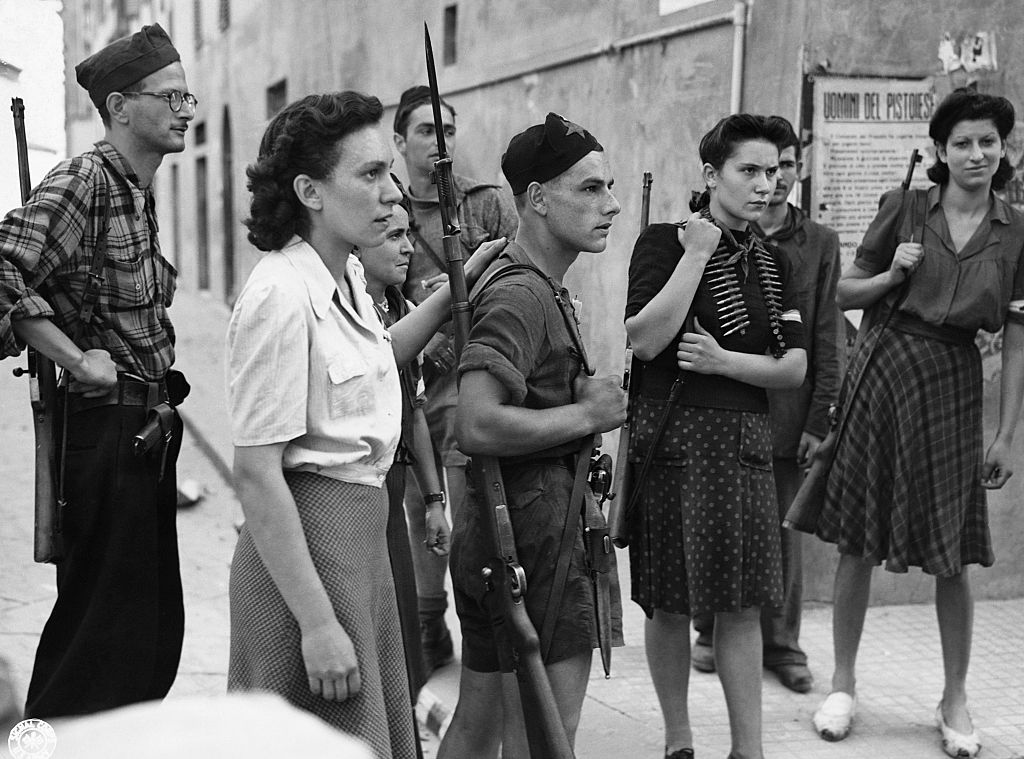
A group of Italian resistance fighters who helped South African troops in Pistoia to locate German snipers. Hulton-Deutsch Collection / Corbis via Getty
The antisemitic “racial laws” of 1938 weren’t the start of Eugenio Curiel’s activism, though they did cause the young physics professor to be fired from Padua University. His family was well-off, but even the communist Eugenio was hardly a black sheep. His cousin Matilde Bassani Finzi was a Socialist partisan leader in both Rome and Florence; another cousin, Henri Curiel, was a leader of the Egyptian independence movement and then a leading supporter of Algeria’s National Liberation Front; he, in turn, was a close relative of the Dutch-British anti-fascist (and later KGB agent) George Blake.
Eugenio Curiel’s short life, ending in his murder by the fascist Brigate Nere in Milan on February 24, 1945, reflected a generation’s rise to political consciousness. Born shortly before the outbreak of World War I and growing up in the shadow of Benito Mussolini’s regime, Curiel became one of the new cadres of the Italian Communist Party (PCI), which surged to prominence during the anti-Nazi Resistance of 1943–45. Although for two decades it had been a confraternity of prisoners and exiles banished from Mussolini’s Italy, during the Resistance struggle, the PCI became a truly mass force, unlike any that had existed before.
Curiel’s activism had begun in near isolation, as he sought to locate dissidents within the regime’s student unions. Yet already by 1943 he had become a leading PCI cadre and editor of the party’s clandestine organ in Milan, where the workers’ movement was stirring from its slumber. Beyond his individual initiative, he was especially concerned to overcome the elitist political forms of pre-fascist Italy, building a mass democracy rooted in the organs of the Resistance struggle itself. In his call for a “progressive democracy,” Eugenio Curiel represented the promise of the PCI — and the paths the postwar Republic didn’t take.