Twenty Years Since the Genoa G8 Protests, Globalization Is Imploding
Even as massive protests confronted the Genoa G8 summit in July 2001, many saw some form of capitalist globalization as inevitable. But today, national capitalisms are regaining strength — and the Left has to adapt its strategy accordingly.
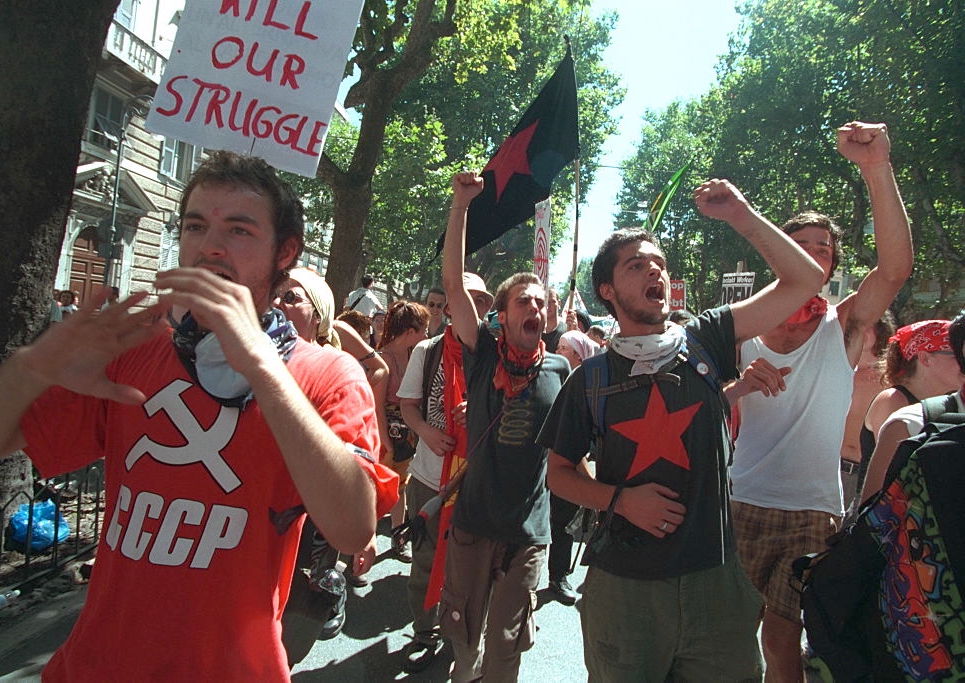
Anti-globalization protests during the G8 Summit in Genoa, Italy, 2001. (Antoine Serra / Sygma via Getty Images)
From July 18 to 22, 2001, hundreds of thousands of people gathered in the streets of Genoa, northwest Italy, to protest the G8 summit. Twenty years later, the summit is mostly famous for the police violence against the demonstrators. On July 20, twenty-three-year-old protester Carlo Giuliani was shot dead by carabinieri, during violent scenes of repression in which police jeeps almost mowed down demonstrators. The following day, in the late hours of July 21, security raids struck against the Diaz School, where dozens of protesters taking shelter were brutally beaten by police. Police also targeted the media center of the protest’s official organizers, the Genoa Social Forum (GSF).
The people gathered at the media center that day included Walden Bello, a Filipino economist and environmentalist whose theory of de-globalization was becoming influential at the time. Since the 1990s — a decade which had seen the NAFTA agreement, European economic integration, and trade liberalization under the aegis of the World Trade Organization — there had been much debate on the Left on how to approach the global era. For some, economic globalization and its superseding of nation-states was an irreversible tendency. Yes, its nefarious effects had to be attacked — but its progressive aspects should be reclaimed, pursuing global justice and global democracy as a higher form of universalism.
Bello’s approach was more blunt. True to its popular name, the anti-globalization movement had to fight for outright “de-globalization,” an overall reduction in planetary economic interconnectedness and a re-localization of economic processes. For Bello — whose ideas were informed by economist Samir Amin’s discussion of “de-linking” from global capitalism — de-globalization would mean taking away power from transnational corporations and re-empowering local communities and citizens. It would prioritize equity and environmental sustainability over growth.