How Egg Price-Fixing Went Unpunished

The Department of Justice had evidence that three major egg producers colluded to raise egg prices, driving “eggflation” while padding their profits. Like a long list of corporate price gougers before them, they are getting off with a slap on the wrist.
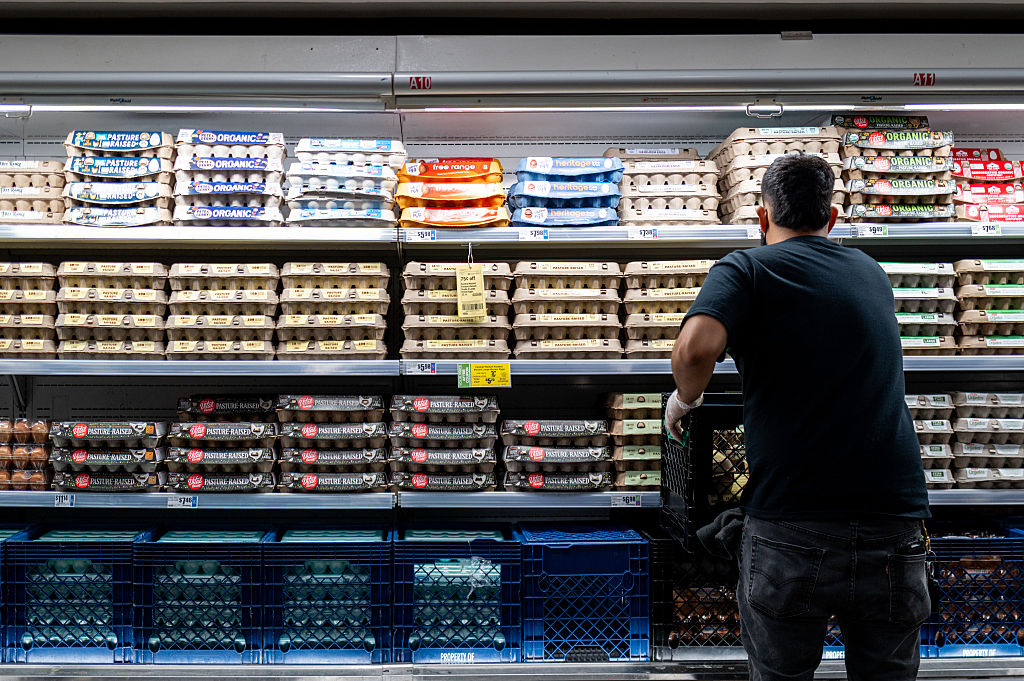
employee stocks eggs in supermarket

Three large US egg producers look to have engaged in blatant collusion to fix prices. (Brandon Bell / Getty Images)


Despite acknowledging he thinks about Americans’ financial situations “not even a little bit,” President Donald Trump has made a show of addressing the cost of living through a variety of initiatives. These have included, among other things, establishing TrumpRx.gov to sell generic drugs, occasionally suggesting that he’ll directly send checks to Americans, and warnings to grocers to voluntarily reduce beef prices.

One example is the recent investigation by Trump’s Department of Justice (DoJ) into three egg producers for collusion and price manipulation. Cal-Maine, the country’s largest egg producer, worked with two competitors to manipulate egg prices from 2022 to 2025. Annual profits at Cal-Maine alone rose from about $200 million a year to over $1 billion a year.

The case was settled earlier this month, resulting in a $3 million fine and agreement to donate fifty million eggs — basically a slap on the wrist. The egg producers no doubt settled out of court because of the strength of the evidence against them: conference call and message records demonstrating a very straightforward, cartoonish kind of collusion. Yet the Trump administration, when push came to shove, refused to seek serious penalties for the companies. The episode fits an all too familiar pattern: corporations and top executives flagrantly break the law in the interest of their bottom lines, without worrying about significant consequences.

The Competitor Is Their Friend, and the Customer Is Their Enemy

Inflation in recent years has reached its highest point since the early 1980s, but egg prices have been on another planet. Paying 5 or 10 percent more for groceries, rent, and gas every year is bad enough, given that wages for most people have barely budged in fifty years, but eggs have at times tripled in price since the beginning of the COVID-19 pandemic.

Egg producers have blamed bird flu. They claim that the egg supply collapsed, and so, due to the fundamental laws of economics, they were forced to keep raising the price of this staple food.

In other words, egg companies would have you believe that the problem is regrettably out of their control. This story failed to convince consumers and public officials, eventually leading the DoJ and seventeen state attorneys general to sue and investigate the price increases.

Bird flu is a real issue, with about 40 million egg-laying hens killed in 2022 as a result. But in an earlier episode of bird flu, in 2015, 43 million egg-laying hens were killed and prices increased three times less per lost hen. And even after egg inventories recovered from the recent outbreak, according to Food and Water Watch, prices remained high.

Agricultural economist Raj Patel told Jacobin that while “most Americans think supermarket prices come from supply and demand, that’s just a handy economic fantasy which exists only in 101 classes. Real pricing happens against benchmarks like Urner Barry’s egg quote, which a handful of dominant firms can move with a few strategic bids.”

Benchmarks are reports on how much egg producers pay for eggs from their suppliers; these sales are technically conducted as auctions, allowing different egg producers to bid on sales of eggs. Urner Barry, now called Expana, is a company that collects information on these bids and sets that benchmark. The benchmark is then used by grocery stores to set prices.

Egg production is so concentrated that just three companies — Cal-Maine, Versova, and Hickman’s — controlled enough of the market to manipulate this benchmark, with Cal-Maine alone selling one-fifth of all eggs in the United States. According to the DoJ complaint, from June 2022 to March 2025, executives from these companies got on weekly phone calls to coordinate submitting fake bids, with one CEO coaching others that “as a group we need to bid like they vote in Chicago, early and often.”

Starting in 2022, the executives urged each other to place fraudulent bids and celebrated as prices ticked up. When Urner Barry reported record egg prices, Hickman’s CEO, Glenn Hickman, congratulated his competitor-colleagues on a “great job in the northwest today!” In 2024, they executed another round of price gouging during a smaller bird flu outbreak. The DoJ documented the same pattern of coordination among competitors to make bids, raise the benchmark, and withdraw most of the bids to juice profits. When prices threatened to fall, Cal-Maine’s CEO, Sherman Miller, urged Hickman’s CEO to “let it rip” with more bids because Urner Barry’s reporter “needs premium trades to hang her hat on” — that is, to justify the higher benchmark.

This evidence forced a settlement, giving the government, if not consumers, an apparent victory. But while “Cal-Maine cleared over $3 billion from the scheme,” Patel says, “the penalty was $3 million and some donated eggs.” (Note that Cal-Maine has been found guilty of fixing egg prices in the past.)

It’s Not Just Eggs

While this case has received widespread coverage, two important points have been neglected. First, these three companies have been raising prices on behalf of the whole egg industry, not just themselves. When the parties in question colluded to bid up egg prices, even the firms that weren’t in on the scheme benefited from the “eggflation.” Yet there has been no suggestion of consequences for the industry as a whole: they’re keeping the profits they reaped thanks to the price gougers.

Second, it’s not only egg prices that can be so easily manipulated. In his book Stuffed and Starved: The Hidden Battle for the World Food System, Patel details a number of similar cases. The most prominent of these was the lysine scandal, in which manufacturers colluded to fix prices for the common livestock feed additive. The leading corporation of that cartel, ADM, pleaded guilty to fixing prices and was fined a record $70 million. At that same trial, ADM was fined another $30 million, this time for fixing the price of the preservative citric acid. ADM’s president was recorded on tape explaining what was described as the corporate slogan: “Our competitors are our friends. Our customers are the enemy.” These examples suggest that price-gouging is typical across agribusiness.

More recently, Patel highlights the Indiana data firm Agri Stats, which like Urner Barry compiles information on chicken, pork, and turkey, “essentially creating a private intelligence service for coordinating a market.” The DoJ and a coalition of states sued; after three years, just before the trial was scheduled to begin, “the case settled for a monitor, a compliance program, and a promise to behave.” The problem with that promise, Patel explained to Jacobin, is that “when behaving normally, this is a service that encourages the below-average firms to raise their prices. A promise to behave is a promise to work against anyone struggling to afford basic groceries.”

Corporate Profits Über Alles

While egg prices are down today, the overall affordability crisis continues. But even the light touch of pro-consumer pressure eventually faced by the egg price-fixers shows what a genuinely pro-worker government might accomplish on this front. The moment egg companies found out about the DoJ investigation, prices plummeted — demonstrating that egg prices don’t passively reflect the balance between supply and demand but rather are set by producers to be as high as they can get away with.

Even short of far-reaching reforms, governments have a variety of tools at their disposal to keep prices down for consumers and punish price-fixers. In the case of lysine, for instance, there was an actual substantive fine of $100 million, and three executives were tried and jailed in 1998. Antitrust legislation aimed at addressing the consequences of market concentration has been used since the twentieth century to break up giants like Standard Oil, Kodak, and Microsoft. Price controls are another measure that has been making a comeback in recent years, with economists like Isabella Weber arguing that their strategic use is warranted to combat the sort of supply-shock-driven price rises that we saw during the pandemic.

There are specific solutions for groceries. Patel points to the need for “public food system alternatives, like grain and food reserves, public groceries, and support for decentralized producers, so that no cartel can hold a staple hostage.”

But in the near term, expect President Trump to continue making an occasional fuss about food costs without reducing your grocery bill. Beef producers are the latest target, with the DoJ investigating the four largest companies for price-fixing. Yet Trump’s true colors are on display when he uses his extensive powers to dismantle the Consumer Financial Protections Bureau, or to commute the prison sentence of an asset manager who stole nearly $2 billion from workers and retirees.

This is not to say that the Democratic Party has been a champion of affordability or corporate accountability. Barack Obama infamously refused to prosecute the bankers responsible for crashing the global economy, with all the loss of jobs and homes that followed. Joe Biden gestured at antitrust measures and enacted a few small-bore regulatory changes. But in the end, his most significant legal intervention on the side of workers was probably the appointment of a relatively labor-friendly National Labor Relations Board. Nonetheless, major corporations like Amazon and Starbucks still got away with flagrantly illegal union busting, and union density continued to flatline.

On the other hand, in New York City, socialist Mayor Zohran Mamdani is giving us a glimpse of what serious efforts to address the cost of living and attack corporate malfeasance might look like. In addition to enacting a promised rent freeze on the city’s one million rent-stabilized apartments and beginning to roll out free childcare, Mamdani’s administration is aggressively prosecuting labor law violators and cracking down on junk fees. And with its Fix the City initiative, the administration is now turning its sights on lawbreaking landlords.

Whether national politicians will take a cue from the increasingly popular New York mayor remains to be seen. If they don’t, we can look forward to getting fleeced by our corporate overlords again and again.