Britain’s General Strike Was Class Struggle at Its Rawest
This year marks the centenary of the 1926 general strike, the biggest episode of class struggle in British history. The response of Britain’s rulers showed their iron determination to keep the working class in its social and political place.
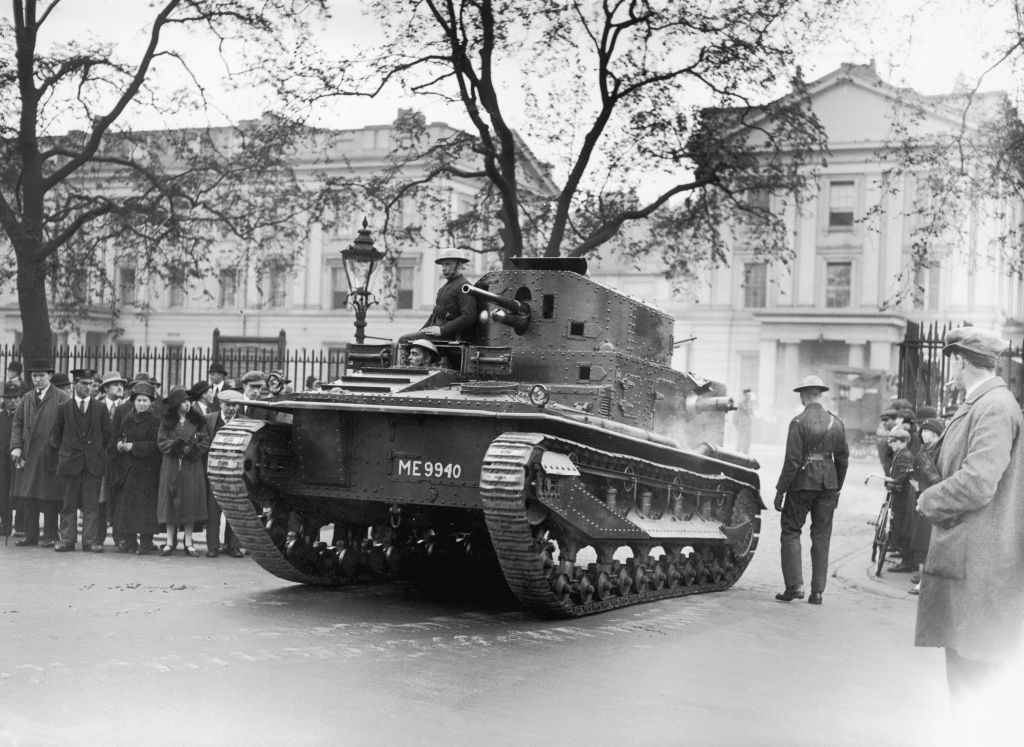
An armored tank leaves Wellington Barracks in London on May 10, the eighth and penultimate day of the 1926 general strike. (Hulton Archive / Getty Images)
A century ago, Britain was rocked by perhaps the most serious episode of class struggle it has ever known. Millions of workers joined the general strike of 1926, buoyed by hope that they could fend off attacks on the pay and conditions of coal miners and reverse efforts by bosses to claw back the gains organized labor made when workers were in urgent demand during World War I.
They faced opposition from employers, Stanley Baldwin’s Conservative government, and a larger swath of the middle classes who were anxious about the growth of trade union power and the political instability that Britain had experienced over the previous decade and a half. David Torrance’s new account of the general strike, The Edge of Revolution, addresses the strike as a pivotal industrial and political conflict that had profound and lasting consequences for Britain.
Cast of Characters
Torrance is a journalist and a political historian as well as a House of Commons Library constitutional expert. His previous books include The Wild Men, an account of Britain’s first short-lived Labour government that was elected in 1924. The first Labour prime minister, Ramsay MacDonald, remained the party’s leader in 1926, facing the difficulties of marrying support for the miners with the growing conventional wisdom that Labour was committed to a parliamentary road to socialism.
The Edge of Revolution continues what Torrance describes as the “biographical approach” he applied in the previous books. Readers are introduced to a set of “dramatis personae” which includes key political and trade union leaders as well as industrialists who represented the interests of the mine owners. But Torrance’s cast extends beyond such expected characters.
It also includes, for instance, socialist women with memories of organizing support for the strike such as Ellen Wilkinson, the Labour MP for Middlesbrough East, who would later gain fame as the leader of the Jarrow March of unemployed shipbuilders and their supporters during the Great Depression. Jennie Lee, the Fife miner’s daughter who founded the Open University as a Labour education minister in the 1960s, was an embattled Edinburgh University student at the time, trying to rally the pro-strike minority in a hostile environment.
The Road to 1926
The 1926 strike is exceptional in British history as a generalized withdrawal of labor on a national basis that was officially sanctioned by trade unions. In the years before and following World War I, there were several important episodes of strike action inspired by radical syndicalist perspectives in Ireland and Britain that centered around the idea of linking up workers across occupational or industrial divisions through organizing direct action.
These perspectives were visible in high-profile localized disputes like the Liverpool transport strike of 1911, the Dublin lockout of 1913, and the forty-hours strike in the west of Scotland led by the Clyde Workers’ Committee in 1919. Politicization and displays of workers’ power marked these disputes, with crowd mobilizations involving women and children. That alarmed the British authorities who deployed police and troops to help defeat the strikers.
Following World War I, the coal industry became a key focus. British miners had launched their first national strike in 1912. This confirmed a new level of national organization in a sector historically marked by the parochial orientations of county unions in regionally disparate coalfields. Government took over the running of the industry during wartime, which facilitated further gains for the miners.
The Sankey Commission, appointed to see off an upswell of mobilization after the war ended, had recommended that public ownership should continue permanently. However, the mines were handed back to their private owners, who promptly attacked the gains of the miners, leading to a lockout in 1921. On this occasion, the miners were isolated and defeated. Their “triple alliance” partners in the rail and transport unions abandoned them to stand alone.
Before the Crash Comes
In effect, the general strike was a larger and more consequential sequel to these earlier episodes. It was the outcome of a determined attempt to reimpose market order and employer authority over the miners, with clear political implications.
Torrance emphasizes the divisions that swept through the fading Liberal Party in 1926. Formerly a dominant party of government, Liberalism was being replaced by Labourism on the left and squeezed by the Conservatives on the right, a position from which it would not recover over the next century. He also quotes the reflections of Lord Halifax, the recently appointed viceroy and governor-general of India, in the aftermath of the general strike: “Democracy has arrived at a gallop in England, and I feel all the time that it is a race for life: can we educate them before the crash comes.”
Here, then, was the nature of the dispute as understood from above: it was a desperate struggle to contain rising forces from below. There had been a major extension of the franchise in 1918, to large swaths of working-class men as well as women over the age of twenty-eight, and Labour soon rose to a position of electoral viability. For a Tory like Halifax, the forces of Irish and Indian nationalism abroad and trade unionism at home were all dangers that British governments had to see off.
Churchill’s Gauntlet
In his role as chancellor of the exchequer, Winston Churchill triggered the dispute by insisting on the pursuit of prewar parity for the sterling/dollar exchange rate. This was an act of economic folly that imperiled Britain’s already threatened industrial exports. Britain had exported around one-third of its coal before World War I, and coal was also a crucial raw material for manufacturing industries that sold their wares on the global market.
Churchill’s policy was an act of class struggle. Industrial workers were forced to pay the price so that middle-class bondholders and the City of London could prosper. The mine owners responded by demanding miners work longer shifts for lower wages in an industry where more than a thousand men commonly lost their lives belowground each year, and where many more were often seriously injured.
As a result of trade unions rallying around the miners, there was a postponement of the confrontation on what was dubbed “Red Friday.” Miners and their supporters celebrated as the government agreed to finance a nine-month wage subsidy. However, this merely put off the inevitable conflict to come, and it created a crucial window during which the state stepped in to organize the resistance that followed.
As Torrance records, these efforts built on earlier preparations such as the 1920 Emergency Powers Act, which permitted the suspension of civil rights in extraordinary circumstances. In preparation for the expected general strike, middle-class volunteers were enrolled into the Organization for the Maintenance of Supplies while others became Special Constables (auxiliary police officers).
Mussolini Minor
Torrance profiles Home Secretary William Joynson-Hicks as one the key protagonists. Joynson-Hicks was an authoritarian, fanatically anti-communist figure whose critics referred to as “Mussolini Minor.” He supplements these pen portraits of political leaders with local examples of strikebreaking once the dispute began.
The Coldstream Guards marched through London’s East End in tin helmets, supported by tanks and armored cars and accompanied by volunteers to move supplies. The Royal Navy even used submarines to provide power at the docks and deployed its ships to port cities. The fearsomely named HMS Warspite was among the warships deployed up the Clyde.
By contrast, the Trades Union Congress’s (TUC) response was much less well planned. The strike was not a general strike in the sense of having been inspired by a syndicalist perspective on workers’ power. Rather, it was a massive “sympathy strike” in support of the miners, scrabbled together as their employers locked them out.
Initially, the unions called out 1.75 million “first line” workers to back the one million miners who were locked out. Railways, buses, trams, and the docks came to a standstill while the power stations and steelworks stood idle.
As Torrance records, there were major divisions at the top of the TUC General Council that was responsible for leading the dispute. Most famously, Jimmy Thomas, the general secretary of the National Union of Railwaymen, was always a reluctant supporter. However, the membership of his union played a crucial role in organizing the strike across the country.
Middle-Class Warriors
Torrance’s book contributes to a growing body of scholarship that has received some renewed attention around the centenary. His focus is primarily on leading personalities, with an elite bias that is related to the memoirs left behind.
This does generate some powerful anecdotes about the organization of the class struggle from above and the feelings of disappointment in bourgeois circles with those who refused to join it. The family of Hugh Gaitskell, the future Labour Party leader, rebuked him as a “class traitor” after he joined left-wing historian G. D. H Cole’s efforts to organize support for the strike while studying at Oxford.
Many middle-class strikebreaking volunteers looked back fondly on their experiences of temporarily working on the docks or the railways. But Torrance underlines the fact that there were moments of coercion and violent class conflict, too. A pitched battle engulfed the streets of Edinburgh’s Old Town as Special Constables, including student volunteers, faced off alongside mounted officers against local men, women, and children.
The Communist MP for Battersea North, Shapurji Saklatvala, was imprisoned in Wormwood Scrubs for refusing to put up bail money. Saklatvala had been arrested after he called for soldiers to lay down their arms at a May Day rally.
Meanwhile, a convoy of cars carrying men who were identified as uniformed members of the British Fascists, an organization that had been formed under the leadership of Rotha Lintorn-Orman in 1923, ominously surrounded the TUC headquarters at Eccleston Square in London while the strike was coming to an end. It collapsed after nine days as the government and the employers refused any compromise with the miners or the TUC.
Aftermath
Although the government ultimately succeeded against the strikers, Torrance stresses the farcical nature of its attempts to have the strike ruled illegal. These spurious attempts culminated in the passing of the Trades Dispute Act the next year, which did in fact legally prohibit sympathetic action.
Yet his depiction of the strike’s aftermath is comparatively sanguine. In the long run, organized labor recovered. Ernest Bevin, the leader of the Transport and General Workers’ Union, was crucial to the organization and ultimate termination of the strike. During World War II, he became Churchill’s minister of labour, and the postwar Clement Attlee government went on to repeal the Trades Dispute Act.
In the coalfields, the conflict continued. Locked-out miners were left isolated and starved back to work in defeat toward the end of the year. These were potent and politically painful memories. Miners and their families did not forget the events of 1926, even if they faded from view more quickly elsewhere.
The folly of Red Friday was a reference point for trade unionists as late as 1981, when miners won an initial victory following a walkout against pit closure proposals under the government of Margaret Thatcher. In the great strike of 1984–85, memories of 1926 resonated in criticisms of other unions for failing to offer industrial support. Such memories also prompted the labeling of Labour’s equivocal leader Neil Kinnock as “Ramsay MacKinnock” in reference to his 1920s predecessor.
Perhaps the key value of Torrance’s book lies in its exploration of perspectives on the strike from elite vantage points. His telling of the strike does not generally flow through the history of the local organizational structures — councils of action — that controlled the transportation of food, people, and coal in many industrial areas.
In The Edge of Revolution, it is the determined opposition to the strike from the government, and the strength of support the anti-strike coalition had from its middle-class supporters, that shine through. In turn, these factors only added to the uncertainties that beset a labor movement leadership broadly committed to understanding the miners’ lockout and the sympathetic action it elicited as an industrial rather than a political event.