The Making of London’s General Strike
One hundred years ago today, a general strike led by London’s dockworkers brought the city to its knees. Police violence and a conservative union beat the workers in the end, but the episode helped shape Britain’s labor movement.
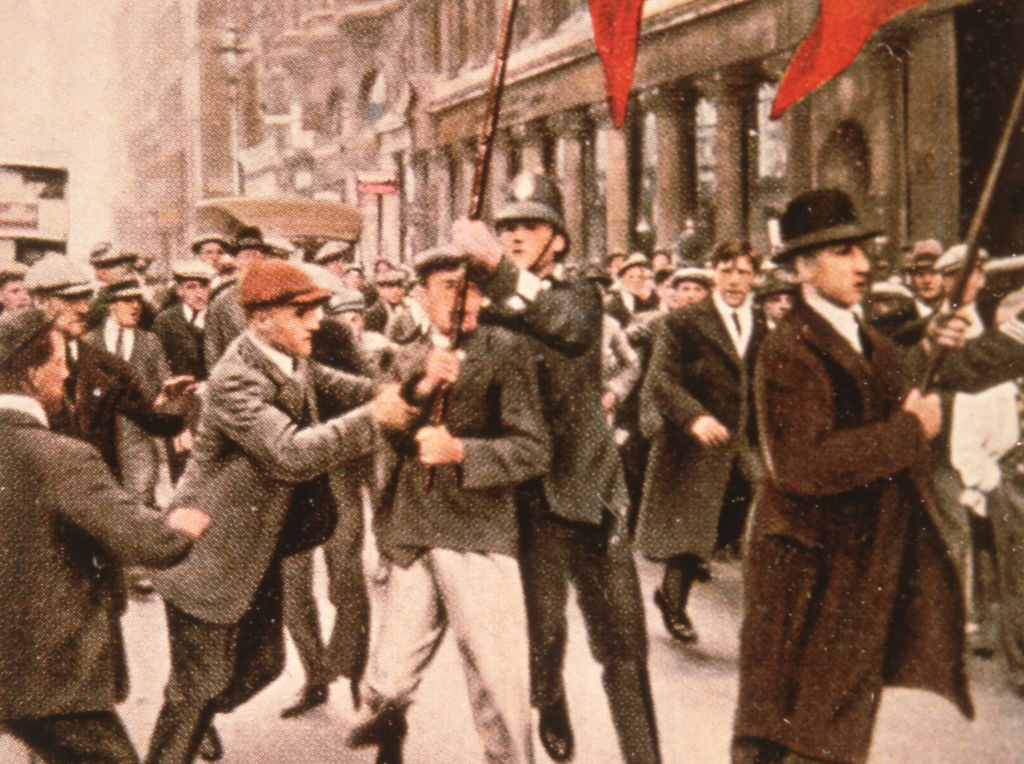
Today, London is seen as a city dominated by international finance and urban professionals. But 100 years ago, dockworkers led a general strike that helped make Britain’s left. (API / Gamma-Rapho via Getty Images)
On the first day of the general strike, the response in East London was strong. Almost all workers at the docks along the River Thames were on strike, as well as hundreds of thousands more in various other industries in the area. For the first time ever, clerical staff at the Port of London walked out, even before they were called out by their union.
In Canning Town, where dockers were confident that no one would be scabbing, mass pickets only formed after news spread that troops were working in the docks, attempting to load lorries. A crowd of locals blocked the entrance and booed the troops in the docks. The atmosphere was good-humored. Then, suddenly, the police started pushing the crowd from behind. The pickets were shunted further and further into the road, leading to arguments with officers, who began to wield their truncheons. The situation exploded. For half an hour, chaos reigned, and the pickets were forced to defend themselves. Strikers were injured, arms were broken, but they had stood their ground. It was just a taste of what was to come over the next nine days.
The next morning, before heading up the main road to the docks, hundreds of pickets walked along the side streets, pulling out the spiked railings from the walls of the houses. Arriving at the docks and seeing lorries again, they forced the drivers out of their wagons before turning over several lorries onto their sides. More lorries arrived, this time with troops on them. The police lined up to make sure the vehicles could get through the crowd. But the pickets weren’t going to be caught off guard again. The crowd pulled out their iron bars and pushed forward. This time it was the police’s turn for a beating. Street battles between workers and police occurred all over the docklands. In Poplar, on the same day, mounted police charged into a crowd of strikers, knocking some to the ground. When the strikers retreated through the side streets, police chased them, following them through doorways and into their houses, where they attacked them. Meetings organized by union branches and other supporters of the strike across the East End were invaded by police and dispersed.
Across the Thames, in Deptford, a more novel response arose to the stationing of troops in the Surrey Docks. Marines were invited into the pub by local communists, plied with drinks and given propaganda on why they should defect and join the workers. MI5 claimed the attempt was “without much result, apart from the consumption of an inordinate amount of beer.”
Lockmen in the Royal Docks joined the strike on May 5. When Navy sailors were sent under armed guard to replace them, workers at West Ham Power Station threatened to cut off all power to the area if electricity was used to open the bascule bridge. This forced the sailors to operate the bridge by hand, a long and arduous task. Navy submarines were brought in to supply power to the docks and keep fresh thousands of pounds of frozen meat stored in the cold warehouses.
The strike was going strong. The almost complete withdrawal of labor made it difficult for the government to keep the docks running, even after transporting in hundreds of Organisation for the Maintenance of Supplies (OMS) “volunteers” via Navy boats. Mass picketing prevented any convoys from leaving the docks. Pickets had even gone out onto the Thames on boats, patrolling the riverside to ensure no work was being done by blacklegs. These boat pickets were such a nuisance that the Port of London Authority considered requesting the river be closed to traffic.
Breaking the Blockade
The government was becoming desperate. It was both logistically and ideologically imperative to break the strike at the docks. The situation was made worse for the authorities by workers at a Shell fuel depot in Thames Haven, twenty miles to the east, singled out by government planners as a critical piece of infrastructure. On May 6, Shell workers walked out to join the general strike. That afternoon, three hundred pickets spotted a convoy of special constables traveling to Thames Haven, and they ran to try and stop them. On the way they cut telegraph wires to impede official communications, pulled down fences, and obstructed the road with trees. When they got closer to the depot, clashes broke out with the special constables. Picketing continued at Thames Haven over the following days. Meanwhile a platoon of soldiers marched through Canning Town, where they stopped and were ordered to fix their bayonets to their rifles.
Then, on May 8, five days into the strike, the blockade was broken for the first time. A military cordon was placed around the docklands. Guarded by armored cars, a convoy of one hundred lorries, each with its own soldier, was loaded with one hundred tons of flour and managed to leave the Royal Docks. R. Palme Dutt, an eyewitness to the events, claimed the troops had been ordered to get the convoy through “at any cost.” Joe Jacobs, fourteen years old at the time, remembers the mass response in Whitechapel to the news:
The crowds were so dense I had great difficulty in getting to the front. Every few minutes hundreds of men would surge forward off the pavements into the road and what followed frightened the living daylights out of me. Police on horseback with long wooden truncheons were hitting out in all directions. The police on foot were engaged in violent assaults on anyone who was not on the pavements while hundreds of others were linked together trying to stop more people getting into the road. I felt sick. . . . My sympathies were all for the miners and I began to hate the police. I was profoundly affected.
This was a great victory for the government, but the general strike wasn’t over yet. At Tilbury, another battle took place on May 10. Tensions were heightened after the Manchester Police and Horse Division were brought down to assist the local police. When special constables tried to drive through the picket, one constable on a motorbike was knocked off, and police cars were attacked. Scab drivers were attacked entering the docks and refused to leave unless given a military escort. When the police entered the docks that afternoon, there had been about three hundred pickets. By nightfall, over a thousand strikers and supporters had congregated outside the gates.
By May 11, armed convoys of food trucks continued to move out of the docks through the unholy alliance of the military, police, and OMS. However, the workers’ strike action remained strong, determined to continue regardless. The Poplar Trades Council and Labour Party called upon the Trades Union Congress (TUC) to escalate the strike and call out even more workers. The National Sailors’ and Firemen’s Union (NSFU), a company union to all intents and purposes, declined to call out the seamen and instead actively worked with shipowners to break the strike, while donating £10,000 to the scab miners’ union in Nottinghamshire. However, a small minority of seamen still came out in support of the general strike, mostly members of the much smaller Amalgamated Marine Workers’ Union (AMWU). It is unclear if these included the significant number of migrant seamen working on the docks, but the lack of reporting and the AMWU’s consistent hostility toward black, Arab, and Asian seamen make it unlikely. Meanwhile, members of the Tower Hill NSFU branch rebelled against their union leadership to join the strike, as did the NSFU branch in Liverpool. Havelock Wilson, president of the NSFU, sought an injunction to rein in rogue branches. The injunction was granted on May 11 by Mr Justice John Meir Astbury, who also deemed all non-mining unions supporting the general strike as being outside the law.
Repression and Surrender
Then, the next day, the TUC called off the strike. In East London, the workers were under no illusions that this meant any kind of victory. They began to prepare for the continuation of the strike, with or without TUC support. In Poplar, the Trades Council put up posters across the borough, informing workers that the strike was still on and that a rally would take place that evening on Newby Place to demonstrate the workers’ continuing resolve. Despite being warned by the TUC to keep out of the area to avoid confrontations with the military, by 6 p.m. a crowd of strikers and supporters had gathered. At the same time, a group of special constables was assembling on the street, waiting to be picked up and taken to Limehouse Police Station.
As in Tilbury, the special constables were not liked by the working class in Poplar. They were mostly recruited from outside the area: the recruiting office at Poplar Station had only successfully signed twelve special constables during the entire strike, and none of them were formally enrolled. A crowd of strikers began to chase the special constables. On the way they encountered a scab driver, stopped his lorry and got him out of his cab, while the constables ran into the docks to hide. Seeing this, a second scab driver drove into the crowd of workers, incensing them further. Around a hundred police arrived, launching an assault on the crowd and driving a car through the demonstrators into the front door of the town hall, where a women’s strike solidarity meeting was taking place upstairs. One of those present at the scene was the Reverend St John Groser, a local priest who supported the strike. He recalled what happened when he asked to speak to an inspector: “The answer I received was a rain of batons.”
Ten police officers then smashed open the door to the nearby offices of the National Union of Railwaymen, truncheons raised, shouting, “Here you are, you dirty dogs!” The 150 people socializing at the bar inside were attacked by the police, who laid waste to the premises. One worker, already beaten to the ground, pleaded for mercy. He was smacked once again by an officer who told him: “Take that one, you bastard.” The railwaymen’s strike committee were sitting in the backroom in a meeting under the chairmanship of Joseph Hammond, a fifty-two-year-old railway signalman and mayor of Poplar. He came out and informed the police of his position, appealing for them to stop attacking the people inside. Instead, a series of jeers and curses were thrown his way, and three officers subjected him to a brutal assault, hitting him on the arm, back, and head, hospitalizing him. By that night, six workers had been arrested, twenty-five hospitalized, and many more injured. The next day, letters were sent from various union branches and Poplar Borough Council to protest the police’s brutality. The government insisted that the force used was entirely proportionate.
On May 13, it was reported that even more workers were on strike in Poplar than before. The scene was similar across much of London’s docklands. On May 14, a secret meeting of military officials, civil commissioners, and Port of London Authority managers noted great difficulty in bringing enough food through the docks. The refusal of railway workers to end the strike in significant numbers meant any unloaded foodstuffs had to be transported by armed motor convoy, an inefficient method, problematic for frozen items such as meat. Matters were further complicated by the fact that the few union drivers who had returned to work still refused to operate their lorries unless the military retreated from their occupation of the area. Grain companies were threatening to turn around cargo ships heading to London if the situation was not fixed, causing great anxiety for the government. The contest between the state, employers, and workers was still very much in the balance, two days after the TUC’s withdrawal from the struggle.