The Soviet Crisis Was Predictable. Its Outcome Was Not.

The Soviet collapse in 1991 was so sudden and comprehensive that it came to seem inevitable. New work by historians of the USSR asks whether the system’s crisis could have ended in reform of its structures rather than disintegration.
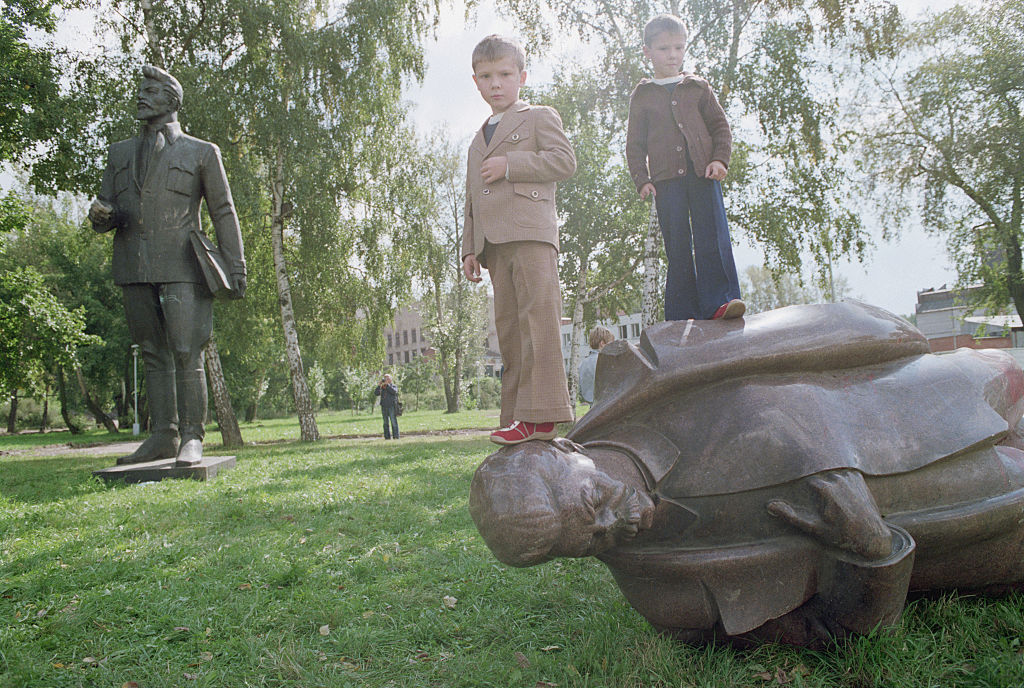
Children stand on a fallen statue of Joseph Stalin.

Until 1991, the USSR was central to the development of global politics, but it now represents a lost world. Mark Smith’s book, Exit Stalin, is an attempt to recreate that Soviet world with a focus on everyday life. (David Turnley / Corbis / VCG via Getty Images)


Until 1991, it was impossible to be on the Left and not have an opinion about the Soviet Union. Moscow was, remarks Mark Smith in his new history of the post–Joseph Stalin Union of Soviet Socialist Republics (USSR), the center of half the world. That world’s fate seemed to hang on the changing relationship of the United States and the USSR.

Today, the USSR is gone. Its once biggest components, Russia and Ukraine, are fighting each other. China and other countries loom larger in the questions we ask about the future of the world.

The USSR represents a world that the Left, for good or ill, has lost. Smith’s book is an attempt to recreate that Soviet world with a focus on everyday life. Toward that end, he calls it “a history in fragments.”

Possible Futures

For Smith, Soviet Russia was “a revolutionary civilization,” but his heart is not in “big theory.” He says his book makes six interrelated claims about periodization, revolution, decolonization, personhood, normality, and culture. But these issues are lightly impressed in the book. Any reader searching for a structured analysis of the social nature of the USSR as a mode of production or social formation and its wider dynamics will be frustrated.

So too will those who want to know how what came after linked back to 1917. Victor Serge famously said that he had no objection to allowing that the germ of Stalinism was to be found in Bolshevism from its beginning, because Bolshevism also contained a mass of other germs or possibilities. While Smith does not quote this remark, he seems to have some sense of it as he talks of “multiple possible futures” as the USSR developed.

At the same time, he also writes about straight lines from the past. This does not seem particularly helpful. Straight lines can move off in any direction from a single point of origin.

Does it matter when other accounts treat these issues more systematically? I think not. What Smith focuses on is the recreation of the world in which several generations of Soviet Russians lived. He echoes the historian Svetlana Alexievich, herself once Soviet and now Belarusian, whose ambition has been to tell us about “love, jealousy, childhood, old age, music, dance, hairdos. The myriad sundry details of a vanished way of life.” Smith follows such trails and invites us to make our own judgments about daily life, work, and the mentalities it produced.

The book is informed by a sense of loss, including, as we learn at the end, a personal one. Yet Smith always keeps his eyes wide open to the many negative and ambiguous aspects of Soviet society. He draws on some of the best historical research, including his own. Fascinating details then spill out as each fragment takes off in different directions.

Stalin’s Heirs

Smith is intrigued by different senses of time. The USSR looked so permanent, yet it struggled to last seventy-five years after 1917. The post-Stalin era was not quite thirty-nine years.

The 1989 Soviet census showed that there were 287 million people. Just twelve million were over seventy and possibly had memories going back to the earliest postrevolutionary years, while 3.5 million were over eighty and might have had some memory of Tsarist Russia. Well over 70 percent of these long-term survivors were women.

Soviet history had disproportionately culled the male population. But there were some prominent male survivors who had seen the revolution as adults, such as Vyacheslav Molotov, who died in 1986 at age ninety-six, and Lazar Kaganovich, who died in 1991 at almost ninety-eight years old. On the other hand, 68 percent of the population in 1989 were under forty-five and therefore could have had no meaningful memory of Stalin.

The problem was that the legacy of Stalin’s regime and the role of repression, even if moderated, remained. If we date the Stalin regime from 1929, then it lasted for twenty-four years — twice as long as the rule of the Nazis. During that time, some twelve million people were sent to the gulag.

But the Soviet regime in all its forms claimed to be the natural successor to 1917. It espoused the aspiration to catch up with and overtake the West. It took pride in its contribution to victory in World War II — a pride that became central to postwar Soviet “civilization.”

Once Stalin died, it was obvious that the system had to change. However, what the poet Yevgeny Yevtushenko called “rooting Stalin out of Stalin’s heirs” proved difficult, and reforms were erratic.

Zone of Slush

In much of the former USSR, the transition between the winter snow and ice in the spring is marked by a period of slush. Smith sees the thaw of the Nikita Khrushchev years as “a zone of slush” in Soviet society. The USSR moved toward a more stable dictatorship.

The prison camps were slowly emptied. The number of “counterrevolutionary crimes” fell from forty thousand a year just before Stalin’s death to 623 in 1956. De-Stalinization created what Smith calls “a morally inhabitable environment” in which people were caught between looking back over their shoulders and looking ahead to future horizons.

Society began to move forward. The extended reconstruction of big cities — not least Moscow, which the planners hoped to make “a glittering metropolis” — offered signs of hope, and the Soviet housing program proved to be “one of the great social reforms of European history.”

But de-Stalinization still left “residues in the mentality of the Soviet people,” as Smith observes. And social progress was still narrow. When Yuri Gagarin untangled himself from his parachute in a rural district having orbited the Earth in 1961, he had to go in search of a telephone to tell his superiors where he was.

Having replaced Khrushchev in 1964, Leonid Brezhnev went on to rule until his death in 1982 at age seventy-five. There is a picture of him in the book in 1956, looking young and dynamic, though he had already suffered his first heart attack. By the late 1970s, it was evident to all that his physical and mental condition was declining.

Most historians see Brezhnev’s condition as a metaphor for the decline of the Soviet Union as a whole. For Smith, however, “the long 1970s” still remained positive for most people, even if the pace of improvement slowed from the mid-1970s.

Center and Periphery

During this period, wider living standards rose, and leisure became more important. The shift toward a more consumer-based society, which had begun under Khrushchev, was consolidated under Brezhnev. A larger and more sociable private realm was emerging. Despite the pressures of military spending, the huge housing program continued with the gradual reduction (though not elimination) of communal forms of accommodation.

Shops remained more basic than in the West, but their numbers grew. Prices for most everyday needs were low and relatively stable. Despite the queues, the quantity, variety, and (even if lagging) quality of goods was rising. Soviet citizens began to acquire everything from fur hats and coats to frying pans, furniture, and, in some cases, cars. There was even, Smith notes, a significant increase in pet ownership — a reflection of the increase in housing space, improving conditions, and a better attitude toward animals.

To understand how people understood this world themselves, Smith interlaces hard social history with extensive stories from contemporary songs, poems, novels, television programs, and films. These elements helped form part of the culture of Soviet citizens, or at least its more educated elements.

He recognizes that we tend to see the Soviet past through the eyes of the more educated and urban elements. By 1989, 66 percent of the population was urban, with nine million living in Moscow and five million in Leningrad. That still left half the population living in the countryside or in urban settlements of between three thousand and one hundred thousand people. Getting at the “deep USSR” is a challenge for researchers.

There is a related issue that Smith also recognizes — our propensity to see the USSR through the lens of its Russian (and, to a lesser extent, its Ukrainian) parts. In 1989, just 51 percent of the population lived in the Russian Soviet Federative Socialist Republic (RSFSR). The fracturing of the USSR has led us to be more sensitive to the stories of the other 49 percent, but it is harder to mold their experience into a single narrative.

These wider experiences affected not only the “periphery” but the center. Rapid industrialization and urbanization meant that society was socially mobile. Leaders, as Smith emphasizes, were typically outsiders who “came from the geographical and social margins.” It would take time for children to inherit their parents’ positions.

The Long 1970s

The “long 1970s” for most ordinary people came to embody what Smith calls “a Soviet eternity.” There were problems and contradictions, as there were in the West, but these did not foreshadow the end of the system. Nor did they shape most people’s understanding of their world. Smith quotes an historian of Britain during the same era who observes that “most people happily live with contradictions.” And so it was in the USSR.

It did not last. The improvements were not enough, and the problems were clear in the form of stalling life expectancy and the limited resources devoted to health provision. Politically, Stalinism, the “maximally coercive variant of the Russian Revolution” had been replaced by what Smith dubs a “low-key civil war” on dissent under Brezhnev.

The USSR remained a one-party state where the rule of law was limited and there were no free trade unions or legal strikes. Prisons and prison camps remained, as did the experience of exile, supplemented now by psychiatric hospitals for some dissidents.

This did not stop occasional revolt. Smith opens his book with the shooting of protesters against food price increases in Novocherkassk in 1962. In absolute terms, he notes, the KGB was “the biggest secret police force in the world.”

Uniformed people were everywhere. When the Olympics were held in Moscow in 1980, an additional forty-five thousand uniformed personnel were drawn into the city. People breathed more freely after 1953, but they were still aware of the limits.

In 1989–91, the collapse of the USSR threw the lives of nearly three hundred million people into turmoil. When it happened, it seemed that such an epochal shift must have been born of a deep crisis in the system — whatever that system was.

Suicide by Accident?

Later commentators have not been so sure. In his final section, Smith argues that the Soviet Union was “the country that committed suicide by accident.” If some reform was needed, perhaps there was an alternative option to what actually took place?

Smith talks, as many do, of a possible Chinese-style option. This would not have been a question of following China under Deng Xiaoping directly. In 1989–91, it was still not much of a model, and it was barely discussed as one. Rather, the question is whether the political consequences of economic reform could have been much more tightly controlled.

Smith appears to think it could have. He shifts his focus to the top processes by which control was lost, including what he sees as Mikhail Gorbachev’s admirable but politically naive view of power and regime support. This seems a very narrow view, and it sidelines much of the ferment that reform opened up below.

He deals sketchily with the ways in which parts of the system and some of the most powerful groups survived. “The people who ran the state gave up and walked away,” he says. But that is only partially true. Stopping the story in 1991 without a more structured approach to the aftermath seems too limiting.

1991 is now three and a half decades ago — only a little less than the period from 1953 to 1991. Smith’s evocation of that time has much to commend it for those outside of Russia who want to learn about changing daily life then. But, if it is distant from us, it is also a time increasingly distant for Russians themselves.

Today, the Russian successor state of the USSR has a population of just 147 million. Only those over forty could have any meaningful memory of the last years of the USSR. Those who were eighteen in 1991 are now fifty-three or above, and they make up less than a third of the population. “Soviet eternity,” as Smith observes, was transient.