The Tragic Lives of the Communists Trapped in Stalin’s Shadow
Communists who came to the Soviet Union seeking refuge found themselves caught up in the madness of the Stalinist purges. But many, argued Isaac Deutscher, still couldn’t think of breaking with the system that Stalin created and ended up working for their former persecutors.
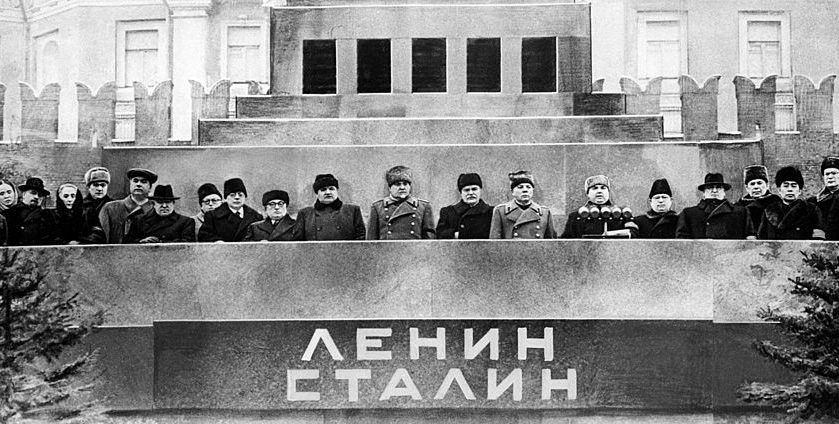
Following the death of Josef Stalin on March 5, 1953, his friends and political colleagues, including a number of communist leaders from Central and Eastern Europe, gather at the tribune of the Moscow mausoleum. (Keystone-France / Gamma-Keystone via Getty Images)
Polrugaria need not be exactly located on the map. Enough that it lies somewhere in the eastern reaches of Europe. Nor need the name of Vincent Adriano, a high Polrugarian official, be looked up in any Who’s Who, for he is a half-real and half-imaginary character. Adriano’s features and traits can be found in some of the people who now rule the Russian satellite countries, and not a single one of his experiences related here has been invented.
It need not be specified what post Vincent Adriano holds in his government. He may be the president or the prime minister or the vice-premier, or he may be only the minister of the interior or the minister of education. In all likelihood he is a member of the Politbureau, and he is known as one of the pillars of the People’s Democracy in Polrugaria. His words and doings are reported in newspapers all over the world.
It is common to refer to men of Adriano’s kind as “Stalin’s henchmen,” “Russian puppets,” and “leaders of the Cominform fifth column.” If any of these labels described him adequately, Adriano would not be worth any special attention. To be sure, he is unavoidably something of a puppet and an agent of a foreign power, but he is much more than that.