Tenants Have More Economic Power Than They Think

Just as workers can withhold labor to halt production, tenants can withhold rent to challenge corporate landlords. In Los Angeles, a coalition of tenants and debtors is proving that housing is a site of real economic power.
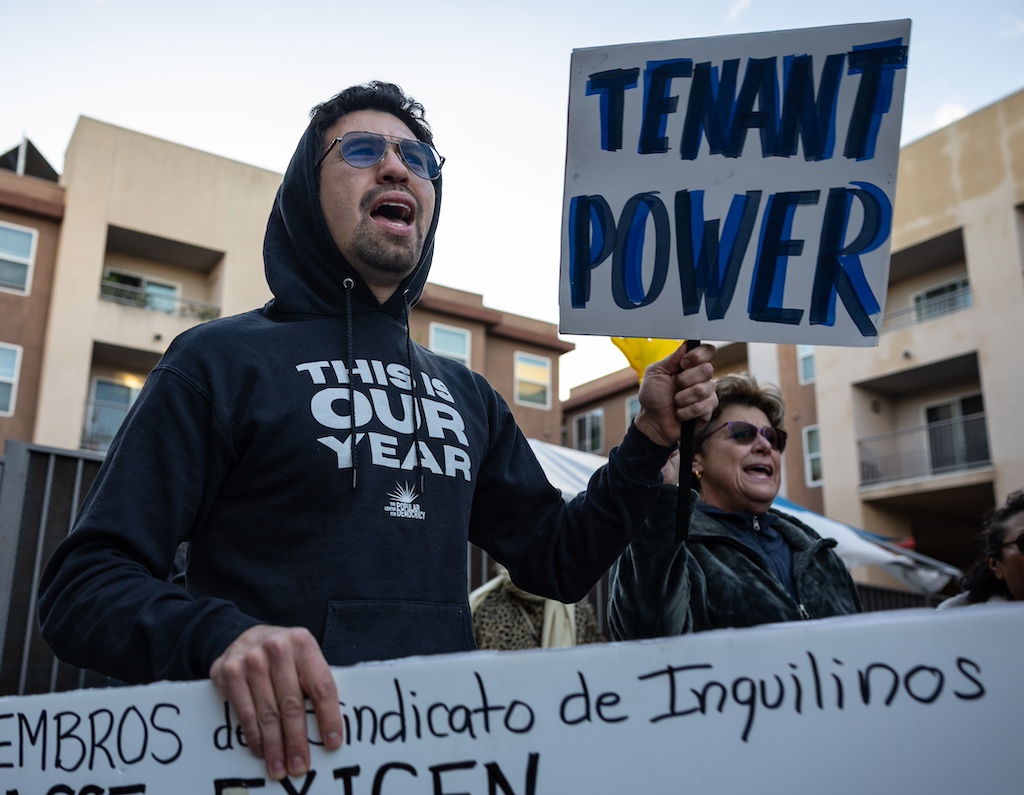
Housing costs make up the vast majority of Americans’ annual bills and outstanding balances. (Jason Armond / Los Angeles Times via Getty Images)

Less than a year out from the congressional midterm elections, President Trump has at times styled himself as an economic populist — signing executive orders against institutional investors in the single-family housing market, floating credit card interest rate caps, and teasing “Trump Accounts” to help Americans build wealth.

Many of these ideas have clear appeal across party lines. Indeed, some of them are borrowed directly from progressives. But Donald Trump’s seriousness about these proposals is highly questionable at best. At a cabinet meeting in late January, for example, the president said off the cuff that he actually wanted to “drive housing prices up,” adding that he would not “destroy the value” of existing homeowners’ property “so that somebody that didn’t work very hard can buy a home.”

For affordable housing advocates, a larger question looms over the particular contradictions of Trump’s presidency: Why should millions of people’s ability to secure a good home depend on the prevailing political winds in the first place? Housing is a basic need, just one step above food and water. A transformative politics would reclaim it as shelter, home, and community — not a financial playground for Wall Street speculators.

Crucial to achieving that vision is recognizing the existing power of tenants and homeowners. We don’t need to rely on elected politicians to prove their sincerity and take action. Just as workers can withhold labor and halt production, tenants and homeowners have collective financial power too: our monthly rents and mortgages trickle up to the 1 percent and keep the economy running.

In this age of financialization, in which every corporation is seemingly a bank, what does leveraging tenant power actually look like? In Los Angeles, tenants and former tenants are lighting one path to victory.

Tenants and Debtors Unite

Nine months into a historic utility strike, tenants in multiple buildings — led by the Virgil Square Tenants Association and the Mozaic Tenants Association — are withholding their monthly utility payments from their corporate landlord.

In these apartment complexes, tenants don’t pay for their own individual water and electricity usage. Instead, each tenant is forced to pay an equally divided portion of the entire building’s utilities through a shady apportionment system known as a ratio utility billing system (RUBS). Illegal in many jurisdictions across the country, RUBS allows landlords to skirt rent control protections by carving out a large expense from the controlled rent. Moreover, RUBS subsidizes neglect. If an aging pipe bursts or the pool has a persistent leak, tenants are on the hook for the increased bills.

After several months of collectively withholding monthly utility fees, the tenants’ corporate landlord conceded and returned tens of thousands of dollars to dozens of tenants in one building, noting that future bills would be lowered to provide “relief.” The tenants, however, remain on strike until they receive transparency for how the bills are calculated.

Meanwhile, just down the street, former tenants are engaged in other bold acts of economic disobedience. Nine tenants who were evicted by their corporate landlord — and left buried deep in debt with ruined credit — have banded together and gone on a novel back-rent debt strike. Having been evicted by the same landlord, these former tenants, now in debt and rendered unhouseable by crushing hits to their credit scores, owe tens of thousands of dollars to their corporate landlord. Post-eviction rental debt, which exploded after COVID-19 eviction moratoriums expired, has trapped millions of households with billions in arrears.

The rent debt strike takes inspiration from fifteen bold debtors who, a decade earlier, refused to pay another shady California corporation called Corinthian Colleges, the now notorious, predatory, for-profit college. Known as the Corinthian 15, that initial number grew to thousands, and after years of moral and political protest and invoking consumer protection law, state and federal prosecutors took action and canceled all debts owed by Corinthian Colleges debtors. The growing debt strike of former tenants in California follows that successful playbook.

Most exciting about the tenants withholding utility payments and the former tenants on debt strike for back-rent is that they’re leveraging their power in concert against the same financial entity. These working-class tenants and debtors are all taking action against the same exact landlord, Equity Residential, which happens to be the fifth-largest corporate landlord in the nation.

Equity Residential, and other real estate investment trusts like it, use an exploitative profit model that favors “lower stringency in screening, higher turnover rates and more frequent evictions in exchange for higher average rents,” said Alexander Ferrer, a researcher at the University of California, Los Angeles. In other words, it’s a better bang for their landlord buck to churn and burn tenants, extracting as much rent as they can from the current tenants before evicting them, and then extracting as much back-rent debt as they can when tenants are gone.

Now, tenants and debtors have caught on to Equity Residential’s extraction machine and are flipping their landlord-creditors’ financial weapons back around. From excessive junk fees slapped on top of rent to abusive, potentially illegal debt-collection practices on people who they shamefully evicted, tenants and debtors have created the Equity Residential Tenants and Debtors United (EQRDTU) so that anyone in the country who resides or used to reside in an Equity Residential building can join in collective action.

Reporting Abusive Landlords and Rent Debt

This bottom-up economic resistance didn’t happen in a vacuum. Organized by the Debt Collective, a union of debtors for which I organize, tenants and debtors were brought together to expose what happens when the 99 percent bands together. Workers see each other on the factory floor every day, while debtors are kept isolated and ashamed. But through a virtual factory floor, a space only a union of debtors can facilitate, the corrupted terms of our financial contract can be exposed, and we can organize against creditors collectively.

To complement these parallel strikes, Debt Collective launched a legal tech tool dubbed the “Landlord Reporting and Rent Debt Tool,” which anyone in the country can use to fight their back-rent debt or document their landlord’s abusive practices. The tool helps tenants and former tenants turn their complaints about junk fees, deceptive utility bills, and poor conditions into collective power, transforming them into legally actionable claims that add pressure to regulatory agencies to punish bad actors like Equity Residential, AvalonBay Communities, Essex Property Trust, and others.

Our campaign is unfolding within a larger tenant uprising against corporate landlords. In San Francisco, tenants of Veritas Investments, working with an organization called the Housing Rights Committee of San Francisco (HRCSF), organized thousands of units into collective bargaining over leases and conditions — and helped pass a local law enshrining tenants’ right to bargain. Tenants with the Tenant Union Federation (TUF) have made similar strides, organizing roughly 10 percent of Capital Realty Group’s neglected portfolio of federally subsidized housing units across six different states. From the KC Tenants to the Autonomous Tenants Union Network to New York City mayor Zohran Mamdani’s efforts to “freeze the rent,” a rent revolution is burgeoning.

Real estate is the largest sector of the global economy. In standard financial reports, the Federal Reserve details the trillions of dollars’ worth of debt Americans owe in just two simple categories: housing debts and nonhousing debts. Put simply, housing costs — mortgages and rents — make up the vast majority of Americans’ annual bills and outstanding balances.

As workers, debtors, tenants, teachers, nurses, and all of us in our various political identities consider the forms of power we have at our disposal to transform our economic and political conditions, it’s clear that building power around housing debt — the relationship between rents and mortgages — should be at the center. Not just because homes keep us safe from weather, pandemics, and immigration raids, but because serious resistance aimed at taking on our bosses and creditors alike means taking the financialization of our homes seriously too.