Teamsters for a Democratic Union Leaders Explain Their Strategy
As the union reform organization Teamsters for a Democratic Union turns 50, we spoke to its cochairs about their work building rank-and-file power inside one of the most important unions in the United States.
“TDU’s job is to build union power from the bottom up. We call that rank-and-file power, and that’s our focus no matter who is running the union at the top.” (Andrew Lichtenstein / Corbis via Getty Images)
- Interview by
- Eric Blanc
Teamsters for a Democratic Union (TDU), the organization dedicated to rank-and-file organizing within the International Brotherhood of Teamsters, is one of the most important labor reform organizations in the United States. The group has played a key role within one of the most powerful unions in the country over the years, including in the election of insurgent Ron Carey as Teamsters president in 1991 and then the United Parcel Service (UPS) 1997 strike, as well as the election of current Teamsters President Sean O’Brien and within the UPS contract campaign in 2023.
This year, TDU turns fifty. In an interview with labor scholar and organizer Eric Blanc, TDU cochairs Antonio Rosario and Bryan Trafford talk strikes, organizing, Amazon, Donald Trump, the upcoming Teamsters election, and building union power from the bottom up.
Eric Blanc
Five years ago, Teamster members elected Sean O’Brien and the Teamsters United slate to lead the international union. What’s your balance sheet of what’s been accomplished since then?
Antonio Rosario
We were promised militancy, and that’s what we’ve seen. The first big fight was the UPS contract campaign in 2023, and that set a new tone for our union. We used to be kept in the dark and have givebacks shoved down our throats. This time, members were mobilized. We had parking lot meetings and leafleting. We had rallies on Martin Luther King Day under the slogan “Make UPS Deliver on the Dream.” Tens of thousands of Teamsters participated in practice picketing. We mounted a real strike threat, and we won.
That contract campaign model is being spread to other industries by the international union, by local unions, by TDU, and by the rank and file. There have been more strikes in the last four years than there were in more than a decade under [James P.] Hoffa. When you go on strike, you get $1,000 a week in strike benefits from the international union. Strike benefits now start on day one of a strike; you used to have to wait until the eighth day.
These are huge changes put in place by the new leadership that put power in the hands of the rank and file. TDU’s job is to show members how to use them and build power where they work.
Bryan Trafford
Coordinated bargaining and strikes have been game changers too. After the organizing department organized 1,100 workers at DHL’s largest air hub, the company was retaliating against workers and refusing to bargain a fair contract. This happens all the time in new organizing. The Teamsters put strikers on airplanes and extended picket lines from Boston to Los Angeles. DHL was in chaos.
Those 1,100 workers won a first union contract and a neutrality agreement that allowed another 1,300 DHL workers to join the Teamsters.
In Louisville, where I live, we organized 120 Sysco drivers. We struck for a contract and extended picket lines and won by coordinating with other locals. That spurs further organizing.
After the UPS contract campaign, we got contacted by UPS administrative employees and specialists who wanted to join the union. Sean O’Brien negotiated a national neutrality agreement. We’ve organized thousands of new members at UPS.
The same thing happened with nurses in Michigan. Ten thousand nurses at Corewell joined the Teamsters in just one union election. A member of their organizing committee spoke at our TDU Convention and said they were inspired by the UPS contract campaign to organize with the Teamsters.
People want to join a union that is fighting the boss. As an organizer, I get five or six leads a week, every week. That increased militancy is why people reach out to us in the first place.
Eric Blanc
Can you say more about the role of TDU?
Antonio Rosario
TDU’s job is to build union power from the bottom up. We call that rank-and-file power, and that’s our focus no matter who is running the union at the top. The difference now is that Sean O’Brien and the international union want members to fight. The union is much more open to member mobilization. More Teamsters than ever are participating in TDU.
During the UPS contract campaign, we started holding webinars. Thousands of members would sign on to get an update on negotiations, then we would talk about the next contract campaign action, and UPSers would teach other organizing basics like leafleting or distributing a contract unity pledge or holding a parking lot rally.
At the end of the webinar, members could sign up to get contract campaign materials and talk to a TDU organizer or member about how to get involved. The movement grew. Today, our UPS Teamsters United network reaches tens of thousands of members.
TDU builds contract campaigns at the local level too. At the San Diego Zoo last year, TDU members formed a group called Zoo Solidarity to fight a weak contract. They voted it down. Six months later, they elected Zoo Solidarity members to lead their local.
TDU helps members run for local union office and build strong locals after they win. Bryan talked about coordinated bargaining and strikes with Local 135. That local used to be led by the old guard. Not anymore. TDU members now run that local, which is one of the largest in the Teamsters.
I like to say, “I got involved in TDU to change a problem. I ended up changing myself.” I think that’s true for a lot of members. They come to TDU for education and stay to become organizers for change.
Eric Blanc
Some union activists are promoting the idea, first proposed by United Auto Workers President Shawn Fain, of coordinated strikes around May Day in 2028. What do you think about this proposal?
Bryan Trafford
Honoring picket lines is something we take very seriously in the Teamsters. Under new leadership, we have renewed focus on striking and extending picket lines. I would love to see that spread across the entire labor movement.
A lot of our siblings in the labor movement rely on Teamsters to honor their picket lines and be leverage to help them win. I’m proud to do that. We should all be honoring each other’s picket lines and negotiating the contract language that lets us do it. That would personally give me a lot more faith that a general strike would be possible.
Antonio Rosario
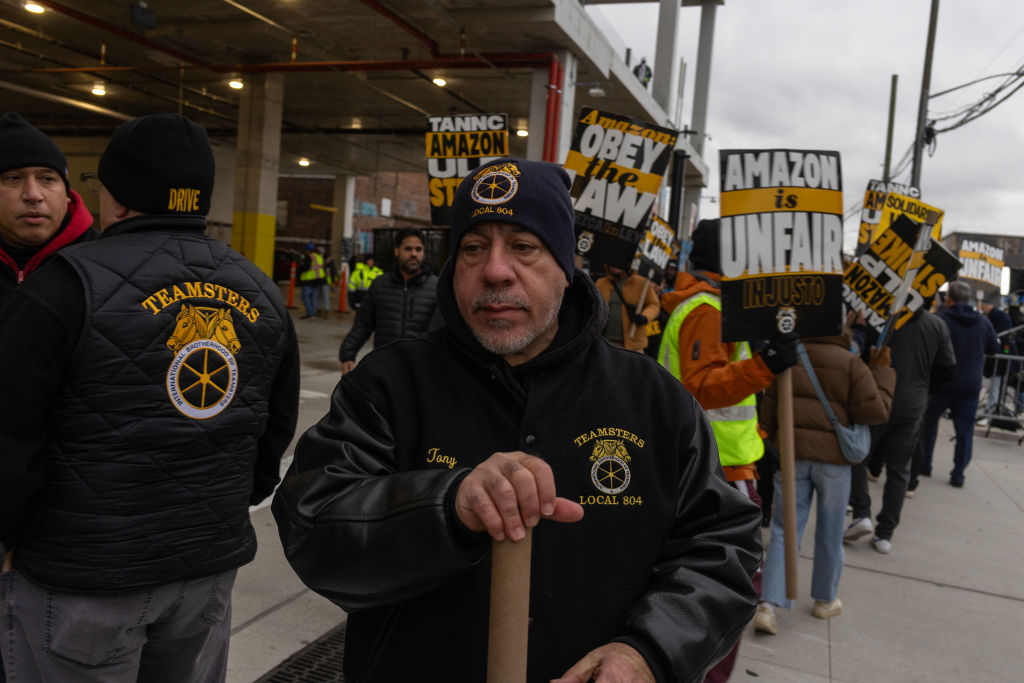
Striking together is the ultimate form of solidarity. We’ve done that at Amazon where workers who don’t even have a contract go on strike together. We’ve even extended picket lines across the country.
There are a lot of ways to show solidarity. We organized a May Day action at Amazon offices with banners that said, “Amazon delivers poverty, war, and ICE.” We stood with unions, immigrant rights organizations, and community groups. It was powerful.
Eric Blanc
You’re both involved in Amazon organizing.
Antonio Rosario
For me, this campaign is taking on the challenge of organizing hundreds of thousands of workers and raising union density, which is at an all-time low. Amazon is driving down standards not just at UPS, but in grocery, food distribution, movies, television, you name it. They just launched Amazon’s Supply Chain Services to target the core of UPS’s business, which is business deliveries. That is a wake-up call.
Bryan Trafford
If UPS was not organized, what would a UPS driver make? We know it would be about $20–$21 an hour like an Amazon driver. And Amazon absolutely wants to spread that model: low pay, low benefits, no path to a decent middle-class lifestyle for folks.
Amazon workers themselves understand very quickly without very much prodding the situation that they’re in, and that this company absolutely does not care about them and sees everybody as disposable. They just want to churn and burn ’em, get ’em in, use ’em up, throw ’em out.
Antonio Rosario
I think the UPS contract campaign was a real catalyst, because it was literally televised everywhere. It isn’t a big lift to show Amazon workers what it looks like when workers come together as a union, because, here you go, this is what it looks like.
That’s where it all starts. Having one-on-one conversations with Amazon workers who are tired of the exploitation, helping them develop into leaders, and watching them take it to the boss. This is what’s led to twelve thousand Amazon workers joining the Teamsters. This is real grassroots organizing.
Another aspect of this is community coalitions and legislative campaigns. In New York, we’re fighting to pass the Delivery Driver Protection Act, which would end the scam subcontractor model.
Amazon and FedEx would have to directly employ their drivers. They’d be held to safety standards and workers would have protections against being fired without just cause.
Eric Blanc
UPS is cutting Amazon deliveries, trying to reduce the workforce, and building up nonunion aspects of the business. Can you talk about these challenges?
Bryan Trafford
We punched UPS in the mouth in the contract campaign, right? That doesn’t mean that they lay down and give up. That’s just not the way corporate America works. So UPS is doing two things. They are absolutely fighting back, as any company does. But they’re also responding to external market pressures that are being put on them in the logistics industry, especially by Amazon.
UPS is cutting the number of Amazon deliveries in half to focus on deliveries that make maximum profit. This is a huge amount of packages, and we’ve seen layoffs.
UPS bought a company called Roadie that uses gig workers who drive their own cars to pick up and deliver packages. This is straight out of the Amazon playbook. UPS is automating hubs where packages are sorted to try to eliminate jobs.
The last UPS contract was about reversing givebacks from the past. This next contract has to be about securing good union jobs for the future — including organizing the growing nonunion branches of UPS.
TDU’s role is educating members about these threats, building our UPS Teamsters United network, and training new rank-and-file organizers to build the 2028 contract fight.
Eric Blanc
The Teamsters are the most prominent union that has looked to find common ground with Trump. I think it leaves a lot of progressives in the labor movement scratching their heads, wondering why O’Brien is taking that strategy, and wondering why TDU is supporting Sean O’Brien’s reelection.
Bryan Trafford
I can understand why many progressives would be mad, and I’ve had many conversations with people about that — “Hey, what’s up with the Trump stuff?’
When I got involved with TDU, I wasn’t looking for an organization to tell me who to vote for or to get involved with electoral politics. I joined TDU because I wanted to focus on bottom-up, grassroots organizing with my coworkers to get them involved so we could win a better contract.
Personally, I’m a democratic socialist. Those are my politics. Do I agree with all of the political choices that our international union leadership has made? No, I do not. But I don’t expect to. The same goes for TDU. We support and work in coalition with the O’Brien-[Fred] Zuckerman Teamsters United team and our union is building real, militant power for workers. But we don’t expect that the leadership is only going to make decisions we agree with.
As TDU, we maintain our independent organization and run our own programs and campaigns. Our approach is we focus on what unites us, not what divides us — and we focus on what we can impact, not what we can’t. We focus on what we do, not what we post.
TDU focuses on shop-floor organizing, militancy, education, participation, solidarity, not presidential politics. I think that we do a great job of staying focused on the mission, not having mission creep.
Eric Blanc
You talked about being focused and not having mission creep, but sometimes the world creeps up on you, doesn’t it? How do you respond to people who say Trump is attacking unions, he is attacking immigrants, he is attacking working people. Doesn’t TDU need to oppose Trump to be true to its mission?
Bryan Trafford
TDU stands with unions, workers, federal workers, immigrant workers. That’s solidarity. But the moment TDU gets defined as a partisan or political organization, that would cut us off from half or more of Teamster members that we want to engage. That’s not organizing.
In my own workplace, I was absolutely the farthest-left person. The vast majority of my coworkers were Republicans, and they still elected me steward, and they still understood that we all had an interest in fighting the boss and coming together around our issues.
Most Republican members and Teamster siblings who support Trump still want to see the union work like it’s supposed to. They still want to fight the boss. We build our common ground and unity from there, not by dividing around partisan politics.
Antonio Rosario
If you’re against Trump, I am personally 100 percent with you. But TDU is not for that. We focus on rank-and-file organizing and building power at work.
If you feel a certain way about a political issue, whether it’s Immigration and Customs Enforcement (ICE) or Palestine or whatever, there are campaigns and organizations that you can join to organize and take action.
In Minneapolis, TDU members organized a contract campaign and strike of 1,400 custodians and dining hall workers at the University of Minnesota — many of them were immigrants from East Africa. They won that strike by uniting everyone.
When ICE started its terror campaign in Minnesota, TDU members passed out “know your rights” cards and organized mutual aid to deliver food and groceries and household necessities to their coworkers. They took the solidarity from the workplace to their community.
In 2024, some TDU members and other Teamsters formed Teamsters Against Trump (TAT). They raised money and paid members to take union leave to do Teamster-to-Teamster outreach about Trump’s anti-worker record. TAT was broader than TDU, and it was more effective as a result. It worked with top Teamster leaders in swing states who don’t like TDU but wanted to defeat Trump.
Those officials let TAT send mailings to every Teamster in Michigan and Pennsylvania. That never would have happened if it was TDU and not Teamsters Against Trump. Different organizations are suited to do different things. Trying to mix TDU and Teamsters Against Trump would have made both groups more narrow and more ineffective.
Eric Blanc
This month at the Teamsters Convention, the Fearless Slate is putting itself forward as the opposition. They’ve made Trump very central to their campaign, and they’re putting themselves forward as the progressive alternative to Sean O’Brien.
Bryan Trafford
We have the scorecard now for the new leadership. If you look at the things that the O’Brien-Zuckerman Teamsters United ran on, and the things that they accomplished, you will see that a lot of those boxes are checked.
Our union faces new challenges. But I don’t see the Fearless Slate campaign offering any plan or track record of tackling these issues. I just see a lot of talk and social media posts and AI-generated videos and podcasts. There’s no mention of strikes or organizing or mobilizing or coordinated bargaining or picket line extensions or bargaining to organize or contract campaigns or any of those things.
A lot of members don’t like Trump. That doesn’t mean that they want a different leadership team at the international. I think our members want to know that the leadership that they vote for is going to set the tone, give them the resources they need to be successful in their contract fights, and things that protect, preserve, and improve their contract and their standard of living as Teamster members.
Eric Blanc
TDU fought for and won the right for members to elect international union officers in one-member, one-vote elections. If opposition candidates are not able to get on the ballot, and there isn’t an election, how would you feel about that?
Antonio Rosario
TDU fought for the right to vote and for fair election rules, and we won. But fair election rules don’t mean that whoever raises their hand gets on the ballot. You have to demonstrate you have some support from the members.
The first step is to get accredited. Under our rules, candidates who collect signatures from 2.5 percent of the members are given a copy of the entire Teamster membership lists so they can do outreach to all members, and they are given the right to have campaign literature published at union expense in the Teamster magazine and mailed to every member, and posted on the website too.
Every single campaign in Teamster history before this one has gotten accredited by collecting signatures. The opposition slate this time barely tried. They didn’t build a network, recruit volunteers, hold events, raise money. They didn’t go to Teamster workplaces and do basic one-on-one organizing.
That’s another right TDU won, by the way. As a candidate, you have the right to campaign in the parking lots of any Teamster employer. The rules are written to encourage involvement, participation, and organizing.
To get on the ballot, candidates need to be nominated by 5 percent of the delegates at the Teamster convention. Any member can run for convention delegate. The officers used to just go automatically. That’s another right TDU fought for and won, the right for members to elect convention delegates. The opposition slate this time barely ran in convention delegate elections.
These Democratic election rules are there for any candidates to use whether TDU supports you or not. But you’ve got to use them. The Fearless Slate is not using the election process to run a campaign. They’re running a campaign to “expose” the election process so that afterward they can say that members were denied a choice. It’s really cynical.
Bryan Trafford
I believe in democracy. I don’t think that that means that I should go help the Republican to make sure that both people get on the ballot. I think that you pick the candidate and the team that you support, and then you help those folks get elected and you work toward that end. I don’t think because you believe in democracy, it means you help every candidate that runs so there will be an election. That just doesn’t make a lot of sense to me.
Eric Blanc
Any final thoughts?
Bryan Trafford
Our international union has strong, fighting leadership that is taking on employers. At the end of the day, I’m not counting on Sean O’Brien to solve all our problems. I’m counting on Sean O’Brien, Fred Zuckerman, and the rest of the leadership to empower members, to give us the tools that we need to be successful and back us when we step up and fight.
As TDU, we’re going to focus on building union power from below — rank-and-file power. We do that by spreading the contract campaign model, which wins better results because members are activated and strike-ready.
We’re going to continue to educate members, to build grassroots networks, to show members how to organize on the shop floor to take on the boss. It’s much bigger than any single contract fight or grievance or union election. The Teamsters and the whole labor movement need more leaders and fighters. That’s where building power starts.