How Penn Graduate Workers Got Their Union Contract

As workers at the University of Pennsylvania pursued a first contract, Trump’s second presidency rendered the administration cowed, the labor board unreliable, and international workers afraid. The antidote: high-participation, worker-led organizing.
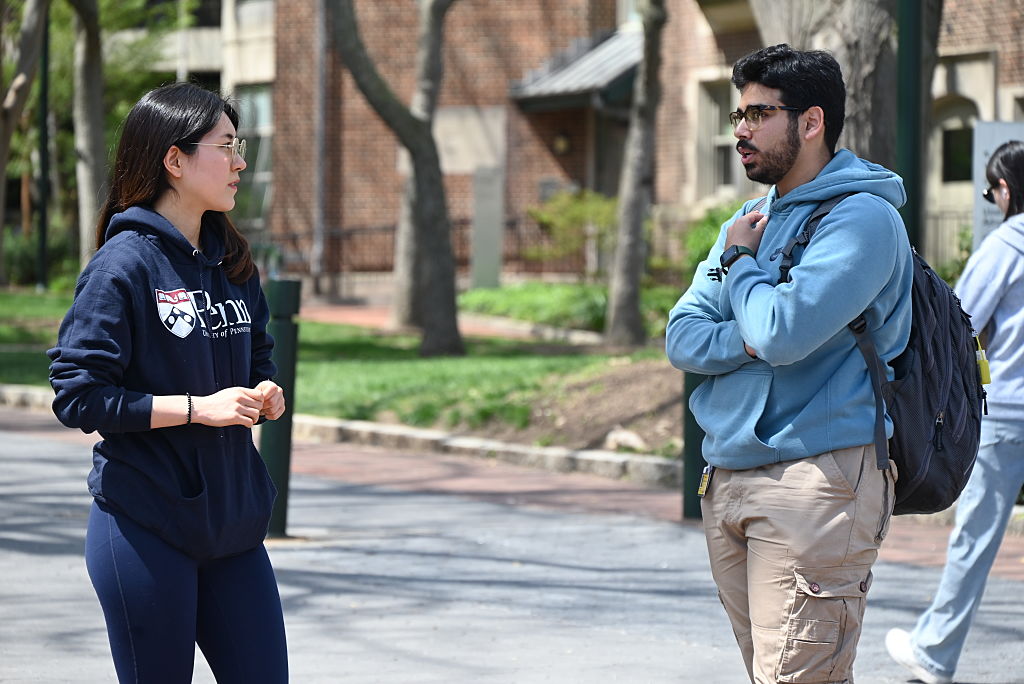
Two students speak on the campus of the University of Pennsylvania, in Philadelphia.

Over 2,600 Penn grad workers voted to ratify their first contract. The strategy that got them there is the same that wins in any workplace: tapping organic networks, building organic leaders, and frequent high-participation actions. (Kyle Mazza / Anadolu via Getty Images)


May Day, 2024, was a day of celebration for over 3,500 graduate student research and teaching assistants at the University of Pennsylvania (Penn): we had just won our National Labor Relations Board (NLRB) election in a landslide and formed the largest new private sector union in Philadelphia in over half a century. By October, we elected a bargaining committee, ratified our initial bargaining demands, and headed into negotiations.

Just a few weeks later, US voters elected Donald Trump back to the White House. At first, we wondered whether we would need to develop new organizing strategies to confront this obstacle. But ultimately, the same strategy that won our union election — developing a broad and deep network of worker leaders throughout the workplace — also won our first union contract. These leaders built supermajority support and moved their coworkers to take an escalating series of actions together. Workers from the University of California and Mount Sinai proved the success of that organizing strategy, and our campaign taught us that it works regardless of who is in the White House.

Still, the Trump administration presented new challenges. Unlike the dozens of new higher ed unions that organized after 2020, we could no longer count on the NLRB to enforce labor law, since filing an Unfair Labor Practice charge could give the Republican-controlled board an opportunity to overturn student workers’ right to unionize. Meanwhile, the Trump administration leveraged public research funding to extract political concessions from universities and encourage them to adopt new regimes of austerity. And it undertook frightening deportation measures, putting international workers — about one-third of us — under additional fear and uncertainty. To win our first contract, we had to overcome these obstacles.

Organizing Thousands of Workers

During the fight for our first union contract, we built worker support through structure tests: a series of escalating actions that engage the entire workplace and build leadership, where success is measured by the number of individual workers involved. Between winning our NLRB election in May 2024 and winning our contract in February 2026, Penn Grad Workers led seven structure tests. This began with a survey to collectively determine our initial bargaining demands and ended with signing up for picket line shifts in the event of a strike.

We found that our coworkers are most likely to take action when they are asked to do so by someone they know and trust, and with whom they already have a working relationship. Thus, we built majority support by developing leadership breadth across campus. Moving a workplace of thousands of people to take action together entailed organizing hundreds of leaders, making sure that each was caught up on the status of the campaign and engaged in conversations with their coworkers.

Workers’ organizing was most effective when it operated through existing social and work networks. For people who worked as teaching assistants in classrooms arbitrarily located across campus, it made sense to organize workers by program through the social networks that develop in departmental events. For research assistants who worked together in common labs, floors, and buildings, it was more effective to organize the turf by physical workplace. Such networks are present in any workplace, even though they may take different forms. Regardless of the workplace, workers can use existing social and work relationships to move their coworkers to take action.

Activating thousands of our coworkers required us to have thousands of conversations. During each structure test, workers would physically walk through labs and offices to talk with colleagues about the status of the union campaign and ask them to participate in the current petition, sign-on letter, or in-person action. For each structure test, we ensured at least one walk-through of every building where grad workers worked. Workers held phone banks to call colleagues that we were unable to find in person. A series of emails and social media posts accompanied each organizing drive — every worker got several mass emails during the structure test and at least one email from a colleague in their department or building. During each structure test, we tracked each worker’s participation. And we would aggregate participation at the building, department, and college levels to identify areas where leadership was strong and areas where leaders were needed.

Dense leadership networks also curbed turnover problems. Throughout our campaign, we faced a common problem: a single strong leader in a department could move the majority of their coworkers to participate. However, if that leader graduated or left Penn, or their temporary work position ended, that energy could quickly dissipate. Departments or buildings could be full of union-supporting individuals, but without knowledgeable leaders who could keep them engaged, the typical distractions of graduate school made it easy for them to fall out of touch. Good leaders made themselves redundant by involving their coworkers in leadership tasks.

Running structure tests repeatedly, on top of work and school obligations, can get tiring. Sometimes structure tests would plateau and leaders would get disheartened. As the stakes of our campaign got higher, workers had more questions to discuss before we could move them to action. For example, we found that each strike pledge required about four times as many organizing hours as a signature on our antidiscrimination petition. The secret to overcoming those plateaus was not some convenient shortcut. We simply “turned the crank harder. More union conversations between coworkers — whether through walk-throughs, phone banks, or otherwise — always correlated positively with more participation.

Old Strategies Overcome New Obstacles

High worker participation and leadership breadth density helped us overcome new political obstacles under the Trump administration. For example, Penn admin opposed our proposal for strong rights prohibiting workplace discrimination and harassment, something standard in collective bargaining agreements. It was a symptom of our political moment: the Trump administration wanted to demolish all programs that aimed to make higher education more equitable, and university leadership did not want to draw the ire of the White House. Instead of agreeing to include these fundamental rights in our contract, the university hid behind their fear of Trump. We knew we had to build power beyond the bargaining table to win this article.

Ultimately, over two thousand grad workers, the majority of us, signed a public petition demanding protections from discrimination and harassment and enforceable recourse through the grievance process in our contract. And a few months later, over five hundred grad workers took to Walnut Street for an informational picket, where we announced that we were signing strike pledges. The day after this picket, we won our demand at the negotiating table.

The Trump administration’s attacks on immigrants made many international workers fearful of speaking up for themselves. International workers on temporary visas helped our colleagues overcome their fears by becoming visible leaders on the campaign, demonstrating that there was safety in unity. International workers spoke directly with each other on walk-throughs and phone banks. For some of our colleagues, it could take up to a dozen conversations before they moved beyond their reservations to join collective action.

Workers built trusting relationships by engaging consistently over time. As organizers, we had to meet our colleagues where they were. We began by expressing sympathy toward their hesitations, followed by educating them with the facts and then working through how a strong contract could address an issue that motivated them. International workers also served on the bargaining committee, signed public petitions, and spoke openly about our support for our union at rallies, in the press, and on social media. Throughout all of this, international graduate student employees reminded each other that we are part of a bigger movement across the United States alongside thousands of international workers fighting for safer workplaces.

The Trump administration’s threats to cut funding for scientific research, especially from the National Institutes of Health, made many workers who relied on this funding wary of asking for the compensation and benefits they deserved. With the state of federal funding for research in dire straits, how were we supposed to ask for more money? Hearkening back to the concessionary bargaining of the 1980s, some workers became convinced that they shouldn’t be asking for more. Ultimately, we worked through all of these fears by constantly reminding ourselves of the fundamental motivation behind coming together as a union, and the value of the labor we provide. This labor deserves to be fairly compensated regardless of funding uncertainties. Penn can weather the storm. In the past few years, Penn has seen an annual university budget surplus in the hundreds of millions of dollars and it sits on a $24.8 billion endowment.

We successfully fought back against Trump’s threats to research funding by uniting with other groups of organized workers on our campus. Penn is not just an ivory tower; it’s the largest employer in Philadelphia. Penn employs workers in almost every sector: librarians, custodial staff, physicians, clerical workers, security guards, and more. Penn workers built relationships with each other through the Coalition of Workers at Penn, a group sponsored by the Philadelphia chapter of the AFL-CIO. After the Trump administration offered Penn preference on government contracts in exchange for implementing right-wing policy changes, we put these networks into action. Penn Grad Workers joined the American Association of University Professors (AAUP) chapter at Penn, which spearheaded an effort for workers to demonstrate their opposition via a petition and a rally.

The day before workers had planned another rally, the Penn administration became one of the first universities to publicly reject the compact. Penn Grad Workers continue to work with United Auto Workers (UAW) members across the country to fight against cuts to research funding that threaten groundbreaking research and endanger our livelihoods.

Worker-Led Organizing Wins

The success of our strategy was apparent. Without a friendly NLRB, we had no legal recourse to keep the Penn administration bargaining in good faith; they came back to the bargaining table because we were keeping them there. We expanded supermajority support, even as the stakes of our campaign escalated, and the political environment grew more frightening. Eighteen hundred eligible grad workers voted yes in our union election in May 2024, two thousand signed a public petition in April 2025 calling for a workplace free from discrimination and harassment, and in November 2,400 voted yes to authorize a strike.

By demonstrating that thousands of workers supported strike action, we also won increasing support from local unions and elected officials. Teamsters Local 623 promised to turn their UPS deliveries away from picket lines. Our fellow UAW members and elected leadership in Region 9 sustained us along the way and activated their political connections. Dozens of state legislators and city council members signed letters to Penn management calling them to come to a fair agreement.

Demonstrating majority worker participation made our strike threat credible. In the (literal) eleventh hour before our strike deadline, Penn finally came to the table with reasonable offers. And we secured an agreement that enshrined essential workplace rights and raised almost everyone’s wages by 15 to 20 percent, with some workers seeing their pay double. We also won benefits that few other graduate student employees have secured, like retirement benefits and paid medical and parental leave. When we ratified our agreement, 2,600 grad workers voted yes.

Now as UAW Local 5124, Penn grad workers will enforce our contract using the same strategy with which we won it: we will continue to recruit and develop a dense network of worker-leaders across our workplace and exert our power in repeated, high-participation actions. In the past several years, workers in higher education and beyond have faced new political obstacles to organizing. When we do not build durable majorities, we leave ourselves vulnerable to attack, and we deny our colleagues the opportunity to be part of a large, transformative movement. This movement is what will win concrete gains for all of us now and offer a model for future political and economic action throughout our lives, within and beyond higher education.

Workers in any workplace have the power to adopt this strategy. Just two weeks before we won our agreement with Penn, thousands of Volkswagen workers in Chattanooga, Tennessee, brought their own worker-led UAW campaign to a victory and won 20 percent raises. On May Day, 2026, Penn Graduate Workers joined our fellow organized workers from Philadelphia restaurants, construction, schools, hospitals, city government, and other workplaces to ratify a Working People’s Vision for the Future of Philadelphia. In fact, high-participation, worker-led unionism may be the only way to build the worker power we need to win.

Share this article

Contributors

Emily Aunins is a PhD candidate in cell and molecular biology at Penn. She served as a member of the UAW Local 5124 bargaining committee and works at Penn as a research assistant.

Sam Schirvar completed his PhD at Penn in the history and sociology of science in 2026. He worked at Penn as a teaching assistant and lecturer.

Guru Shabadi is a PhD Student in computer and information science and the president of UAW Local 5124. He served as a member of the bargaining committee and works at Penn as a research assistant.

Filed Under