Obama Blasts Dems for Their Most Obama-Like Traits

Barack Obama has attacked his party for its unwillingness to challenge institutional obstructions to enacting their agenda. It’s a fair criticism, but the 2009–10 retreat on a public option in Obamacare might be Exhibit A of this tendency.
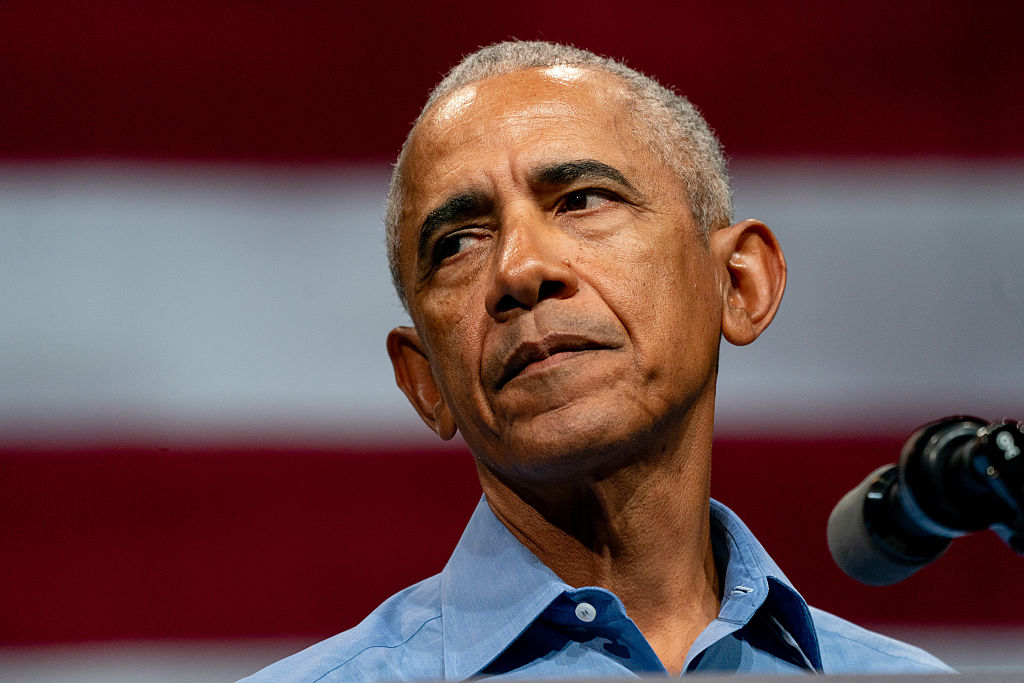
Barack Obama speaks during a 2025 campaign event for then–gubernatorial candidate for Virginia, Abigail Spanberger.

“Your disappointment is duly noted. I’ll try to be less of an idiot next week!” wrote Barack Obama to a constituent lamenting his timidity during the ACA public option fight. (Stefani Reynolds / Bloomberg via Getty Images)


As Democrats debate how and whether to use power if they regain control of Congress and the White House, former President Barack Obama has lambasted his party for failing to more aggressively challenge or circumvent obstructions to enacting their campaign promises.

“There’s been some unwillingness on the part of Democrats in the past to break down some of the institutional barriers for us getting stuff done, just because, well, it’s always been done that way,” he lamented to a YouTube host earlier this year.

Obama said he was frustrated during his presidency with Senate filibuster rules, which require sixty votes to pass most legislation. He suggested it was a mistake for Democrats to preserve the filibuster “when it blocks us from making government effective,” arguing that it “makes people feel like government is corrupt.”

However, amid Obama’s media tour unveiling his new $850 million presidential centerdocuments obtained by Zeteo and the Lever through an open records request show Obama as president scoffing at demands that he more forcefully navigate those same barriers on health care policy, when he and his party controlled the White House and large majorities in Congress.

The documents also show Obama’s staff cheering him on after he rebuffed a supporter who was disappointed by the president’s surrender on his promise to enact a public health insurance option — a proposal that conservative Democrats continue to tout today as an alternative to Medicare for All.

“Your Disappointment Is Duly Noted”

In 2010, Obama received a letter from Temple University law professor David Sonenshein, a supporter who accused the president of “mishandling the legislative process,” and being “outmaneuvered” by “evil and sleazy Republicans.”

Obama responded with an extended defense of his record — as well as a parliamentary excuse for why he would not try to attach a public health insurance option to Democrats’ Affordable Care Act, which he signed into law weeks later.

“I read your letter with interest,” Obama wrote in his reply. “I won’t try to respond point by point, although factually your assessment of how the Senate operates isn’t quite accurate (for example, I could not get the public option through reconciliation).”

At the time, some Senate Democrats were pressing to avoid the filibuster and use the so-called reconciliation process, which they argued would allow them to create a public health insurance option with just fifty-one votes, in a Senate that had fifty-nine Democrats.

“There is a history of using reconciliation for significant pieces of health care legislation,” wrote Sen. Michael Bennet (D-Colo.), who was calling for a reconciliation vote on a public option in the same week the White House received Sonenshein’s letter.

Weeks earlier, Obama’s chief of staff, Rahm Emanuel, had berated progressive groups as “f–king retarded” for proposing to pressure congressional Democrats to support a more robust health care bill.

CNN reported at the time that Senate Democrats “could implement a legislative option known as reconciliation, which would require only 51 votes” to enact a public option, but that “Republicans warn against such a move as shortsighted legislative warfare that would sow deep and long-lasting division.”

Obama ultimately dropped his demand for the public option he had promised during his 2008 campaign, and the Democratic-controlled Senate never held a reconciliation vote on the initiative. Democrats in Congress did, however, use reconciliation to pass a second health care bill to make fixes to their Affordable Care Act.

In his response to Sonenshein, Obama defended his broader record: “I will say that a) having saved the country from another Great Depression; b) passing the largest investments in education, research and development, green technology, and infrastructure in a generation; c) passing progressive legislation on hate crimes, equal pay, mortgage fraud, credit card abuses, national service; d) reversing Bush administration setbacks in environmental protection and passing the first national auto mileage standards; e) and being on the verge of passing a bill that gives 31 million people insurance and represents the toughest restrictions on the insurance industry in history — all while executing a drawdown from Iraq on schedule — isn’t bad for one year.”

Obama concluded: “Still, your disappointment is duly noted. I’ll try to be less of an idiot next week!”

“Everyone Read This”

As president, Obama made it a practice to read ten letters from constituents each day in an effort to “resist the bubble,” as he put it. His White House posted some of those letters and responses online, but this exchange was not among them. It was only released nearly four years after a request under the Freedom of Information Act.

Included in the government’s response were emails showing Obama officials’ enthusiastic response to the president’s defiant letter.

“Everyone read this,” wrote speechwriter Adam Frankel.

“This is awesome,” wrote another speechwriter, current Pod Save America cohost Jon Favreau, as he forwarded Obama’s response to David Axelrod, who was a White House senior adviser.

When reached for comment, Sonenshein, now a professor emeritus at Temple University School of Law, said he thought Obama’s response to his letter was somewhat “defensive” and “kind of missed the point.” Still, he was impressed that the president replied personally and didn’t take himself “100 percent seriously.”

Sonenshein has Obama’s letter framed and displayed on his mantle at home. The response didn’t make him rethink the money he donated to the 2008 Obama campaign. “I supported him the next time out with even more money,” Sonenshein said, referring to Obama’s 2012 reelection race.

He praised Obama for parts of his record, such as overseeing the country’s economic rebound after the global financial crisis, but also believes the administration’s failure to prosecute Wall Street executives contributed to the political rise of Donald Trump.

“In retrospect, I think he made Trump possible by prosecuting nobody out of that,” Sonenshein said. “I think that directly led to Trump. I absolutely believe that.”

He added that his disappointment in Obama’s presidency has grown over time, particularly regarding judicial appointments. In his letter to Obama, Sonenshein repeatedly cited the president’s failure to prioritize rapid nominations and confirmations, writing that the president “could have changed the face of American justice, at least in the federal courts” early in his term.

He noted that Joe Biden appointed judges at a faster rate during his presidency, despite a narrower Senate majority, and “left Trump with very few vacancies.”

“It’s sad,” Sonenshein said, reflecting back on Obama’s time in office. “I just think of what might have been.”

Obama’s new presidential center, which will open later this month, has received at least $1 million from the health insurer Health Care Service Corporation, which is part of Blue Cross Blue Shield.