Workers Are Dying in the Heat in India

South Asia is witnessing scorching heat waves, with temperatures in Bangladesh, Pakistan, and India regularly surpassing 110 degrees Fahrenheit. The heat is killing an unprecedented number of workers who have no choice but to work under the blazing sun. 
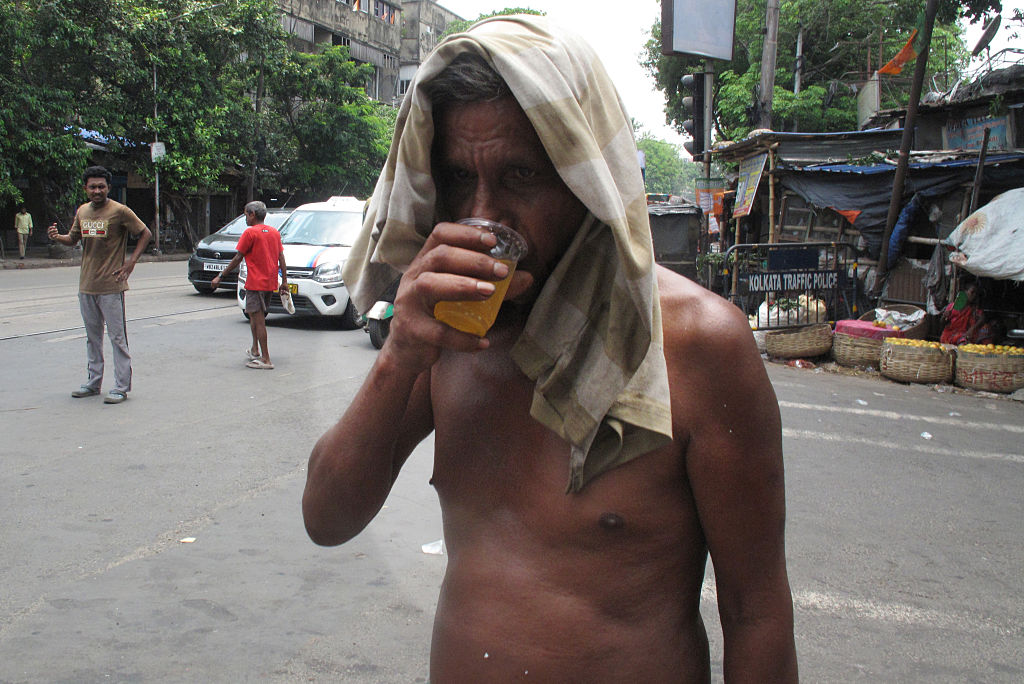
People cool off with a glass of cold water by the roadside amid a severe heat wave in Kolkata, India, on June 8, 2026.

Scorching temperatures are blazing all across India and the rest of South Asia — and workers without adequate heat protections from their governments are dying because of it. (Rupak De Chowdhuri / NurPhoto)


Haryana, India — On April 26, under a blazing sky in Haryana’s grain market, Rajendra Paswan, fifty, a migrant laborer from Bihar, collapsed while lifting sacks of grain. Hundreds of laborers watched as the father from Bihar died far from home. Paswan’s death is India’s first case of a workers’ death in a heat wave in 2026.

“There was no shaded shelter to rest beneath, no emergency medical team nearby, and not even clean drinking water for laborers working through temperatures crossing 45 degrees Celsius,” says Choppan Kumar, a forty-two-year-old worker who has joined protests against heat deaths in India.

Like millions of India’s informal workers, Paswan kept working because missing a day’s wage meant his family would go hungry. India’s Haryana state is now witnessing a severe early season heat wave. Across South Asia, governments have issued emergency alerts, closed schools, and issued public advisories in response to the rising temperatures. In Bangladesh, the temperatures reached 37 degrees Celsius (98.6 Fahrenheit), schools demanded the government cancel classes or close them before noon.

An orange alert has been announced by the India Meteorological Department (IMD), warning that high temperatures and humidity are raising health concerns, especially for those who work outside. As temperatures in Sindh, Punjab, and Balochistan surpassed seasonal averages, Pakistani weather authorities too issued heat wave advisories.

However, experts believe that these alerts essentially misinterpret the essence of the situation. “Amid intense heat waves, the laborers remain exposed as climate policy is treated as a weather emergency rather than a persistent structural risk,” Anjal Prakash, the former research director at the Bharti Institute of Public Policy, told me.

He says vulnerable workers in South Asia continue to be exposed as informal sectors do not incorporate cooling measures, such as shade, water points, and midday breaks, into labor standards. “South Asian nations lack legally binding heat protection regulations for outdoor workers,” he said.

No Tracking to Identify Heat Wave Deaths

The exact number of heat wave deaths is far higher than official statistics throughout South Asia capture, due to inadequate public health monitoring systems and inadequate tracking of heat-related mortality. Instead of naming heat as the primary cause of death, several nations in the region such as Bangladesh, India, and Pakistan frequently report deaths under categories including cardiac arrest, dehydration, kidney failure, or respiratory issues.

There are massive gaps in heat wave surveillance due to a lack of national registries, unreliable hospital reporting, poor infrastructure for rural health care, and lack of cooperation between the health and meteorological departments. Many deaths are never officially reported as heat deaths, and death cases go unreported in several regions where poor people don’t have access to health care.

According to a report of the World Meteorological Organization, 2000 to 2019 saw 489,000 heat-related deaths annually, with 36 percent in Europe and 45 percent in Asia. The official diagnosis and reporting of heat-related cases and fatalities is underreported globally.

India witnessed a massive number of heat wave fatalities, with 24,223 reported heat wave deaths between 1992 and 2015, according to official government estimates published by the Energy and Resources Institute. From 2015 to 2025, India alone reported 3,815 heat wave deaths related to the rising human cost of excessive temperatures brought on by climate change.

Pakistan witnessed devastating heat waves in recent years that killed 2,990 people in multiple reported incidents, mostly in the southern provinces of Sindh and Karachi. In 2015, Pakistan reported 1,200 heat wave deaths in Karachi alone when temperatures exceeded 49 degrees Celsius. Extreme heat is becoming more fatal in Pakistan due to climate change, extended power outages, rising urbanization, and a lack of heat protection for outdoor workers, according to scientists and public health professionals.

Both India and Pakistan have made investments in Heat Action Plans (HAPs), aimed to prevent mortality caused by heat waves. But few suggestions in these action plans have been implemented.

“South Asia requires epidemiological techniques to estimate excess mortality, improved cause of death certification, and [incorporation of] heat attribution into regular surveillance,” Prakash told me.

In recent years, Bangladesh reported one of its longest and hottest heat waves ever, with temperatures in numerous regions crossing to 43 degrees Celsius. At least fifteen people died from heatstroke in 2024, according to health officials, which is the nation’s first officially recorded heat wave death toll since systematic monitoring started.

The Directorate General of Health Services (DGHS) in Bangladesh recognized that the number was probably underestimated due to the late commencement of heatstroke surveillance and the incomplete inclusion of data from private institutions.

South Asian nations have poor tracking monitoring to identify heatstroke death cases. Anjal Prakash added that South Asia recorded 209,537 deaths due to severe temperatures in 2021, but India’s official death toll for the 2022 heat wave was only about ninety across India and Pakistan.

Over one hundred died during a heat wave in 2024, but there were also 40,000 suspected cases of heatstroke. Outdoor workers, casual laborers, and the impoverished who lack access to health care and cooling infrastructure are among the groups most severely undercounted and affected.

No Government Protections

As per data from the International Labour Organization, nearly 86.6 percent of workers in South Asia are employed without formal contracts, social insurance, or legal protection. Millions of daily wage workers who work in construction sites and agriculture fields and as street vendors make up the region’s enormous informal economy.

Anamika Barua, a South Asia–based professor and an expert on climate change and water security, told me that outdoor laborers are among the worst affected, because their livelihoods depend on continuous physical work under direct exposure to extreme heat, often without adequate shade, hydration, cooling facilities, or social protection.

Over the last few years, India’s formal sector has also been bearing the brunt due to intense heat waves. Last year, in Uttar Pradesh, thirty-three polling staff members died in a single day during elections. The chief electoral officer of India’s northern state, Navdeep Rinwa, announced monetary compensation of 1.5 million rupees for the families of the deceased. On April 26, two teachers died in India’s Odisha state while carrying out surveys.

While Indian authorities compensate people associated with the formal sector, no compensation is being given to the laborers when they die.

“They are being compelled to continue work despite serious health concerns and in the absence of legislative assurances for paid rest intervals, heat-safe working conditions, or income compensation during extreme weather events,” says Barua.

She stressed that the poorest communities are most at risk even though they contribute the least to global emissions. As a result, policies for adaptation must go beyond infrastructure to incorporate social protection, labor fairness, and climate-sensitive workplace safety. Policies must include income support programs with enforceable heat adaptation laws rather than relying only on short-term advisories.

Emergency Alerts Not Enough

In South Asia, heat weaves already claim more than 200,000 lives annually. According to a recent study, as temperature rises, the death toll might exceed 400,000 by 2045. India is at high risk.

The study further reveals that over 200,000 deaths are currently attributed to severe temperatures, and this figure may nearly quadruple over the next twenty years.

With deaths increasing and governments lacking strategies to protect laborers from dying, vulnerable workers across South Asia are demanding their governments provide heat wave protections.

Ashok Kumar, forty-two, a migrant worker from India’s Bihar state, has been running a barber shop on a footpath with no roof in India’s national capital, New Delhi, where temperatures exceed to 46 degrees Celsius (114.8 degrees Fahrenheit). With no shaded resting area, Kumar spends nine hours a day in a scorching heat to support his family.

“Where shall I go? I have to feed my family. The government cannot install air conditioning at the roadside for us. We are dying under the blazing sun. We have no options. If we stop work, our families will die hungry,” Kumar told me.

Migrant laborer Ashok Kumar, forty-two, runs a barber shop in India’s Zakir Nagar where temperatures are rising each day.
Migrant laborer Ashok Kumar, forty-two, runs a barber shop in India’s Zakir Nagar where temperatures are rising each day. (Mohsin Mushtaq)

While governments issue emergency alerts aimed to prevent heat wave deaths, the economic instability faced by laborers like Ashok Kumar means they must leave their homes.

“We are bearing intense heat. When people stay inside their homes, it kills our livelihood,” Kumar said.

In India, 49 percent of street vendors lost more than 40 percent of their daily income during extreme heat events, according to a Greenpeace India survey, and a sizable percentage did not have access to any cooling facilities close to their workplaces.

Daily wage laborers are raising similar concerns in Pakistan. Shabaz Khan, forty, an auto driver from Karachi, has stopped driving as the heat has impacted his health.

“How long shall I sit idle at home? I have no option but to bear the intensity of the heat and earn for my family. Who can work under 46 degrees Celsius?” he said.

Hospitals across South Asia are witnessing a massive influx as patients complain of heat-related ailments, dizziness, and high blood pressure. Experts warn that the number of cases will increase in the region now that they are entering summer.

“We are checking hundreds of heatstroke patients everyday. The flow of patients is unexpected,” says Dr Waqas Khan at Jinnah Hospital Karachi Pakistan.

Why Is the Sun Blazing in South Asia?

As global temperatures continue to rise as a result of greenhouse gas emissions from fossil fuels, climate change is the primary cause of the hottest and most intense heat waves in South Asia.

In countries like Bangladesh, Pakistan, and India, what were earlier thought to be uncommon occurrences are quickly turning into seasonal reality. The World Meteorological Organization reports that South Asia had some of the highest temperatures ever in 2025 and 2026, with climate change boosting the frequency and intensity of fatal heat waves.

According to a recent NASA Earth Observatory assessment, rapid warming and excessive humidity are making South Asia one of the world’s most heat-vulnerable regions, posing a threat to millions of people’s lives.

While knowing risk factors, many migrant laborers are unable to do much more than cover their heads with wet towels.

“We saw how the laborer Paswan collapsed and died in India’s Nuh grain market. I can’t forget. I am working in the same market and at the same temperature. Covering my head with a wet towel gives relief. But no guarantee of life,” says Narayan Kumar, forty, a migrant worker. “All I want is for laborers to be compensated. Don’t leave them to God’s mercy.”