Rodrigo Duterte’s Trial Is a Blow Against Impunity

The International Criminal Court has scheduled the trial of former Philippines president Rodrigo Duterte for November this year. It’s an overdue reckoning for the mass killings under his rule that should worry other leaders guilty of major atrocities.
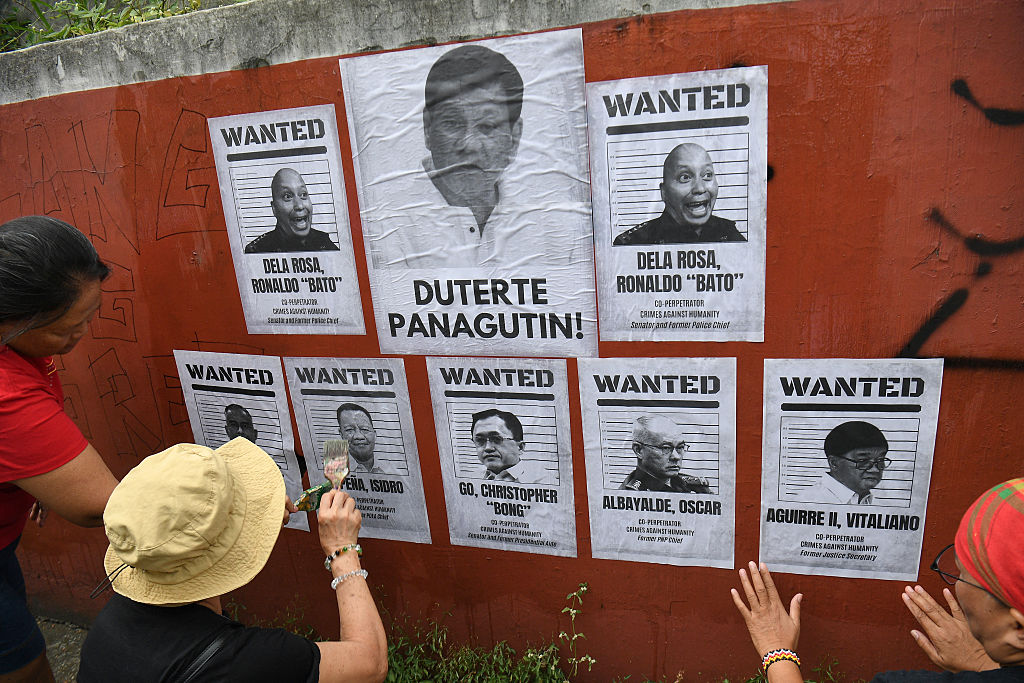
Relatives of drug suspects, who were allegedly illegally killed under orders from former Philippine president Rodrigo Duterte, post portraits of Duterte and his alleged coperpetrators during a rally along a street in Manila on March 11, 2026.

In the ongoing swirl of global calamities, almost every news report these days seems like another demoralizing atrocity. The arrest and impending trial of Rodrigo Duterte, former president of the Philippines, runs counter to such fatalism. (Ted Aljibe / AFP)


In the ongoing swirl of global calamities — climate breakdown, the collapse of democratic norms, spiraling inequality, the normalization of state terror at home and abroad — almost every news report these days seems like another demoralizing atrocity.

However, the arrest of Rodrigo Duterte, former president of the Philippines, and his subsequent transfer to The Hague to face criminal charges runs counter to such fatalism. While Duterte’s impending trial may not resolve the structural wounds of militarized violence or imperial domination, it does mark a rupture in the logic of elite impunity.

On March 11, 2025, Duterte touched down at Manila’s Ninoy Aquino International Airport after a flight from Hong Kong to find more than three hundred officers waiting for him. Under “Operation Pursuit,” Filipino police and Interpol executed an International Criminal Court (ICC) warrant tying him to crimes against humanity committed during his self-proclaimed “war on drugs” and quickly put him on a plane to the Netherlands.

The ICC judges have now confirmed that Duterte will stand trial in November 2026. We should be happy that the once untouchable strongman has been in jail for over a year and will soon be held to account for his record in power.

Against Impunity

While he is not the first Filipino ex-president to have been arrested, Duterte is in a much more serious situation than Emilio Aguinaldo and Jose P. Laurel in 1945, Joseph Estrada in 2001, and Gloria Macapagal Arroyo in 2011, all of whom were held in relation to domestic criminal cases. Duterte faces international charges and now has the infamous distinction of being the first Asian former head of state to have been delivered to the ICC.

Duterte’s arrest and transfer to international custody is more than a procedural novelty — it signals a potential sea change in human rights justice. As president from 2016 to 2022, he declared a war on drugs based on the premise that the apparatus of the state could act with impunity so long as propaganda framed its actions as upholding “order.”

Some six thousand extrajudicial killings of alleged drug users and petty criminals as well as poor and dispossessed people in general were not anomalies but systematic. Now the machinery of transnational justice is forcing the regime of terror to stop and face a judicial process.

There is no cause for triumphalism. The trial ahead will be long, contested, and politicized. Duterte’s defenders claim that he is a victim of “state kidnapping” and point to his government’s withdrawal of the Philippines from the Rome Statute in 2019 as a supposed bar to ICC jurisdiction.

Bigger questions also remain. Will the proceedings truly address the ubiquity of Filipino state violence? Will the country’s institutions prove capable of reforming themselves? Will the transnational process simply substitute one spectacle for another? Will this turn out to be yet another case elite Filipino clans feuding with each rather than a true quest for justice?

Drawing a Line

Nevertheless, there is reason to allow ourselves a measure of hope. For the victims and their families, this is recognition not just of their suffering but of their claim that those who unleashed the violence can be held to account. When the children of the urban poor, shot in alleyways under the guise of “anti-drug operations,” see the operator at the top hauled before a tribunal, it conveys a message that their lives and their grief are not invisible.

Moreover, when a former president cannot rely on the protection of office or networks of power to keep him above the law, it indicates that the game has changed. While authoritarianism will adapt and try to claw back its impunity, this precedent matters.

Both domestically and internationally, the arrest also reinforces the idea that legal norms have some bite. The ICC is imperfect (painfully slow, arguably politicized, and seemingly selective), but it stands as one of the few remaining institutions that insists even heads of state must answer for their crimes — an important line to be drawn in an age when the influence of international law is declining.

For the Philippine state, this process forces a confrontation with its own legacy of how institutions permitted mass killing, how civil society and democratic safeguards were eroded, and how reform must proceed from here.

A Global Crisis

We should not see the arrest as a single judicial fix that induces complacency. The necropolitical culture that enabled the killings, based on vigilante logic, police impunity, and the criminalization of poverty, remains intact. Without parallel reform of the security forces, the judiciary, and the press, along with the strengthening of social protections, the next strongman may emerge, offering a different narrative to justify similar violence.

There is also a backlash against the upcoming trial. Duterte’s base remains politically potent, and it frames his arrest as a case of foreign interference, a betrayal of sovereignty, and a neocolonial maneuver. It falls to progressive movements not only to support the trial but to counter any nationalist backlash by rooting accountability in democratic self-determination.

Finally, this case reminds us that our struggles are global. From Duterte’s “war on drugs” in the Philippines to elite impunity in Africa and Latin America, from Russian war crimes in Ukraine to Israeli genocide in Gaza and Donald Trump’s record of murdering sailors, kidnapping heads of state, starving Cuba, and ordering the illegal bombing of Iran, we face a global crisis of accountability. When one dictator stands before a court, we must hope that it will lead to a larger assault on authoritarian impunity.