American Communists Did a Lot Right and a Lot Wrong

Members of the Communist Party USA in its heyday were much more complicated than the stereotypes of them, shaped so strongly by rabid anti-communism, in our country’s imagination. Today’s socialists should closely examine their track record.
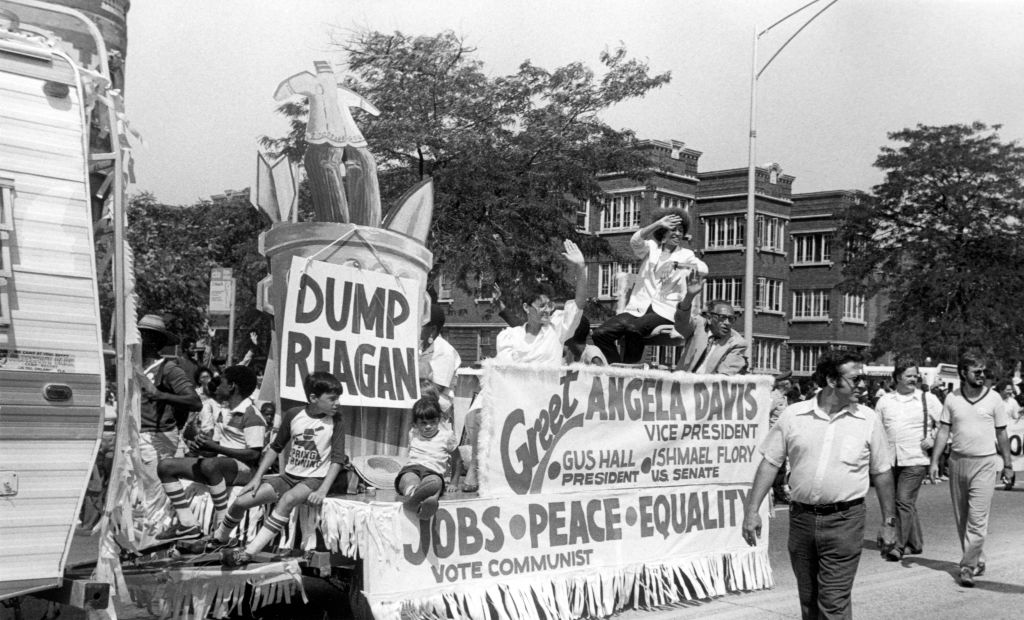
Communist Party nominee for vice president Angela Davis waves to the crowd while riding in a float during the annual Bud Billiken parade, sponsored by the Chicago Defender, Chicago, Illinois, 1984. Activist and Senate candidate Ishmael Flory is visible on the right.

American Communists made vital contributions to a wide range of progressive social movements. Today’s leftists can learn much from their successes and failures. (Abbott Sengstacke Family Papers / Robert Abbott Sengstacke / Getty Images)


I was a small child while the Eastern Bloc was collapsing. During this time, my parents and I would vacation in Upstate New York at a retreat called Arrow Park. The austere resort was known for being owned by a Communist Party–affiliated fraternal organization, with an ostensible bust of Walt Whitman at the entrance that looked more like Karl Marx than the American poet.

At the lake, I enjoyed swimming, boat rides, and a limited menu. While I was oblivious to the crisis of “real existing socialism” on the other side of the world, I was not immune to the anti-communism in US culture. When I saw a large portrait of Abraham Lincoln in a main building, I asked my parents, “If they’re Communists, why do they have a picture of Lincoln?”

My mother succinctly replied, “Lincoln freed the slaves.”

Her response taught me that US Communists were more complicated than the stereotypes of them in our country’s imagination. The new book Red Lives: Our Years in the US Communist Party (1950–2000) gives a deeper understanding to my unchanged childhood assessment of a group of people that are much more nuanced than their enemies would want to admit.

This edition of Red Lives is the first anthology of a planned third-part series. This book includes sixteen memories from the post–World War II experience of, nearly universally, former Communist Party members who still believe in socialism or did until their passing.

While a retrospective of the second half of the twentieth century, the book offers real lessons for today, especially for young socialists for whom Soviet communism is at most a distant memory or never existed in their lifetimes.

The socialist authors offer deep reflections on what they did that worked well, like building progressive and popular movements, as well as what they lacked, like healthy democratic practices in both the Communist Party USA (CPUSA) and its sister parties abroad.

The book is a welcome addition to the canon of left-wing self-criticism. Specifically, it shows that there were many flaws and self-inflicted wounds due to party leadership alone, and that acknowledging these problems is not “anti-communism” but rather helps leftists learn from the past to build a stronger and more democratic movement for socialism today.

The Red Contributors

The authors are largely boomers and from a mix of backgrounds, including those who came from families in the party (“red diaper babies”) and others who found the CPUSA through mass work. A book editor and contributor, Jay Schaffner, reflects that many of the authors were coming with a history from earlier Communists and their peers: “My political view of the world is a product of two generations: my own, the political generation of the 1960s, and that of my immigrant parents, who were radicalized in the 1920s, 1930s, and 1940s.”

Unlike other books by former Communists, all the contributors remained anti-capitalists throughout their political lives. Some have joined the Democratic Socialists of America (DSA), and even more were part of the 1991 split from CPUSA that became Committees of Correspondence for Democracy and Socialism (CCDS). There remains a contingent of “dual carders,” socialists who are members of both organizations, today.

Personally, I know a quarter of the writers from decades of movement work. One is my DSA chapter mate; another belongs to my caucus, Socialist Majority, in DSA; a third has served as a mentor to me in the labor movement and sent me numerous historic and out-of-print books and pamphlets about socialism; and the last was my coworker at Local 1199SEIU, the country’s largest hospital workers’ local that plays a prominent role in the book.

What makes all the book’s stories educational for today is that the authors were grassroots members and cadre of the CPUSA who offer firsthand accounts of what the party did very well to advance labor, racial justice, and electoral alternatives, as well as where it came short on internal democracy here and abroad.

It was also a party that echoed the Soviet Union’s position on matters until the end. The party’s pro-Soviet orientation was influenced heavily by the country’s funding of the CPUSA. Chris Townsend, a trade unionist with a strong commitment to rank-and-file militancy (and my patron for long-lost socialist literature), reflected that while he had no problem with the party taking money from the Soviet Union from an ethical standpoint, in the long run, it was bad organizing. His union background taught him that not solely relying on members for funding weakened the leadership’s need to build consensus with projects that could keep people in the party, because the lost dues would be supplemented by other income from Moscow.

Attitudes Toward the USSR and “Real Existing Socialism”

Like many in the old DSA before Bernie Sanders’s first presidential campaign in 2016, one reason I joined the organization as a teenager was because I agreed with its anti-Stalinist viewpoint — one that the book demonstrates was shared by contributors even as party members. In addition, I had and still do share concerns about the lack of political freedom in the USSR and other Leninist-led states. Red Lives includes others who reached a similar conclusion.

Schaffner, who worked for the party for a time doing international delegations to the USSR and its allies, somewhat ironically grew disillusioned with what was called “real existing socialism” (states governed by Marxist-Leninist parties) through these trips. He described his shift that “developed on ‘real existing socialism’ helped [his] own development, and it brought [him] into conflict with the top national leadership of the party.”

While I shared an analysis with older DSAers of the problems of the Soviet Union and Communist party–run countries, I differed with them on my view of the US party, especially its members. Perhaps because of generational shifts and life experiences, I tended to view at least the rank-and-file party members as nearly universally well-meaning. This sentiment is shared by Leon Wofsy, a scientist who left the party in 1956 and famously challenged then Governor Ronald Reagan on TV in 1969. His family were in the party: “I remember many gentle and idealistic folk, now gone, whose daily lives were selflessly committed to a decent and humane future of full equality. Among them were my parents. I remember with pride.”

Sectarianism and Self-Isolation 

Red Lives makes clear the sectarianism I have occasionally seen in DSA was certainly not unique to democratic socialists and could be found as well in the CPUSA in different forms. Both organizations’ histories include coalition politics and self-isolation, although the latter to a greater degree by the Communists.

In the book, the former party members offer a mixture of reflections of inspirational coalition building — especially in civil rights, racial justice, and labor organizing — that could often be matched with sectarianism toward other leftists.

The contributors mainly focus on their experiences in the party and only occasionally comment on other socialists. But when they do, it is often about hostility propagated by the party. Which the other leftist groups happily directed right back.

Peter Hodes, whose family went into self-exile in China in the 1950s due to McCarthyite blacklists, summed up his parents’ attitudes toward other self-identified socialists:

There were plenty of other Left organizations, but they were all on the wrong path! Either they were “Trots” (followers of Leon Trotsky) or “ultra-leftists” or “reformists” or “social democrats.” These were practically curse words in my household.

Some of the socialist leaders mentioned by other contributors include Socialist Party leader and perennial presidential candidate Norman Thomas and future DSA chair Michael Harrington. Thomas gets a more negative appraisal in the book because of his efforts against the Communist Party (which treated the Socialists similarly). Harrington is praised twice, despite his shared anti-Stalinism, as an effective speaker and public intellectual.

Geoffrey Jacques, a Michigan-born activist who would later go on to work for the party and Local 1199 like others in the book, attended the founding DSA convention and found its lack of diversity a turnoff. Jacques also saw the New American Movement, the organization of Dorothy Healey in the late 1970s to early 1980s, a California party leader until she left over the party’s actions in Prague in 1956, as unattractive. “Whatever else we as a group were searching for, it did not include becoming African-American tokens in an otherwise all white left-wing organization.” This attitude came not from sectarianism but a genuine commitment that the party and its members held to multiracial organizing, especially for black Americans.

The Party and Racial Justice

Advancing racial justice, with special attention to the plight of black Americans, is a long-standing and central plank of the CPUSA’s domestic program and its international solidarity work. Several accounts in Red Livesshow how people became Communists because of the party’s fight for racial equality. Many members participated in other well-known mass organizations that focused on black rights. While the party members bravely fought in the South, their struggle against racism was across the country. Frank Emspak, who was also active in labor and peace movements, recalled that the party “was a leader in the fight against racism, the defining issue in Boston at the time,” where he lived.

But the leadership could go astray. David Cohen, another Massachusetts-based trade unionist, recalled how party heads pushed party branches and members to move before they were ready and could best intervene for racial justice. Cohen, then a leader in his regional United Electrical Workers (UE) union, remembered being directed to get the local to back a resolution to defend a black minister being legally prosecuted under dubious circumstances over his housing rights activism.

At first, Cohen succumbed to pressure to get a quick vote on the resolution, which failed. But he received pushback from a member of the ultraright John Birch Society, who said Cohen shouldn’t use the union for his own agenda. While he could have easily dismissed the message because of the source, he wisely recognized the truth the Bircher was expressing: the union members weren’t bought in. At that point, it was just his agenda, not theirs.

Over time, Cohen carried out political education to move the UE members and won a genuine majority to back the resolution. He made it a popular issue. This led to genuine support — and an example of how the CPUSA’s labor work was best when it fostered democratic unions, not top-down leadership.

The Party and Labor

Cohen’s story highlights how the greatest success of the party in the workers’ movement chronicled in the book was when the CPUSA built broadly among union members and had a real democratizing impact on organized labor. The contributors share numerous stories about fighting and reforming unions that were corrupt, had sweetheart deals with management, or simply had little desire to fight the boss.

Despite a reputation of adhering closely to party discipline, the Communists sometimes were given the authority by party leadership to articulate their own views. When Local 1199, then an independent union, debated affiliating with two international unions, party members in the local were allowed to argue their own positions.

Unfortunately, this example was the exception more than the rule as the second half of the twentieth century crept forward. Increasingly, the book shows members trying to modernize the party’s strategies in union organizing to be met with archaic and outdated ideas of the working class.

Hodes noted that for many years, the party thought it best to put cadre in manufacturing and larger industries rather than trying to unionize smaller and service workplaces. This strategy made less sense as industries such as steel, automaking, and electrical began to see massive job losses to globalization and technological change.

But it took years for the party members to convince leadership to expand what it considered key industries. Eventually, health care did become a target, beyond Local 1199, and party members across the country took positions in hospitals and other medical providers. This example of openness to political and strategic shifts, however, was missing in other key areas, eventually pushing members out.

For example, the top party brass would not move on from decades-old beefs with other leftists in organized labor. Jim Williams, born to a poor Socialist Party–voting Kentucky family, was an editor of the CPUSA’s Labor Today periodical. Williams interviewed United Auto Workers (UAW) union leader Victor Reuther about the antiwar movement in labor for the magazine. Reuther and his brother, longtime UAW president Walter Reuther, had sparred with the party in the past and significantly defeated the CPUSA in the autoworkers’ union. Williams viewed such a conversation as a coup and a positive sign of rapprochement.

His hopes were dashed. Instead, party leader Gus Hall killed the piece. Williams, who had grown frustrated with such sectarian impulses, quit his post. He noted that the magazine folded anyway when Soviet subsidies ceased. One can draw a similar lesson as with Townsend’s observation that outside funding made the party leaders care less about the rank-and-file’s opinions. Similarly, Hall didn’t care if the readers of Labor Todaywould like the interview — only that its content fit in a limited, Soviet-dictated view of what is acceptable.

While Hall was unwilling to forgive liberal-left union leaders like the Reuthers for their moves against the party, he and other party leaders approached some previously anti-Communist labor leaders differently. Cohen eventually left the party partly because, to him, it totally abandoned the fight for union democracy and militancy by the 1980s. This was partly to win favor with heads of particular unions and the AFL-CIO, not the workers who many organizers had joined the party to uplift.

One instance Cohen gave for his own frustration was the party’s complete opposition to relating to the Labor Party that formed in the 1990s. He saw the CPUSA by that point as having no interest in alternatives to the Democratic Party.

The Party and Elections

The party’s electoral strategy from 1950 to 2000 was seemingly contradictory, balancing running their own candidates while trying to ensure that Democrats defeated their GOP opponents.

While not consistently and everywhere, during these decades, especially before the end of the Soviet bloc, the party ran its own candidates, from the president on down. While the party did not run with an expectation of winning, their contestation was to demonstrate that they were a legitimate part of US civil society. And people obliged. Even former CIA director John Brennan admitted to voting for Hall’s 1976 presidential campaign to express disaffection with the current state of affairs.

Sometimes the local office campaigns would net a significantly higher vote than their presidential counterpart. Schaffner and a few others, for example, ran for the University of Illinois Board of Trustees and received four to five times as many votes, including endorsements and cross-endorsements, as the party’s presidential ticket. While they did not win the university posts, they helped mainstream the party as much as possible and tackle undemocratic electioneering rules.

Ultimately, the party’s electoral strategy bore little other fruit. Schaffner provided this analysis about how the party’s electoral candidates and political campaigns put its own members in a bind:

But I think on the part of the national leadership of the Party, the ballot campaign also reflected a combination of leftism and syndicalism (an avoidance of participation in the electoral process as it really existed). It was a go-it-aloneism that would only manifest itself more sharply in later years. And it pitted the Party as an organization against its own members and the mass work they were doing as communists in non-Communist organizations and coalitions. . . .  It also separated and isolated the party and Party members from what was taking place within the Democratic Party — the increase in the number of elected African Americans to public office . . . and the increased influence of the peace movement, which in 1972 was able to capture the Democratic Party nomination.

Williams, on the other hand, simply said the party’s electoral work “went nowhere.”

An example of this was the party’s dissonance around the Jesse Jackson presidential campaigns. Jackson, a national figure from the civil rights movement, campaigned for the Democratic presidential nomination in 1984 and 1988. In the 1984 general election, the party ran Gus Hall and famed educator and activist Angela Davis for president and vice president but declined to run anyone again four years later. While the book contains many instances of local party members trying to support Jackon, including getting their unions to back him, they did this without party permission (or punishment).

This did not a coherent politics make. The lack of enthusiasm or ability to develop a strategy to relate to Jackson and his Rainbow Coalition helped plant the seeds for the 1991 split that formed CCDS.

Gus Hall and His Discontents

The embodiment of the impasse that broke the party into two was Gus Hall. Hall, the party’s general secretary from 1959 until his death in 2000, receives nearly universal disdain in Red Lives. His stewardship of the party is identified as both sectarian and authoritarian, worsening as he consolidated power in the last twenty-five years of the twentieth century, including abolishing the chairman position held by beloved party leader Henry Winston after his death in 1986.

Hall’s narcissism was reflected in his perennial presidential campaigns that some former party members felt were a huge waste of time and resources. Judy Atkins, a Bay State union activist, said some party cadre privately ridiculed his notion that they were “speaking to millions” by failing to even get him on the ballot despite being forced to petition in many states.

Atkins, who left the party to join CCDS, reflected that had she not followed the ban on reading Dorothy Healey’s memoir Dorothy Healey Remembers (prohibited because of its criticisms of the party by a prominent former party leader), she could have been forewarned that the fight with Hall to change the party would be a losing one, and party members were being fed lies. Several entries in the book share the same heartbreaking story of the final convention before the split in Cleveland where the CPUSA leadership under Hall called the city’s police on dissident party members.

I read Healey’s memoir nearly twenty years ago, and it remains one of my favorite books. It echoes the stories in Red Lives: that the party members did real work for social justice under terrible repression by state and capital, but they suffered also at the hands of a deeply flawed and undemocratic party structure that could foster its own witch hunts without Joseph McCarthy.

Democracy Beats Centralism

The key element of the party’s democracy deficit was how it used democratic centralism. Schaffner provides a description of the basic concept of democratic centralism:

Democratic centralism was supposed to mean the fullest discussion in the ranks of the membership, with the elected leadership at all levels then making decisions based on such discussion, including full debate of positions and alternatives, which would be binding on all members.

But he and others found the party did not always live up to this ideal feedback loop. Sometimes it did, as Hodes noted. For a period, his political activities were determined by the party but through real discussions and debates. Over time, however, he felt there was too much emphasis on centralism and not democracy. Asymmetries of information favoring the top brass made it increasingly difficult for rank-and-file party members to meaningfully contribute to decision-making.

Like with the contradictions in the electoral strategy that alienated party members in that field of struggle, Communist trade unionists found the juxtaposition of their fighting and participating in democratic unions, then battling with their intractable party leaders, to be dispiriting.

Atkins compared her union life to party strife:

UE conventions were an experience of rank-and-file democratic involvement: reports, committee work, resolutions, and plans of work. Votes were taken on everything. There were great speakers and lots of partying. In comparison, national Party meetings were ritualized and constrained.

Cohen, also in the UE, believes that building democratic unions is a critical task, because that will be a model of how a future socialist society could be run collectively, honestly, and compassionately. He now rejects a top-down party model as one of miserable failure. Frank Emspak took the need for organizational democracy one step further. The veteran unionist said that “internal democracy is key to the commitment of any political organization, especially one that demands all kinds of sacrifice.”

Putting the Movement First but Building Organization

One of the most important tasks for leftists is building a movement that can eventually overtake capitalism while making working people’s lives better in the short term. The CPUSA, especially its rank-and-file members, did impactful and genuine mass work, notably in labor and racial justice, but also peace, climate action, and much more.

And party members were able to do this for years because of their vision of a socialist world, not just a slightly better version of capitalism. This is exemplified by civil rights activist Marian Gordon:

The Party also taught the importance of being with the people in the trenches, of building a movement, and of organizing. And the difference between being present, and mobilizing, and organizing. I learned the importance of having a class approach to movements. I learned the necessity of always fighting to bring the various movements together, and teaching the concept of a united front. And the importance of having a vision, because having a vision can give one the strength to go on.

But the party was limited by its own strategy, some of it self-imposed and some from Soviet directives, such as its desire to make an anti-monopoly coalition of workers, small business owners, and small farmers. This formulation made sense in a popular front against actual fascism but not when those groups, which have numerous contradictions among themselves, are existing in an imperfect though liberal democracy.

Party leaders would turn on movements and other organizations if they threatened their power. Socialists, instead, should seek to be part of a democratic formation that is moving different trends, not just desiring to lead them. Jay Schaffner summarizes the tension outlined in this review and the solution here:

I joined the Communist Party to help build and expand the people’s movement. Over the years, the Party leadership developed a political position that counterposed the building of mass movement with the building of the Communist Party. I believe the primary catalyst for change is a broad mass people’s democratic movement, whatever form it takes, with the socialist movement being a component, perhaps agitating for more advanced positions.

I agree that the catalyst for change will be much larger than any single organization. We will need a movement and groups that are run democratically and transparently in order to win and be sustainable. In order to not make the same mistakes as the past, it is important to read books like Red Lives to see firsthand what people did to both see how we can repeat their successes but also avoid their pitfalls.