Omer Bartov: “I Don’t Believe Zionism Can Be Repaired”

Omer Bartov

Leading historian Omer Bartov has called Israel’s crimes in Gaza a genocide. In an interview, he explains that Zionist radicalization is rooted not just in recent events but also in fundamental choices made when Israel was created.
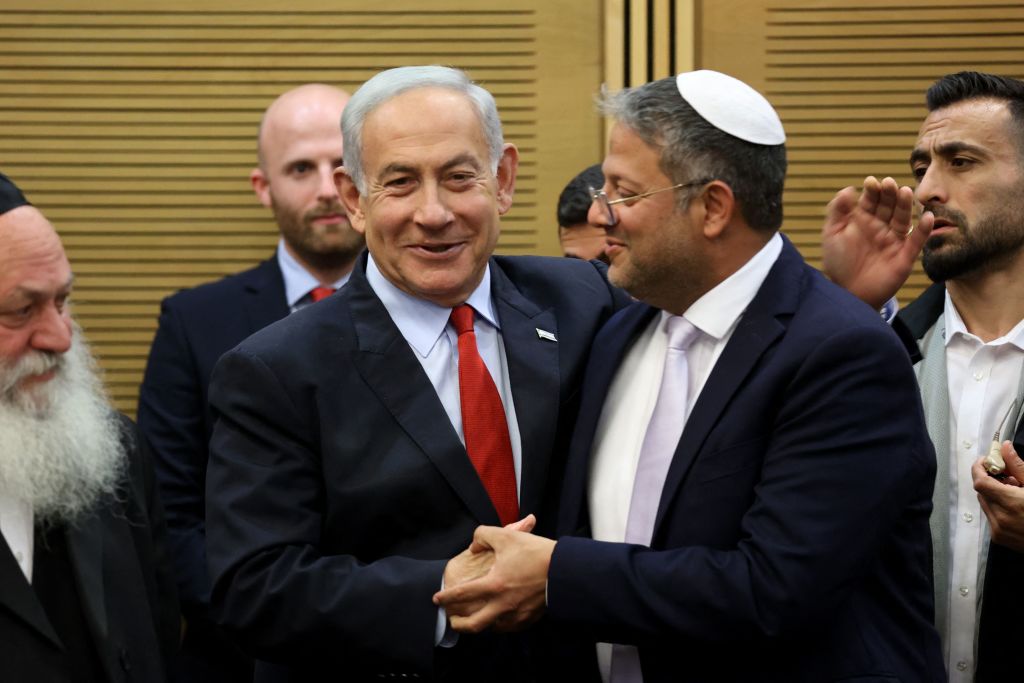
Benjamin Netanyahu greets Israeli National Security Minister Itamar Ben-Gvir, during a media briefing on May 23, 2023

Israeli Security Minister Itamar Ben-Gvir speaks in especially fanatical and genocidal terms. But, historian Omer Bartov explains, it’s only a more extreme variant of a broader radicalization of Zionism. (Gil Cohen-Magen / AFP via Getty Images)


Interview by
Elias Feroz

Omer Bartov is one of the world’s leading scholars of genocide and the Holocaust. A professor of history at Brown University, he has written extensively on nationalism, political violence, and historical memory.

In his new book, Israel: What Went Wrong?, Bartov examines the evolution of Zionism from a movement that spoke of universalist grounds for Jewish self-determination, into what he sees as an increasingly militarized, expansionist, and exclusionary state ideology. He argues that Israel’s current crisis is rooted not only in recent political developments but also in foundational choices made at the state’s creation.

In this interview with Elias Feroz for Jacobin, Bartov discusses the historical transformation of Zionism, the rise of far-right figures such as Itamar Ben-Gvir and Bezalel Smotrich, and the limits of Israel’s political opposition.


Elias Feroz

In Israel: What Went Wrong?, you describe your father as “the last Zionist” and portray Benjamin Netanyahu as “the great destroyer of Zionism as my father had understood it.” What exactly do you think has disappeared from Zionism today — and do you believe that the version your father represented can still exist politically in Israel?

Omer Bartov

I think that version is in the past, and I don’t believe Zionism can be repaired or resurrected.

I don’t want to idealize [my father’s interpretation of] it. It was a national and ethnonational movement, and, like all such movements, it contained violent elements. But it also had strong socialist components and was based on appeals to humanitarianism, human rights, and the rule of law. What it has become today is something different. First, it was transformed from a movement into the ideology of a state. It has become increasingly militaristic, expansionist, and racist. Following October 7, it has also been used to justify genocide.

Starting with the Gush Emunim movement [the ultranationalist “Bloc of the Faithful” which from the 1970s pushed for more settlements] and the settlement project in the West Bank, Zionism has gradually, over time, been taken over by a particular religious element. This has transformed not only Zionism but Judaism itself into a fanatical, messianic, racist, and Jewish-supremacist ideology that is foreign to any form of Judaism that has existed since Roman times.

This combination of Zionism as an increasingly racist and militaristic ideology with a new type of Judaism — a type that would not have been recognized by my Orthodox grandparents and could never be adopted by most Jews living outside Israel — has turned it into a completely unsupportable ideology. A state that is controlled by that kind of ideology is bound to behave the way Israel is behaving, and is, in fact, in the process of becoming a pariah state.

Ironically, some elements resemble aspects of the ideology of the Iranian state and certain Hamas ideologues. There is a strange convergence between this transformation of Zionism and forms of Islamic fundamentalism. In any case, I do not believe that an ideology that supports genocide can be repaired.

Elias Feroz

You argue that before 1948 Zionism had two faces — a liberation movement and a settler-colonial, ethnonational project — and that after the establishment of the state, the latter increasingly dominated Israeli politics. What explains that shift?

Omer Bartov

In 1948, Israel faced a choice. It had created a Jewish-majority state through war and ethnic cleansing. It then became a recognized and legitimate state within the international community. At that point, Zionism had effectively achieved its central goal: the creation of a Jewish-majority state. The next step could have been to build a state that served all its citizens equally. One expression of that would have been a constitution embodying the bill of rights promised in the Declaration of Independence. But no constitution was ever adopted. Israel also never formally defined its borders.

Like other ideologies that come to power, Zionism developed its own momentum once it became embedded in state institutions.

That was not inevitable. We saw attempts, certainly in the 1990s, both to pass constitutional laws and to have some compromise over the occupied territories, but all of those failed. And after that, certainly after the assassination of Yitzhak Rabin and after the second intifada, Zionism became increasingly racist and violent and, as we saw after October 7, also genocidal.

Elias Feroz

In your book you often call the absence of an Israeli constitution a historical mistake. What do you think would be different, if it did have a constitution?

Omer Bartov

We can’t say for sure. Countries have had constitutions that didn’t necessarily prevent them from doing bad things, both to their own citizens and to other countries.

But I think it is possible that, if Israel had a constitution in the spirit of its Declaration of Independence, it would have made it much more difficult to follow the kinds of policies that it immediately began implementing. Most importantly, it would have been difficult to maintain military rule over the remaining Palestinian citizens for twenty years, because it would have been clearly unconstitutional. And the Supreme Court, bound by such a constitution, might have found it much more difficult to justify that.

It might also have made the country more willing to find some way of restitution, or partial repatriation, of Palestinians expelled in 1948. Again, for constitutional reasons, it would have made it very difficult for the Supreme Court after 1967 to sanction the status of Jewish settlers in the West Bank, which it has effectively done. The court has been complicit in the creation of what has become apartheid in the West Bank. A constitution would also have made that much more difficult, without major changes to the constitution itself.

It would also have had implications for internal matters, such as limiting the power of the ultra-Orthodox. Israel, in many ways, already has theocratic laws — civil marriage, for example, does not exist. All of this is, of course, in the realm of the possible. Constitutions can be overturned or changed. But I think it would have been more difficult for Zionism and the state to evolve as they did.

The other element is borders. A constitution might have defined the borders of the state, which David Ben-Gurion had strongly opposed. Instead, Israel has only ever had ceasefire lines, which are accepted in practice but not real borders in a constitutional sense.

If you look at the United States, for example, laws were passed that were in clear violation of the constitution, but eventually the constitution “kicked back in.” So, it does create a legal framework that Israel has never had.

Elias Feroz

Today, when many people think about Zionism, they increasingly associate it with figures like Itamar Ben-Gvir, Bezalel Smotrich, or Benjamin Netanyahu. Recently, Ben-Gvir’s behavior toward flotilla activists — including the way he publicly treated and spoke about them — caused significant international, especially European, outrage. Yet his dehumanizing rhetoric toward Palestinians has been documented for years. What does it mean that figures like Ben-Gvir not only see themselves as representatives of Zionism but increasingly also as representatives of Judaism itself — often blurring the distinction between the two?

Omer Bartov

There has been a great deal of reporting — like Nicholas Kristof’s New York Times article — on maltreatment and even sexual violence against Palestinian prisoners, especially since October 7, and on a massive scale. But European countries said almost nothing about it. It was only when European citizens were mistreated — and Ben-Gvir was, frankly, arrogant enough to post a video of it — that they finally reacted. And even then, I don’t see much follow-up. So, this also tells you something about European responses to Israeli behavior.

What Ben-Gvir represents is exactly this dynamic. Ten years ago, he was under investigation by the Israeli security services, with cases against him, known as an extremist and a violent lawbreaker who should never hold public office. Now he is in charge of the prison system and of the police. And he is popular. It’s not just him. Maybe 30 percent of the population agrees with him openly. Others may be embarrassed by him, but they don’t strongly disagree with what is being done — especially not when it comes to [injustice toward] Palestinians. They may not like his extremism, but they accept the direction.

And what has already happened, even before October 7, is that tactics once used against Palestinians are increasingly being used against Jews inside Israel. So Jewish citizens — liberal or secular Jews — have begun to feel a little of what it means to be Palestinian in that system. And most of them have fallen in line, partly out of fear.

Elias Feroz

Do you think it would make any difference if someone else were elected instead of Netanyahu?

Omer Bartov

The opposition now say they won’t go with Arab parties, but if they don’t include them they would not be able to form a government. They don’t want to do it partly because they are racist, and partly because they are afraid of their voters who are racist as well. But they would have to, and I think eventually they would.

Elias Feroz

What difference would it make?

Omer Bartov

In terms of the occupied Palestinians, I think the changes would be, if any, very minor. In terms of Palestinian citizens of Israel, I think there might be a change. I think that a different minister of police — as it used to be called, rather than “national security,” which is Ben-Gvir’s invention — might make a difference.

Under the previous short-lived government of Naftali Bennett, there were attempts to use the police to deal with gang violence in Arab communities inside Israel, which has become very severe. That might change again. There may be some slowdown in the erosion of the rule of law and some attempt to rein in a police force that is currently out of control. They might also be slightly more responsive to external pressure, because Netanyahu is fighting for his political survival. He is putting his own interests first. Another leader, even someone from the Right like Bennett, might be more open to external pressure, because he would not be fighting for his immediate survival.

But in the long run, none of that would be enough. Israeli politics will only change with external pressure in the form of sanctions.

For me personally, a change in the government might make it possible to contemplate going there for visits again. Conversely, if Netanyahu were to win, I think many Israelis would leave the country, and I would possibly never be able to visit again, since another Netanyahu government might well spell the end of democracy and the rule of law in Israel for many years to come.

Elias Feroz

Your perspective and your views on Israel’s actions in Gaza seem to be an exception in Israeli society. It seems to be very difficult, as an Israeli, to reach the conclusions you do — especially given that Palestinian identity and history are often ignored in Israeli society, particularly the Nakba. When did you first learn about the Nakba, and when did you first engage with Palestinian society and history?

Omer Bartov

I didn’t know any Palestinians in my youth. I think it started at university, as a student. My first real encounter was as an occupying soldier. I served in the West Bank and Gaza. I would say I was uncomfortable with it, but I can’t say I fully thought it through at the time. I thought the occupation was wrong even before I went into the army. So, around 1970–71, when I was in high school, I was part of very small groups that were already against the occupation. But we were very young. There were no Palestinians involved. It was just Jewish students from secular, Ashkenazi backgrounds. My more political thinking developed later. I became involved with Peace Now in 1977–78, as one of the founding members.

At that time, it was also just a Jewish movement. There were no Palestinians involved. It was mainly about peace with Egypt. A major turning point for me was the first intifada in 1987. The idea that I would have to suppress Palestinian demonstrators as a reserve officer did not appeal to me at all. I went to the United States on a fellowship instead. But even then, direct engagement with Palestinians came much later. I would say the most intensive interactions only began around 2015. That was through a research project I organized at Brown University, where I brought together Israeli, Jewish, Palestinian, and other scholars. That was when I started to know people not only intellectually but personally — as colleagues and sometimes as friends. And that changed things significantly.

Elias Feroz

Since the announcement of a ceasefire last year, more than a thousand Palestinians in Gaza have been reported killed, and thousands injured. How does this ongoing violence affect your assessment of whether what is happening in Gaza constitutes genocide — and did the genocide end, in your view?

Omer Bartov

I concluded that genocide was occurring already in summer 2024. What has happened since the ceasefire is, as you said, that there is still ongoing violence in terms of killings. There is also ongoing violence in terms of the inhumane conditions in which people are living. We know that the Israel Defense Forces (IDF) have been moving the “yellow line” increasingly into what was supposed to be the remaining Palestinian territory in Gaza. Recently, Netanyahu said that Israel will control 70 percent.

In some ways, what Israel is doing right now is the same thing by other means. It is still trying to do what it tried to do from the beginning: to carry out ethnic cleansing, to remove the population from Gaza, and, because the population has nowhere to go, it is creating conditions that are unlivable. It did this previously through destruction, and now it continues through other means. It did not choose to stop; it was forced, partly by Donald Trump, to stop the large-scale destruction phase. So, now it is making life unlivable. The policy of ethnic cleansing is continuing. It has the same structural and societal dimensions.

We don’t even know how many people are dying indirectly on a daily basis from these conditions, but that can fall under the Genocide Convention, because it includes causing severe mental and physical harm, preventing births, and killing members of the group.

As for the future, I have a kind of nightmarish scenario. The so-called Trump plan — the twenty-point plan — and other statements could lead to the continuation of genocide in another form. A situation in which everyone profits except the Palestinians. Arab states would provide funding to build a so-called futuristic “Riviera” city. The labor force would be Palestinians who are still there. The area beyond the “yellow line,” which has been flattened, would be turned into greened settlement zones. Real estate developers and actors such as Trump, Jared Kushner, and others, would profit, managing this real estate project.

The Palestinians would be enclosed in so-called humanitarian cities and later would effectively become the labor force — cleaning and servicing the area, and so on — for those coming from Europe and the United States to enjoy the coastline. That would be a terrifying prospect, not only for Palestinians but also for anyone thinking about future forms of violence and dispossession where destruction is followed by profit.

Elias Feroz

The IDF’s current operations in Lebanon seem to mirror aspects of its strategy in Gaza.

Omer Bartov

On one hand, Israel is doing in Lebanon what it has been doing since the 1970s. There is nothing fundamentally new about it. Back then it was the Palestinian Liberation Organization Israel tried to destroy, and today it is Hezbollah, killing many civilians in the process, then withdrawing because it is not able to occupy Lebanon. And this repeats itself.

On the other hand, there are also elements that clearly resemble Gaza: massive population displacement — over a million people — and systematic demolition of homes. That is very much in line with Gaza tactics. But there is no clear strategic goal. That’s the striking thing. Israel is not going to destroy Hezbollah by flattening villages, just as it did not manage to destroy Hamas, because it is not engaging in politics, only in destruction.

So, in that sense, there’s the same logic in Gaza and Lebanon. The difference is that I do not think Israel will occupy or annex parts of Lebanon. I do not see that happening. Whereas in Gaza there are clearly more voices in that direction. And I think the main driver of much of this, including the tensions with Iran, is Netanyahu himself. He is fighting for his political survival. Much of this is driven not by long-term strategy but by his need to keep conflict going until the elections.

Elias Feroz

Given that Israel has never formally defined its final borders, to what extent does this open-ended territorial framework shape the way military operations evolve across Lebanon, Gaza, and beyond?

Omer Bartov

Obviously, there are some people who think in those terms — of grabbing territory from Syria, from Lebanon, from Jordan, and claiming it is land mentioned in the Bible, tribal territories, and so on. But I don’t think this is a serious, realistic project.

As I said, the main issue is not really the relationship between Israel and Hezbollah, or Syria, or Jordan, but the relationship between Israel and Palestine. That is at the core from the very beginning, from 1948. Many Israelis want a land without Palestinians; that has wide support in Israel. But to change that paradigm is not something that can be done in that way, because the Palestinians are not leaving, and the Jews are not leaving either.

So there has to be major pressure on Israel, and that pressure has to come first and foremost from the United States, in the form of sanctions. Israel has done much of the work in making itself a pariah state, and it is on the way to being subjected to sanctions that would force Israeli society — and therefore Israeli politics — to rethink itself and to redefine the paradigm going back to 1948.