Workers Have a Secret Weapon Against the AI Build-Out
The AI build-out depends on gas turbines and power transformers made by a handful of workers at a handful of plants in the US South. That bottleneck is a vulnerability — and a rare opportunity for labor to exercise real power over the tech giants.
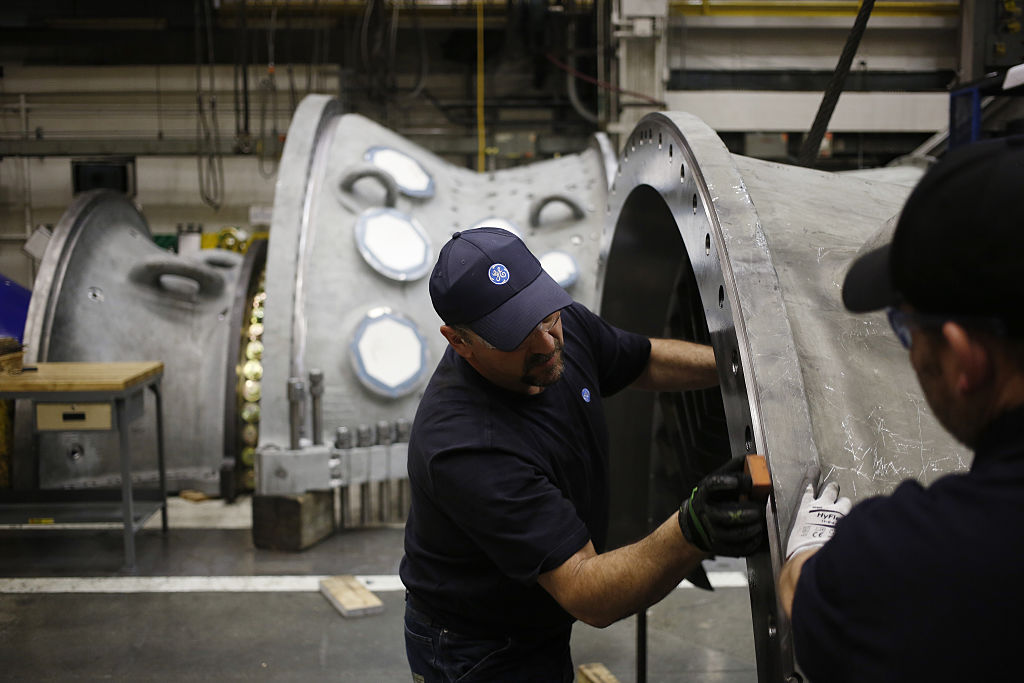
Any disruptions to production of gas turbines would have cascading and wide-ranging impacts, giving workers powerful leverage over the AI build-out. (Luke Sharrett / Bloomberg via Getty Images)
“We’re really going into what we believe is the early chapters of an investment supercycle in the US for electricity growth,” Scott Strazik, CEO of GE Vernova, told Barron’s during an interview at the World Economic Forum in Davos earlier this year. “If you take a step back, we probably haven’t seen an analogous period of time like this since 1945.”
The AI build-out being undertaken at lightning speed is big business for companies like GE Vernova, which, along with Siemens Energy and Mitsubishi Heavy Industries, supply over 75 percent of the world’s gas turbines. GE Vernova’s equipment alone supplies 25 percent of the world’s electricity, and a staggering 55 percent in the United States. In the first quarter of this year, the company racked up $2.4 billion in sales related to orders for data centers, more than total sales for the previous year. Orders for gas turbines are booked out into 2030.
In February, Siemens Energy announced it was investing $1 billion to expand its production of grid equipment in response to soaring demand for electrification, including restarting production of gas turbines at a plant in Charlotte, North Carolina, which had stopped producing them in 2020.
Hitachi Energy invested $37 million to expand an existing facility in South Boston, Virginia, that produces large power transformers — another key piece of equipment in meeting the energy demands of the AI build-out. The company has invested over $1.5 billion into its transformer business alone. Like the gas turbine business, more than 50 percent of the large power transformer market is controlled by the same three companies, alongside Hitachi Energy and Toshiba Energy Systems.
Even beyond these key suppliers, AI investment propped up an otherwise anemic economy, accounting for anywhere from half to 75 percent of GDP in the first quarter of this year.
The windfall of profits for these manufacturers, however, reflects a severe supply crunch for these critical pieces of equipment, with both gas turbine and large power transformer orders backed up for years and associated costs rising. These pieces of machinery are generally made to order and are incredibly capital- and labor-intensive, taking over a year to deliver after an order is placed. The supply strain is so severe that the White House is considering bumping orders for GE Vernova turbines from other countries to move up US-based hyperscalers in their place.
What industry publications warn is a growing “hardware bottleneck” that threatens to limit the AI build-out and the ensuing profit-making for many corporations and Wall Street speculators could be a key point at which workers can leverage power in the living struggle breaking out around AI and its quickly expanding impacts on conditions for the working class, the climate, and government.
The Destruction of Labor Power?
In a 2021 blog post, OpenAI CEO Sam Altman mused that his work at the company reminded him daily of “the magnitude of the socioeconomic change that is coming sooner than most people believe. Software that can think and learn will do more and more of the work that people now do. Even more power will shift from labor to capital.”
Left to their own devices, the likes of Altman and the other titans of the tech billionaire elite would like nothing more than to remake society into one where all else is subservient to their profit margins. Amazon founder Jeff Bezos is currently on a fundraising spree to bring in $100 billion to Project Prometheus, of which he is the co-CEO. Describing itself as a “manufacturing transformation vehicle,” the fund aims to buy up, hollow out, and implement AI and other forms of automation across manufacturing firms in various sectors.
This future is being actively contested on multiple fronts. Communities across the country have banded together to fight the construction of data centers in their towns and have won moratoriums blocking future construction in others. Unions are beginning to bargain around AI and workers are developing tactics to fend off the impacts of AI in an increasing number of workplaces. In 2024, automation, though not directly related to AI, was a central issue of the three-day strike by the International Longshoremen’s Association (ILA) that shut down ports across the East and Gulf Coasts.
The impacts, however, are already being felt. Young people entering the workforce face a particularly bleak job market. The Dallas Federal Reserve reports that “workers age 22 to 25 in the most AI-exposed occupations have experienced a 13 percent decline in employment since 2022.” Unemployment rates among young people and recent college graduates are the highest in years. This comes alongside grim warnings from the AI architects themselves on the massively disruptive impact AI may quickly have on a wide range of industries, though particularly among white-collar workers.
In 2024, Elon Musk announced that he would build the largest supercomputing facility in the world in Southwest Memphis — the facility, called Colossus, was built with no public input whatsoever. Powered by thirty-five gas turbines, this facility emits more pollution into a nearby black community at one time than the levels of pollution emitted from the Memphis International Airport, according to Memphis Community Against Pollution.
Musk was recently awarded a permit to build a second facility nearby. Memphis, a majority black city, has been particularly targeted by the right-wing billionaire class. National Guard troops and Immigration and Customs Enforcement (ICE) agents were mobilized to the city by the Trump administration, and it was just split apart in redistricting efforts to deprive the city of political representation and hand another congressional seat to the Republicans.
Data centers across the country are driving up power bills, using tremendous amounts of water and causing related water quality issues, emitting pollution from turbines and other machinery, and even causing illness among those living nearby.
With eye-popping amounts of capital at their disposal — and plans to increase their investments — the Big Tech companies show no signs of stopping the rapid build-out and their attempts to integrate AI into as many parts of the economy and our lives as possible. Linking the broader fight against AI with worker organizing efforts at key choke points in the data center supply chain is a critical strategy and a potent weapon.
AI’s Limiting Factor: Electricity
A gas turbine is a colossal machine. Weighing in at more than 400 tons and measuring nearly fifty feet long, a single turbine can generate enough electricity to power a modestly sized city, or between 100 and 400 megawatts. Faced with order backlogs, many manufacturers and hyperscalers are opting for smaller turbines, called aeroderivatives, that are essentially jet engines repurposed for energy generation.
“[Energy] is the bottleneck,” NVIDIA CEO Jensen Huang told Joe Rogan during an interview in late 2025, adding emphasis on “the.”
The industry analysis firm Industrial Info Resources (IIR) reports that around $2.4 trillion in AI data center development is currently underway in the United States. The power needs of these data centers have continued to increase. IIR reports that electricity demand in the United States has “risen from roughly 23 GW of new load in 2023 to about 42 GW today, with another 32 GW under construction.” By comparison, in 2024, data centers consumed 24 GW of energy. IIR estimates that by 2030, new load demand may reach around 90 GW, if not higher.
Hyperscalers have few options available to them to quickly meet these energy needs besides gas turbines and large power transformers. Many companies are scrambling to develop nuclear small modular reactors (SMR), but that technology is likely still years away from being readily deployed. Increasingly, battery production capacity — spurred by policies and investments by the Biden administration primarily to assist electric vehicle (EV) production, which were subsequently nixed under Donald Trump — is being redirected toward producing energy storage solutions for the growing power needs of data centers.
Power generation and distribution are thus key sites of struggle for workers to exercise power in the battle over AI and its potentially wide-ranging impacts on work, life, the environment, and government.
Not only are these machines in high demand and capital- and labor-intensive, but they are also manufactured domestically in only a few locations. GE Vernova’s main gas turbine production facility is located in Greenville, South Carolina, with over 2,500 workers; Siemens Energy’s main production facility is in Charlotte, North Carolina, with around 1,500 workers; and Mitsubishi Heavy Industries’ main plant is in Savannah, Georgia, with over 500 workers.
Large power transformer production is clustered in a similar geographic area, with key plants like Hitachi, Prolec GE, Siemens (at the same facility that produces gas turbines), and Eaton, among others, located from southern Virginia through North Carolina and into Upstate South Carolina. Production of various input components and other production related to the grid is also fairly concentrated in this same general geography.
Because these critical machines are manufactured in so few locations, and those locations are clustered together, any disruptions to production would have cascading and wide-ranging impacts, giving workers powerful leverage over the AI build-out.
In addition to direct outreach to workers in this sector and at these key facilities, capital investment in these plants means many are or will soon be hiring. For the last two years, the Southern Workers Assembly (SWA) — where I serve as organizing coordinator — has been recruiting workers through its Rank and File Program to get jobs in strategic industries to organize. The primary focus of this effort to date has been the electric vehicle and battery supply chain. As a result, in-plant organizers are now rooted at key facilities and are building out a network across the sector, connecting committee-building efforts across the region rather than confining organizing activity to a workplace-by-workplace basis. Recruitment and committee building are ongoing.
Another area of work is now emerging to build out a similar network of worker militants engaged in committee-building efforts and connected together through an industrial network in power generation production. With the stage set for a general strike on May Day 2028, the role this sector of workers could play in exercising power behind a broad set of working-class demands — around AI implementation and automation, for the climate, and for redistribution of the exorbitant profits of these companies toward social needs — would be quite significant.
The United States is the world’s second-largest manufacturing economy by output. Large-scale, capital-intensive plants in heavy manufacturing make for stable, important targets for worker organization. A company that invests $13.9 billion in a brand-new factory (the cost of Toyota’s new EV and hybrid battery plant in North Carolina, for example), is planning on staying put for the long term and obtaining a profitable return on its investment — even if it’s confronted with labor unrest and worker organizing.
The massive strikes and organizing sweeps of the 1930s and ’40s rightfully serve as inspiration for worker militants today. There is much to be learned and studied from that period, particularly as it pertains to how workers laid the groundwork for the upsurges and pitched battles that took place by building similar networks of worker militants rooted in key facilities today. But no doubt the social turmoil of the period in general played a large role, as it may now, in opening an opportunity to advance the working-class movement in a more militant and combative direction, focused among the unorganized sections of the class in these simultaneously vulnerable and strategic sectors of the economy.