Another Energy Transition Is Possible
Jean-Baptiste Fressoz’s dizzying history of energy consumption argues that no energy transition has ever occurred: each generation consumes more of past fuels. Not only are his claims ahistorical but they justify an unwarranted pessimism about the future.
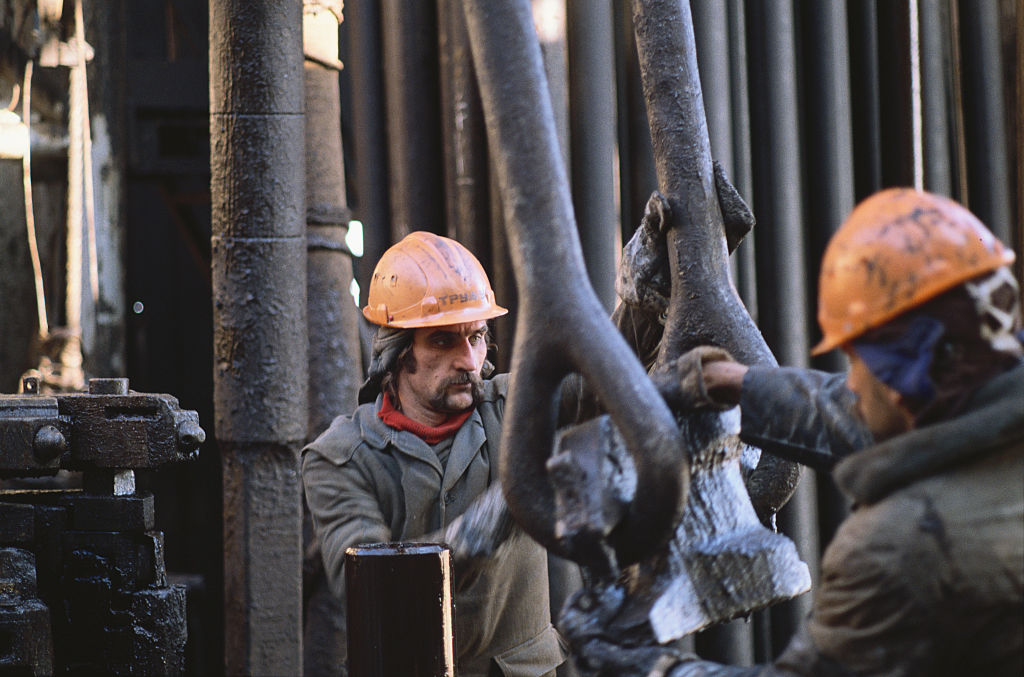
Since the discovery of human-caused climate change, there has been a strand of thought that blames modernity for environmental destruction. But industrial society and its technologies have improved human life and offer solutions to the climate crisis. (Bernard Bisson / Sygma via Getty Images)
In the 1990s, the trade unionist and environmentalist Tony Mazzocchi made a humble plea: if the state is willing to care for “dirt” — by investing in a superfund for the cleanup of pollutants — why not a “superfund for workers”? We should treat workers just as well as dirt, he reasoned.
Taking inspiration from the GI Bill, Mazzocchi proposed that plans to shut down polluting industries should also involve a robust transition program for workers, including income support, free education, and other real material provisions. Since he made these arguments in the 1990s, the term “just transition” has come into vogue, becoming a buzzword in academia and within NGOs that insist the energy transition must include justice not only for workers but also a wider variety of marginalized groups. Meanwhile, many workers in the fossil fuel industry have either never heard of the “just transition” or, if they have heard of it, don’t believe in it. Who can blame them when all they see is mass unemployment and economic devastation when coal mines or power plants are shut down?
But there’s a deeper problem with the whole notion of a “just transition” — it assumes the transition is happening, and it only needs to be more just. But when it comes to the climate crisis, it candidly doesn’t matter if the transition away from fossil fuels is just or not. It simply needs to happen and, unfortunately, it’s not happening. For most of the last several decades the percentage of the global energy mix devoted to fossil fuels has remained stubbornly fixed at around 80 percent.
This is the premise of the French historian Jean-Baptiste Fressoz’s provocative and fascinating new book More and More and More: An All-Consuming History of Energy. His argument is not only that the current energy transition is not happening (it is an increasingly common refrain for energy analysts to point out we only have an “energy addition” of renewables and other clean energy on top of existing and expanding fossil fuel use). Rather, his point is that there has never been an energy transition.
Fressoz’s main target is historians and theorists who hold a naively progressive view of the raw materials and technologies humans have used to generate energy. According to these thinkers, modern society transitioned from wood to coal in the nineteenth century and coal to oil in the twentieth. But this is entirely wrong, Fressoz shows. The real historical record is one of more: more wood, more coal, more oil and gas, and, now, more renewables.
Despite his deep historical and materialist perspective, Fressoz’s analysis obscures as much as it reveals. More and More and More treats our historically specific process of industrialization as our eternal fate, and the prospect of technological solutions to what is inherently a technological problem of climate change as an ideological justification for capital. There is a serious socialist alternative to Fressoz’s pessimism, however his book sets out to ignore it.
Symbiotic Energies
Fresozz’s argument is neatly summed up in the following passage:
After two centuries of ‘energy transitions’, humanity has never burned so much oil and gas, so much coal and so much wood. Today around 2 billion cubic metres of wood are felled each year to be burned, three times more than a century ago.
Given this material and historical reality, Fressoz wants us to dispense with the very notion of transition. Instead, he empirically catalogs a history of more (and more), based on “the entanglement and symbiotic expansion of all energies.” The book lacks much in the way of theory or explanatory frameworks — it is more like a barrage of facts and description — but if it has a conceptual core, it is this idea of “symbiosis.”
Coal, according to Fressoz, did not displace wood so much as create new demands for it — from wood-framed coal mines, to wood-based rail tracks (and even wood-fired steam engines). Likewise, the “age of oil” — Fressoz is particularly critical of the entire “stageist” notion of “the age of X” — was inextricably intertwined with coal-based steel for drilling rigs and pumps, and wood-based derricks and barrels.
There are three other key contributions the book makes. First, we’ve been thinking about energy history all wrong by analyzing it in relative terms (e.g., in relative percentages like 80 percent fossil fuel, 7 percent nuclear). Looking at energy history this way shows a smaller share for “old” energies like wood and coal. The problem, particularly for climate change, is that even if the percentage of coal is decreasing it is only its absolute number that matters — more coal means more emissions and more climate change. When you look at energy history in terms of absolute numbers you see only more (especially fossil fuels).
Second, Fressoz argues it is a mistake to think narrowly in terms of energy: heating or motor fuel, electricity, or even calories to feed muscle power. Rather, his symbiotic perspective insists we must not separate energy from materials because doing so ignores the all-around material dependence of some energy systems on the materials of others (for example, warm and fuzzy solar power currently relies on reams of petroleum-based plastic and coal-based silicone).
Finally, and most importantly for his implied politics (more on this below), Fressoz is deeply critical of how the very notion of an energy transition creates a reassuring “futurology” wherein the climate challenge’s solution is rooted in historical precedent. One of the merits of More is that it shows how deep the roots of this kind of futurology run. For example, he examines how mid–twentieth century nuclear power enthusiasts were obsessed with impending scarcity of fossil fuels (Fressoz calls them “Atomic Malthusians”), and, as such, became fixated on a full transition to nuclear power made sustainable through a promised, but never really delivered, technology of “breeder reactors.”
Industrialization Was a Lot
His story could be told differently: starting in the nineteenth century, industrialization vastly expanded society’s productive capacity — most notably through the development of large-scale machinery. Almost by definition, this new, revolutionary form of production entailed more (and more, and more) of everything. For example, Fressoz shows how oil-powered chainsaws and other machinery massively expanded the efficiency and scale of logging production.
Fressoz’s story does not end in the nineteenth century, it extends to the twentieth and twenty-first centuries increased use of all energy. But the massive expansion of energy and material use more recently is a product of new industrialization in East and Southeast Asia (among other spots), and, as Fressoz shows, this industrial boom has been powered above all by coal.
In other words, the story of “more” is a story of a historically specific process of industrialization. We should be clear, this historical process has by and large been a boon for humanity, as it has accompanied massive gains in life expectancy, mass education, medical care, lifted billions from the drudgery of agrarian life, and offered some (though not enough) access to cheap goods, 24/7 electricity, indoor plumbing, and more.
In the mid-twentieth century, it was painfully obvious that this process of industrialization was a net positive. Only in the 1970s did the transformative gains of the process start to get taken for granted, and a new environmental ideology (above all hostile toward “growth” in the abstract) began to see industrialization as a primarily environmentally destructive force. Fressoz represents a new perspective in this long lineage.
The problem with this is twofold. First, industrialization is not eternal, but a historical process with periods of growth and decline. Some, like Aaron Benanav, suggest once it ends, the next state is not “more and more” in material terms, but rather stagnation and an economy and labor market geared more toward services than energy and material use. There is certainly a possibility that new rounds of industrialization may occur in Sub-Saharan Africa or South Asia — and of course, decarbonization will entail its own, new form of green industrialization — but the real question must be what comes after.
It is also worth adding that the truly astonishing expansion of wood and charcoal use in much of the developing world that Fressoz details in the eighth chapter of More is more a product of capitalism’s imposition of entirely avoidable poverty and scarcity on much of the world. There is no reason why humanity could not deliver electricity and even some degree of gas-powered heating and cooking technology to the developing world, allowing them to avoid the deadly air pollution involved in using wood-based fuel.
Second, industrialization accompanied a demographic explosion starting in Europe and expanding to much of the world (global population has increased over eight times since 1800, a fact that should be celebrated). You don’t have to be a Malthusian to posit this might entail more (and more) energy and material use as a result. But clearly that is also now mostly over, and global population will soon peak (likely around ten billion), and then decline. This, of course, in no way guarantees positive ecological outcomes into the future, but it will be a future starkly different than the history Fressoz tells.
This is why socialists traditionally saw industrialization as a stepping stone, or set of material conditions, that can be built upon to deliver both a materially secure and ecologically sustainable economy for all. In other words, while most of human history was indeed a battle with scarcity, industrialization is an opportunity (but not guarantee) to offer some degree of freedom for society to take control over its metabolism with nature. A straightforwardly Marxist view would aim toward the development of the productive forces in a way that lessens the human impact on nature without compromising human flourishing.
Industrialization, rather than destining us toward climate collapse and ruin, creates a scale of productive capacity that allows humanity to (finally) decide how to collectively provision their needs in a rational way. As Fressoz shows, capital, if left to its own anarchic devices, will simply seek accumulation and the cheapest and most profitable forms of production. That’s exactly why capitalism must be overcome.
Less and Less and Less
Fressoz’s history is deeply empirical, but if you squint you can actually read several examples of how society has made technological changes to drastically lessen the impacts on the environment.
After a stunning chapter detailing the existential dependence of coal mining on wood-based “pit props” (underground wooden structures to keep the mines from collapsing onto workers), Fressoz announces that by the mid-twentieth century these wooden beams had been mostly replaced by the “use of metal props and rock bolting, followed, in the mid-1960s, by the introduction of powered roof supports. . . . ”
A similar story can be told about how rail systems previously relied on wood-based “sleepers” (the base of train tracks). A chemical process (based on coal, of course) of treating wood with “creosote” allowed for the production of sleepers that “instead of lasting a few years . . . could now stay in place for decades.” “Creosote was”, Fressoz tells us, “undoubtedly one of the most important tools of forest conservation in the twentieth century.”
Fressoz also shows how oil-based tractors and other machinery were land-saving technologies: “substantial areas of land once used for cultivating crops to feed horses and mules have been freed up” (citing truly massive figures of thirty-five million hectares for “beasts of burden” in the United States alone). He goes further to point out fertilizers and pesticides dramatically increased yields, and thus, also freed up substantial land.
Another example is closer to Fressoz’s own home country. Through a combination of nuclear power and hydropower, France has basically completely decarbonized their electricity grid. He does not say so, but one can surmise he is not a fan of nuclear power. Nevertheless, it is hard to find a better example of how technology can dramatically decrease environmental impacts — it takes far less land and far fewer materials (thus far less mining) to deliver reliable, abundant electricity than any other electricity-generation technology on offer.
Fressoz suggests France’s gains in this regard are canceled out by their “imported” emissions via international trade (and he cites one study and a government report to make this claim), but it’s worth pointing out at least one other source does see France’s emissions declining even when trade is take into account. While many argue China’s boom in coal-fired growth was mostly in service of the gluttonous West, estimates suggest that even when you take account of emissions embodied in exports and trade, China’s “consumption-based” emissions are 88 percent of the total. Regardless, if the countries France imports from pursued France’s electricity mix, these “imported” emissions could also be reduced.
Fressoz would no doubt counter that any of these efficiency gains will inevitably lead to the “rebound effect” or “Jevons paradox” (when a machine becomes more efficient, it leads to more not less consumption), but again this tends to be the case when production and consumption are left to the anarchy of the market. It needn’t be destiny. The question of technological efficiency and collective determination of social needs and material consumption levels would (one hopes) be the essence of socialist planning.
Dour Degrowthism
You have to read between the lines to find any kind of politics in Fressoz’s account, but it’s there under the surface. Fressoz’s book will leave many with a foreboding sense of doom. If an energy transition never happened, how can we expect one for fossil fuels? On the literal last page of the book, he announces, riffing off his compatriot, Thomas Piketty, “transition is the ideology of capital in the twenty-first century . . . We must not let the technological promises of carbon-free material abundance repeat themselves again and again . . . ” It is clear Fressoz’s disdain for capital is also a disdain for what he calls “techno-solutionism.”
But this is a near universal problem on the Left today: conflating technology itself with capital, as if only capital and capitalists are capable of technical innovation, and a future of technological improvement (and, god forbid, “carbon-free abundance”) could never break free from capitalism. Obviously the more basic socialist perspective sees capitalism as the main barrier to technological development by restricting production to only what is profitable. Moreover, given again a world 80 percent powered by fossil fuel, technology will have to be at the center of any solution.
The general leftist refrain is that this kind of argument wishes to change technology without changing social relations, but the obvious retort is, why not both? Or, more to the point, we cannot actually deliver large-scale socially and ecologically beneficial technological change without changing social relations. Indeed, as Fressoz’s narrative shows so well, the problem with capital is its abstract value-orientation (only concerned with money and profit) and thus its indifference to its material basis (what Marx called the use-value side).
Capital does only seek “more” in terms of money/accumulation, regardless of the material or environmental consequences. But the wager of socialists for over a century is that we could take over production for social need and use value — that is, we could usher in a form of production that takes materiality quite seriously as a question of planning.
So, if Fressoz is skeptical of using technology to solve climate change (even if his text has many examples of the opposite), what are his politics? Again, the last page gives us clues: “Thanks to transition we are talking about trajectories to 2100, electric cars and hydrogen powered aircraft rather than material consumption levels and distribution” (emphasis added).
Fressoz seems to suggest the only path forward is degrowth. We should not aim for new kinds of production, but rather less consumption and redistribution of what already exists. Earlier in the twelfth, final substantive chapter mockingly titled “Play the technology card,” Fressoz laments that the IPCC hasn’t even bothered to model degrowth scenarios where rich countries voluntarily reduce their GDP for environmental reasons (he cites approvingly a study of Australia that modeled the impacts of a 5 percent GDP reduction). It is worth pointing out that most degrowth advocates will not even go as far as call for GDP reductions, because that is obviously called a recession.
This all leads one to the conclusion that Fressoz really has no politics at all. There is clearly never going to be popular support for this dour degrowth perspective that insists we are inevitably trapped in an industrial system that can only consume more (and more) fossil fuels, for all of eternity (or, more accurately, for Fressoz, until we reach what he ominously ends the book with, the “greater perils” of climate breakdown), and the only option is degrowth.
My aim is not to offer false hope, but rather to simply point out that the socialist project has always been rooted in a kind of optimism in the human endeavor. It is ultimately based on a wager: if we struggle, and wrestle control of production away from the depredations of capital, there is nothing we can’t do. An energy transition is not only possible; it’s only the beginning of what we can accomplish.