The Trumpian "War on Fraud" Is a Trojan Horse for Austerity

The State Financial Officers Foundation claims to be a nonpartisan, neutral body representing the guardians of state finances. In truth, the corporate donor–dependent nonprofit pushes a right-wing austerity agenda under the guise of fighting fraud.
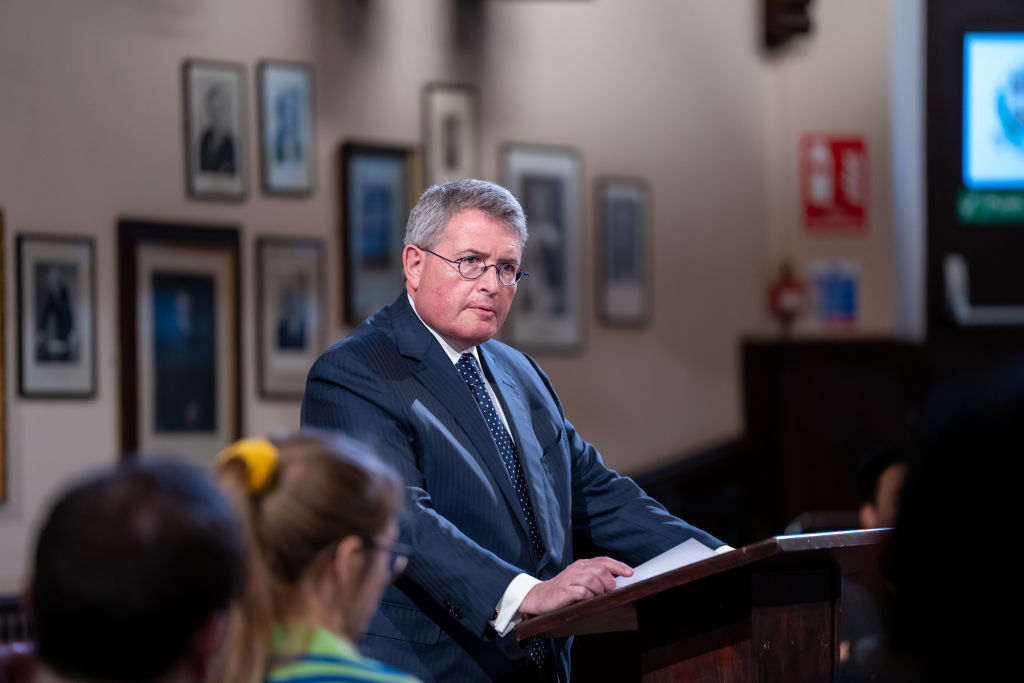
Leonard Leo speaks at the Cambridge Union on March 11, 2025.

Conservative power broker Leonard Leo has deep ties to CRC Advisors, a major funder of the ostensibly nonpartisan State Financial Officers Foundation. (Nordin Catic / Getty Images for The Cambridge Union)


As the Trump administration has slashed benefits programs like Medicaid and raided Minneapolis daycare centers in the name of a new, politicized “war on fraud,” the innocuous-sounding State Financial Officers Foundation has been cheering it on.

The organization, composed of state auditors and treasurers, wished the White House “unbridled success in that mission” and pledged to support it “as allies already on the battlefield,” even releasing a well-timed report that claimed to have identified billions of dollars in fraudulent spending across the country.

The State Financial Officers Foundation, a nonprofit, claims to be a nonpartisan, neutral body representing the guardians of state finances. In truth, the group has been backed by corporate donors, including banks, credit card companies, and hedge funds. It also has ties to conservative power broker Leonard Leo’s dark money network, which has worked directly with state officeholders who are part of the group.

For years, the foundation fought efforts to hold its donors and other big companies accountable by waging an all-out war on ESG, or “environmental, social, and governance,” an investing principle that prioritizes socially responsible holdings over weapons and oil stocks. But now that the foundation has largely won that battle — the group helped advance ESG bans in nearly two dozen states — it has turned its attention to a convenient new bugaboo: fraud.

Building on the Trump administration’s attacks on benefits programs in the name of rooting out fraud, the State Financial Officers Foundation is advancing new and dubious claims about state-level fraud and sending representatives to Congress to testify on how such misconduct is fueling a “crisis” raging across the country. Along the way, the organization is writing the script for a new brand of austerity politics.

“This is a pay-to-play group,” said David Armiak, the research director with the watchdog group Center for Media and Democracy, which has tracked the influence and movements of the State Financial Officers Foundation for years. “People that give money — they’re looking to get influence and something out of it.”

The State Financial Officers Foundation did not return the Lever’s request for comment. But its anti-fraud pivot raises pressing questions. For starters, because the organization has grown more secretive about its donors as it has faced more public scrutiny, it’s difficult to know exactly who is sponsoring its radical shift in messaging.

“I’ve never seen them, in my years of tracking them, publicly talk about uncovering fraud,” Armiak said.

Even more worrisome? The fervent new mouthpiece for President Donald Trump’s “war on fraud” is now facing fraud and corruption allegations of its own.

Winning the War on the “Weaponization Of Capital”

From its 2013 foundation with corporate seed money by a group of state treasury officials, including former CEO Derek Kreifels, who now consults for global investment firms, the State Financial Officers Foundation has pledged fidelity to austerity and fiscal conservatism.

The mission statement attracted corporate donors: According to an investigation by the Center for Media and Democracy, previous foundation backers have included major financial players like Fidelity, J. P. Morgan, Visa, and Mastercard. (The organization now keeps its corporate sponsors hidden.)

These banks and investment firms had a vested interest in the Foundation’s fight against ESG, which was attracting attention to the corporations’ more unsavory dealings in weapons and fossil fuels. By 2023, at the height of the organization’s crusade, then-CEO Kreifels proclaimed the foundation’s mission was to fight against the “weaponization of capital.”

As the Center for Media and Democracy wrote at the time, the foundation, which has millions of dollars at its disposal, proved a critical tool for the right to create “a manufactured crisis” around ESG. There’s plenty of evidence that ESG investing is profitable and can improve a firm’s value; many anti-ESG bills were essentially Trojan horses for policies that stripped away investors’ power and allowed Wall Street to operate with less scrutiny.

Critically, foundation members used their position in public office to amplify anti-ESG messages, as an extensive New York Times investigation into the organization’s activities highlighted in 2022.

To do so, the Foundation tapped the political communications firm CRC Advisors, which is chaired by Leo, a former Trump judicial adviser who’s used his billion-dollar political network to help build the Supreme Court’s conservative supermajority and deliver conservative victories like the overturning of Roe v. Wade. Other clients of the PR firm have included the oil giant Chevron, the pharmaceutical company Eli Lilly, and the Heritage Foundation, which produced the Project 2025 manifesto to dismantle the federal administrative system.

In some cases, per the Times investigation, CRC Advisors worked directly with state treasurers to coordinate media strategy.

The foundation’s ability to push media narratives, thanks in part to its work with Leo’s political network, is central to its power, Armiak said. “That’s really where the influence is,” he said.

Now, the group is using the same playbook to fan the flames of the White House’s war on fraud.

Fighting Fraud With Fraud?

On May 14, the watchdog group Campaign for Accountability sent a letter to the State Financial Officers Foundation demanding that the nonprofit remove its board president, Seth Metcalf, a former Ohio state deputy treasurer.

The anti-fraud group’s president, noted the letter, was facing corruption allegations himself. While helming the organization’s board, Metcalf has also been at the center of an alleged collusion scheme rocking Ohio.

Allegations against Metcalf, who departed the Ohio state treasurer’s office in 2017, first surfaced in spring 2024. That’s when whistleblowers contacted Ohio’s governor with allegations that board members of the state’s teachers’ pension fund were colluding to direct $65 billion in public pension dollars to QED Management, an investment firm Metcalf had cofounded, which promised big returns for pensioners.

The scheme, wrote the whistleblowers, amounted to a “hostile takeover of a public pension system by private interests.”

Ultimately, the planned partnership with QED — which would have diverted up to 70 percent of the pension fund’s assets to the private entity — never materialized. In February 2026, after a protracted legal battle, an Ohio judge removed the chair of the pension fund board and barred him and another participant in the scheme from ever serving on the board again.

In her ruling, the judge wrote that the board members were acting as “mere puppets” of Metcalf and his business partner and “engaged in secret communications with representatives of QED. . . . with the ultimate goal of steering a significant amount of [pension] funds to QED’s control.”

To strong-arm the pension fund into forking over money to his company, Metcalf reportedly authored documents alleging the pension board was “committing fraud.”

The only way to fix the fraud problem, the logic went, was to adopt “the QED strategy” — and let Metcalf’s company take control of the pension fund’s coffers.

After the plan collapsed, Metcalf moved on to other business ventures — and additional controversies. A lawsuit filed in Ohio federal court this month now accuses Metcalf and two other business partners of mismanaging an AI start-up’s money. The complaint charges Metcalf with fraud and breach of fiduciary duty, claiming he engaged in “wasteful and self-serving spending” and destroyed sensitive company data. (Those allegations, which have not yet been adjudicated, were filed in response to Metcalf’s own lawsuit against the AI company for wrongful termination.)

In sum, the allegations “raise the question of whether or not Seth Metcalf is the right person to be the board president at an organization that claims to care about financial conduct and fiduciary duties,” Michelle Kuppersmith, executive director of the Campaign for Accountability, told the Lever.

Kuppersmith said that the organization had not yet responded to the Campaign for Accountability’s demands to remove Metcalf as board chair.

The State Financial Officers Foundation did not return the Lever’s inquiries about the letter. Metcalf did not respond to a request for comment.

Metcalf isn’t the only member of the State Financial Officers Foundation’s leadership who’s been plagued by scandal in recent months. The organization’s vice chair, Adam Crum, has been facing mounting scrutiny over his past tenure as Alaska’s revenue commissioner.

This month, the Juneau Independent reported that during his tenure in state office, Crum awarded $8.5 million worth of contracts to a consulting firm after it sponsored a glacier cruise for the State Financial Officers Foundation.

The revelations followed allegations that Crum violated protocol when he tried to invest $75 million of state reserve funds in a private equity fund, a move that one lawmaker called “gross incompetence,” given the investment’s high-risk nature and Crum’s apparent deviation from standard procedure to push it through. (Ultimately, just $20 million was invested, and the state lost close to $1 million.)

Crum resigned from his state position last August and announced a run for Alaska governor shortly thereafter. In October, lawmakers launched an inquiry into his handling of state reserve funds during his tenure. In the meantime, he has retained his leadership position at the State Financial Officers Foundation.

Crum did not respond to a request for comment from the Lever.

A $28 Billion Question Mark

In April, as questions swirled about the State Financial Officers Foundation’s leadership, House Republicans brought multiple representatives of the organization to testify in a hearing on “fraud prevention” in state benefits programs, shortly before federal law enforcement staged incendiary raids across Minneapolis, which have been continuing in recent days.

At the hearing, Republican Kentucky state auditor and former Foundation chair Allison Ball testified that she had uncovered $1 billion in “waste, fraud, and abuse” in her state, calling it a “target-rich environment” for such activity. She went on to tout the role of AI in her anti-fraud efforts, claiming that the technology “will drastically cut down the amount of time it takes to audit, allowing us to tackle more issues than ever before.”

She spoke alongside the Foundation’s CEO, OJ Oleka, who testified that the Foundation was leading a “nationwide movement” of state treasurers and auditors taking on fraud. As proof, he claimed his members had identified and prevented $28 billion in fraud and waste in their states in 2025 alone.

That figure came from the organization’s inaugural Oversight Report, released in February. But not everyone agrees with the foundation’s findings.

In Kentucky, Ball’s claims of identifying $1 billion in wasteful spending have since been challenged by Democratic Gov. Andy Beshear.

“Her claims are wildly inflated,” Beshear told local press after the House hearing. “If an audit is done right, it is not hyperbolic, it is not talked about on Capitol Hill — it’s meant to provide help to the organizations that are there.”

Likewise, while the State Financial Officers Foundation has touted the efforts of member Blaise Ingoglia, Florida’s chief financial officer, questions have emerged about Ingoglia’s claims to have identified $1.86 billion in “excessive local government spending” in cities and towns, including Orlando, Palm Beach, and St Petersburg.

After Ingoglia, a Republican, publicly accused St Petersburg of overspending by $49 million, the city hired an independent auditor to look into the matter. The investigator found that Ingoglia’s analysis was based on a formula created by billionaire Elon Musk’s Department of Government Efficiency, which compared annual budget growth with the city’s population and consumer price increases.

But St Petersburg’s disproportionate budget growth compared to its population wasn’t so simple. In fact, the outsize spending was related to the city’s devastating 2024 hurricane season. And many of those expenses, according to reporting by Florida Politics, were set to be reimbursed through federal and state disaster relief funding.

“They’re using public office and public resources to investigate social welfare programs or programs that benefit the disadvantaged for fraud,” Armiak said. “So again, weaponizing the office, similar to their attacks on ESG and DEI.”