Zohran Mamdani Has a Choice on Free-Speech Restriction
The New York City Council has passed two bills that would restrict the freedom to protest across the city. Mayor Zohran Mamdani must now decide if he can stop at least one.
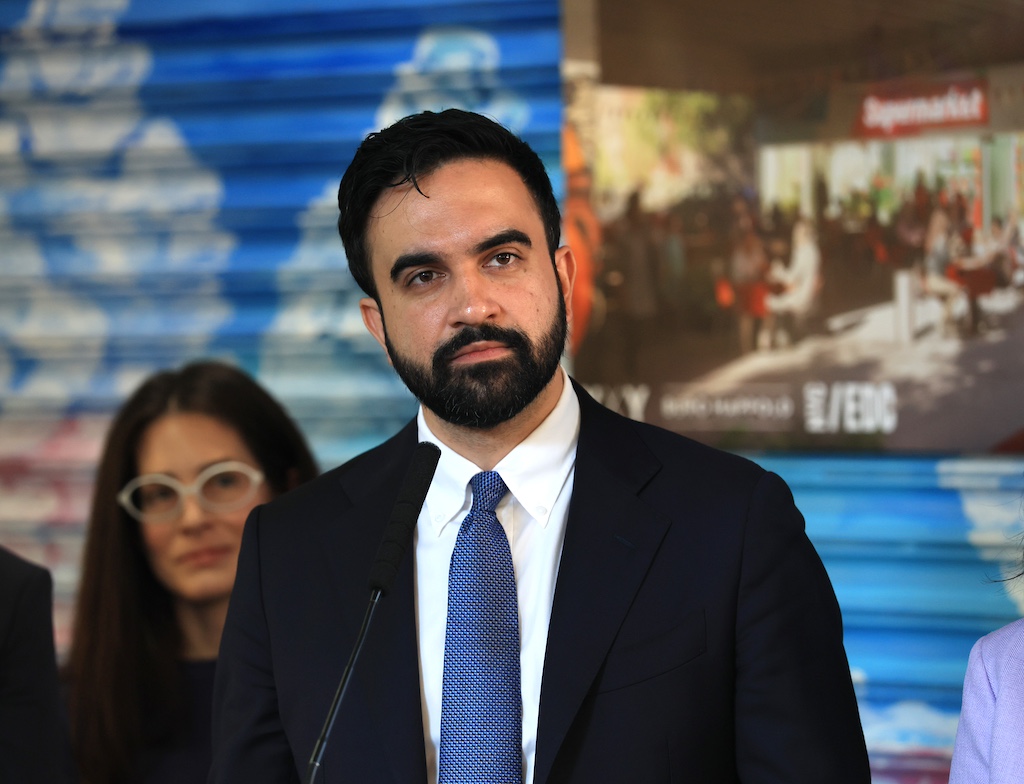
Mayor Zohran Mamdani is facing a decision about whether to veto two protest buffer-zone bills passed by the city council late last month. (Spencer Platt / Getty Images)
New York City Mayor Zohran Mamdani is currently facing a choice: whether to veto either of two protest buffer-zone bills passed by the city council late last month, which critics say would be a major blow to free speech.
Intro 1-B and Intro 175-B, the “buffer zone” bills, would enable the New York Police Department (NYPD) to enact restrictions on protesting around houses of worship and educational institutions, respectively. Both bills passed the city council on March 26, and both have drawn extensive criticism. Unions, civil rights groups, activists, and the city’s ascendant democratic socialist left have argued that passing the bills would curtail the right to protest in large swaths of the city.
The mayor has thirty days to veto or sign laws after they are passed by the council. If he does neither, the bill automatically passes. Mamdani’s last chance to issue a veto on both or either bill is this Saturday. Opponents are concentrating on Intro 175-B, the Education Buffer Zone Bill. Unlike Intro 1-B, Intro 175-B passed the city council without a veto-proof majority, which leaves room for a Mamdani veto to sink the bill.
Critics of the bill point to how broadly it defines educational institutions. The final version would apply protest restrictions to “any building, structure, or place where educational programming takes place. . . . [This] includes but is not limited to public and nonpublic childcare programs, early childhood programs, elementary schools, middle schools, junior high schools, high schools, colleges, and universities.”
Furthermore, the bill is vague about the exact type of action it seeks to regulate. The language of the proposal aims at preventing “interference” and “intimidation,” which it defines as “restricting an individual’s freedom of movement” and/or “placing an individual in reasonable fear of physical harm to themselves or to another individual.”
That broadness has drawn sharp criticism from free-speech groups like the Knight First Amendment Institute at Columbia University, which urged the mayor to veto both bills in a press release issued April 21.
“We’re disappointed that the City Council passed these bills, which would task the NYPD with writing the rules on where and how people may engage in lawful political protest near the city’s thousands of schools, educational facilities, and places of worship,” said Xiangnong Wang, staff attorney for the group. “These measures risk chilling and even criminalizing a wide range of speech protected by the First Amendment around some of the city’s most important sites for public discourse. Governments shouldn’t task law enforcement with determining the limits of political expression.”
The buffer-zone proposal around educational institutions has also faced opposition from organized labor. The bill includes a single line preventing it from being “construed or interpreted to infringe upon rights granted under the National Labor Relations Act or the labor law.” But unions like the United Auto Workers, Teamsters, and Professional Staff Congress at the City University of New York (PSC-CUNY), remain worried about a chilling effect and the bill’s potential to be used by management as a strike-breaking tool. An open letter sent to Mayor Mamdani in April made that point by asking, “Why would a corporation or institution not call in the NYPD during a strike at their facility saying that the picket is making people feel 'intimidated' as defined by this law?”
Other labor leaders have also raised similar concerns as well as questions of constitutionality.
“This bill is unnecessary. It will have unintended consequences. It is almost certainly unconstitutional,” PSC-CUNY President James Davis said at a rally in front of city hall on April 16. “And it will give comfort to opponents of freedom of expression in Washington DC.”
The fight over the two buffer-zone bills has also highlighted the conflict between Mamdani, his base, and Speaker Menin. The two forces have previously clashed over proposals to tax the rich, which the speaker has opposed. Menin sponsored the Houses of Worship Buffer Zone Bill, and a close ally of hers, Councilmember Eric Dinowitz, sponsored the Education Buffer Zone Bill. Both pieces of legislation were touted by Menin as part of a push to fight antisemitism.
Yet many in Mamdani’s base have argued that instead, these proposals are part of a larger crackdown on pro-Palestine activism. The bills seem to be envisioned as responses to recent campus protests as well as demonstrations outside of New York synagogues hosting events promoting migration to Israel and illegal settlements in occupied Palestinian territories.
At least two major backers of Mamdani’s election, the New York City Democratic Socialists of America (NYC-DSA) and Jews for Racial and Economic Justice have run letter-writing campaigns directed at Mamdani asking him to oppose Intro 175-B. According to the ActionNetwork page for NYC-DSA, the group has sent over 8,000 letters.
In a statement to the press, Joe Calvello, press secretary for the Mamdani administration, acknowledged the worries of unions and Mamdani’s core supporters.
“Mayor Mamdani is aware of the concerns raised regarding the potential for 175-B to limit the constitutional and labor rights of New Yorkers,” Calvello said. “The Mayor will weigh these concerns seriously as he makes a final decision on this legislation.”
If Mamdani does listen to his base and vetoes the Education Buffer Zone Bill, he will likely find himself in further opposition to Menin, who has publicly argued against opposing either proposal.
“I really hope that there is not a veto of that legislation,” Menin said at an April 22 event. “Because I think that will lead to more divisiveness when we need less divisiveness.”
Menin’s position, however, is not shared by the New York Civil Liberties Union (NYCLU), which has been critical of both pieces of legislation and has warned that they risk exacerbating tensions at protests.
“These bills also do nothing to make New Yorkers safer; we already have laws against harassment and intimidation on the books,” NYCLU Executive Director Donna Lieberman stated on April 22. “Instead, no-speech zones would put us at risk by flooding protests with police and escalating tensions — a move that threatens a binding legal settlement with the city, reached by the NYCLU and others, to protect protest in the aftermath of sweeping NYPD misconduct and rights violations during the George Floyd protests.”