Barbara Kopple on Her Labor Documentary Masterpieces
Barbara Kopple’s films Harlan County USA and American Dream captured labor struggle as it was happening: on picket lines, inside unions, and under pressure. Decades later, both remain some of the finest labor documentaries ever made.
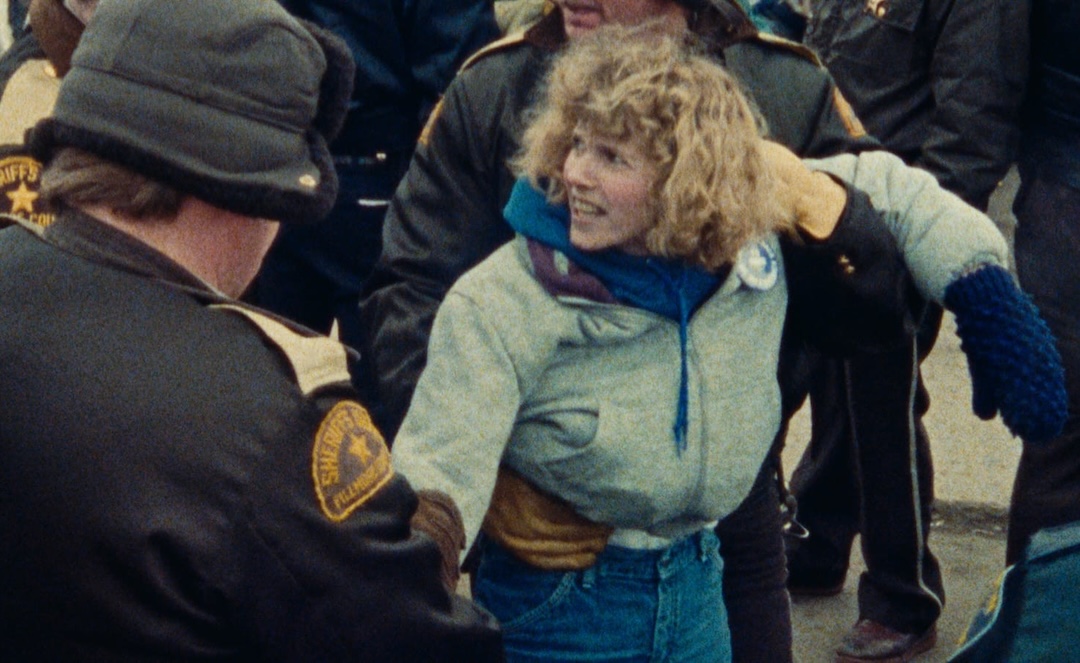
In Harlan County USA and American Dream, Barbara Kopple embedded herself with the people she was filming without knowing how the story would end. Both documentaries do not tell viewers what to think so much as place them within unfolding events. (Prestige Films)
- Interview by
- Alex N. Press
Half a century after its release, Harlan County USA (1976) still lands with the force of something happening in the present tense. The documentary is full of scenes that have become part of the language of labor in the United States: miners’ wives holding the picket line at dawn, a woman pulling a gun from her bra in preparation to face down company violence, picketers singing “Which Side Are You On?” as trucks try to break through their line. It is one of the most influential labor documentaries ever made in the United States — not simply a record of a 1973 coal strike in Eastern Kentucky but a way of seeing what struggle looks like from the inside.
Its follow-up, American Dream (1990), is no less gripping. Covering the 1985–86 Hormel strike in Austin, Minnesota, the film turns from a fight against a company to a conflict that runs through the labor movement itself, capturing a moment when concessions, plant closures, and internal divisions reshaped what union power could look like. Together the films map a shift in American industry from the coalfields to the meatpacking line, and the pressures that accompanied it, while holding on to the texture of daily life inside those fights: on picket lines, in union halls, and in the relationships that hold a strike together or pull it apart.
Both films are now returning to theaters through a rerelease by Janus Films, arriving at a moment when labor has reentered public view, even as many of the dynamics they depict remain intact. The films were directed by Barbara Kopple, who won Academy Awards for both and has spent decades documenting political struggle across a wide range of subjects. But these two works remain central in part because of how they were made. Kopple embedded herself with the people she was filming for long stretches of time, without knowing how the story would end. The result is a form of documentary that does not tell the viewer what to think so much as place them within unfolding events, allowing them to make sense of competing strategies, loyalties, and consequences as they emerge.
Alex N. Press spoke to Kopple about filming labor struggle from the inside, showing conflict within unions rather than smoothing it over, the afterlives of these films, and the continuities she sees between those earlier struggles and the US labor landscape today. The conversation has been lightly edited for length and clarity.
Jacobin is sponsoring a showing of American Dream in New York City at the Independent Film Center (IFC) on May 2. You can purchase a ticket here.
Alex N. Press
Both of these films depict incredibly tense, high-stakes situations, and you spent a long time with the people in these movies. How did you build the trust that made it possible for them to let you into these vulnerable and at times quite dangerous moments?
Barbara Kopple
In Harlan, I was filming with the Miners for Democracy (MFD). Joseph “Jock” Yablonski, [MFD’s candidate for the presidency of the United Mine Workers], his wife, and daughter were murdered [in 1969], and Tony Boyle, who was then the president of the United Mine Workers, was found guilty.
I wanted to be part of this new, incredible movement that was just storming the coalfields. So I went out, and I was filming Arnold Miller [MFD’s candidate to oust Boyle], and filming lots of things like old miners singing songs and telling us things you ultimately see in the film, such as how if a rock falls on a man, it doesn’t matter, but it does if it falls on a mule — because you have to buy a mule, whereas you can always hire another man.
We’re starting to get a sense of what coal miners were going through. And when Miller gets into office as the new president, he says, “I’m going to organize the unorganized.” I knew that there was a strike going on in Harlan County, where, in the ’30, they used to call it “Bloody Harlan County.” I went to see if he would keep his promise.
When we got there, it was dawn, pretty dark out. The light hadn’t lifted, and I got out of the car and spoke to the women who were on the picket line. At the beginning, they didn’t trust us. They gave us phony names, like they were Florence Nightingale or Martha Washington or Betsy Ross.
The next day, they said, okay, you can come to the picket line. You’ve got to be there at 4 a.m. in the morning. And we agreed. We were staying at that time at a little motel on the top of Pine Mountain, which was a really steep mountain. The road had no guardrails whatsoever. It was pouring down rain that morning, and another car came swishing in front of us, and our car went over the side. Nobody was hurt, we were all okay, and we just crawled out of the car and walked to the picket line with all our gear in the rain.
It was at that moment that they just opened up to us. We lived with the Johnsons, a coal mining family, and we became part of the community.
Alex N. Press
You mentioned that you spoke to the women when you got there, and it’s remarkable how much the women steal the show in Harlan County USA specifically. Did you realize that would be the case when you started the project?
Barbara Kopple
No, but they had watched their fathers and their grandfathers and everybody go into the mines, and this was a time for them to really do something. Nothing was going to stop them. And Lois Scott, who is this incredible woman — she’s the one who pulls a loaded gun out of her bra in the movie — she was just a beauty. She was amazing, with so much passion and would do anything that she possibly could do to keep things going and to have the women participate. Some were a little reluctant, and some weren’t, but that’s what they wanted to do.
As for how I got into American Dream: I was in Worthington, Minnesota, because I had wanted to do a film on plant closings and Reaganomics and PATCO [the Professional Air Traffic Controllers Association’s 1981 strike]. So I went to Worthington and an Armour plant, a meatpacking plant, was closing, but the people had in their contracts that they could go to other Armour plants.
I was sitting on the porch with some people, a husband and wife, and she said, “I’m gonna miss all my friends, and I’m so rooted in this community.” And her husband said, “But at least we have somewhere to go. We have another job. We’ll make other friends. We’ll stay attached to these people too.”
Then the phone rang. He went in, answered the phone, came out, burst into tears, and he said, “They’re selling all the Armour plants. So all the Armour plants are closing, so there’s nowhere that we can go.” Different people were coming over and saying, “Why are they doing this? I never missed a day of work, even when I was sick. I worked really fast and did what I had to do.”
It was very depressing. People put things in their trucks and went on to go to Texas where they thought there may be some work. It was almost like The Grapes of Wrath. I heard on the radio that in Austin, Minnesota, people were yelling and screaming, saying “We’re not going to take it anymore.” It was a meatpacking plant, the Hormel plant. It’s about eighty or so miles from Worthington, so I went. I tried in the editing to keep Worthington in a little bit, but it didn’t work.
Alex N. Press
Harlan County USA and American Dream are very different stories. Internal conflict features in both films, but in American Dream, the internal union conflict is a through line. Was there pressure not to show those divisions? Sometimes unions will tell you that revealing the extent of internal division will hurt them. How did you handle that?
Barbara Kopple
I just felt that. I felt that Jim Guyette [the president of P-9, the union local representing the Austin Hormel workers] and Ray Rogers, who was hired with the corporate campaign to get a lot of publicity and to fight power with power, were incredible guys. I mean, they had huge hearts.
You can’t blame these workers. They were making $10.69 an hour, and the company reduced their wages to $8.25. Their grandfathers worked in the plant. Their fathers worked in the plant. They worked probably when they were going to high school. It was the only industry in Austin, Minnesota; the only other industries were service industries, themselves tied to the plant.
So Jim Guyette was fighting a good fight for the people, and the people wanted that. They felt that they had given concessions in the ’70s when they were building a new plant, and that they had earned their $10.69 and were trying to live comfortable lives and buy a house and go on a vacation and all the things that people do.
Lewie Anderson, who was the vice president of packing for the United Food and Commercial Workers (UFCW), was at his wit’s end. He was handling twenty-five or thirty different plants that were getting concessions and struggling with everything he had, all over the country, and he felt that the other members making $6.57, $5.50, doing the exact same work as the people in Austin — that it was important to bring everybody up to one level. That was his strategy.
Then we also had the P-10ers, as they were called, who went along with the international union, and then, of course, the company, who had made almost $30 million in profits, who still wanted to be competitive. That’s what I was working with, and I wanted to show every side of it, because that’s the only way that you learn and understand, to see the different strategies and different people, where they’re coming from, and also what that then does to people.
Alex N. Press
American Dream and Harlan County USA share a cinema verité approach. There are no talking heads in these movies, like you see in so many documentaries today. Why did you take that approach?
Barbara Kopple
In my films, I want you, the viewer, to be there, to feel what they are feeling, to watch how their lives unfold, and not be aware of the presence of a camera or a talking head. That’s the way I love to make films, to allow people to make their own decisions as to what’s right and what’s wrong, or how they would do it. I think it’s very effective, because it’s really the way you get to learn who people are and what they’re about, what makes them tick.
Alex N. Press
At the same time, your presence certainly influences what people do. Were there instances in the making of these movies when you felt like your presence or the camera’s presence changed how people behaved, what they were willing to do or say? I’m wondering especially in the case of Harlan County USA, where there is real violence unfolding.
Barbara Kopple
They just really wanted us there — even if we didn’t have film to put in the camera, we were there. I think having the cameras there kept down violence.
Alex N. Press
Harlan County’s labor struggles have had an outsize cultural impact, from the strikes in the 1930s onward. There were literary collections about the strikes, there was a rally at Madison Square Garden to raise awareness about the miners’ fights, and the music is just unbelievable.
Barbara Kopple
The music was absolutely incredible, because coal miners are geographically isolated, and the way that they hear each other’s stories is through the music. I had the privilege and the honor of meeting Florence Reece, who wrote the song “Which Side Are You On?” in the ’30s.
She sang it at one of the rallies during the strike, and I really got to know her. When she saw the film, she wrote me a little note and just said, “I’m so proud of you. Thank you.” Then there were Hazel Dickens and Si Kahn, who did a lot of the music. Instead of having a talking head, it was our way of doing narration in a way that fit into their culture.
Alex N. Press
It’s one of the best soundtracks of any movie, it’s really striking. And anyone who has spent any time in Eastern Kentucky knows it comes out of the people themselves.
So these films are being theatrically rereleased, fifty years on from Harlan County USA and quite a few decades on from American Dream. When you look at how labor is covered today, do you see anything that still isn’t being captured, or that you wish were more visible?
Barbara Kopple
I’m doing a third film about labor right now — we’re currently in editing, so if something happens, we run out to capture it in case it works in the film. It’s about UPS and the Teamsters. It’s about Amazon workers, many of whom have voted to have the Teamsters help them. And it’s about deliveristas — the people who deliver your noodle soup if you’re sick. So it’s looking at modern-day unionism, following three people who deliver, and each one has incredible stories.
For example, Amazon: even though thousands and thousands of workers work for Amazon, they’re not Amazon workers. They’re freelance, independent, so they can get fired right away and get minimum salaries; if they get hurt they’re responsible for it. So there’s a lot of organizing work to be done.
The deliveristas are in an even worse position, because they came to this country with dreams of working, of helping their families, and they’re responsible for everything. People try to steal their bikes, and it’s very dangerous for them.
So I’m getting into what’s happening in our modern times, and unfortunately it’s not much different than what you see in American Dream and in Harlan County. In American Dream, the people who didn’t cross the picket line didn’t get their jobs back. I think over the years, 15 or 20 percent may have gotten their jobs back, but Hormel made part of the plant another company, and they have people of a different company name working for $6.50, doing the exact same work as the other people. So that’s a two-tier wage system — that’s what happened at the Austin Hormel plant, a familiar problem today.
Alex N. Press
How did you decide when to end these two documentaries? I’ve certainly seen other filmmakers grapple with the temptation to keep filming, or to stop prematurely when it’s a clean ending. So for both of these films, when did you think, okay, this is the ending?
Barbara Kopple
For Harlan County, it was the first time that all the miners were able to vote on their first contract, and the right to strike was taken away in that proposed contract, which is very important for workers. So I wanted to film that contract and see how they were feeling. After that, I stopped.
For American Dream, the struggle there was very intense, and I just wanted people to know what happened to the major characters who were in this fight for so long. That’s where I stopped.
I was able to show the film there on Memorial Day a long time ago, thirty-five years ago, and it was in a high school. It was very hot — there was no air conditioning because it had been closed up — and maybe 1,500 people came. It was the first time that they had all come together in a long time since what had happened in American Dream.
They watched the film, and it was really quiet. Maybe you heard someone sneeze or cough or say, “I don’t like that guy,” but pretty quiet. And at the end, 1,500 people stood up, and they clapped and they clapped, and they were clapping for themselves, for what they had done. Afterward people came up to me and said, now my children will know where I was when I wasn’t here. It was the start of the healing back then.
Alex N. Press
Did you have a similar showing in Harlan County?
Barbara Kopple
By that time, the Ku Klux Klan had moved in, but we showed it where we had all the meetings, at the Everett’s Multi-Purpose Center. A guy was wheeled in from the hospital who was slowly dying from black lung to see it. It was amazing. The women sat on one side; the men sat on another. By the end of the film, they were all sitting next to each other, and it was beautiful. It was really beautiful.
When Harlan County won an Academy Award, the first people I called were the people of Harlan County, and they said, “We know, we know, we won an Academy Award!” They were driving all over and screaming.
Lois Scott had been made head of the Black Lung Association, and the film was going to be shown at the New York Film Festival, and Hazel Dickens was there, and the miners were there, and the women were there. We put the song Hazel Dickens wrote for the end of the film in the playbooks, and so we asked at the end of the film, will everybody join us? And they joined us and sang “They’ll Never Keep Us Down.”
And then Lois Scott got the idea that she could raise money for the Black Lung Association at Alice Tully Hall. So she was asking people to please throw money to help, and people were throwing five- and ten- and twenty-dollar bills. I was in the back sort of laughing, and she had her mic on, and she said, “Barbara, you stop that laughing, and you take that money and you stuff it in your bra right now — we need it.”
I just can’t wait to show these films again. American Dream is showing May 1 and May 2 here in New York at the IFC Center. I can’t wait to see what the response will be, what people will think of it now. I feel so honored that these films are still around and still being shown, and that these people’s stories will never be erased.